On 26 November 2026, TechCrunch, citing a Wall Street Journal report, said Nvidia has moved to hit pause on server shipments to Malaysia, Singapore, Thailand and Indonesia. Seven days earlier, a US Bureau of Industry and Security rule took effect. The Federal Register notice says a licence will now be required to export, reexport or transfer advanced semiconductors to Indonesia, Malaysia, Singapore, Thailand and Brazil, which the rule says carry a higher-than-normal risk of diversion.
The easy read from Mumbai is that Southeast Asia stalls, India is not on the list, and the GPUs flow to India. It is a tidy story, but nothing in the reporting we have seen says a single shipment has been re-routed to India.
The pause is about proof, not power
It is worth slowing down on what the pause is. As reported, Nvidia is pausing for an unspecified period while it assesses whether regional partners such as Dell and Super Micro meet US export requirements. That is a paperwork problem. It is not a shortage of land, electricity or demand.
The rule itself points the same way. It says foreign data centres will be expected to perform robust due diligence on their customers. The same document treats a data centre that cannot or will not disclose ownership or control by customers in the rule's D:5 group or Macau as presumptively giving the exporter knowledge. A data centre already serving such customers must obtain a licence within 90 days of the 19 November 2026 effective date.
There is an escape hatch, and it is also a paperwork test. The licence requirement does not apply to companies whose ultimate parent is headquartered in the US, but only if they submit monthly reports on the transactions covered. Either an operator reports to Washington every month, or it is audited as a risk.
The reporting does not say the pause is specifically about verifying who rents the GPUs. The closest support is the rule's own due-diligence language for foreign data centres. We read the pause in that light, as a judgment and not a reported fact.
Malaysia had the power and was paused anyway
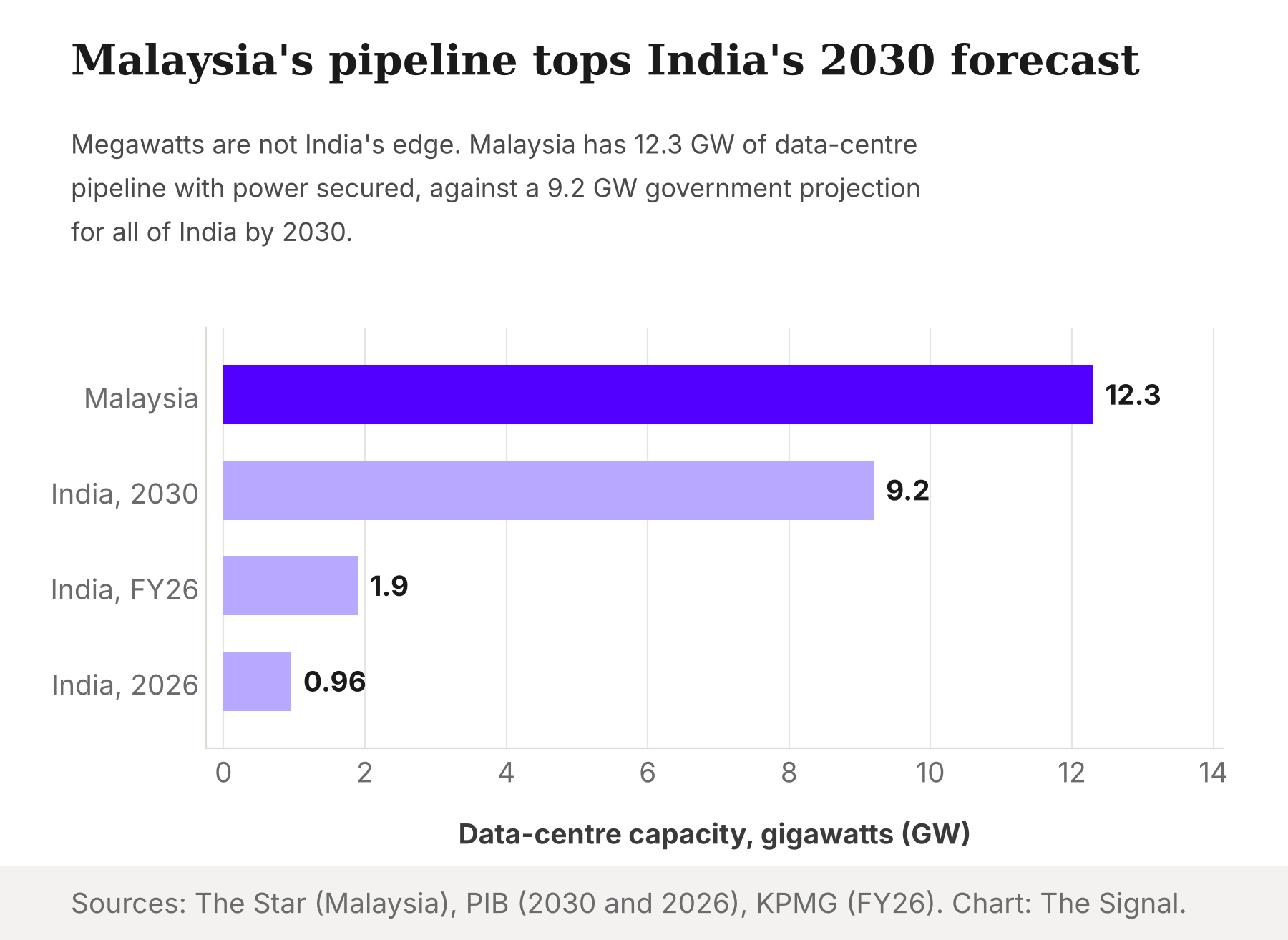
Consider the jurisdiction with the strongest case on infrastructure, as reported in mid-November 2026. Malaysia has a 12.3 gigawatt data-centre pipeline with electricity supply secured, according to The Star. Approved investment in data centres and cloud rose 44.5 percent year on year to RM123.5 billion across 86 projects, or 35.2 percent of all approved investment, the same report says.
Goldman Sachs forecasts that South-East Asia's data-centre capacity will grow fourfold in the next five years, with Johor the largest Asean hub by 2030, The Star reports. That is the prize the pause puts at risk.
Now set that against India as of February 2026. India's government puts installed data-centre capacity at about 960 MW, roughly 3 percent of global capacity, and projects 9.2 GW by 2030. Malaysia's secured pipeline of 12.3 GW is about 1.3 times India's entire 2030 projection. Power did not shield Malaysia from the pause, and India has less of it to offer.
India's base is small on either count
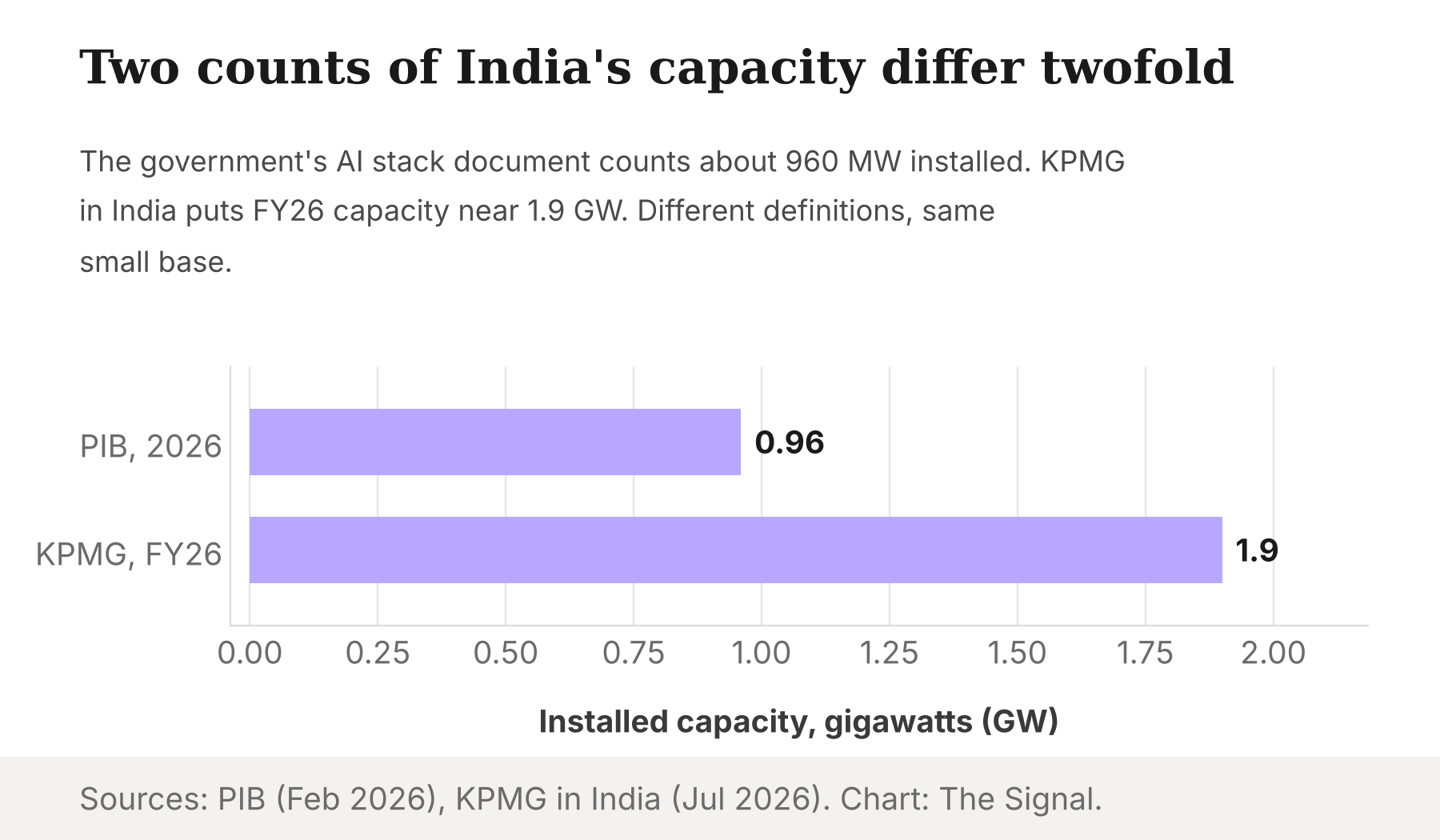
India's capacity has two published figures, and they use different definitions. A July 2026 KPMG in India report estimates installed capacity at about 1.9 GW in FY26, more than tripled since FY19, with about 4.5 GW of pipeline expected over the next five years. The government's figure of about 960 MW is the lower one. We keep them apart and read them as a range, roughly 0.96 GW to 1.9 GW.
Against the government's 960 MW, the 9.2 GW projection for 2030 is about 9.6 times today's base. Against KPMG's 1.9 GW, it is about 4.8 times. Either way, India would need to build several times what it has before it could absorb a Southeast Asian spillover.
The state has also bought its own compute. The IndiaAI Mission has Rs 10,300 crore or more allocated over five years, with 38,000 GPUs deployed, according to the Press Information Bureau. That figure is from October 2025, so it predates the rule.
What India already has on paper
The rule's test is whether an operator can name its customers. India has a partial answer already. CERT-In's directions under section 70B(6) of the IT Act require data centres, VPS, cloud and VPN providers to register accurate customer information and keep it for five years or longer. The directions date from 28 April 2022.
That is a real foundation, though it was built for a different purpose. A registry of customer details is not an export-control attestation, and nothing in these directions asks an operator to certify that no renter is tied to a restricted destination. The distance between those two things is the compliance bet.
The honest objection
The strongest case against this thesis is that megawatts still decide where capacity gets built. Capacity takes years to build, and customers follow cheap, reliable power. India is outside the five named destinations, so its operators face no new licence under this rule. On that view India does not need to prove anything. It only needs to be not-Malaysia.
That case is real, and it covers the short run. But the rule treats unverifiable ownership as presumptive knowledge, and it places the duty on foreign data centres. The excerpts we rely on do not say whether the same expectation reaches India. It would be a reasonable bet that exporters, having just been paused for paperwork, will ask Indian operators for the same assurances before shipping at scale. That is our judgment, not a finding of the rule.
There is also a second point the objection misses. Even if India needs no licence, an exporter that has just paused over whether its partners meet US export requirements has reason to favour buyers it can clear quickly. Capacity that cannot show its customers is capacity an exporter has to second-guess.
The Signal
The easy headline is that India wins when Southeast Asia stalls. The numbers say otherwise. Malaysia's secured pipeline of 12.3 GW is bigger than India's 9.2 GW projection for 2030, and Malaysia was paused anyway. The rule asks about customers, not about how much power the building has.
India's edge, if it has one, is a regime that can name its renters: customer registration under CERT-In's directions, plus whatever attestation Indian operators can add on top. Watch three things. Whether Nvidia's pause ends and on what terms. Whether the rule's customer-disclosure expectations are applied to Indian operators. And whether Indian data-centre firms start publishing the customer checks they run. A data centre is only a haven when someone has checked who is inside.
Reporting basis: the licence requirement, the monthly-reporting exemption and the due-diligence language are from the US Bureau of Industry and Security's interim final rule, as published in the Federal Register and in the agency's rule document. The Nvidia pause rests on a single origin, a Wall Street Journal report as relayed by TechCrunch, and the reason for the pause is as described there. Malaysia's pipeline and investment figures and the Goldman Sachs forecast are from The Star (Malaysia), which is the only source for both. India's 960 MW and 9.2 GW figures are from the government's AI stack document via the Press Information Bureau, and the 1.9 GW and 4.5 GW figures are from KPMG in India; the two use different definitions and are not combined. The GPU and funding figures are from the Press Information Bureau, and the customer-registration duty is from CERT-In's 2022 directions. The Signal's interpretation of the pause as a customer-verification test is our own judgment and is not stated by any source. The 1.3 times, 9.6 times and 4.8 times comparisons are The Signal's calculations from those figures.