Google's announcement on November 19, 2026 reads like a security story, and mostly it is one. Google told Android Authority that "our global rollout will begin in January 2027" for developer verification, starting with seven distributors including Google Play, Galaxy Store, Xiaomi and Vivo, and expanding to all installation sources on certified Android devices over several months. An app whose developer has not registered with Google, and proved who they are, will not install the ordinary way. The pitch is scam prevention, and in India that pitch lands.
It is worth slowing down on what the rule replaces. In India, the old arrangement also carried legal weight. A tribunal cited it as the reason for scrapping a regulator's order.
The order India's tribunal threw out
The Competition Commission of India fined Google Rs 1,337.76 crore on October 20, 2022 for abusing its dominance in Android, a penalty Bar & Bench reported in October 2022. Alongside the fine came ten corrective directions, and one of them protected sideloading, the practice of installing an app from a website or a rival store instead of Play.
Google appealed. On March 29, 2023, the National Company Law Appellate Tribunal kept six of the ten directions, and overturned the sideloading one on the ground that it "was not required as Sideloading, by users, is already possible on Android OS through a change in the device settings." The tribunal noted that users simply got a warning about the risks before installing, and it treated that warning as acceptable.
That reasoning rested on a fact about Android in 2023: one settings switch, one warning screen, done. The 2027 rule changes that fact.
What sideloading will cost from January
Under the new regime, an app from a verified developer installs as before, wherever it comes from. An app from an unverified developer needs what Google calls the advanced flow. Google's March 2026 post describes it: turn on developer mode, pass a check that nobody is coaching you, restart and re-authenticate, then sit through "a one-time, one-day wait" before confirming with a fingerprint or PIN. Google's FAQ calls this a "24-hour pause" meant to break the urgency scammers depend on, and confirms that ADB installs, the developer's cable-and-command-line route, skip the wait.
For developers, the price of staying on the easy path is identity. A full distribution account carries a $25 fee and government ID, while a free account without ID can reach only 20 devices. The rule applies to certified devices running Android 8 or higher.
Set the two descriptions side by side and the gap is plain.
| What a user had to do | 2023, as the NCLAT described it | From 2027, for an unverified developer's app |
|---|---|---|
| Change a device setting | Yes | Yes (developer mode) |
| See a risk warning | Yes | Yes |
| Pass an anti-coaching check | No | Yes |
| Restart and re-authenticate | No | Yes |
| Wait before installing | No | 24 hours, once |
Source: Khaitan & Co summary of the NCLAT ruling (March 2023); Google's developer verification FAQ and March 2026 blog post.
None of this is a ban. Google's own line, from its August 2025 announcement, is that "developers will have the same freedom to distribute their apps directly to users." But a tribunal that excused Google because sideloading was one toggle away was ruling on a different product.
Why this lands hardest in India
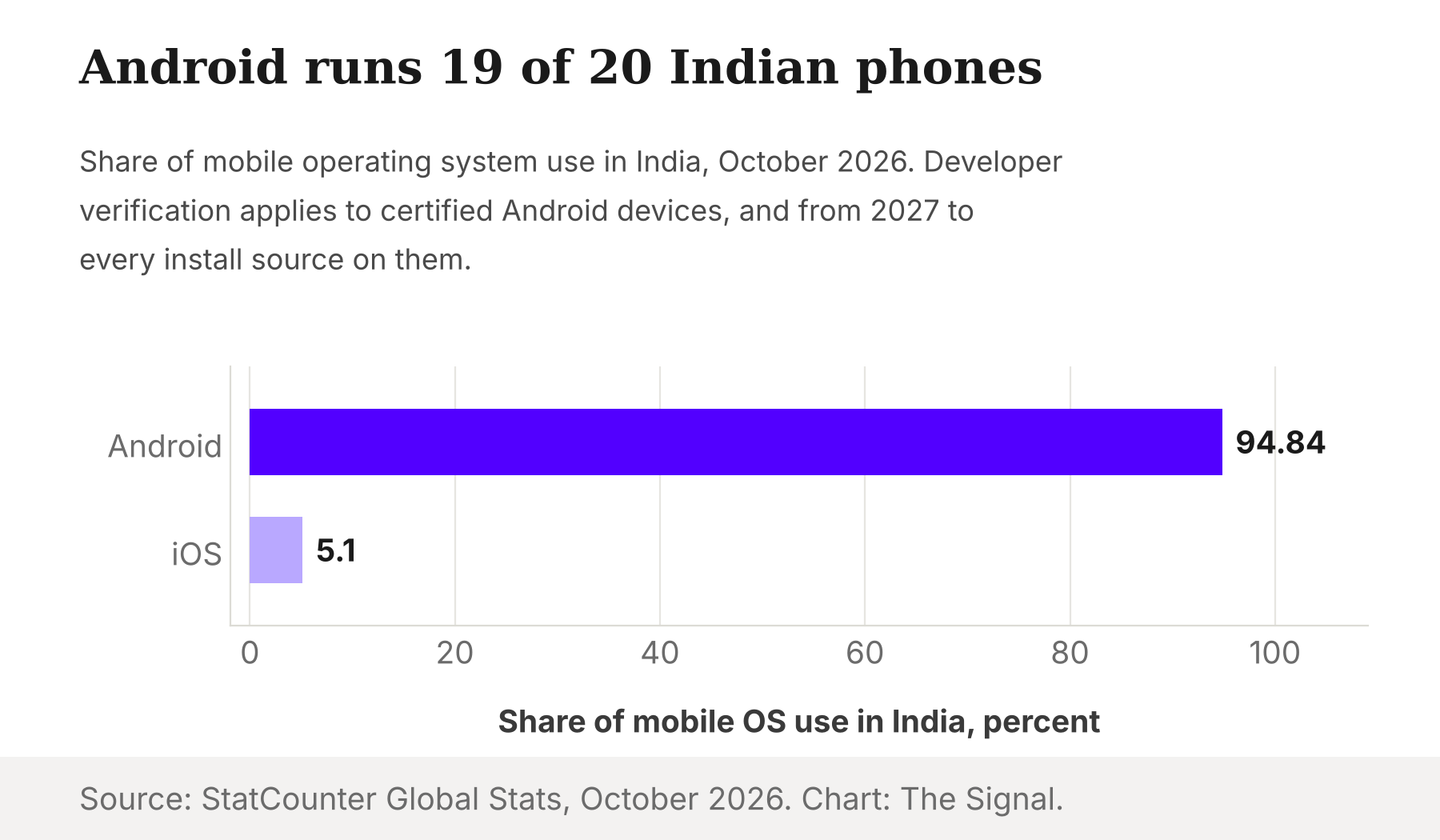
StatCounter's data put Android at 94.84 percent of India's mobile operating system use in October 2026, against 5.1 percent for iOS. In India, Android is nearly the whole market, so a change to how Android installs apps is, in practice, a change to how Indians install apps.
The alternative stores feel this first. PhonePe says its app store, formerly Indus Appstore, is on over 200 million devices through OEM partnerships, as of its October 28, 2026 announcement. That store is not among the seven launch distributors Google named. Google's documentation is clear that rival stores stay usable: apps from verified developers install normally from any source. The cost falls instead on every developer who distributes outside Play and now needs Google's verification to reach those 200 million devices without friction. Google Play automatically registers 99% of apps, so the burden lands almost entirely off Play, which is exactly where competitors to Play live.
That is the second-order effect. The CCI's sideloading direction was meant to keep a channel open that Google did not control. Verification leaves the channel open but makes Google the registrar of who may use it without a 24-hour penalty.
The honest objection
The case for Google's rule is strong, and in India it is stronger than anywhere.
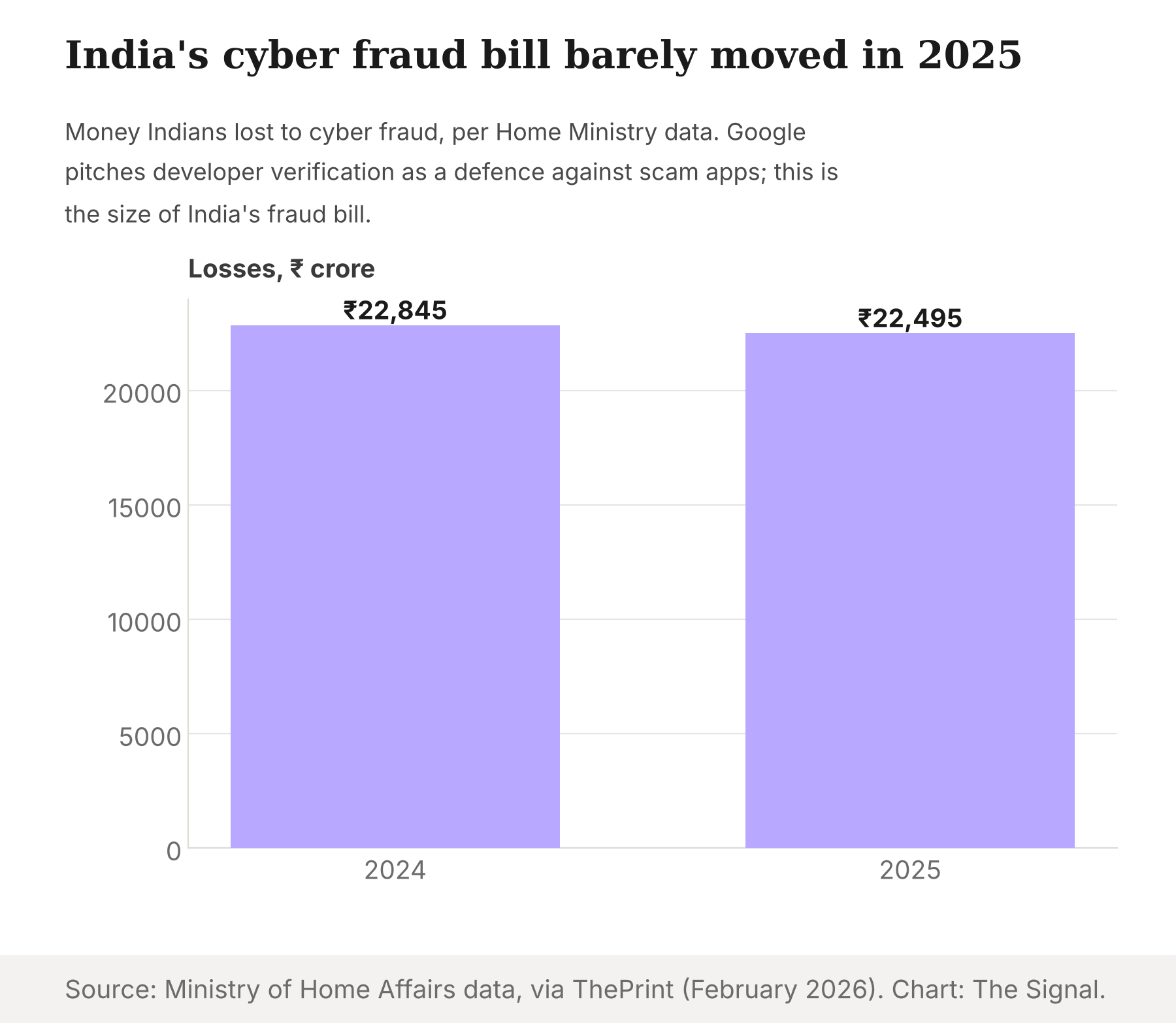
ThePrint, citing Home Ministry data, reports that Indians lost at least Rs 22,495 crore to cyber fraud in 2025, against Rs 22,845 crore in 2024. The government itself has been fighting rogue apps one at a time: I4C had blocked 3,718 mobile apps, including fraudulent loan apps, by June 30, 2026, according to a Home Ministry reply in the Lok Sabha. And Google said in 2025 that its analysis found "over 50 times more malware from internet-sideloaded sources than on apps available through Google Play". A 24-hour pause is aimed squarely at the scam where a caller talks a victim into installing a fake app while still on the line.
The objection deserves its full weight: a security gate that Indian users need may simply be the right call, whatever the tribunal assumed. The answer is not that the gate is wrong. It is that the gate and the gatekeeper are the same company the CCI found dominant. Google says verification checks identity, not app content, and that point matters. But identity checks run by the platform owner are still a toll booth on the road rival stores depend on, and India's competition law exists to police exactly that kind of toll.
The Signal
The NCLAT did not bless sideloading in the abstract. It said a protective order was unnecessary because Android already let users install from anywhere with a settings change and a warning. From January 2027, that will no longer describe Android. Google may well be right that India needs the friction. The question it reopens is who gets to impose it.
Watch whether the regulator, or any Indian app store, argues that the tribunal's premise has lapsed. Then see which Indian distributors join Google's partner list in the months after January, and which stay outside it. A rule written for scammers will also sort India's app stores into those Google vouches for and those it does not.
The tribunal relied on a settings toggle, and the toggle is about to become a 24-hour wait.
Reporting basis: the January 2027 rollout date, the seven launch distributors and the extension to all install sources are Google's statements as reported by Android Authority, a single relay for those details. The 99 percent Play registration figure, the 24-hour wait, the $25 fee, the 20-device limit, the Android 8 floor and the 2025 malware comparison come from Google's own developer documentation and Android Developers Blog posts, which describe Google's policy in Google's words. The CCI's October 2022 penalty is per Khaitan & Co's summary of the NCLAT ruling, as also reported by Bar & Bench; the NCLAT's reasoning on sideloading and its six-of-ten outcome are per Khaitan & Co's summary, not the judgment text itself. Android's share of Indian mobile operating system use is StatCounter's usage measure. The PhonePe Appstore device count is PhonePe's own claim. Cyber fraud losses are Home Ministry data as reported by ThePrint, and the 3,718 blocked apps are from a Home Ministry Lok Sabha reply as reported by The Free Press Journal. The 2023 versus 2027 comparison table is The Signal's own compilation from the Khaitan & Co summary and Google's documentation.