The first read of Washington's new chip rule is a map. The rule designates Indonesia, Malaysia, Singapore, Thailand and Brazil as countries with an "unacceptable risk of diversion", and advanced chips headed there now need a licence. India is not on that list. Markets read it as a blow to Nvidia, and Nvidia's shares fell 4.1 percent on the news, after losing more than 30 percent of their value over the past month.
Read that way, India is a bystander, or even a winner. The country list is the dullest part of the rule.
The rule's real change is a switch in what gets controlled. Export controls used to ask where a chip was shipped. This rule asks which customer is computing on it, and it asks that question of data centres anywhere in the world. That includes India's.
A ceiling came down
Start with what India is freed from. Under the January 2025 AI Diffusion Rule, one-time licences permitted shipments of 50,000 H100-equivalents until 2027 to a country in India's group. That was a cumulative cap, and it was expandable only through a government-to-government deal. The same rule gave each such country a default allocation of 790 million TPP, the industry's measure of total processing performance.
In January 2025 that ceiling looked distant. The IndiaAI Mission then aimed to deploy 10,000 to 18,000 GPUs, far below the framework's thresholds. It did not stay distant. By February 2026, more than 38,000 high-end GPUs had been made available under the Mission at ₹65 an hour, with an expansion to more than 58,000 announced.
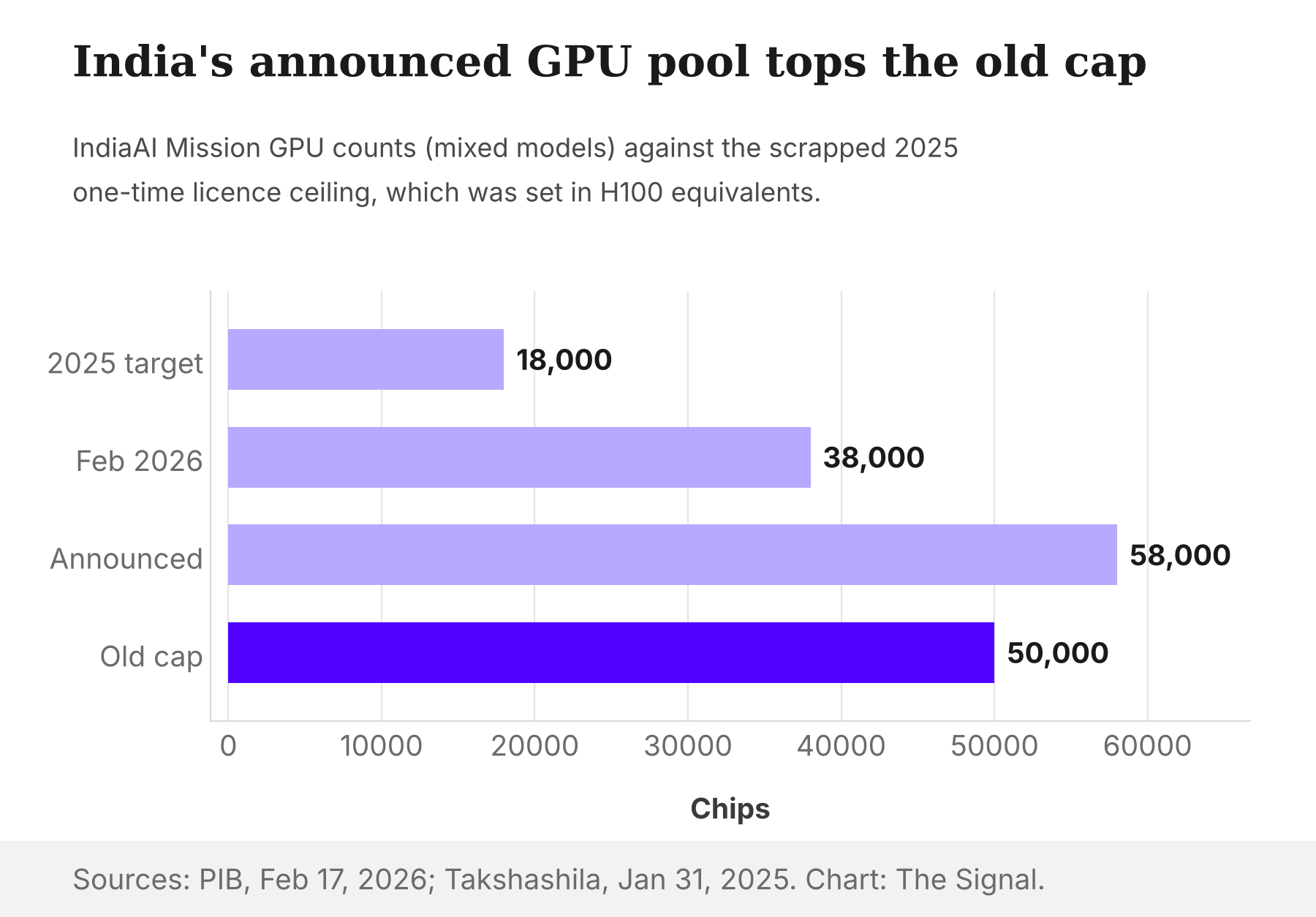
The comparison is rough. The Mission's pool is a count of GPUs of several models, and the old cap was set in H100 equivalents. Still, the direction is plain. India's public compute plan grew past the kind of number the 2025 rule was built around. The new interim final rule formally rescinds the regulations implementing that framework. The ceiling is gone on paper as well as in practice.
A tripwire went up in its place
What replaces the ceiling is a much smaller number pointed at a different target. The rule requires a licence for data centres that give companies headquartered in China more than 12 million "aggregate TPP" of compute, and data centres already doing so must obtain a licence within 90 days of the rule taking effect, expected on November 19.
Twelve million TPP sounds large until it is converted. The 2025 rule's 790 million TPP default allocation sat alongside a 50,000 H100-equivalent ceiling, which prices one H100 at roughly 15,800 TPP. On that basis, our calculation puts the new 12 million TPP trigger at about 760 H100s.
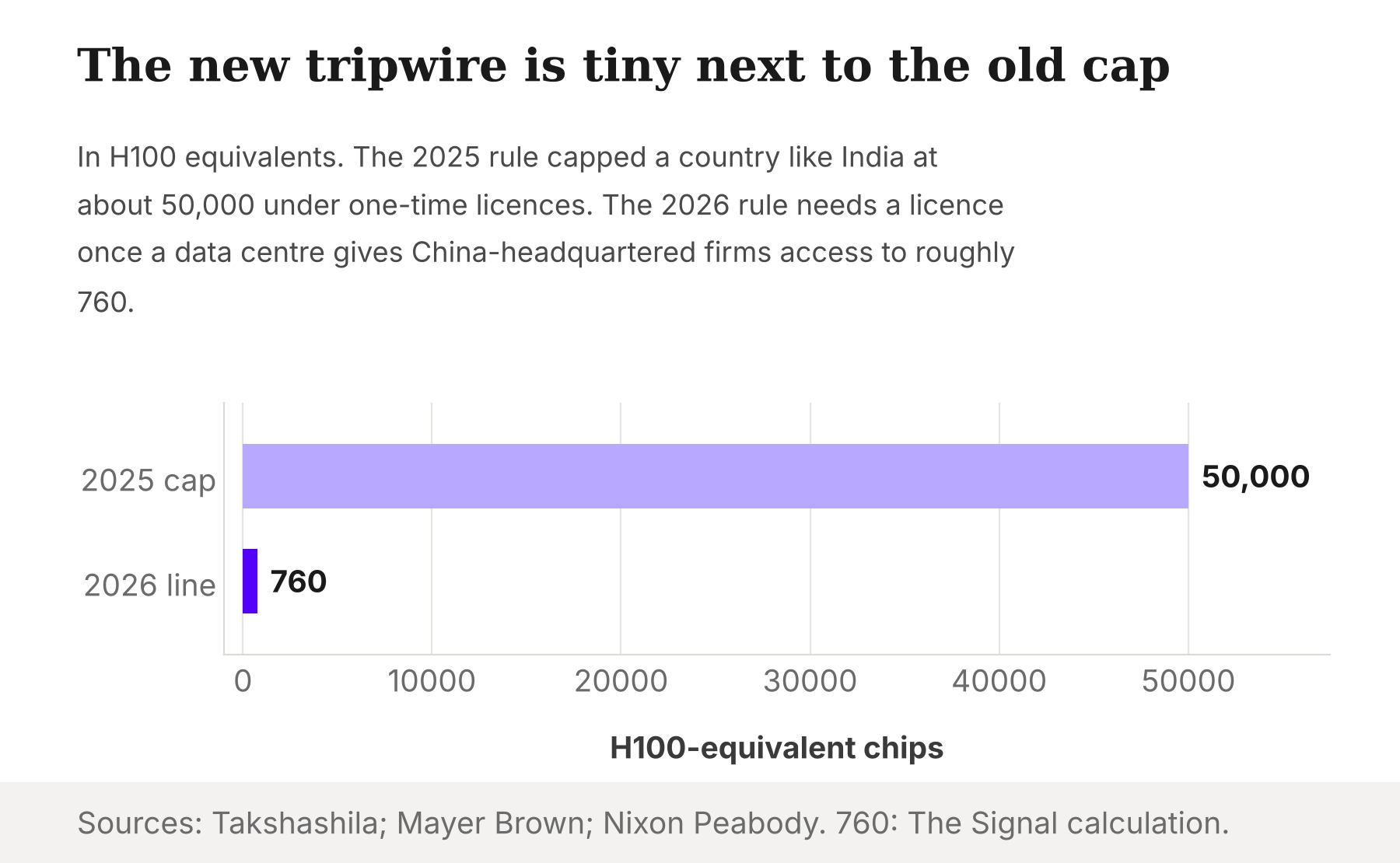
A cluster of 760 H100s is a mid-sized training rig, not a national programme. It is about 2 percent of the 38,000-plus GPUs India's Mission had pooled by February 2026. Any Indian provider renting that much compute to a China-headquartered client now needs Washington's permission. The test is the customer's ownership, not the provider's address.
Why the list of five is a distraction
The list reads as a response to where diversion has been alleged. Megaspeed bought more than $4.8 billion of Nvidia chips over two years, according to The New York Times as reported by The Next Web, and its Malaysian unit was a data-centre tenant. Malaysia had already required a trade permit since July 2025 to re-export, trans-ship or transit high-performance US-origin AI chips.
A country list cannot fix that problem, because rented compute does not need to cross a border. A model can be trained in Johor or Hyderabad by an engineer in Shenzhen. So the rule moves the check from the shipping manifest to the customer register. Naming five countries deals with cases already uncovered; the customer test, which carries no geography, is what governs new ones.
The enforcement is mostly self-enforcement
The rule's own paperwork estimates that it will add only about 100 licence applications a year, at an extra cost of $1,900, plus a net 970 additional submissions under its exceptions collection.
One hundred licences a year cannot mean inspecting every data centre. The design expects operators to screen their own customers and stay under the line, as the rule's due-diligence language on customers' ownership makes clear. The burden lands as compliance work inside the provider: knowing the ultimate owner of each client, tracking how much compute each one draws, and adding it up across linked sites. Large hyperscalers already run these checks. Smaller Indian GPU clouds serving the Mission's subsidised pool will now need to show they do too.
The honest objection
The strongest case against this reading is that it overstates the reach. Indian GPU clouds have little reason to rent large clusters to Chinese firms. Their demand comes from the Mission, Indian startups and global enterprises, and a provider that never serves a China-headquartered client has nothing new to do. On that view, India simply got the better half of the deal: the cap is gone and no new licence applies to Indian shipments.
That is largely right for today's customers. The weakness is in the word "headquartered". The test reaches companies whose ultimate parent sits in China, which includes subsidiaries and holding structures an Indian provider may not recognise on sight. The rule also leaves the list of risky countries open to additions by the Commerce Secretary. A provider that cannot show it screened its customers is exactly the kind of gap the five named countries were penalised for. Low exposure is not the same as low obligation.
The Signal
The 2025 framework treated India as a country to be rationed. The 2026 rule treats Indian data centres as checkpoints to be deputised. That is a better deal for a country building compute faster than the old ceiling allowed, but it is not a free one. India's GPU build-out was designed for access to chips. Its next constraint is proof of which customers use them. Watch whether MeitY folds customer-ownership checks into the Mission's empanelment terms before an Indian provider is the one named in a probe. The ceiling was Washington's to lift. The screening is India's to own.
Reporting basis: the rule's scope, the rescission of the 2025 framework and the licensing burden figures are from the US Commerce Department's interim final rule as filed for public inspection with the Federal Register. The TPP trigger, the 90-day window and the expected effective date are per a Nixon Peabody client alert summarising that rule. The five designated countries and Nvidia's share move are per Al Jazeera. The 2025 framework's 50,000 H100-equivalent ceiling and the Mission's 2025 target are per a Takshashila Institution analysis, and the default TPP allocation is per a Mayer Brown analysis of the same rule. IndiaAI Mission GPU counts are from the Ministry of Electronics and Information Technology, via the Press Information Bureau. Megaspeed's purchases are per The New York Times as reported by The Next Web, and Malaysia's permit rule is per its trade ministry as reported by The Next Web; those two facts rest on that single relay. The TPP per H100, the 760-chip equivalent of the trigger and the trigger's share of India's pool are The Signal's calculations from those figures.