
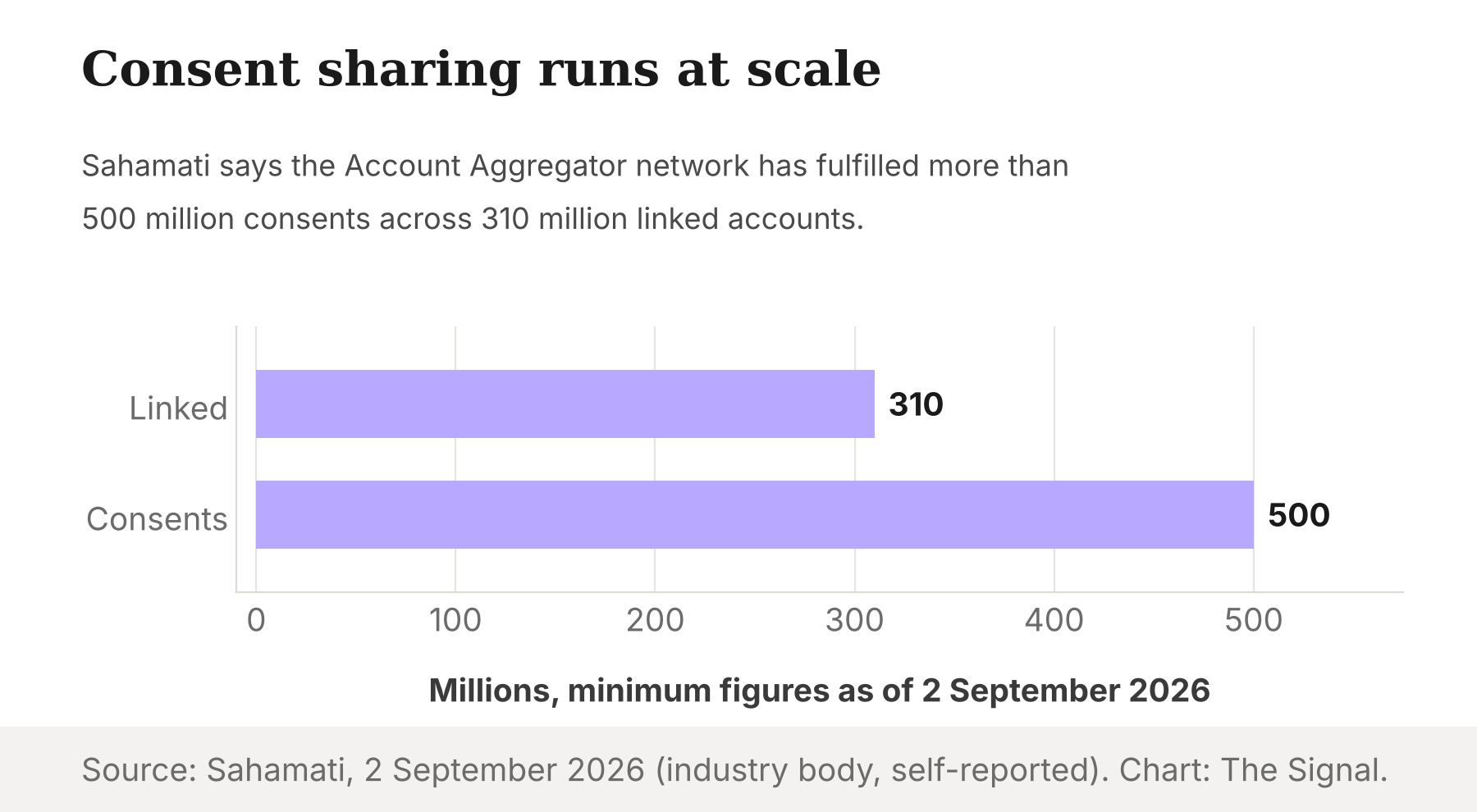
India has spent years teaching its banks to ask before they share. Under the Reserve Bank's rules, an Account Aggregator must provide customers a functionality to revoke consent to obtain information, and the Department of Financial Services says registering with an Account Aggregator is fully voluntary for consumers. Sahamati, the industry body for the network, says the system has crossed 500 million fulfilled consents as of 2 September 2026. That is the consent-first picture of Indian data sharing, and it is a fair one.
Now read what the government wrote about the next use of the same kind of data. On 30 October 2026, the IT ministry released a handbook on sharing hospital, bank and government data to train AI models. ThePrint reports that the handbook calls individual consent "impractical at this scale". The two documents are about different things. But they sit in the same country, under the same data law, and they disagree about who decides.
Two systems, two answers
The Account Aggregator network moves data about one person to one lender, for one purpose, after that person says yes. The training handbook describes the opposite shape. Models learn from pooled records, and no single record is the point.
The handbook accepts the consequence. According to ThePrint, people whose data is used "may not interact directly with the training network". They are not asked, not shown, and not given a revoke button. The practical question is who stands in for them.
The handbook's answer is the data-sharing platform. ThePrint reports that it proposes secure data environments and differential privacy in place of the individual's yes. The aim is that models train on the data without anyone handing over a person's raw record.
That is a real design, and it moves the safeguard from the person to the platform. In the Account Aggregator system, the safeguard is a person's decision. In the training system, it is the quality of an anonymisation method and the discipline of whoever runs the platform.
The number that carries the argument
Here is the comparison that matters. The Account Aggregator framework had more than 2.88 billion financial accounts enabled to share data as of 31 March 2026, and 284.6 million accounts linked by users. Put plainly, about one enabled account in ten has actually been linked.
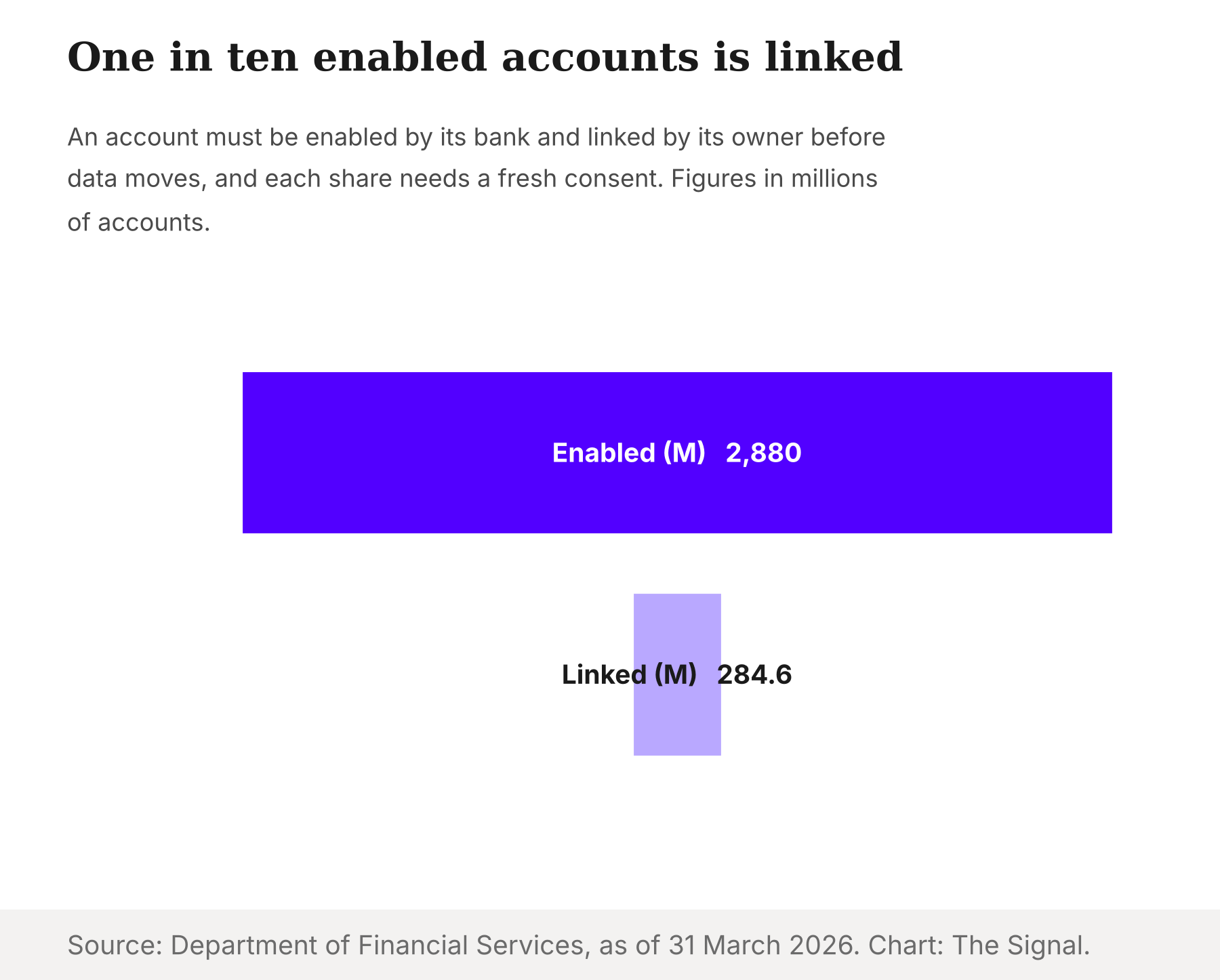
Consent here is a working gate, and most enabled accounts have not been through it. By September, Sahamati was counting more than 500 million fulfilled consents and 310 million-plus linked accounts. Those are the industry body's own figures and should be read that way.
Consent in the banking network is a gate that people choose to open, and the Department of Financial Services data show most enabled accounts remain closed. Removing the gate from AI training changes who decides whether the data gets used at all.
What replaces the yes
The handbook's own text is candid about the limit of its main tool. ThePrint reports that it says removing names and identifiers from datasets "does not by itself prevent re-identification". Datasets can be combined, and a record with no name can still point to a person.
So the safeguard rests on the two techniques above, plus a governance layer. The handbook leans on a governance layer, which ThePrint's report describes as a multi-stakeholder body. Until the certifying authority is named, the question of who answers for a failure has no address.
The legal footing is not settled
The Digital Personal Data Protection Act is a consent law at its core. PRS Legislative Research summarises it this way: "Personal data may be processed only for a lawful purpose upon consent of an individual." The same law gives research a separate path. ThePrint notes that the Act exempts personal data processed for research or statistical purposes from most of its provisions, and that those provisions take effect in May 2027.
The Rules say the same about timing. SCC Online's summary of the Rules shows Rules 5 to 16, which include the research and statistical exemption in Rule 16, coming into force eighteen months after publication. The Rules were notified on 14 November 2025.
That timing creates a gap. The handbook is open for public recommendations, and the exemption it would lean on is not yet in force. ThePrint notes that the handbook does not say whether it relies on the exemption at all. A framework that cannot say which legal basis it stands on is asking providers to start building before the foundation is poured.
The honest objection
The strongest defence of the handbook is that consent at training scale is not a smaller version of consent at lending scale. It is a different task. A hospital cannot sensibly re-ask millions of patients whether their records may contribute to a statistical pattern, and a consent screen that nobody reads protects nobody. Requiring a yes for every contribution could also push AI development toward data that is already unregulated and less representative of Indian patients and borrowers.
That case is real. But it argues for a better substitute, not for dropping the question. A training framework that offers no comparable step has to prove its safeguards are at least as strong as the one it removed. So far, the handbook's own admission that removing identifiers does not prevent re-identification is the weakest link in that proof.
The Signal
India now runs two data regimes side by side. One treats a person's yes as the gate. The other treats the platform's design as the gate. Neither is wrong on its own terms, but they answer the same question in opposite ways.
Watch three things. First, whether the ministry names the authority that certifies models as fit for use. Second, whether the final handbook states which legal basis it relies on before the Rules' eighteen-month clock runs out in May 2027. Third, whether any pilot in finance or healthcare publishes how often its anonymised data resisted re-identification.
One network has counted its yeses. The other, by design, will not.
Reporting basis: the handbook's contents are per ThePrint's reporting; the handbook text itself was not independently verified, so every handbook claim rests on that single outlet. Account Aggregator consent rules are from the Reserve Bank's Master Direction. Account counts are from the Department of Financial Services, which cites Sahamati, and the 500 million consent figure is Sahamati's own report as the industry body. The DPDP Act's consent rule is per PRS Legislative Research, and the Rules' timing is per SCC Online's summary. The one-in-ten share is The Signal's calculation from the Department of Financial Services figures.