On 20 November 2026, at a White House news conference, Donald Trump said American companies that build data centres in other countries would pay for it. "They can, but we're going to put a tremendous tax on them," he said, as Bloomberg reports, without detailing how the threat would be carried out or what legal authority the government might use. He framed it as a ban ("We're not going to allow our companies to build data centers outside of our country") and said he had not yet told his own staff, according to the AP report carried by The Washington Post.
From India, the easy read is obvious. Amazon, Microsoft and Google pledged a combined $67.5 billion in Indian investments between October and December 2025. India's Budget 2026-27 then built a tax holiday running to 2047 to pull in exactly that kind of foreign cloud money. A US penalty on offshore data centres looks aimed straight at India's biggest bets.
It is worth slowing down on that, for two reasons. The first is that the threat, so far, is a sentence. Nothing in the remarks names a rate, a legal mechanism or a start date, Bloomberg notes. The second is that India's incentive was designed around a question Trump's sentence skips entirely: who owns the building?
Three US firms, less than half the pipeline
Start with the denominator the government itself uses. A PIB explainer on Budget 2026-27, published on 14 February 2026, counts nearly $70 billion of data centre investment already underway in India, plus $90 billion in announced projects. That is about $160 billion in all, and a PIB backgrounder in September 2026 repeated the same two figures.
Against that, the $67.5 billion the three firms pledged in late 2025 is 42 percent. That is a ceiling, not an estimate. Amazon's $35 billion in that total covered all its Indian businesses, not only data centres. Microsoft's $17.5 billion over four years, reported by Bloomberg, spans skilling and operations as well as cloud and AI infrastructure. PIB does not say whether any of these pledges sit inside its own tally.
Strip the pledges down to money an official source tags as data centres, and the share falls. MeitY told the Rajya Sabha in December 2025 that Google has announced a $15 billion AI hub in Visakhapatnam and Amazon Web Services a $8.3 billion data centre in Maharashtra. Together that is $23.3 billion, about 15 percent of the $160 billion PIB counts. Add Microsoft's full pledge and it reaches about 26 percent.
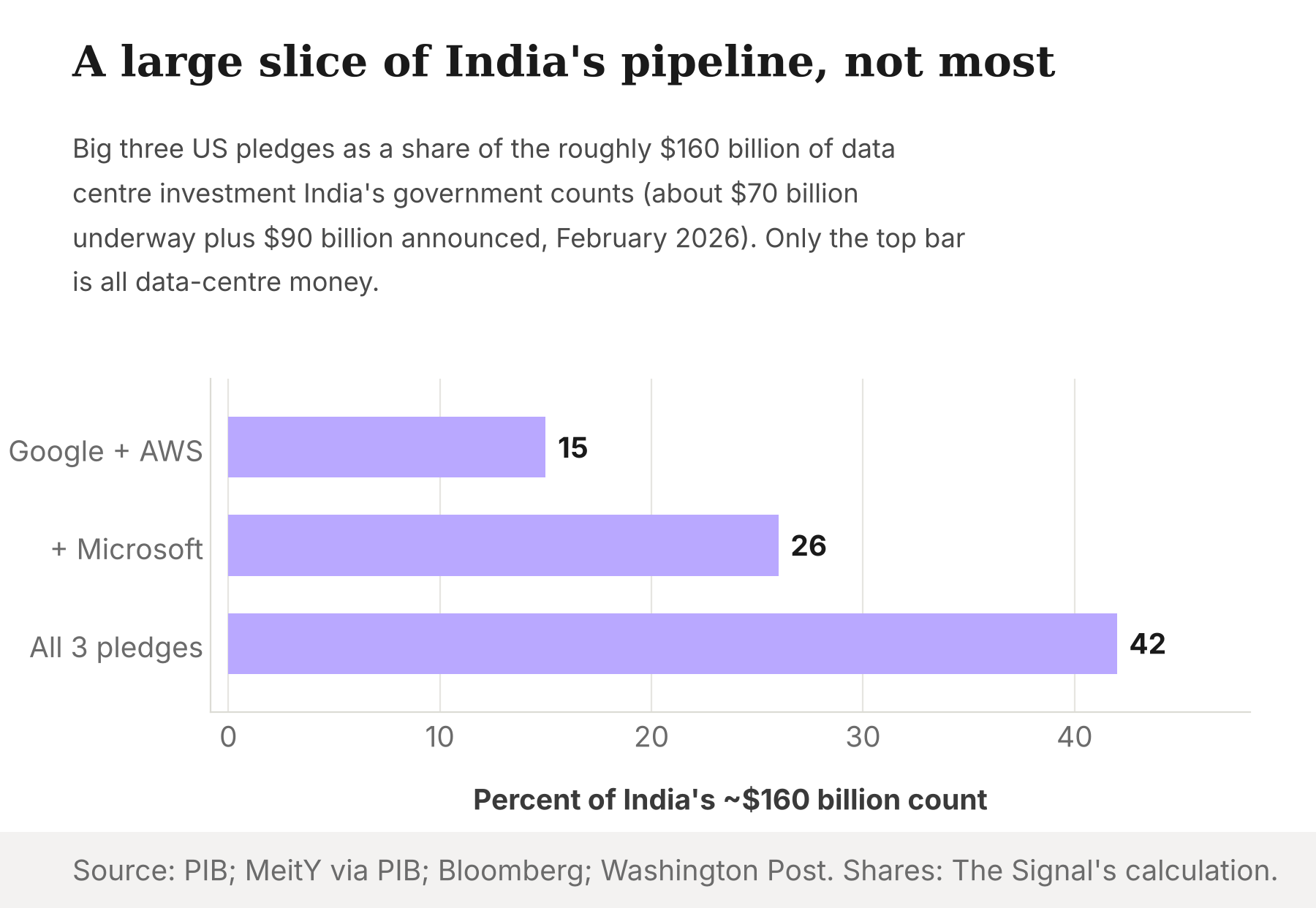
Sources: PIB Budget 2026-27 explainer; MeitY Rajya Sabha reply, December 2025; Bloomberg; The Washington Post. Shares are The Signal's calculations. Chart: The Signal.
Three companies holding between 15 and 42 percent of a national pipeline is real concentration. It is not the bulk. The pledges have also kept rising: Amazon added $13 billion in June 2026 to expand AWS data centre capacity in Mumbai and Hyderabad, taking its India commitment to $48 billion for 2026 to 2030, again across all its businesses.
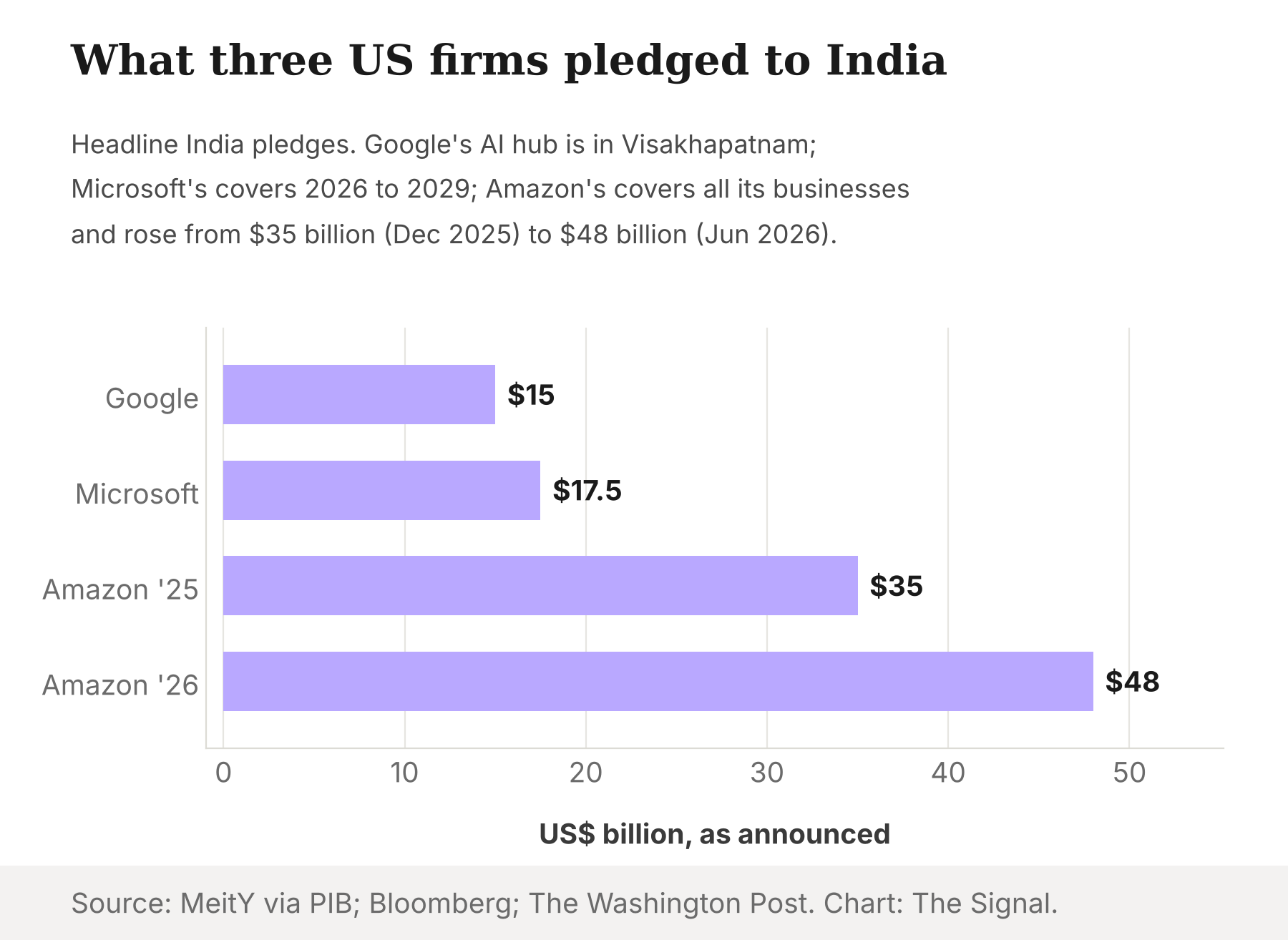
Sources: The Washington Post, December 2025; Bloomberg, December 2025; Bloomberg, June 2026. Chart: The Signal.
India's holiday was built around who owns the building
India's Ministry of Finance says Budget 2026-27 proposed a tax holiday till 2047 for any foreign company that provides cloud services to customers globally using data centre services from India. MeitY presented it as a way to encourage long-term investment in the sector.
The design matters more than the date. The PIB explainer spells out that the data centre services must be procured from an Indian company operating a data centre in India, and that the exemption runs from Tax Year 2026-27 to Tax Year 2046-47. The same Budget proposed a safe harbour of 15 percent on cost when that Indian data centre company is a related entity.
In plain terms, the foreign cloud firm is the customer and an Indian company is the owner. That Indian company can be the cloud firm's own subsidiary, selling it data centre services at cost plus 15 percent. India did not design this with Trump in mind. It designed it to keep the physical asset, and its taxable margin, inside an Indian company.
The two policies differ on nearly every term that would decide the bill.
| Term | Trump's remarks (20 Nov 2026) | India's tax holiday (Budget 2026-27) |
|---|---|---|
| Form | Spoken at a news conference | Budget proposal, set out by the Finance Ministry |
| Rate or benefit | "Tremendous tax", no rate given | Tax holiday for qualifying foreign cloud firms |
| Who it covers | US companies that build data centres abroad | Foreign firms selling cloud services globally from India |
| Who owns the data centre | Not defined | An Indian company operating it in India |
| Related-party pricing | Not addressed | 15 percent cost-plus safe harbour |
| Timeline | None given | Tax Year 2026-27 to Tax Year 2046-47 |
Sources: Bloomberg; Ministry of Finance via PIB; PIB Budget 2026-27 explainer.
The word Trump did not define
Trump's target, as the AP reported it, is US tech companies that build AI data centres in other countries. India's structure puts the building on an Indian company's books and makes the US firm a buyer of services.
The biggest single US project already sits in that grey zone. MeitY says Google's $15 billion Visakhapatnam hub, which broke ground on 28 April 2026, is being developed in partnership with Adani ConneX and Airtel Nxtra and will include a 1 GW hyperscale AI data centre. The release does not say who will own which part of the campus, but it names two Indian partners on a project counted as Google's.
Whether that counts as building abroad is exactly what the remarks leave open. Two readings follow, and neither is settled. If "build" means owning the asset, India's design already separates the owner from the cloud seller. If it means any US parent's money flowing into foreign capacity, a wholly owned Indian subsidiary is still the US parent building abroad, and the related-entity route is no shield at all.
The answer would also shape India's next wave of capital. A rule that taxes ownership but not leasing would push US firms toward buying capacity from Indian operators, which India's rules already reward. A rule that looks through subsidiaries would put the related-entity model in question.
The honest objection
The strongest case against reading comfort into India's design is that it was never meant as a shield. The holiday was proposed in the February 2026 Budget, more than nine months before Trump spoke, and the related-entity route lets a foreign firm keep the building in the family. Any US penalty aimed at parent companies could look straight through a subsidiary.
India's exposure is also concentrated where it hurts. MeitY put India's cloud data centre capacity at about 1,280 MW in December 2025, an industry estimate, and projected it to grow 4 to 5 times by 2030. That implies roughly 5,100 to 6,400 MW. On a broader measure, installed data-centre power capacity, a PIB backgrounder put India at 1.57 GW in August 2026, heading for nearly 8 GW by 2030. In its December 2025 Rajya Sabha reply, MeitY describes Google's Visakhapatnam hub as Google's largest investment in India. It is one project.
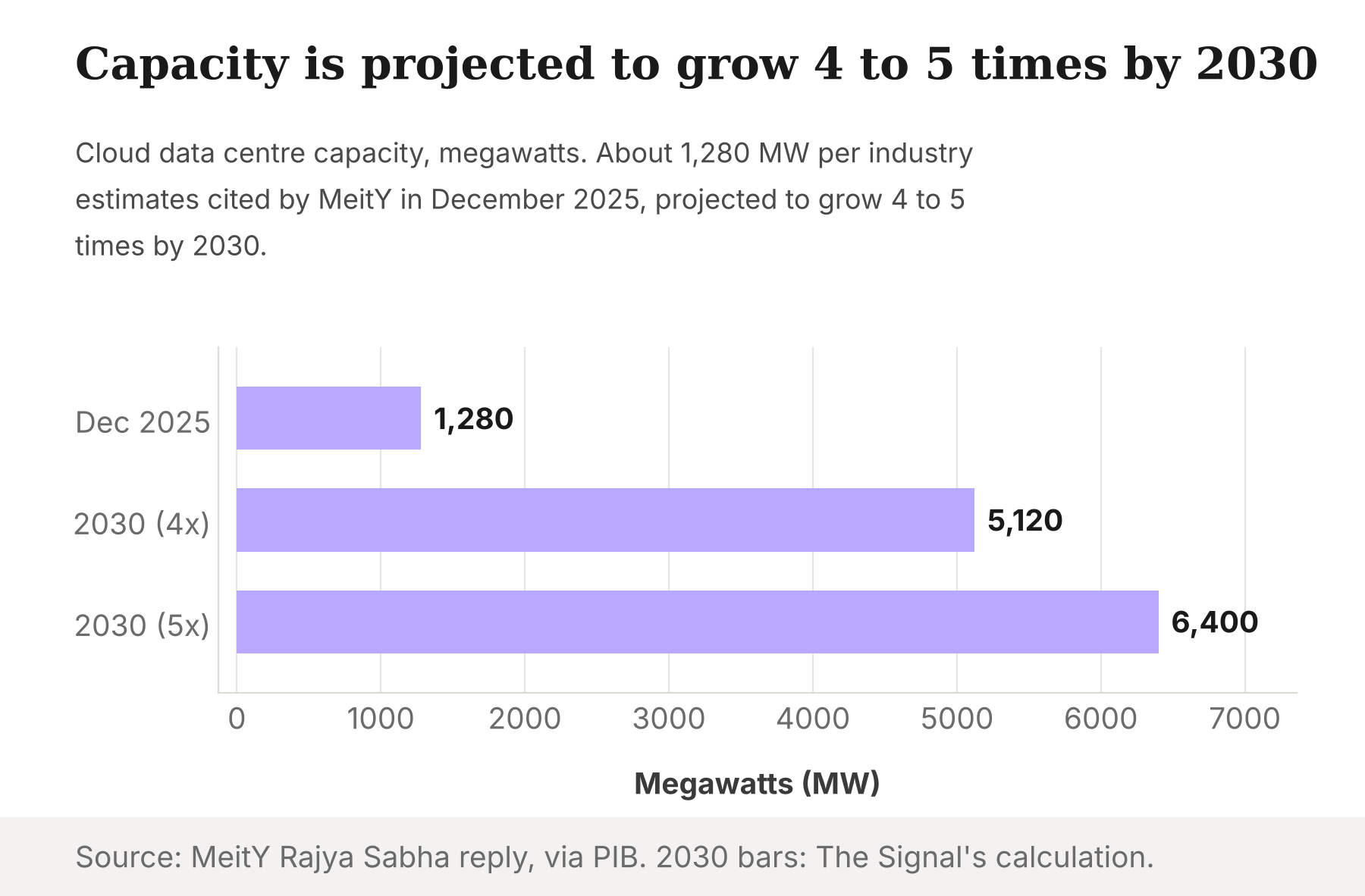
Source: MeitY Rajya Sabha reply, December 2025. The 2030 range is The Signal's calculation. Chart: The Signal.
That case is real, and it is why this piece does not claim India is insulated. But it argues against a rule that does not yet exist. The remarks came with no detail on mechanism or legal authority. Until a rate and a definition of "build" appear, India's exposure is a range, and on the government's own count the range tops out below half the pipeline.
The Signal
Trump has named a target without a weapon. India wrote its rules first: a holiday covering Tax Year 2026-27 to Tax Year 2046-47 that works only if an Indian company owns and runs the data centre. The three biggest US pledges come to at most 42 percent of the roughly $160 billion India counts, and as little as 15 percent on the strictest reading.
Watch three things. First, whether any written instrument defines "build". Second, whether it reaches foreign subsidiaries. Third, whether US firms announcing Indian capacity start describing it as services bought from Indian operators rather than facilities they own. If the US rule taxes ownership, India's 2047 design is already the workaround. If it taxes the parent's money, the design is the target. Everything turns on whose name is on the building.
Reporting basis: Trump's 20 November 2026 remarks are per Bloomberg, with the "not going to allow" wording and the line about his staff per the Associated Press, as carried by The Washington Post; these are two reports of one press conference, and no written instrument is cited because none was described. The tax holiday, the related-entity safe harbour, the Indian-company requirement, the tax-year window and the roughly $70 billion underway and $90 billion announced are from the Ministry of Finance's Budget 2026-27 material and a PIB explainer, and MeitY's framing of the holiday is from its own release, all via the Press Information Bureau. India's 1,280 MW capacity figure is an industry estimate cited by MeitY in a December 2025 Rajya Sabha reply, which is also the source for Google's $15 billion and AWS's $8.3 billion projects. The Adani ConneX and Airtel Nxtra partnership on Google's Visakhapatnam hub is from a MeitY release of 28 April 2026, and the 1.57 GW installed capacity, the 8 GW projection for 2030 and the repeat of the $70 billion and $90 billion figures are from a PIB backgrounder of 14 September 2026, both via the Press Information Bureau. Microsoft's $17.5 billion and Amazon's $13 billion top-up are per Bloomberg, reporting the companies' announcements; the $67.5 billion combined total and Amazon's $35 billion are per The Washington Post's sum of company announcements. The 15, 26 and 42 percent shares and the 2030 capacity range are The Signal's calculations from those figures.