Elon Musk has promised cheap Starlink for India. On October 10, 2026, he wrote on X that "if Starlink is too expensive in India, no one will buy it, so SpaceX will need to make pricing affordable," and he named no price. The post landed days before Reliance's Jio Platforms lists, with Reuters reporting a target valuation of $106 billion. Reuters framed the contest as Starlink against Jio, in a country where mobile data costs about 8 US cents per gigabyte. Read that way, a satellite network is about to take on some of the cheapest mobile data in the world.
It is worth slowing down on that. Starlink does not sell a gigabyte. It sells a home connection, and the product it resembles is not a phone plan.
The price it cannot beat
The Telecom Regulatory Authority of India (TRAI) measures what operators earn per gigabyte. In the January to March 2026 quarter, average revenue was Rs 7.51 per GB, with each data subscriber using 26.70 GB a month. Multiply the two and the typical mobile data user generates about Rs 200 a month in data revenue. That is the whole bill, for a phone that moves with the user.
Starlink's only published price we can point to is far from that. At its Bangladesh launch in May 2025, the Residential package cost Tk6,000 a month, and Residential Lite Tk4,200. Those are Bangladeshi prices in taka, and India's will differ. Musk has named no Indian figure, and nothing published points to Rs 200 a month. A cheaper Starlink is still not a cheaper gigabyte. On the mobile side, there is little to attack.
Where the exposure actually is
The three products measure different things, which is why the headline price comparison misleads.
Mobile data is priced per gigabyte. Home broadband is counted per connection.
| What is sold | Unit | Latest TRAI figure |
|---|---|---|
| Mobile data | Revenue per GB | Rs 7.51 (January to March 2026) |
| Fixed wired broadband | Subscribers | 48.63 million (August 2026) |
| Fixed wireless broadband | Subscribers | 19.34 million (August 2026) |
Source: TRAI quarterly performance report and August 2026 subscription release.
The revenue that a home connection can take is the broadband line, and that market is moving.
In August 2026, India had 48.63 million fixed wired broadband subscribers, up 1.01% on July, and 19.34 million fixed wireless access (FWA) subscribers, up 2.68%. TRAI's FWA category covers 5G FWA, Wi-Fi, Wi-Max, radio and satellite links. Wireless is already 40% of the wired base (19.34 against 48.63), and it added about 0.50 million subscribers in the month against about 0.49 million for every wired line in the country combined.
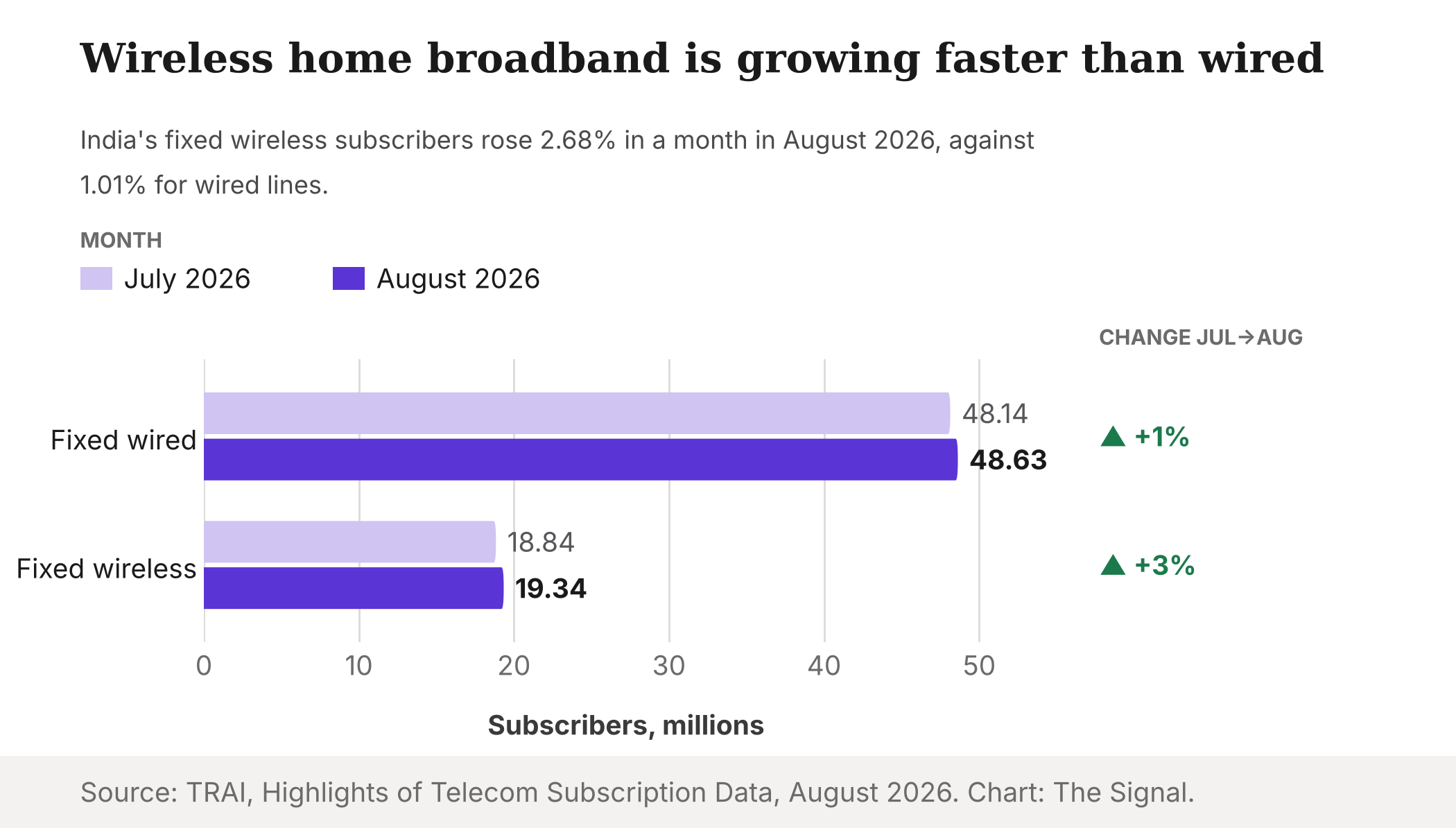
Within that, the 5G segment is the one Jio and Airtel built. 5G FWA grew from 13.21 million in July to 13.45 million in August 2026, with 51.90% of subscribers in rural areas. Rural is the place a satellite pitch is strongest, because there is little fibre to compete with. It is also where Jio and Airtel's wireless boxes are already being installed.
Jio dominates both halves. At the end of December 2025, Reliance Jio held 78.92% of FWA subscribers and Airtel 21.08%. And in wired access, Jio is the largest provider with 14.81 million subscribers, ahead of Airtel with 11.44 million.
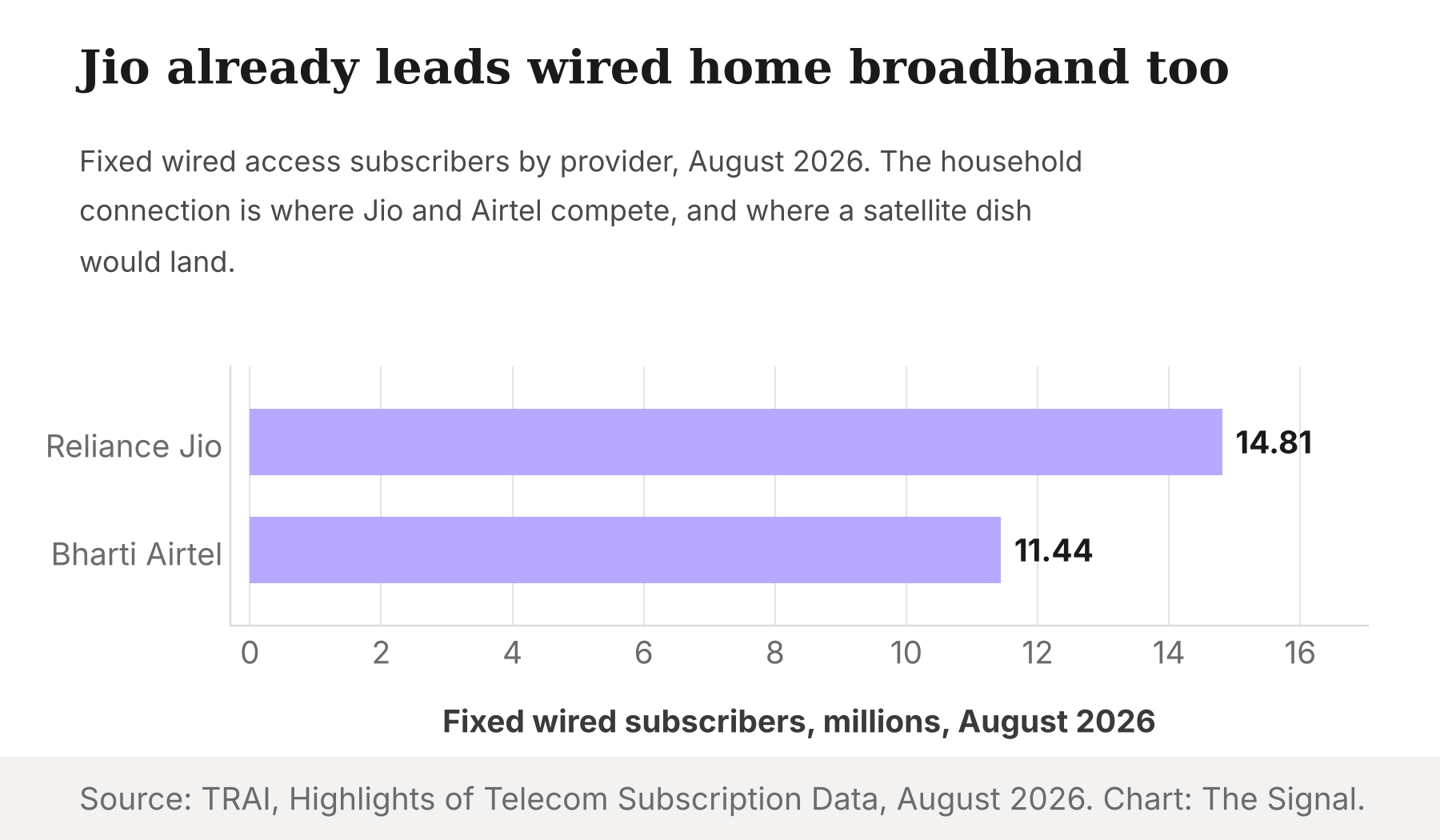
So the unit of competition, the household connection, is where Jio's growth story now sits, and where a Starlink dish would land.
The honest objection
The strongest case against this reading is that Starlink has not launched and may never be a mass-market product. Nobody has published a Starlink tariff for India, a subscriber cap or a launch date. On that view, the whole contest is a feud between two billionaires, with no effect yet on any operator's numbers.
That is partly right. The regulatory position is also unsettled. IN-SPACe authorised only Starlink's first-generation constellation of 4,408 satellites in July 2025, and as of August 2026 the telecom department had finalised a spectrum framework but not sent it to the Union Cabinet, so no operator gets working spectrum. India's communications ministry says Starlink and two other licensed satellite operators are undergoing security assessments and are at broadly the same regulatory stage. Reuters adds that the three ventures awaiting final security clearance include Jio's own, so Jio is hedging inside the same queue. A delayed threat is still aimed at a specific target. Even a modest satellite footprint would show up first in the 19.34 million wireless broadband base, not in the cheap-data base, because that is where the product overlaps.
The Signal
Jio's listing prices a mobile franchise whose data sells at Rs 7.51 a gigabyte, per TRAI's January to March 2026 report. Starlink's arrival would not change that line. What it could change is the growth the market expects from home broadband, where wireless lines are being added at the pace of every wired line combined and Jio held almost four in five of them at the end of December 2025, the latest split TRAI has published in its quarterly report. The numbers to watch are not Musk's posts but TRAI's monthly FWA count and the Cabinet's decision on satellite spectrum. The cheap gigabyte is safe from Starlink. The household connection is not.
Reporting basis: Musk's X post, the 8 US cents per gigabyte figure and Jio's $106 billion target are per Reuters, as carried by Investing.com. The Telecom Regulatory Authority of India is the origin of the per-gigabyte revenue and usage figures (its quarterly performance report for January to March 2026), the August 2026 broadband and fixed wireless counts (its monthly subscription release) and the December 2025 FWA market shares (its report for October to December 2025). Starlink's Bangladesh prices are per The Business Standard of Dhaka at the May 2025 launch, and no Indian price has been published. Starlink's authorisation and the spectrum framework are per MediaNama, and the ministry's security-assessment statement is per TechCrunch. The Rs 200 monthly data revenue, the 40% wireless-to-wired ratio and the monthly subscriber additions are The Signal's calculations from those figures.