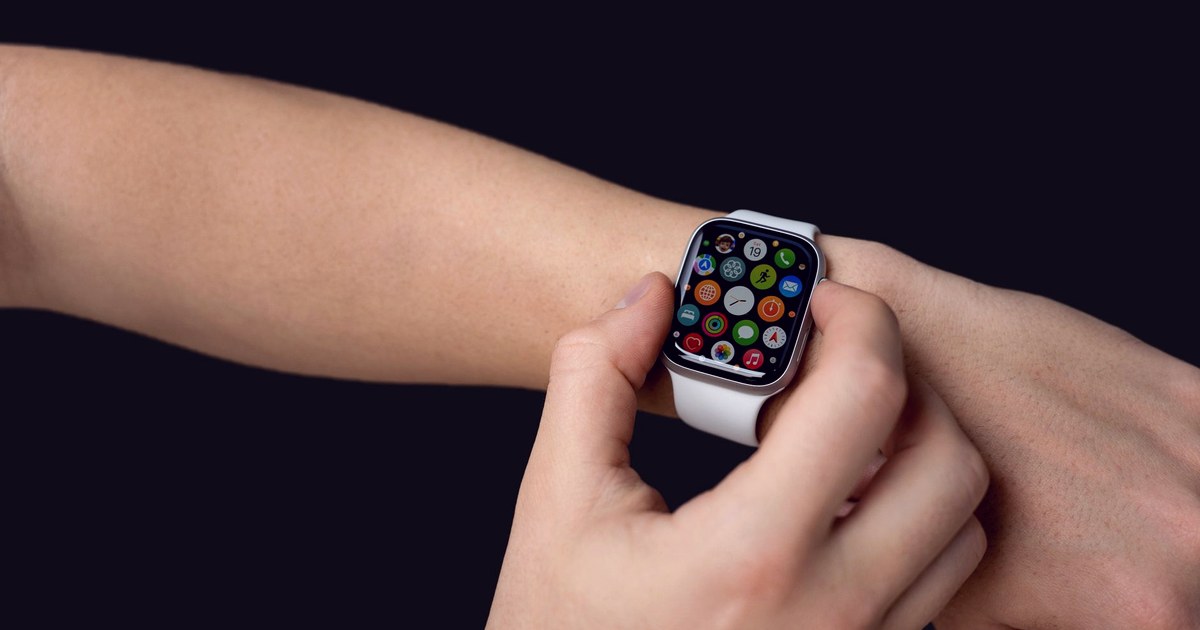
A federal jury in San Diego ordered Apple to pay $5,721,961,750 to Taction Technology on September 25, 2026, after finding that the haptic feedback built into the iPhone and Apple Watch, the buzz you feel under a fingertip, infringed two of Taction's patents (AppleInsider reports). Taction filed the case in the US District Court for the Southern District of California in April 2021, asserting that Apple's Taptic Engine infringed US Patent Nos. 10,659,885 and 10,820,117 (the federal court docket shows). The trial began September 14, 2026, and a seven-member jury needed two days of deliberation before returning its verdict at 1:15 p.m. Pacific time on September 25 (TechEchelon reports).
Converted at the rupee's rate on September 18, 2026, the most recent reading before the verdict, of Rs 95.87 to the dollar (Federal Reserve Economic Data shows), that $5.72 billion works out to roughly Rs 54,860 crore. No Indian court, regulator or tribunal had any part in this case. It is a US federal jury verdict, in Apple's own legal system, over a feature buried inside hardware Apple happens to build in enormous volume in India.
That is a large number by any household measure and a small one against what Apple's India-made iPhones alone earn. Mobile phones have gone from India's 153rd-largest export item in FY2014-15 to its largest in FY2025-26, with exports surging 165-fold from Rs 1,566 crore to Rs 2.60 lakh crore over that period (the Ministry of Electronics and Information Technology reports, via PIB). Apple's own India-made iPhones drove much of that: iPhone exports hit a record Rs 2 trillion in FY26 on 11 months of Commerce Ministry data through February, making the iPhone India's single largest branded export across every product category (Business Standard reports).
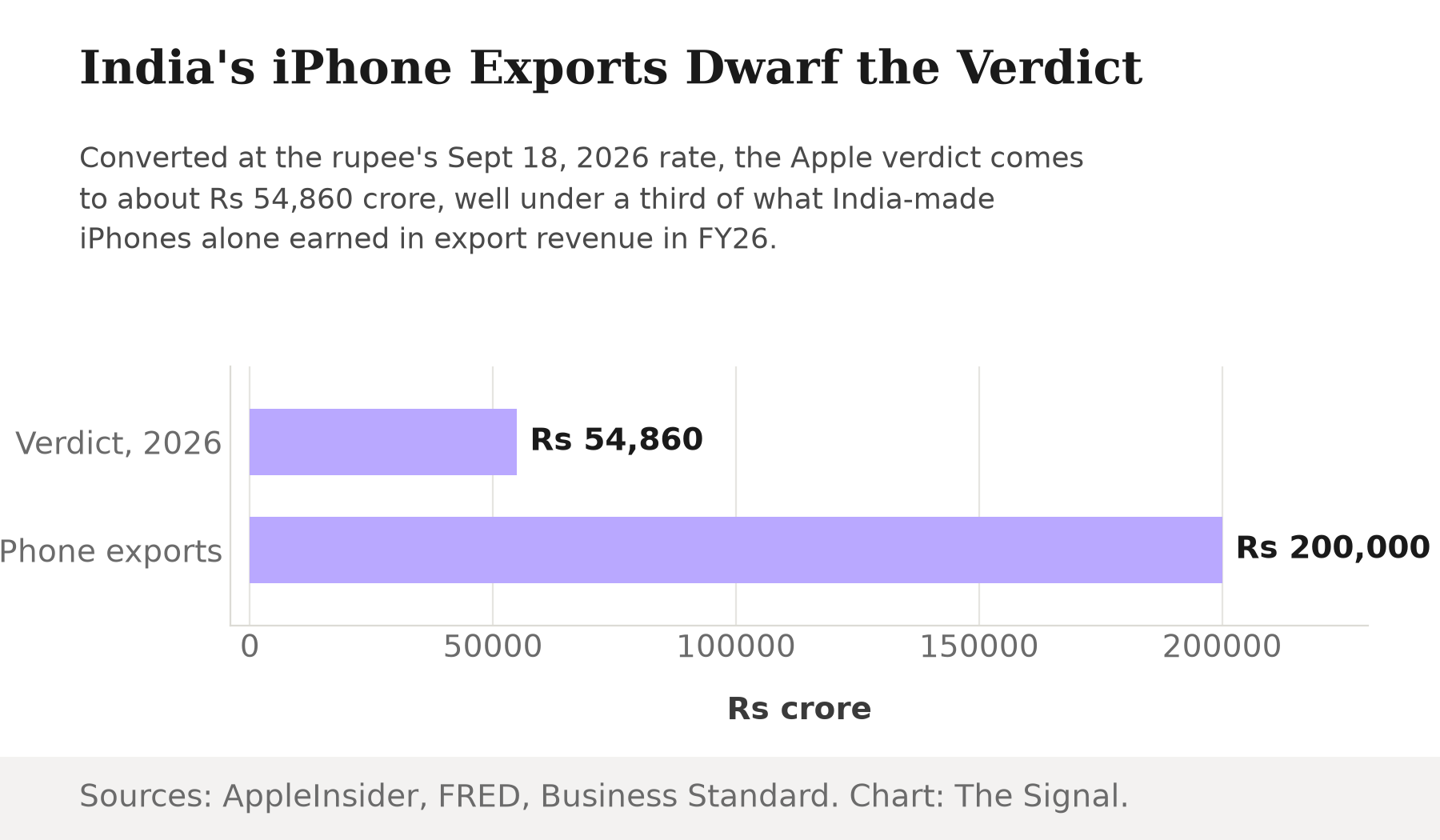
The verdict, in other words, is worth well under a third of what Apple's India-made iPhones alone exported in FY26. Whatever this case is about, it is not a threat to Apple's India manufacturing math.
The financier nobody named at trial
The more interesting fact sits in the discovery record, not the verdict form. The jury found that Apple's infringement was not willful, and separately, discovery in the case revealed that Taction's litigation was financed by Gronostaj Investments LLC and Kenosha Investments LP, entities identified in separate litigation as an indirect subsidiary of litigation funder Burford Capital Ltd (Bloomberg Law reports). Taction is not a haptics giant; it is a company that licenses its vibration technology into headphones and gaming headsets (Reuters reports, via Investing.com). A company that size does not fund five years of litigation against Apple's legal department on its own. An outside financier decided the patents and the odds were worth the bet.
That combination, a record-scale award with no finding of intent, is the actual signal here. Juries do not need to believe a company stole a technology on purpose to award billions over it; they need to believe the patent is valid and the product uses it. Once that bar is cleared, the size of the check follows from the size of the defendant, not the size of the wrongdoing. For a professional litigation funder pricing which patent suits to back, that is a useful data point: against a company with Apple's balance sheet, even a non-willful finding can produce a nine-figure-plus-per-patent verdict.
A jury found no intent to infringe, and still awarded more than twice the last record verdict.
Not close to Apple's biggest problem
Whatever the number means for the next litigation funder, it does not move Apple's own numbers much. Apple reported $416.161 billion in net sales and $112.010 billion in net income for fiscal 2025, the twelve months ended September 27, 2025 (Apple's SEC filing shows). The $5.72 billion verdict comes to about 5 percent of one year's net income, our calculation, before any reduction on appeal.
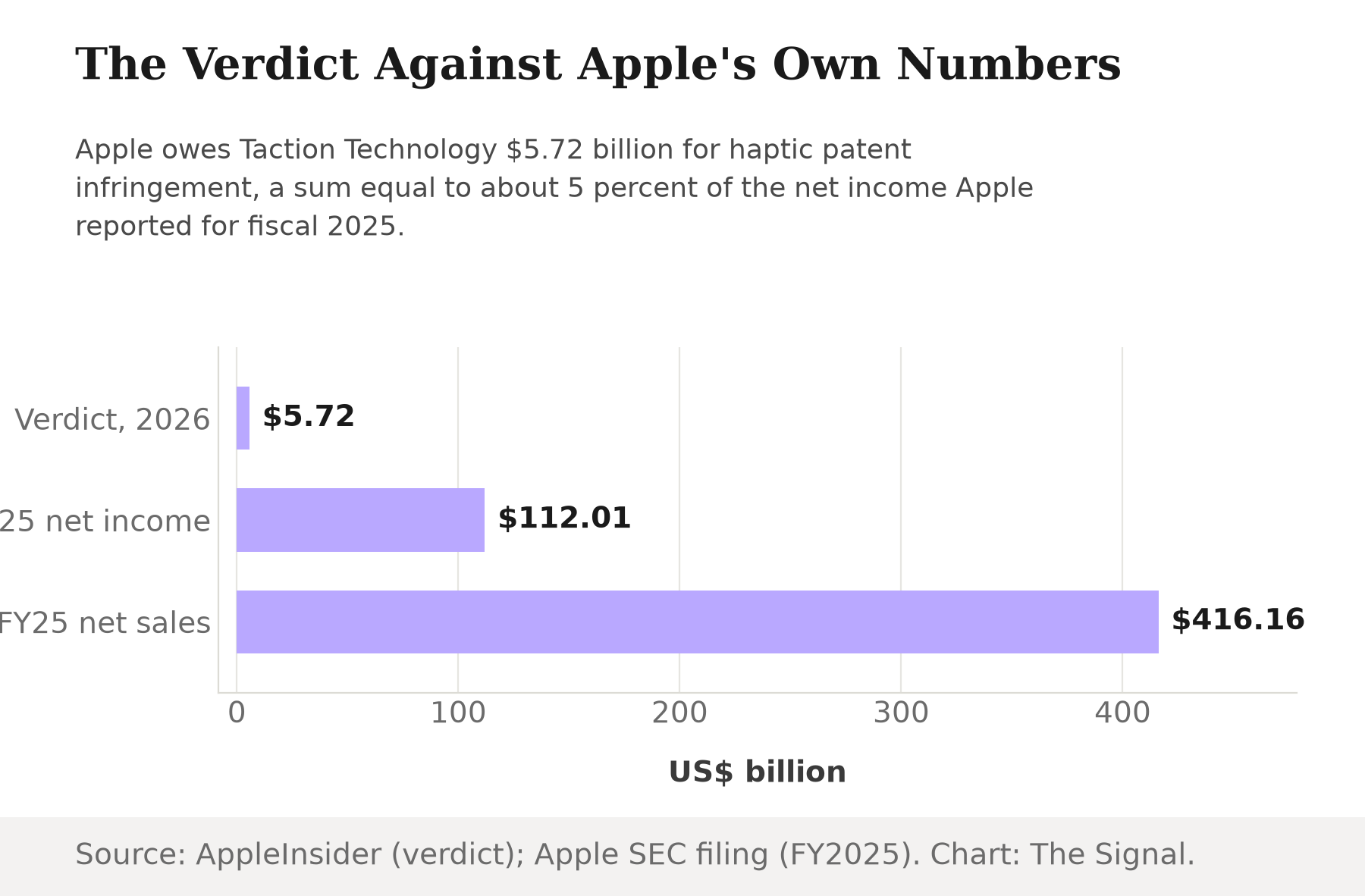
That gap matters for who should actually worry about this ruling. Apple can absorb a $5.72 billion hit and barely notice it in a single earnings call. A smaller hardware maker facing the same fact pattern, a real patent, a jury willing to find infringement without intent, and a financier willing to fund the suit, would not have that cushion. The verdict is a rounding error for Apple and a template for anyone deciding whether to bankroll the next case against a company with less room to absorb it.
A record verdict, with recent history against it
The Taction award more than doubles the $2.18 billion jury verdict Intel faced over VLSI Technology's patents in 2021, which had stood as one of the largest patent-infringement verdicts in US history before later patent-invalidation rulings undercut it (Bloomberg Law reports).
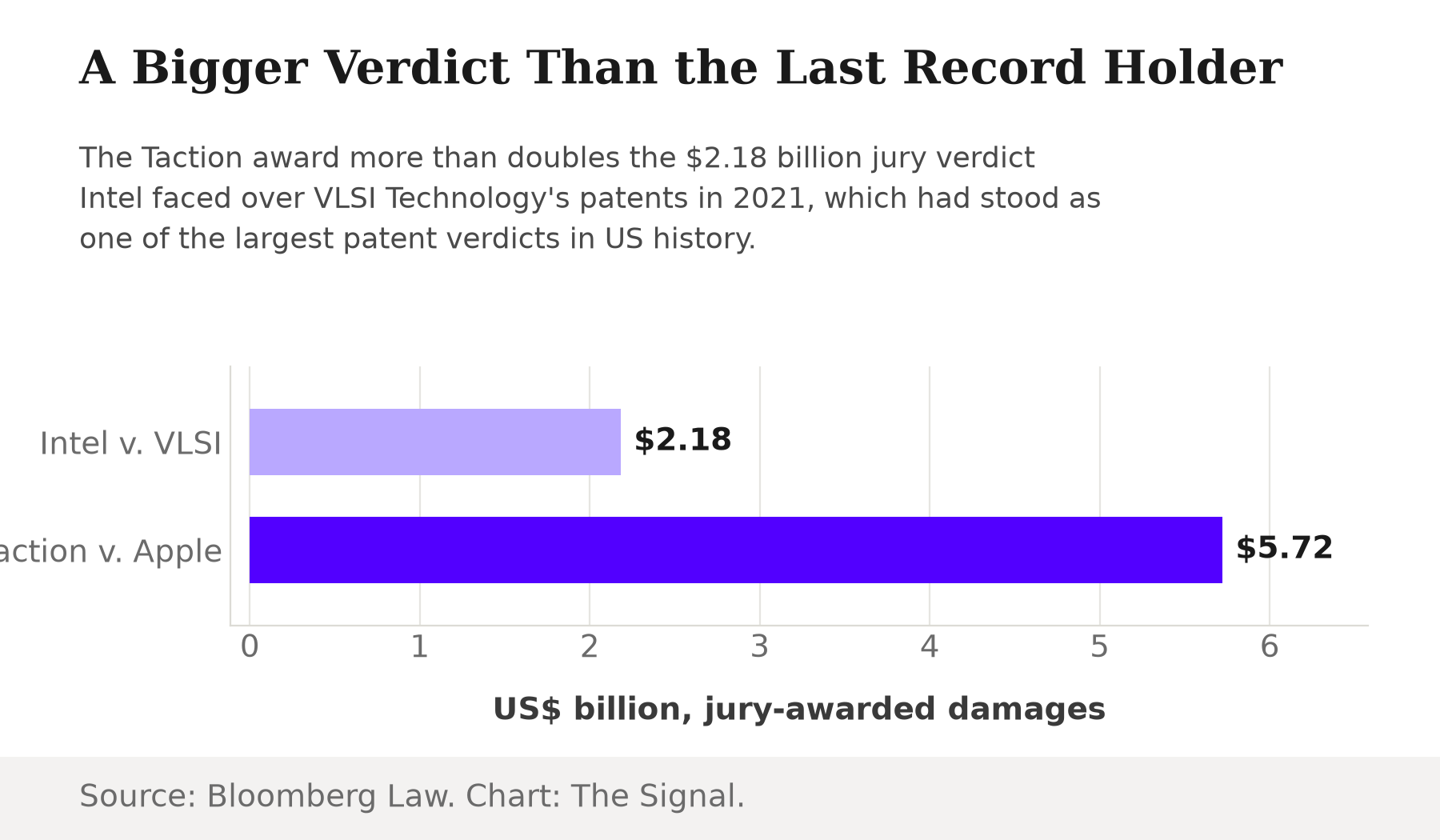
That precedent is also the honest caution here. This case is five years old, and it has already reversed once. A San Diego federal judge ruled in 2023 that Apple did not infringe Taction's patents; the Federal Circuit revived the case on appeal in 2025, sending it back to trial (Reuters reports, via Investing.com). The Intel verdict shows that a headline number of this size is not the final word: it can shrink or vanish entirely once the underlying patents face further challenge. Apple has already said it will appeal, calling the verdict "entirely unsupported by the facts" and arguing its Taptic Engine "is fundamentally different from Taction's technology" (AppleInsider reports).
Five years, one reversal, one verdict.
| Date | Event |
|---|---|
| April 26, 2021 | Taction files suit against Apple in the Southern District of California |
| 2023 | A San Diego federal judge rules Apple did not infringe the patents |
| 2025 | The Federal Circuit revives the case on appeal |
| September 14, 2026 | The retrial begins |
| September 25, 2026 | The jury returns a $5.72 billion verdict for Taction |
Sources: CourtListener/RECAP docket; Reuters, via Investing.com; TechEchelon; AppleInsider.
The honest objection
The strongest case against reading this as a new playbook for litigation funders is that the system did not simply hand a financed plaintiff a win. Taction lost at the district court in 2023. It only got back to a jury because the Federal Circuit found the earlier ruling wrong on the merits of the patents themselves, not because a funder's money bought a rehearing (Reuters reports, via Investing.com). Apple's appeal follows the same path that eventually cut into the Intel verdict this one just surpassed, hardly a formality (Bloomberg Law reports). Financiers here are fronting years of legal cost, not manufacturing verdicts out of weak patents, and courts are still deciding who is right.
That case holds up as far as it goes, but it does not change the incentive at the center of this story. Win or lose on appeal, the fact pattern that produced a $5.72 billion jury number, without a willfulness finding, against a defendant the size of Apple, is now a proven outcome a funder can point to when pricing the next patent suit. The appeal can shrink this specific number. It cannot un-prove that the number was reachable in the first place.
The Signal
Apple will treat this as a legal problem to appeal, and at 5 percent of one year's net income, it can afford to be patient about it. The more durable fact is what discovery surfaced along the way: a small technology licensor with no obvious means to fight Apple for five years found a financier willing to bet on the patents, and that bet returned more than double the last record patent verdict in similar circumstances, without a jury even finding the infringement willful. Watch two things next. Whether Apple's appeal follows Intel's path and cuts the number down once the patents face further challenge, and whether more litigation funders start treating "sue a company with deep pockets over a real but non-obvious patent" as a strategy with a demonstrated payout, rather than a long shot. The jury priced Apple's liability. The bigger price, if there is one, is what this verdict tells every funder deciding which lawsuit to bankroll next.
Reporting basis: the verdict amount, trial timeline and Apple's statement are per AppleInsider; the litigation-funding detail and willfulness finding are per Bloomberg Law's reporting on the case's discovery record; the trial's start date and deliberation length are per TechEchelon; the 2021 filing is per the CourtListener/RECAP federal docket; the 2023 ruling and 2025 Federal Circuit reversal are per Reuters, as carried by Investing.com. Apple's fiscal 2025 results are from its own SEC filing, and the rupee rate is from the Federal Reserve's H.10 data via FRED. India's mobile phone export growth is from the Ministry of Electronics and Information Technology via PIB, and the India-made iPhone export figure is per Business Standard's reporting of Commerce Ministry data. The 2021 Intel verdict and its later erosion are per Bloomberg Law's separate reporting. The rupee conversion of the verdict, its share of Apple's net income, and its comparison to India's iPhone exports are The Signal's own calculations.