
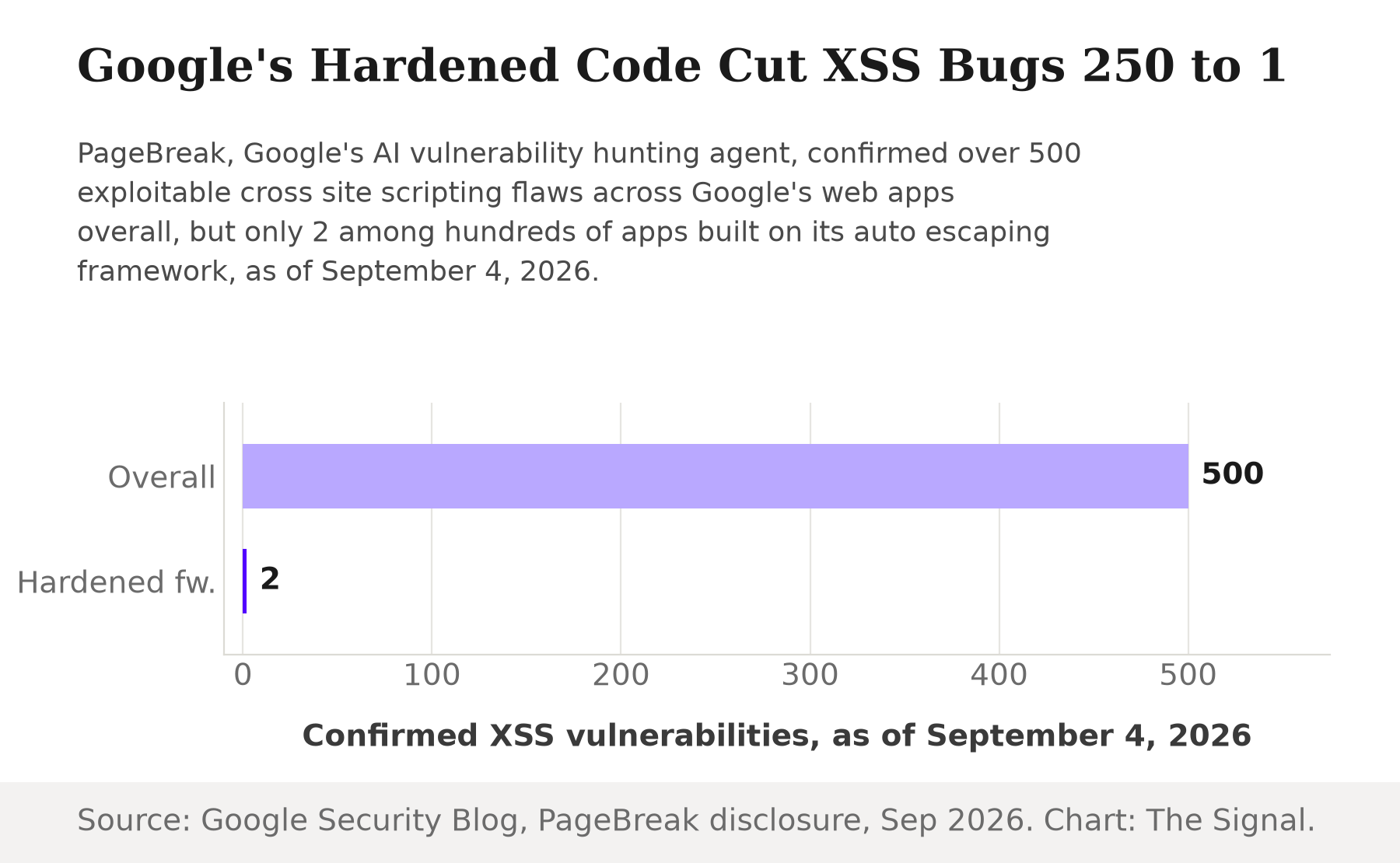
Google ran its own AI hacking agent against its own production code, and the tally so far reads like an indictment. Google's security engineering blog reports that PageBreak, an autonomous agent built by its Product Security team, has confirmed more than 500 exploitable cross-site scripting vulnerabilities across Google's first-party web applications, some of them on sensitive domains. Read only that line and the story writes itself: even the company that built the modern web browser cannot keep one of the web's oldest bug classes out of its own sites.
Only two of those confirmed bugs sat inside apps built on Google's own hardened web framework.
It is worth slowing down on that gap. The same disclosure states that, as of September 4, 2026, the scanner had identified just 2 XSS vulnerabilities across hundreds of web applications built on Google's auto-escaping frameworks, both confined to internal tools or debug endpoints with acknowledged hardening gaps, not to the customer-facing apps that make up most of the 500-plus figure. Without that framework detail, PageBreak reads as a story about how much insecure code even a top engineering organization still ships. Put it back in and the story becomes a controlled experiment: the same company, the same AI hunting the same bug class, and a roughly 250-to-1 difference in what it found, turning entirely on one architectural choice made long before any individual engineer sat down to write a page.
How PageBreak decides a bug is real
Skepticism toward an "AI found 500 bugs" headline is reasonable; automated scanners are notorious for false alarms. Google's account of PageBreak addresses that directly. The project started as a pilot inside Google's Product Security team in November 2025 and moved to a fully-fledged project in January 2026, and its architecture separates guessing from proving. When the agent flags a possible flaw, it does not log a bug on its own judgment. It passes the hypothesis to a separate, non-AI validator, which fires a real exploit payload against a live instance of the application to confirm the exploit actually works before anything is added to the tally. That split is the design choice behind PageBreak's near-zero false-positive rate: nothing on the count is a suspicion, every entry is an exploit that software has already fired and watched land.
PageBreak moved from a pilot project to a confirmed 250-to-1 gap in ten months.
| Date | What happened |
|---|---|
| November 2025 | PageBreak begins as a pilot inside Google's Product Security team |
| January 2026 | The pilot becomes a fully-fledged, ongoing project |
| September 4, 2026 | Tally stands at 500-plus confirmed XSS bugs Google-wide, versus 2 across hundreds of hardened-framework apps |
Source: Google Security Blog, PageBreak disclosure. Table: The Signal.
The bug class is a known villain, not a Google glitch
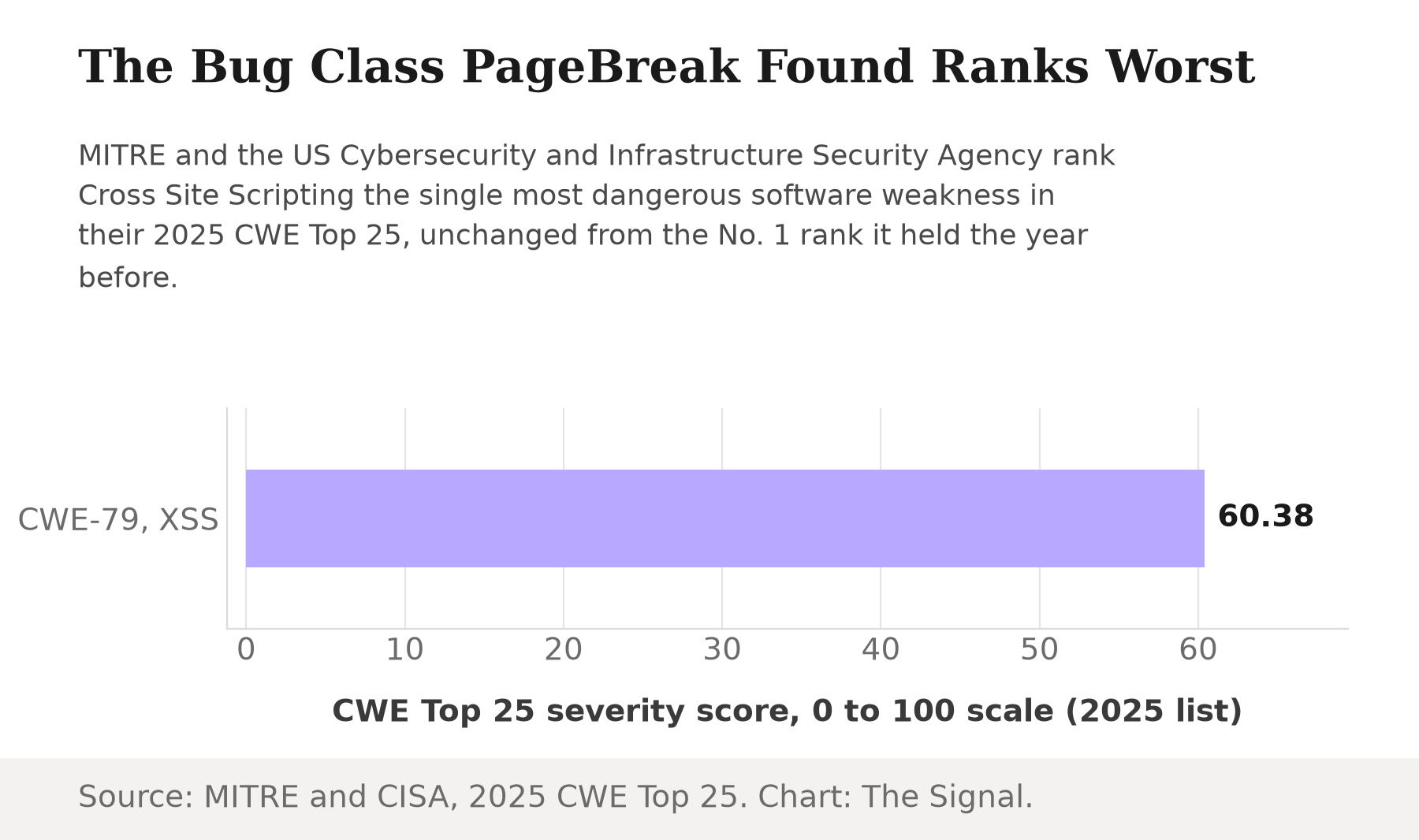
The natural objection to reading this as an architecture story rather than a competence one is that cross-site scripting might simply be an easy bug class that any scanner finds in bulk everywhere. The data says the opposite, or rather it says XSS is dangerous everywhere, which is the point. MITRE and the US Cybersecurity and Infrastructure Security Agency's 2025 CWE Top 25 ranks Cross-Site Scripting, CWE-79, as the single most dangerous software weakness of any class, with a severity score of 60.38 out of 100 and a rank unchanged from the No. 1 position it held the year before. This is not a bug class Google invented or is uniquely bad at. It is the industry's worst, consistently, across every kind of application MITRE and CISA track, which is exactly why it matters that one design pattern suppressed it almost entirely inside a single company's own walls.
A decade-old design choice, not a training gap
The framework PageBreak barely dented did not appear as a reaction to this finding. A 2014 Communications of the ACM paper by Google security engineer Christoph Kern describes how "cross-site scripting (XSS) arises when insufficient data validation, sanitization, or escaping within a Web application allow an attacker to cause browser-side execution of malicious JavaScript," and lays out the technical basis for contextual auto-escaping: building that defense into a template system itself, so a browser never receives an unescaped script in the first place, rather than trusting each developer to remember to escape it by hand. The fix that paper proposed twelve years ago does not require a better-trained programmer. It requires a template engine that will not compile an unescaped string into an HTML context at all. PageBreak's 500-versus-2 finding reads less like a discovery and more like a field validation of an argument Google's own security team made in print in 2014.
India's stake in the same architecture question
This distinction, architecture over discipline, is not an abstract one for the country that writes an outsized share of the world's client-facing web code for a living. India's software services exports rose 8.2% year-on-year to $221.4 billion in FY2025-26, per the Reserve Bank of India's annual exporter survey, reported by India's official news service. That is the scale of the codebase Indian IT-services firms ship into other companies' production environments every year, much of it for clients who, like Google itself before PageBreak ran, have no ready answer for which of their applications sit on a hardened, auto-escaping stack and which still hand-assemble HTML strings.
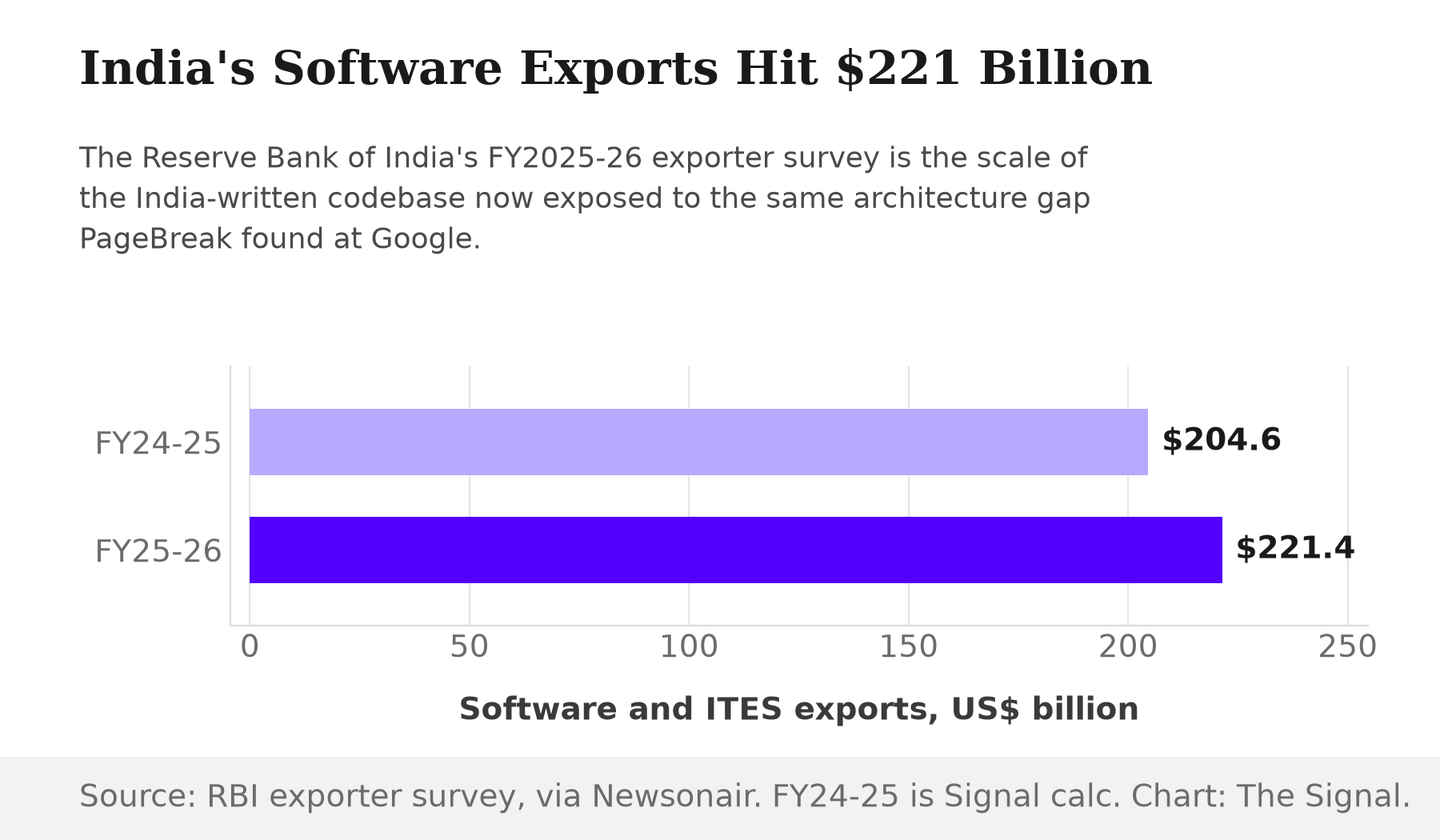
The 250-to-1 gap Google found inside its own walls sits between two kinds of code Indian engineers write every week, sometimes for the same client in the same sprint. PageBreak's numbers do not point at which programmers were careless. They point at which framework a delivery contract happened to specify.
The honest objection
The strongest case against reading this as an architecture story is selection bias: perhaps the apps built on Google's hardened framework are simply newer, smaller or less exposed than the sprawling legacy surface that produced the other 500-plus bugs, so a scanner naturally finds less there. Fewer doors, fewer flaws, nothing to do with the locks.
That case would carry more weight if the two exceptions PageBreak did find undermined it. They do not. Google's own account places both of the framework's confirmed bugs in internal applications or debug endpoints with acknowledged hardening gaps, not in ordinary customer-facing pages built the way the framework intends. The rare failures of the hardened approach happened exactly where the hardening itself was incomplete. That is not evidence the framework was never really tested. It is closer to evidence for the mechanism: take the auto-escaping away, even briefly, on even a debug page, and the same bug reappears on cue.
The Signal
PageBreak's real finding is not that Google has a lot of security bugs; any company running thousands of web applications does. The finding is that the same AI, hunting the same exploit, found the industry's most dangerous bug class roughly 250 times less often when a template engine simply would not let an unescaped script through. For a services industry that writes both kinds of code for clients who rarely ask which kind they are getting, that gap is a procurement question waiting to be asked, not a security footnote: not "how good are your developers," but "which template engine did they use." The next AI agent run against a codebase will not care which answer sounds better. It will just count.
Reporting basis: the PageBreak vulnerability counts, its pilot-to-project timeline and the design of its exploit validator are all per Google's own security engineering blog, the origin and only source for that disclosure. The Cross-Site Scripting severity ranking is from MITRE and the US Cybersecurity and Infrastructure Security Agency's 2025 CWE Top 25. The technical description of contextual auto-escaping is from a 2014 Communications of the ACM paper by Google security engineer Christoph Kern. India's software services export figure is from the Reserve Bank of India's annual exporter survey, as reported by Newsonair, India's official news service. The 250-to-1 comparison between Google's overall and hardened-framework bug counts, and the FY2024-25 export figure shown for comparison against FY2025-26, are The Signal's calculations from those reported figures.