The headline number is bad enough. IDC reports that India's smartphone shipments declined 11.1% year over year to 33.2 million units in Q2 2026. Counterpoint Research, as reported by Fone Arena, calls its own 10% fall the biggest decline for a June quarter in six years. The easy explanation is that Indians are buying fewer phones because phones got dearer, and both trackers say prices rose. Read that way, an AI-driven memory shortage is a tax on every buyer.
It is worth slowing down on that. The shortage is not hitting every buyer. It is hitting one price band almost alone.
The band that disappeared
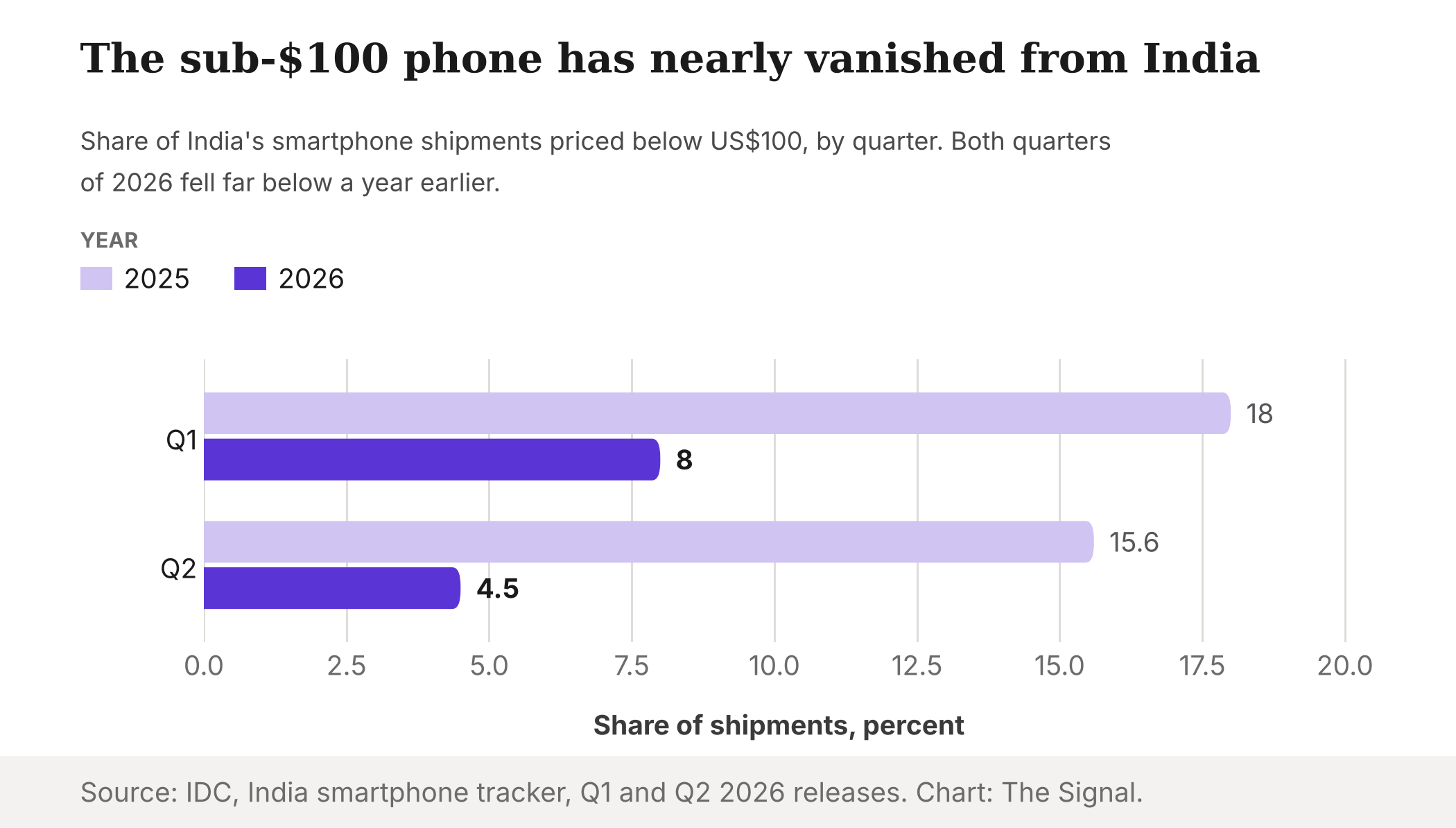
IDC's Q2 release carries the figure that explains the quarter. Shipments of phones priced below US$100 fell 74.3% year on year, and the segment's share of the market shrank from 15.6% to 4.5%. The quarter before was nearly as brutal: IDC found entry-level shipments fell 59% in Q1 2026, with segment share collapsing from 18% to 8%.
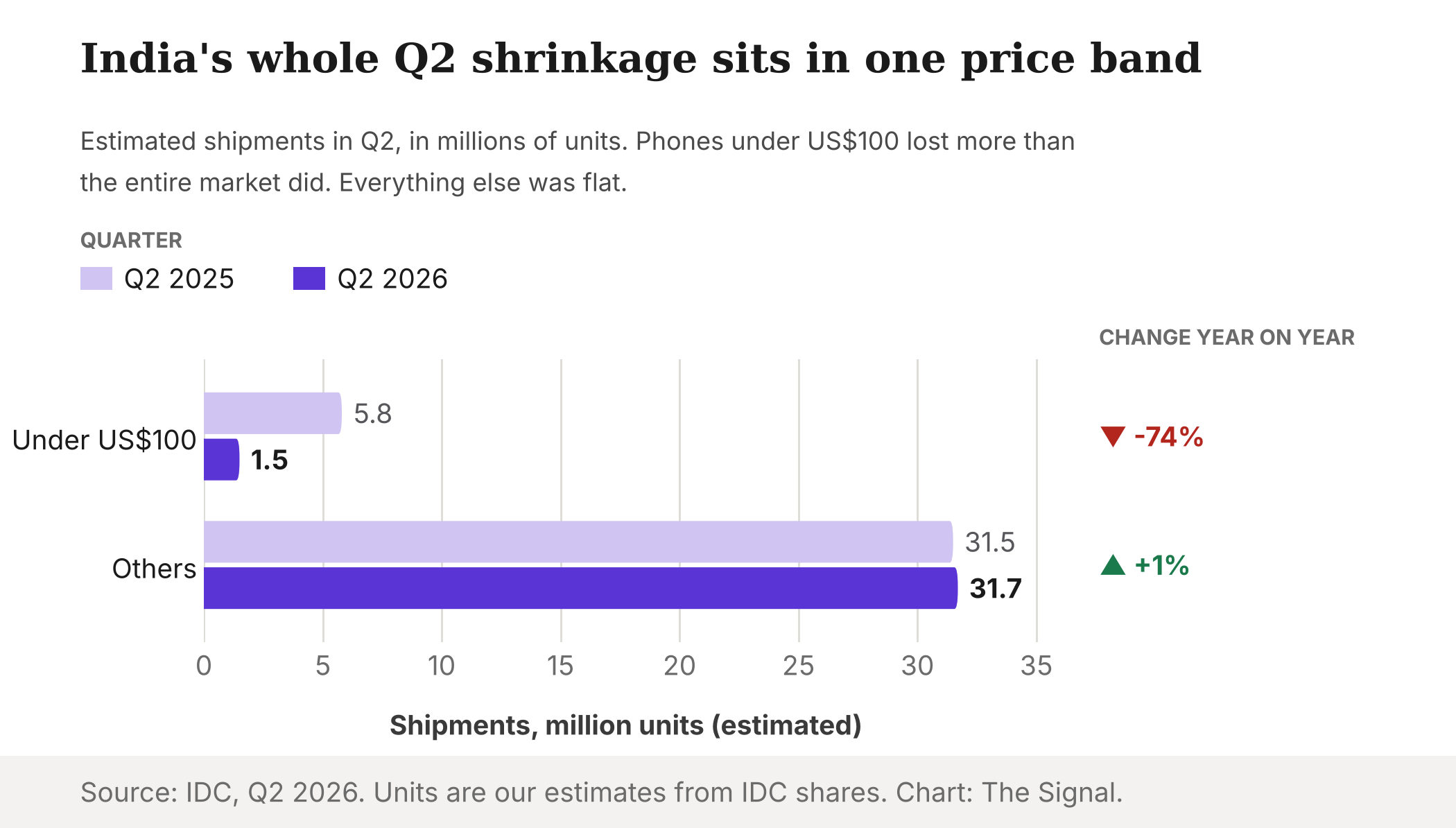
Now turn those shares into units. A market that fell 11.1% to 33.2 million units was about 37.3 million a year earlier. A 15.6% share of that is roughly 5.8 million sub-$100 phones in Q2 2025. A 4.5% share of 33.2 million is roughly 1.5 million in Q2 2026. The band lost about 4.3 million phones. The whole market lost about 4.1 million. Everything priced above US$100 sold roughly 31.5 million phones in Q2 2025 and roughly 31.7 million in Q2 2026. These are our calculations from IDC's rounded shares, so treat the gap as a range, not a point. The direction is not in doubt.
The average price tells the same story from the other side. IDC says India's average selling price climbed 14.4% year over year to a record US$315. Part of that is mix. When the cheapest handsets leave the sample, the average rises even if no single phone changed price.
Why the cheapest phone goes first
The mechanism is simple arithmetic about a bill of materials. Omdia, as reported by The Next Web, found memory alone made up nearly 60% of the bill of materials for phones under US$400 in Q1 2026, and more than 64% for phones under US$99. A maker of a US$90 phone has already stripped out every other cost. When memory moves, it has nowhere to hide.
And memory moved. TrendForce forecast that LPDDR4X mobile memory contract prices would rise at least 70-75% quarter on quarter in 2Q26, with LPDDR5X up 78-83%, according to eeNews Europe. Counterpoint says memory prices have increased nearly 4x since September 2025.
The reason is where the chips are going. Samsung said its Memory Business had another record-breaking quarter by proactively addressing AI demand despite limited capacity, with a primary focus on server products. When a supplier with limited capacity serves servers first, the phone makers at the cheap end are served last. This is the revealed preference of the memory industry: it says capacity is tight, and it spends the tight capacity on data centres.
A premium phone can absorb a dearer chip. A US$90 phone cannot. So the AI build-out lands on the buyer least connected to it, as Omdia's bill-of-materials split implies.
Who is on the other side of the gap
India's budget buyers are a large group. Counterpoint reports the sub-Rs 15,000 segment fell 45% year on year in Q2 2026, a wider band than IDC's sub-US$100 cut, and the loss is steep in both.
The telecom regulator's numbers hint at where the missing buyers live, with a caveat. TRAI reports India had 553.14 million rural wireless subscribers at the end of August 2026, but rural net additions that month were 0.73 million, a monthly growth rate of 0.13%, against 5.25 million in urban areas. In July, rural wireless net additions were 1.54 million. Rural net additions roughly halved in a month. TRAI counts connections, not handsets, and one month proves nothing about causes. But a market that stops selling the cheapest phone should show up first in the places that buy it.
The honest objection
The strongest case against a crisis is that the market is adapting. Business Today, citing IDC data, reports 4G smartphones rose from 5.8% to 11.1% of shipments between Q1 and Q2, as brands brought back cheaper models. Memory makers are also building. SK Group's chairman said SK hynix will double wafer production within five years. Cheap phones, on this view, return when supply catches up.
That case is real, but it runs into the timetable. The same chairman said the memory bottleneck will continue through 2030. Counterpoint does not expect component normalisation until 2027 and forecasts a 13% fall in India's market for 2026. And a 4G comeback at 11.1% of shipments is a repair, not a recovery: the sub-US$100 band alone was a larger share of the market a year ago.
The Signal
The slump looks like a market-wide pullback and is in fact a one-band deletion. Per IDC's Q2 2026 data, the band below US$100 lost 74.3% of its shipments, while by our estimate the market above it held its volume.
That changes what to watch. IDC expects shipments to fall over 15% in the second half, taking full-year volumes to roughly 128-130 million units. Check the Q3 releases for one number: the sub-US$100 share. If it stays near 4.5% while the rest of the market holds, the shortage is a permanent repricing of India's entry tier. If the above-US$100 bands start shrinking too, the squeeze has moved up the ladder.
For now, the AI boom has not made India buy fewer phones, on IDC's numbers. It has made the cheapest phone buyers the ones who pay for it.
Reporting basis: India shipment, price-band and forecast figures are from IDC's Q2 2026 release and Q1 2026 note. Counterpoint Research figures are as reported by Fone Arena, which is what was verified, not Counterpoint's own page. Omdia's bill-of-materials figures are as reported by The Next Web, and TrendForce's mobile memory price forecast is as reported by eeNews Europe. Samsung's statement is from its Q2 2026 results text as reproduced by StorageNewsletter. The SK Group chairman's remarks are per Korea JoongAng Daily. The 4G share is per Business Today, citing IDC. Subscriber figures are from TRAI's August 2026 press release. Several of these rest on a single secondary relay and IDC supplies most of the India figures, so the independent origin count is lower than the number of links. The estimated unit shipments by price band and the implied band-level losses are The Signal's calculations from those figures.