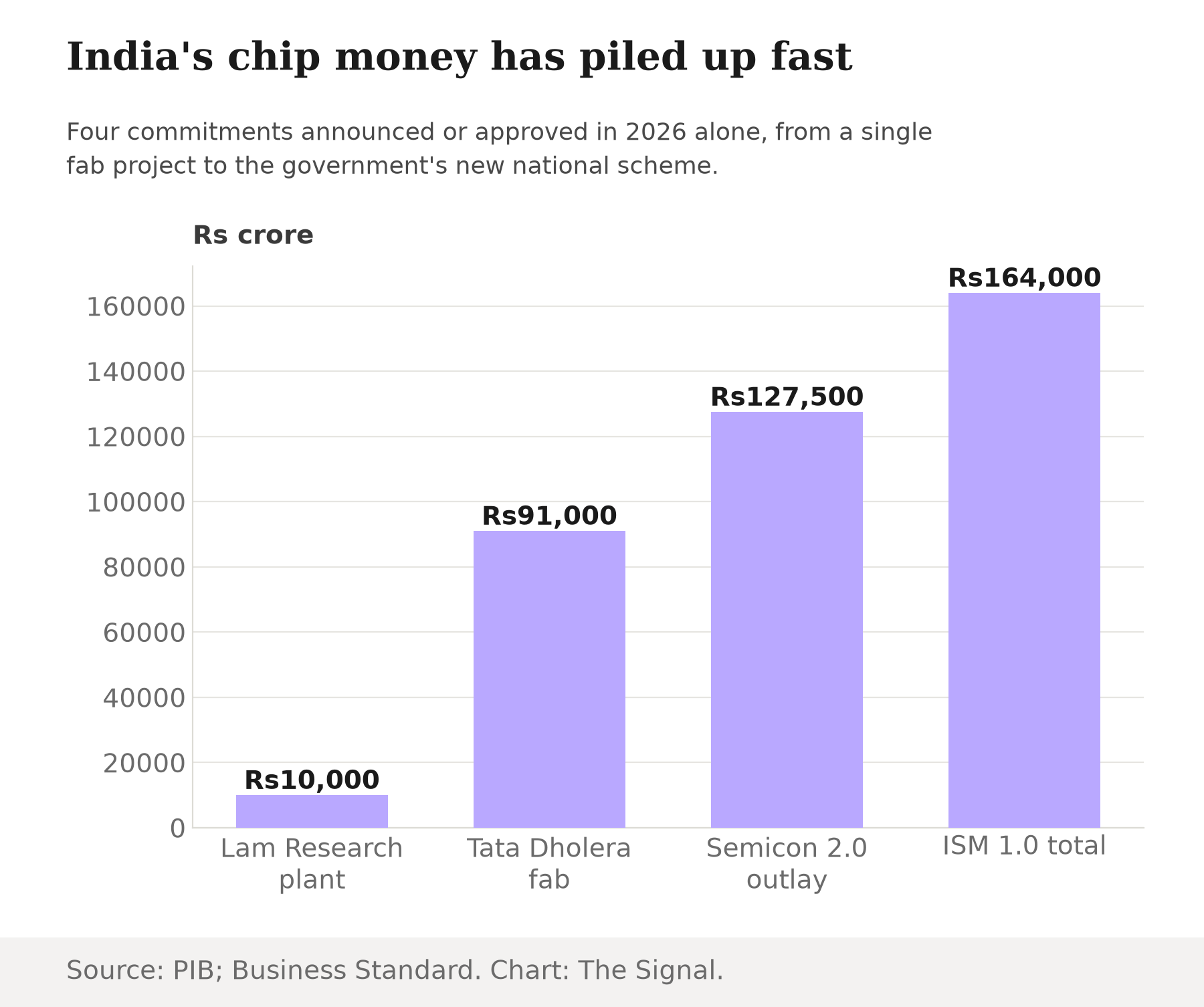
SEMICON India 2026 closed in New Delhi on September 19 with a run of announcements that read like vindication. ASML, the Dutch company that makes the machines without which no advanced chip gets built anywhere, said it has begun operating in India, hiring an initial batch of 20 to 30 engineering graduates and tying how fast that scales to Tata Electronics' progress and to India's own ambitions. Applied Materials committed 5 billion dollars through 2035 under a plan it calls India Vision 2035, aiming to grow its India-based supply chain capacity tenfold, and Lam Research said in the same announcement it will spend about 10,000 crore rupees on its first silicon-component manufacturing facility in the country. The government's own machinery moved in step: the Union Cabinet approved Semicon 2.0 in July 2026 with a total outlay of 1,27,500 crore rupees, and by the end of August the scheme was formally notified, with Electronics and IT Minister Ashwini Vaishnaw saying India could account for nearly 10 percent of the global semiconductor market in the years ahead. Read the week's headlines in sequence and the story writes itself: a decade-long chip push has stopped being a plan and started being an industry.
It is worth slowing down on that reading. At the same event, in the same week, the same minister told PTI something that sits oddly next to all the good news. Vaishnaw said he has candidly told the entire industry to be prepared for cyberattacks and other kinds of threats and disruptions "that might get created by the countries who don't like India to come up in the semiconductor value chain". That is not boilerplate cybersecurity advice. It names the mechanism directly: the threat is a function of India's rise, not a background risk that happens to sit alongside it.
The sabotage warning landed the same week ASML confirmed it had started operating in India.
The two stories are not separate. They are one story told from opposite sides. India's chip push spent years as an ambition with a budget attached to it. September 2026 is the week it became something with hardware, headcount and a fab schedule, which is also the week it became something worth disrupting.
The money that makes India worth targeting
Scale is what changes the calculus, and the scale arrived fast.
Source: The Tribune; Business Standard; Press Information Bureau. Chart: The Signal.
Tata Electronics' Dholera fab, India's largest chip-manufacturing project, carries an investment of about 91,000 crore rupees, a planned capacity of up to 50,000 wafer starts a month, and commercial production is expected to begin in mid-2028. That single fab's investment is more than seventy percent of the entire 1,27,500 crore rupee Semicon 2.0 outlay the government has approved to cover design, fabrication, packaging and materials going forward, and it sits on top of the twelve manufacturing units already approved under the first phase of the mission, with cumulative investment of more than 1.64 lakh crore rupees. State-level sabotage does not follow a few hundred crore rupees moving around. It follows the multiple lakh crore rupees now concentrated in a handful of physical sites, each one a single point of failure until it is actually running.
From classroom to clean room
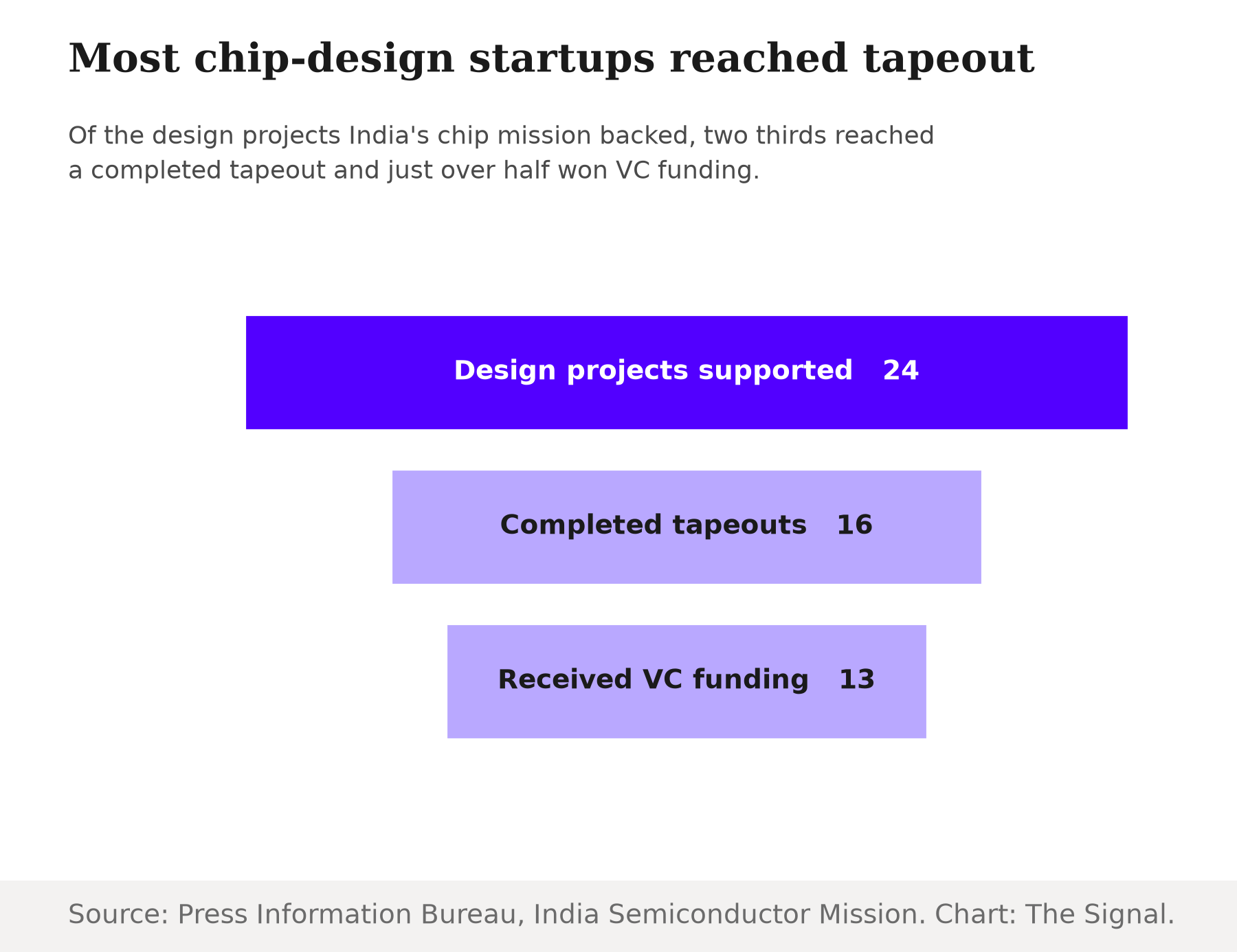
The build-out is not only concrete and capital. Twenty four chip-design projects backed through startups and MSMEs have produced sixteen completed tapeouts and thirteen that went on to raise VC funding, and 350 universities, reaching 65,000 engineers, now have access to industry EDA design tools.
Source: Press Information Bureau, India Semiconductor Mission. Chart: The Signal.
That funnel matters because it is the part of the sabotage risk that has nothing to do with a single fab. A wafer plant can be fenced and guarded. A design pipeline running through 350 universities and thousands of individual engineers is a far wider surface, and it is precisely the layer India has spent the last two years trying to widen on purpose.
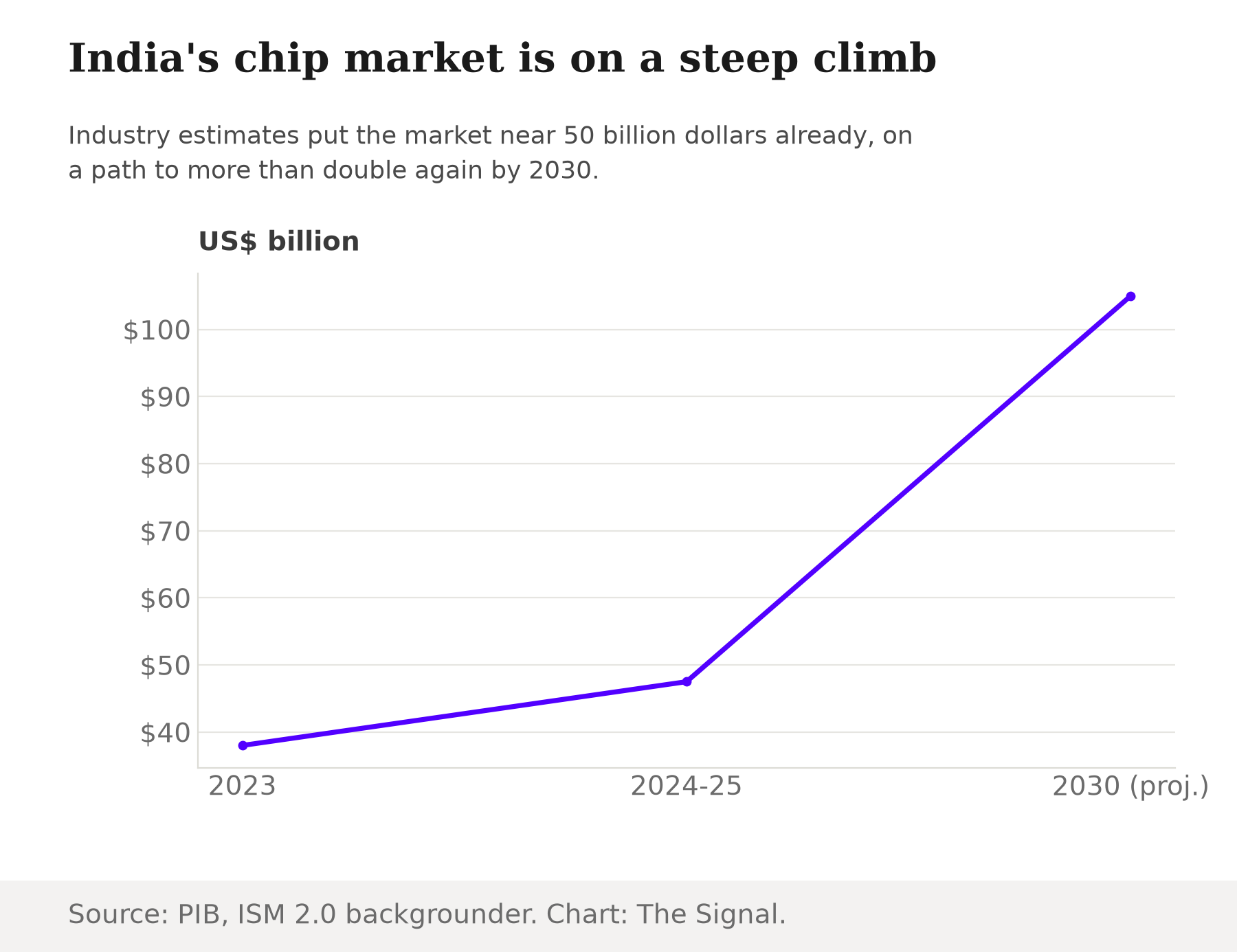
The growth underneath all of it has the same shape. A Ministry of Electronics and IT backgrounder, published in 2025, estimated India's semiconductor market at about 38 billion dollars in 2023, growing to 45 to 50 billion dollars in 2024-25, and projected to reach 100 to 110 billion dollars by 2030.
Source: Press Information Bureau, Ministry of Electronics and IT. Chart: The Signal.
That backgrounder is now more than a year old against today's date, and the 2030 figure is a projection, not a result. But the direction matches everything the government has done since: Vaishnaw's own framing, at the scheme's formal notification, put India within reach of nearly a tenth of the global semiconductor market, the same trajectory read from the policy side rather than the market-research side.
Why success invites the threat, not despite it
Semiconductor supply chains are one of the few parts of modern manufacturing every major power already treats as a national-security asset rather than an ordinary commodity market. Staying a buyer poses no threat to anyone's chip dominance. A country that starts fabricating its own wafers, training its own design engineers, and pulling an equipment maker as central as ASML into permanent local operations changes whose leverage depends on it. That is a description of what happened across the eight weeks of SEMICON India 2026 activity, and it is also, unavoidably, a description of why a rival would prefer that infrastructure not come online cleanly.
ASML's own framing of its India bet is a reminder of how contingent that infrastructure still is. The company said it is probably going to start with 20 to 30 people and will see how fast it scales, because "it really depends on the ambitions of India, and it really depends on the ambitions of Tata". Nothing here is yet running at the scale the headlines imply. A fab still nearly two years from production, an equipment maker with fewer than thirty people on the ground, and a scheme notified three weeks before this piece was written are targets precisely because they are new and not yet resilient. Sabotage aimed at an industry that is already mature accomplishes little. Sabotage aimed at an industry mid-buildout can set a timeline back years.
The honest objection
The obvious skeptical read is that Vaishnaw's warning is the kind of generic caution any minister offers industry at a global investment showcase: useful cover if anything later goes wrong, costless if nothing does. Governments have every incentive to sound simultaneously triumphant and vigilant in the same breath, and a warning about unnamed rival countries names no specific actor, no confirmed incident and no specific vulnerability. Read uncharitably, it is theater timed to a trade show.
There is one incident on the record, though, and it complicates the theater reading more than it settles it. Tata Electronics, the same company building India's Dholera fab, confirmed a cybersecurity incident in June 2026 after the extortion group World Leaks claimed to have stolen and published on the dark web more than 200,000 files, over 630 gigabytes of data, including material purportedly tied to two of its biggest customers, Apple and Tesla, a disclosure that raised fresh supply-chain security concerns. India's CERT-In investigated and found nothing substantial to back the leak claims, and the IT ministry's secretary told reporters that both Apple and Tata Electronics were satisfied they had not lost anything of consequence. No country was ever attributed, and the government's own account treats it as a scare rather than a confirmed breach. But three months before Vaishnaw stood up and said "be prepared," the flagship company of India's chip mission already had a real, dated cybersecurity incident on its books. That does not prove his warning was theater, and it does not prove it wasn't. It proves the industry does not need to imagine what a first incident looks like.
That case would be stronger if the warning had surfaced at a routine cybersecurity conference, disconnected from any particular news cycle. It did not: it came in the same PTI interview cycle, at the same event, in the same week that ASML confirmed it has started India operations, and it names a mechanism, rivals who dislike India's rise in the chip value chain, rather than a generic threat category. A boilerplate warning rarely specifies the attacker's motive. This one does, and the motive it names is India's own success.
The Signal
Watch the sequence, not the announcement. If the ₹1,27,500 crore Semicon 2.0 outlay is disbursed with hardened supply-chain and security requirements attached to it, the warning was a real input into policy, not a talking point. If ASML's India headcount grows past the initial 20 to 30 the way the company said it would if "the ambitions of India" and "the ambitions of Tata" hold up, that is the fragile bet paying off. And if Dholera's mid-2028 production date slips, or a security incident surfaces at any of the sites carrying this year's investment, this week's warning will read as the first sign rather than a throwaway line at a trade show. Chip missions have always drawn attention from rivals who cannot match them. India's problem was never getting noticed. It is staying operational now that it has.
Reporting basis: Ashwini Vaishnaw's sabotage and cyberattack warning, and ASML's confirmation that it has started India operations, are from separate PTI interviews conducted at SEMICON India 2026 and carried by Business Standard. The Semicon 2.0 approval, its outlay and the twelve-unit ISM 1.0 cumulative investment figure are from a Press Information Bureau release from the Ministry of Electronics and IT. The scheme's formal notification and Vaishnaw's near-10-percent global market share framing are from a separate Ministry of Electronics and IT briefing, carried via Prasar Bharati's News On AIR. The Tata Electronics Dholera fab's investment, capacity and production timeline are per Business Standard's reporting, citing Tata Electronics, Powerchip Semiconductor Manufacturing Corporation and Vaishnaw. The chip-design tapeout, VC-funding and university EDA-access figures, and the semiconductor market-size estimates and 2030 projection, are from separate Press Information Bureau releases from the Ministry of Electronics and IT. The Applied Materials and Lam Research investment announcements are per The Tribune's reporting from SEMICON India 2026. The Tata Electronics cyberattack details and the government's investigation findings are from separate Business Standard reports, the first citing Reuters and the second reporting Meity secretary S Krishnan's remarks to press. The share of the Semicon 2.0 outlay accounted for by the Dholera fab alone is The Signal's calculation from those two figures.