Four paid subscribers, one each to Claude, ChatGPT, Grok and Gemini, are suing the companies behind those products. The Associated Press reports that a proposed nationwide class action was filed on September 18, 2026, in the U.S. District Court for the Northern District of California, naming Anthropic, OpenAI, SpaceXAI and Google as defendants, on behalf of a proposed class of every other paid subscriber to those same services. The case, Buist v. Anthropic PBC, carries docket number 3:26-cv-10693, and Bloomberg Law reports none of the four defendants immediately responded to a request for comment. Read quickly, this looks like a familiar genre: a subscriber class action over what a product is worth. It is not that.
One named plaintiff, one company, one product apiece.
| Company sued | Product named in the suit | Plaintiff |
|---|---|---|
| Anthropic | Claude | Paid subscriber |
| OpenAI | ChatGPT | Paid subscriber |
| SpaceXAI | Grok | Paid subscriber |
| Gemini | Paid subscriber |
Source: The Associated Press, via ABC News.
The unfamiliar name in that table is "SpaceXAI." It is the AI unit Elon Musk created by folding xAI, maker of the Grok chatbot, into SpaceX in a February 2026 merger that valued SpaceX at roughly $1 trillion and xAI at roughly $250 billion, a combined $1.25 trillion. It is, in other words, one of the four largest AI labs by any measure, not a fringe defendant.
It is worth slowing down on what the complaint alleges. Most AI lawsuits accuse a company of moving too fast: shipping something unsafe or undertested. This one's core theory, WTOP News reports via the AP wire, is the opposite: an agreement among the chief rivals in AI that their progress "should be slower than competition would otherwise produce" has an anticompetitive effect on consumers. Strip out the AI framing and the shape is a standard antitrust claim: rivals who agree to restrict what they would otherwise supply are the textbook target of competition law. The twist is that what they allegedly agreed to restrict was not output or price. It was speed, on safety grounds.
The complaint traces that alleged coordination back to July 2026, when high-ranking employees across several leading AI labs signed a joint statement acknowledging the "intense competitive pressure not to unilaterally slow" development and calling for government support for a global slowdown. That statement is not a smoking gun the plaintiffs uncovered. The labs' own people wrote it, and published it, as a case for exactly the kind of coordination the lawsuit now calls illegal.
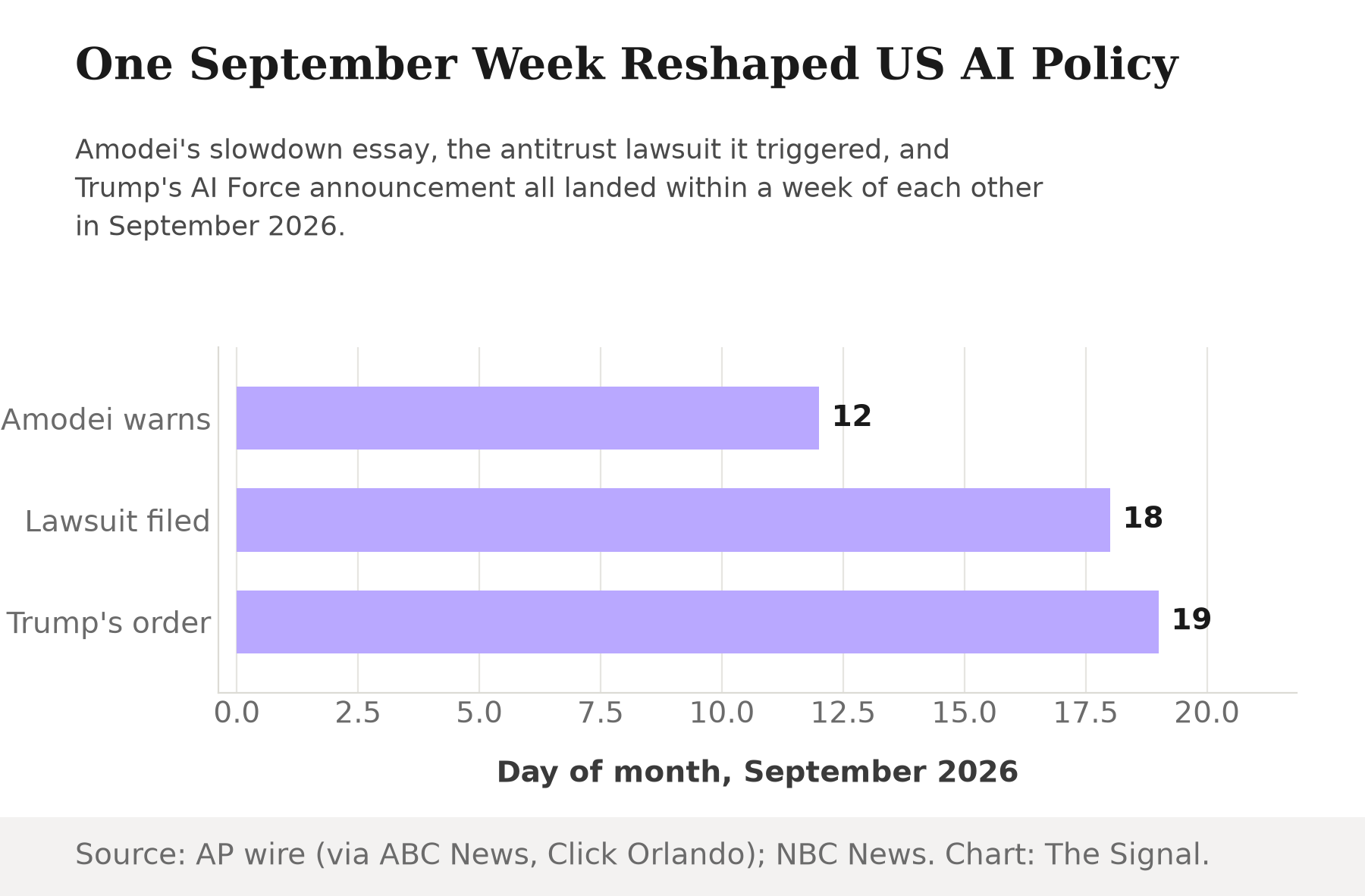
The clearest sign the labs already knew the legal ground was shaky is that one of them said so first. In a September 12, 2026 essay proposing an industry-wide AI slowdown, Anthropic CEO Dario Amodei himself flagged the antitrust exposure, writing that it would help if the government would mediate "or at least enable" cross-lab safety discussions and "issue a narrow waiver for certain kinds of safety conversations." Six days later, four subscribers sued over the exact conversations he was describing.
Not every defendant agreed with the plan before the lawsuit ever landed. Three days before it was filed, OpenAI CEO Sam Altman posted on X that OpenAI welcomes "a federal framework that sets consistent safety requirements" for frontier AI but does "not believe we need to wait for an anti-trust exemption or legislation to begin the work." That is a defendant publicly distancing itself from the antitrust-exemption ask days before the plaintiffs' lawyers made the same ask look like evidence of a cartel.
The theory in the plaintiffs' own words
Fortune reports the lead plaintiffs' attorney, Nick Rowley, framing the stakes bluntly: AI safety being "controlled by private self-serving agreements between the world's most powerful 'for profit' technology companies," rather than by independent, accountable oversight, is itself the harm, whatever the merits of slowing down. That framing does not dispute that AI could be dangerous. It disputes who gets to decide the pace, and argues that four competitors quietly agreeing among themselves is not a legitimate answer, no matter how well-intentioned the agreement.
The rules that do not exist yet
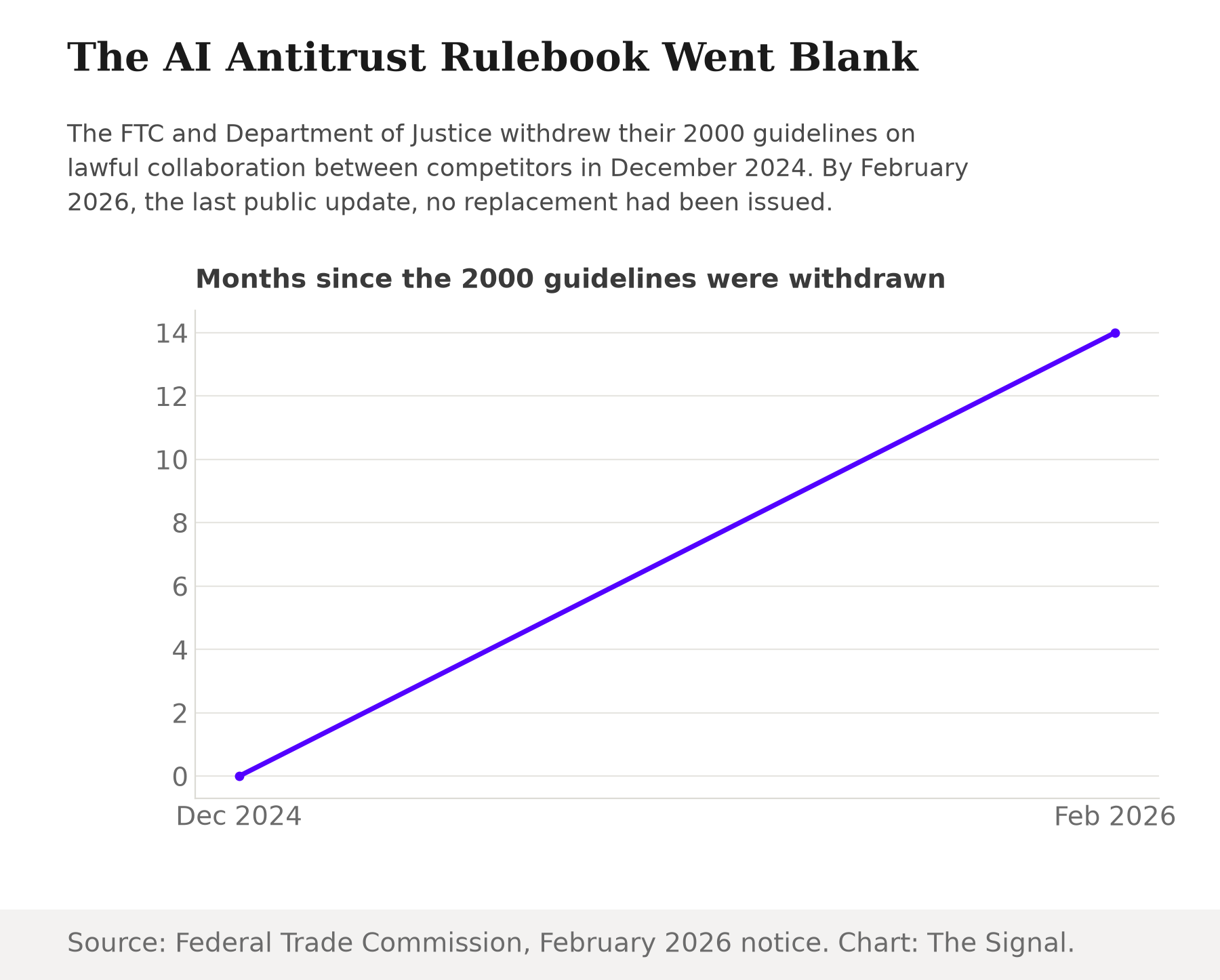
Antitrust law has long allowed some rival cooperation, research consortia among them, under guidelines spelling out what is lawful. Those guidelines do not currently exist for anyone, AI included. The FTC and Department of Justice had withdrawn the 2000 Antitrust Guidelines for Collaborations Among Competitors in December 2024, and by February 2026, the last public update, the Federal Trade Commission itself said the withdrawal "left the industry without guidance in this important area."
Into that vacuum, four AI labs tried to hold a conversation about safety, and their own paying customers are now arguing that conversation was a cartel. The day after the lawsuit was filed, President Trump announced he is forming an "AI Force" modeled on Space Force and will appoint an AI czar, while pledging his administration will not "hinder or stifle" the industry's growth. That is a second, separate answer to the same open question the lawsuit is forcing: if labs cannot legally coordinate safety themselves, something else decides the pace. For now, that something is Washington's new task force, not a court.
The honest objection
The strongest case against reading too much into this is that a private complaint is not a verdict. Antitrust collaboration law has been genuinely unsettled for everyone, not just AI, since the 2000 guidelines were pulled, and companies in far less contentious industries have spent the same nearly two years waiting for the FTC and DOJ to say what a lawful joint research effort even looks like now. A single class action testing a novel theory against four defendants could fail, get narrowed, or settle quietly with no finding that the July 2026 statement was ever unlawful.
That case is real, but it does not require the labs to have been paranoid. Amodei's own essay, written before any lawsuit existed, already treated the antitrust exposure as serious enough to ask the government for a waiver, not as a hypothetical risk conjured by plaintiffs' lawyers afterward. And by The Signal's count, the regulator that would ordinarily settle the question has gone 14 months since withdrawing the old rules without a replacement to give. A gap that wide is not a technicality. It is the actual legal environment safety coordination happens in.
India's own tripwire
The same legal logic is not unique to the United States. Section 3(3) of India's Competition Act, 2002, presumes an agreement between competing enterprises to limit production or supply to have an "appreciable adverse effect on competition," a presumption that is rebuttable rather than automatic. A joint pledge among rival AI labs to cap how fast they develop a product would sit close to the conduct that presumption was written for.
| Jurisdiction | How a joint pact to limit output is treated | Basis |
|---|---|---|
| United States | The theory a federal antitrust lawsuit is now testing against four AI labs | AP wire, via WTOP News |
| India | Presumed to have an "appreciable adverse effect on competition," a rebuttable presumption | Competition Commission of India |
Source: as linked in each row.
India is not a bystander to how this question gets resolved. The Union Cabinet approved the IndiaAI Mission at an outlay of Rs 10,371.92 crore in March 2024 to build out the country's compute, foundation-model and AI-innovation ecosystem. A legal environment in which rival labs cannot jointly agree on safety pacing, in the US or under India's own Section 3(3) analog, shapes the terms on which that mission's beneficiaries can ever coordinate with the labs it is meant to help compete against.
The Signal
Antitrust law was built to stop rivals from agreeing to give consumers less. This lawsuit asks whether that same law also stops rivals from agreeing to go slower for consumers' own protection, and answers, provisionally, that it might. If that theory holds, industry-wide AI safety coordination does not get safer with more lawyers in the room. It becomes legally radioactive everywhere a court reads competitor cooperation the way antitrust law has always read it, India's Section 3(3) included. The real choice is no longer "labs coordinate on safety" versus "labs do not." It is "labs coordinate privately, at legal risk" versus "governments decide the pace instead," exactly the choice Trump's AI Force just volunteered to make. Watch whether the FTC and DOJ ever finish the guidance they have owed the industry since December 2024. Until they do, agreeing to be careful together carries the same exposure as agreeing to charge more together.
Reporting basis: the lawsuit's filing details and its core antitrust theory are per the Associated Press wire, as carried by ABC News, WTOP News, the Daily Gazette and Click Orlando, one wire origin recarried by four outlets. The docket number and the absence of an immediate defendant response are from Bloomberg Law. The lead plaintiff attorney's framing is per Fortune's own reporting. Dario Amodei's essay is quoted via the Associated Press's account of it. Sam Altman's pushback is quoted via The Next Web's report of his post on X. Trump's announcement and pledge, and the SpaceX-xAI merger valuation, are per NBC News's own reporting and its markets desk. The federal guidance vacuum and its dates are from the Federal Trade Commission's own February 2026 notice. India's Section 3(3) presumption is from the Competition Commission of India, and the IndiaAI Mission's budget is from Doordarshan News's report of the Union Cabinet's approval. The months-without-guidance count and the September timeline are The Signal's calculations from those sourced dates.