India's broadband base is still climbing every month. The Telecom Regulatory Authority of India counted 1,059.05 million broadband subscribers at the end of February 2026, rising to 1,065.88 million a month later at the end of March 2026, a monthly growth rate of 0.65 percent. The traffic riding on that base is climbing too. Total wireless data usage rose from 73,324 petabytes in the quarter ending December 2025 to 77,953 petabytes in the quarter ending March 2026, a 6.31 percent jump in three months. Read only those two numbers and the story is the one everyone already tells about Indian telecom: more subscribers, more data, an internet economy still compounding.
It is worth slowing down on where that international traffic physically goes once it leaves the country.
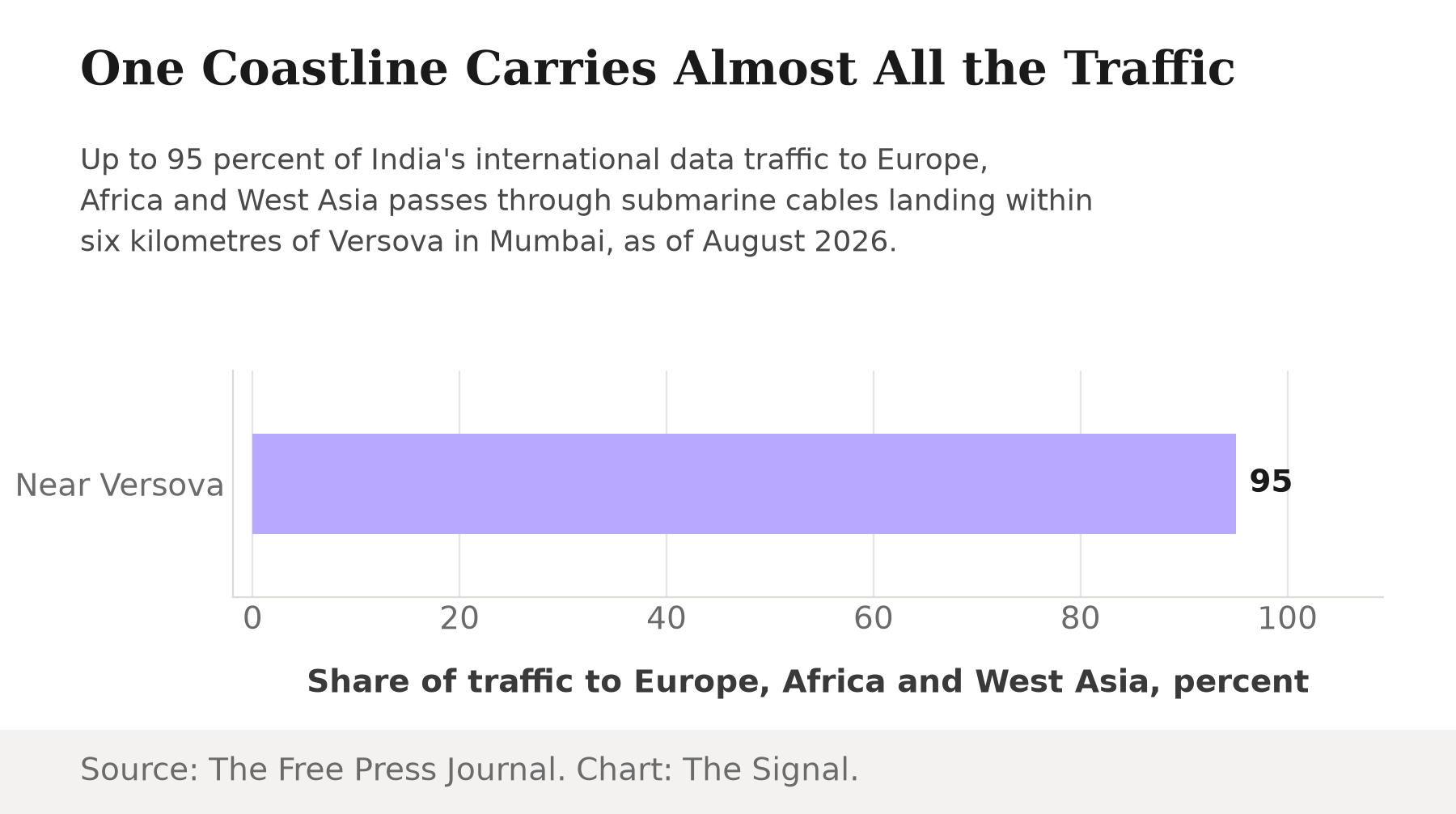
Up to 95 percent of India's international data traffic to Europe, Africa and West Asia passes through submarine cables landing within six kilometres of Versova, a coastal neighbourhood on Mumbai's western shore, The Free Press Journal reports. At least 13 of India's 18 undersea intercontinental cables come ashore in that same six-kilometre stretch. The broadband growth story is national, but the physical infrastructure carrying the country's most valuable slice of that growth, the data headed to Europe, Africa and the Gulf, is not.
Three different counts, the same two cities
Government bodies, think tanks and industry analysts do not all count India's submarine cable infrastructure the same way. Some tally physical landing stations; others count active cable systems. But every count lands in the same two cities.
Every published count of India's submarine cable infrastructure puts Mumbai and Chennai far ahead of the rest of the country.
| What is counted | Total in India | Mumbai | Chennai | As of |
|---|---|---|---|---|
| International submarine cable landing stations | 17 | 8 | 4 | November 2024 |
| Active submarine cable systems | About 20 | 15 | 9 | August 2026 |
Source: National Maritime Foundation; APNIC.
The National Maritime Foundation's count, current as of November 2024, put 8 of India's 17 international landing stations in Mumbai and 4 in Chennai, leaving just 5 spread across the rest of the country's coastline. That count is nearly two years old. But an APNIC Blog analysis from August 2026 counts a different unit, active submarine cable systems rather than landing stations, and still finds around 20 of them reaching India, with 15 landing in Mumbai and nine active in Chennai. The methodologies do not match: a station can host more than one cable system, so the totals should not be added together. What holds across both counts, taken eighteen months apart, is the shape: two cities, and mostly one of them.
The regulator counting the broadband growth has said the same thing about the physical footprint underneath it. TRAI Chairman Anil Kumar Lahoti said India accounts for just 1 percent of the world's cable landing stations, and that experts say this should grow tenfold to secure the country's position as a global digital hub. That is not a critic's estimate. It is the telecom regulator's own read of the gap between India's data ambitions and where its cables actually land.
No one to send when a cable snaps
That concentration would matter less if India could respond quickly when a cable is damaged. It cannot. Ship anchors, trawler nets and undersea landslides are the common causes of cable faults worldwide. A Takshashila Institution policy brief finds that India currently has zero cable repair vessels that are Indian-flagged, Indian-owned, or permanently stationed within Indian maritime zones. A stretch of coast carrying up to 95 percent of the country's data traffic to three continents sits behind a repair capability that does not exist domestically at all.
That absence has a distance and a wait time attached to it. The two vessels that actually cover Indian waters under regional maintenance consortia are stationed in Galle, Sri Lanka and Subic, the Philippines. The average response time to reach a fault in Indian waters runs 3 to 5 months for one consortium and 4 to 5 months for the other, a National Maritime Foundation analysis finds. Zero domestic vessels does not mean zero repair capacity. It means every repair starts with a ship sailing in from another country, on a timeline measured in months.
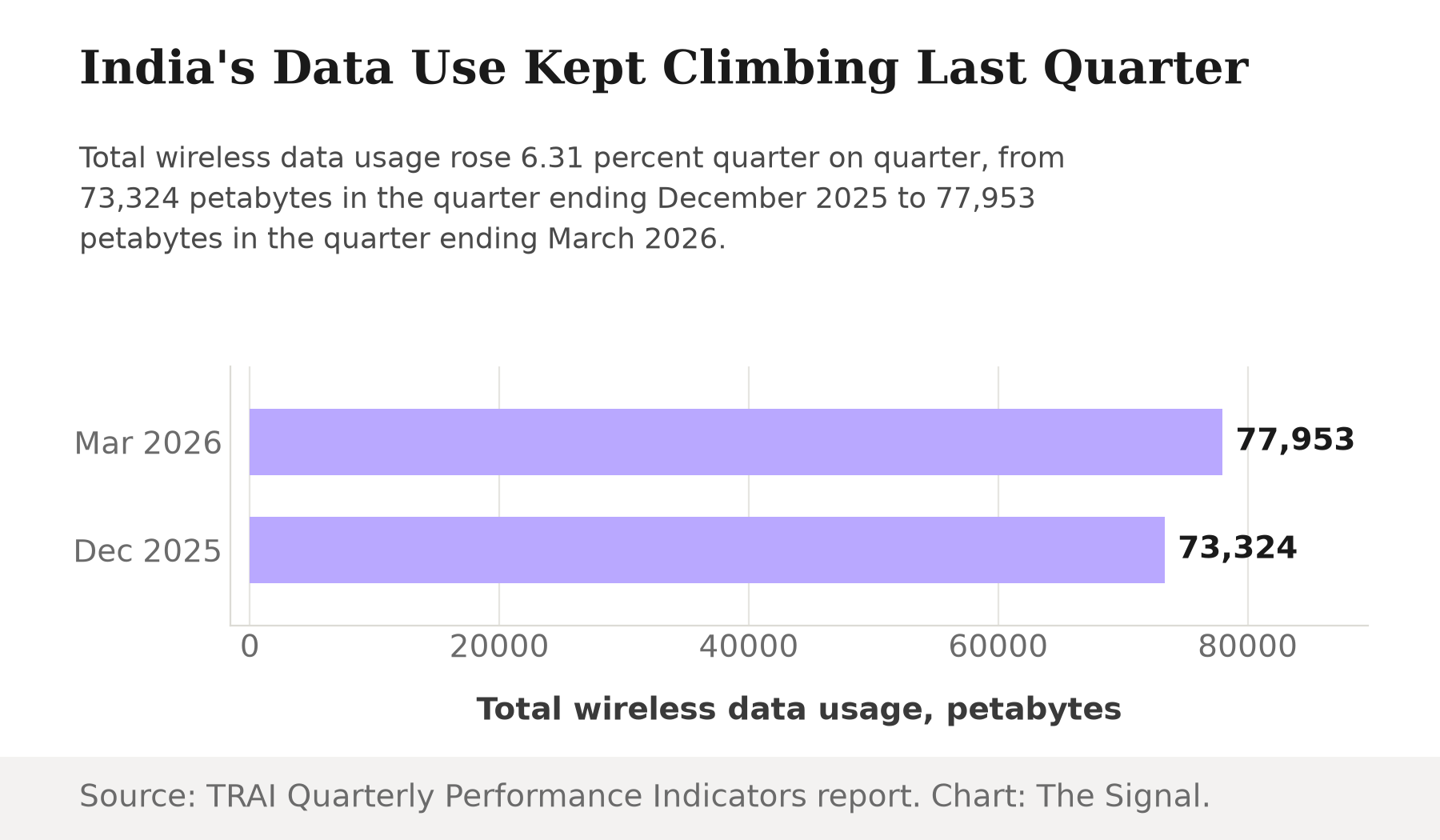
The demand riding on that exposed infrastructure is not slowing down to wait for the gap to close. TRAI's Indian Telecom Services Performance Indicators report puts the quarterly rate of growth in wireless data usage at 6.31 percent for the quarter ending March 2026, and broadband subscriptions kept adding roughly 6.8 million connections in a single month, from February to March 2026. Every one of those new connections adds load to the same physical bottleneck near Versova, not a redesigned one.
The honest objection
The strongest case against calling this fragile is that India is not actually running on one cable. APNIC counts around 20 active submarine cable systems reaching the country, which is real redundancy on paper: an anchor drag that severs one system should not, in principle, take the country offline. Engineers route around a single cut using capacity on the others, and that is exactly what the mesh is designed to do.
That case holds for a single, isolated cable fault, but less well for the specific geography here. Fifteen of those roughly 20 cable systems land in Mumbai, and up to 95 percent of the traffic to Europe, Africa and West Asia is concentrated in cables landing within six kilometres of each other. Redundancy among cables that share a coastline, a set of landing stations and the same storm systems is a weaker shield than redundancy spread across the country would be. And redundancy on paper still assumes someone can reach a damaged cable and repair it. With zero Indian-flagged, Indian-owned or India-stationed repair vessels, a fault that outruns the remaining cables' rerouting capacity has no domestic fallback. It waits for a foreign repair ship to be found and dispatched.
The Signal
India's broadband base and its data traffic keep climbing, confirmed by TRAI's own releases. The physical footprint carrying that traffic across borders has not kept pace: a handful of landing points on one coastline, and no domestic capability to fix them when they break. The two facts sit right next to each other. Up to 95 percent of the country's data traffic to Europe, Africa and West Asia lands in cables within one six-kilometre stretch of Mumbai coast, and zero repair ships fly the Indian flag or sit stationed in Indian waters. Watch what closes first, the concentration or the repair gap. Until one of them does, India's digital growth story is running through a chokepoint it cannot yet defend on its own.
Reporting basis: the Versova landing-point concentration and its share of international traffic are per The Free Press Journal's own reporting. The absence of Indian-flagged, Indian-owned or India-stationed cable repair vessels is per a Takshashila Institution policy brief. The landing-station count by city, current as of November 2024, is per a National Maritime Foundation analysis, and the active cable-system count, current as of August 2026, is per an APNIC Blog analysis; the two use different units and are not additive. Broadband subscription and wireless data usage figures are from TRAI's own release and its Indian Telecom Services Performance Indicators report. The approximate month-on-month subscriber addition is The Signal's calculation from those TRAI figures.