Read the statute and India's content-blocking law sounds careful. Section 69A of the Information Technology Act permits the central government to order a block only "for reasons to be recorded in writing," and only on specific grounds: sovereignty, defence, state security, foreign relations, public order. Rule 8 of the Blocking Rules that implement it goes further, requiring a designated committee to examine each request and decide whether it is "justifiable" before anything gets blocked. That is not a rubber stamp on paper. It is a case-by-case adjudication, order by order, with a written record behind each one.
The law that governs blocking was designed to check one order at a time.
It is worth slowing down on the machinery meant to catch it if that design breaks down. The Blocking Rules also set up a Review Committee, but it is only required to meet once every two months to check whether directions already issued complied with the law. That committee looks backward, not forward, and it looks back on a bimonthly clock. The individualised, reasons-in-writing design at the front end is paired with an audit at the back end that runs six times a year, however many orders pass through in between.
Two months to check what an hour approves
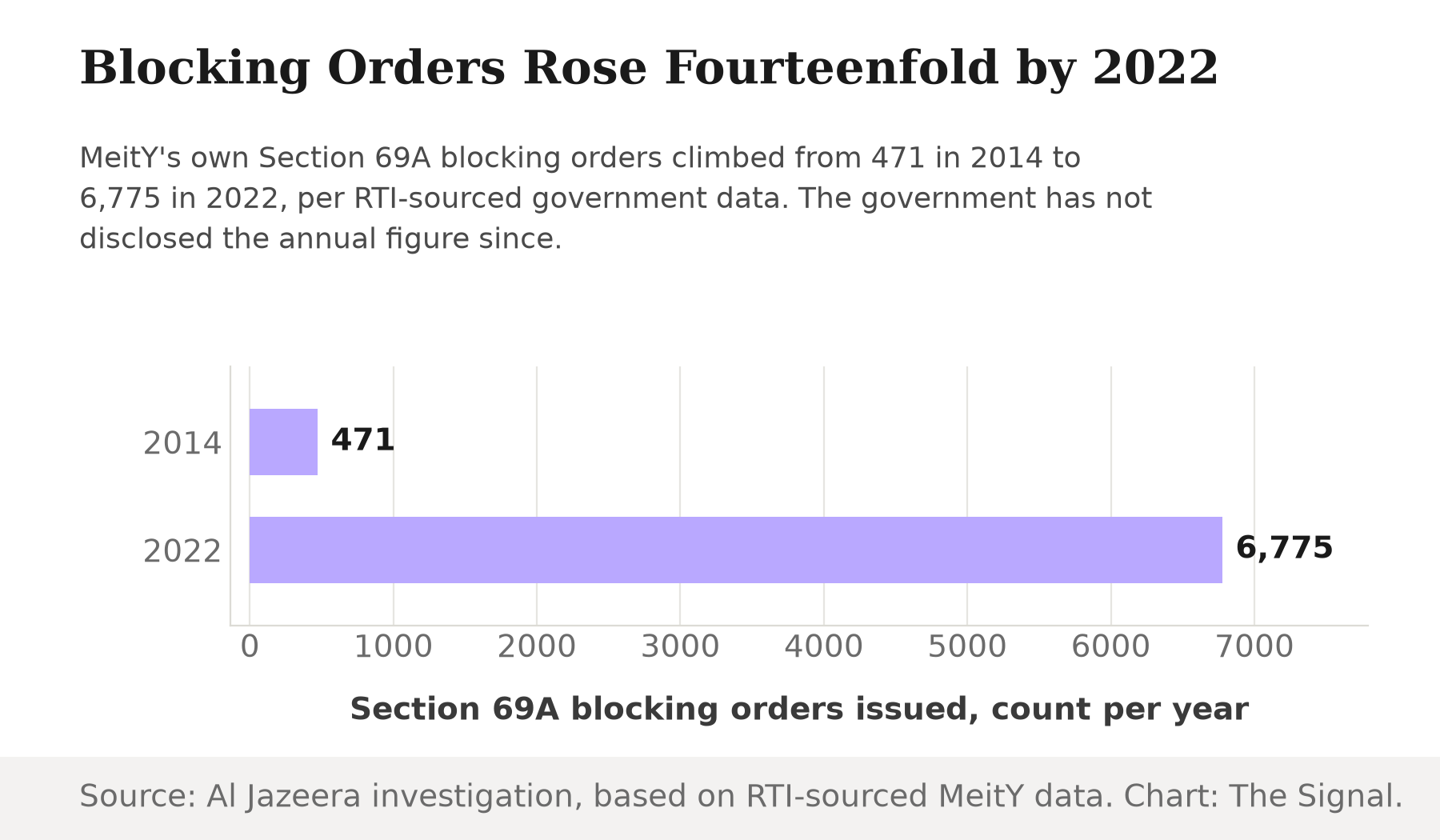
How many orders pass through is itself a fact the government used to publish and now does not. MeitY's own blocking-order count rose fourteenfold in eight years, from 471 orders in 2014 to 6,775 in 2022, according to RTI-sourced government data. That is the last year the figure was disclosed. The count has not been made public since, which means there is no official annual number to compare against a review process that still meets on the same twice-a-season schedule it always did.
One hour, 2,355 accounts, no reasons given
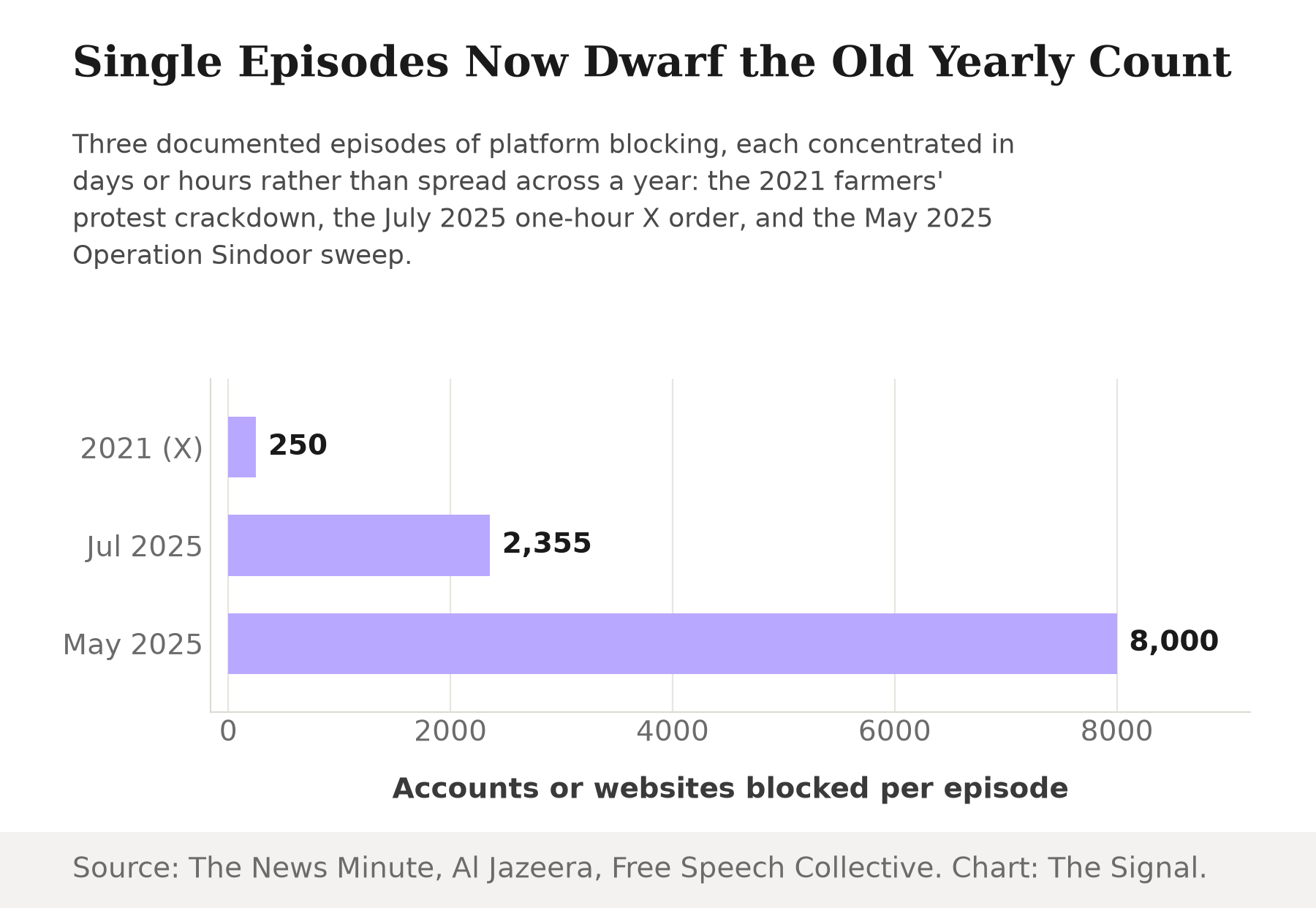
The clearest test of what "case-by-case" means in practice came in July 2025. X said the government demanded it block 2,355 accounts, gave it one hour to comply, provided no justification, and required the accounts to stay blocked until further notice. A committee weighing whether each of 2,355 individual accounts is "justifiable" to block, inside sixty minutes, is not the process Rule 8 describes. The government disputed the episode.
Both sides went on the record, and they do not agree on what happened.
| X Corp | Government | |
|---|---|---|
| Whether a fresh order was issued | Says MeitY demanded action within one hour, without justification, on 2,355 accounts | Says it "has not issued any fresh blocking order" |
| Reuters accounts specifically | Accounts including Reuters were among those blocked | Says it "has no intention to block any prominent international News Channels, including Reuters and ReutersWorld" |
Source: Al Jazeera; Prasar Bharati's News on AIR, citing the Ministry of Electronics and IT.
Neither account can be fully reconciled with the other, and this piece adjudicates neither. What both versions agree on is that a large, fast-moving blocking action happened in July 2025 and the public got no contemporaneous order to inspect either way.
The count that stopped being public
That opacity is not new, and it is not confined to one platform dispute. X had earlier acknowledged blocking roughly 250 accounts of journalists and activists posting about the 2021 farmers' protest, on government direction. Four years later, the scale moved from hundreds to thousands within a single crisis window: MeitY told an RTI applicant it could not disclose information on the blocking of 8,000 social media accounts on X and news websites during the Operation Sindoor period in May 2025, citing national security. Eight thousand accounts and sites in weeks is already more than the last full year MeitY was willing to count in public.
The account that vanished with no order named
The pattern is current, not historical. In July 2026, Instagram made the Citizens for Justice and Peace's official account, with 26.5 million followers, unavailable in India two days after a student-led march at Jantar Mantar. That restriction sat inside a wider run of platform actions that month. No blocking order was named or produced for any of it. Where the July 2025 episode at least generated dueling public statements from X and the government, the July 2026 restriction generated neither: no order, no justification, no denial to weigh against a claim, because no claim about a specific legal instrument was made at all.
The one legal test closed
A platform did try to challenge the newer, less visible side of this system in court and lost. X Corp went to the Karnataka High Court calling the government's parallel Sahyog takedown portal a "censorship portal" that bypasses Section 69A's procedural safeguards. The court rejected the challenge, ruling that Article 19 protections do not extend to a foreign company and are "citizen centric." Whatever the merits of Sahyog as a separate takedown channel, the one attempt to test it against the individualised-review standard Section 69A itself sets has already failed on standing, not on the substance of how orders are made.
That channel is no longer marginal. RTI-sourced data reported by the Indian Express show Sahyog sent more than 2,300 blocking orders to 19 platforms, including WhatsApp, Facebook, YouTube and Instagram, in its first year of operation, October 2024 to October 2025, a pace of roughly six orders a day, on a channel that was never built with a Rule 8 committee in front of it or a Review Committee behind it.
The honest objection
The strongest defence of all this is that Section 69A's own grounds already include national security, public order and sovereignty, so a government moving fast and staying quiet on a farmers' protest, a military operation, or a protest march is not evading the law, it is using exactly the exceptions the law provides for. And the government's record is not one of blanket denial: it explicitly denied blocking Reuters specifically, on the record, rather than refusing to answer, which is not the behaviour of an agency that treats every account of overreach as accurate.
That case is real, but it answers the wrong question. Nobody disputes that Section 69A's grounds are lawful; the mismatch is between a law that promises individual review with written reasons and a Review Committee that checks compliance once every two months, while single episodes now run to thousands of accounts inside an hour, rivaling what used to be a full year's disclosed total. National security can justify withholding a name. It does not by itself explain why the aggregate count stopped being published at all, four years before the volume it once tracked kept climbing.
The Signal
Section 69A's due-process architecture, reasons recorded in writing, a committee judging each request as justifiable, was built for an era of hundreds of orders a year checked by a body that meets six times annually. What it now processes includes a single hour that blocked 2,355 accounts, a single crisis window that touched 8,000, and a single Instagram takedown with no order named at all. The government has not published the aggregate count since 2022, and the one court case testing the newer, quieter takedown channel has already gone against the platform that brought it. Watch two things: whether MeitY resumes publishing an annual blocking figure, and whether the next large single-day action comes with a number attached to it in public, or simply happens.
Reporting basis: the Section 69A statutory text is from IndianKanoon's mirror of the Information Technology Act, 2000; the individualised-review requirement and the Review Committee's meeting cadence are from IndianKanoon's and the Centre for Internet & Society's mirrors of the IT Blocking Rules, 2009. The 2014-to-2022 order count is RTI-sourced MeitY data as reported by Al Jazeera. The blocking episode on X from July 2025, and X's account of it, are per Al Jazeera; the government's denial regarding Reuters is per Prasar Bharati's News on AIR, citing the Ministry of Electronics and IT. The 2021 farmers' protest account figure is per The News Minute, citing earlier Newslaundry reporting; the May 2025 Operation Sindoor RTI response is per the Free Speech Collective's documentation of MeitY's reply. The July 2026 Instagram restriction is per The Wire's reporting. The Karnataka High Court's ruling on the Sahyog portal is from IndianKanoon's mirror of the judgment in X Corp vs Union of India. The Sahyog portal's first-year order volume is RTI-sourced Indian Express reporting, via The Wire; the six-orders-a-day pace is The Signal's calculation from that figure.