On August 10, 2026, Nvidia's newsroom announced that the company had struck strategic partnerships with six of the largest names in global finance, Apollo, BlackRock, Blackstone, Brookfield, Goldman Sachs and KKR, to establish independent compute financing platforms meant to mobilize over $500 billion of third-party capital for the buildout of AI infrastructure over time. Read the announcement the way it was written and this is a supply problem being solved at scale: the world wants more AI data centers than any single company's balance sheet can fund, so Nvidia went and lined up six of the deepest pools of private capital on the planet to close the gap.
It is worth slowing down on exactly which six firms sit on the other side of that capital. Apollo, BlackRock, Blackstone, Brookfield, Goldman Sachs and KKR are not just financiers of data centers in the abstract. They are financing the specific data centers that will fill up with Nvidia chips, generating the specific revenue that shows up on Nvidia's income statement. The company that sells the chips has just become a named partner in raising the money to buy them.
The scale behind the pledge
Nvidia is not a small company asking for help. Macrotrends market data show Nvidia's market capitalization stood at about $5.26 trillion on August 10, 2026, the same day the financing consortium was announced. The $500 billion mobilization target is a little under a tenth of that figure. It looks smaller still next to Nvidia's own trading business: Nvidia's SEC-filed first-quarter fiscal 2027 earnings release states record Data Center revenue of $75.2 billion in the quarter ended April 26, 2026, up 92% from a year earlier. Run at that pace for four quarters, Nvidia's Data Center segment alone would generate roughly $300 billion a year, our calculation, well over half of what the six-firm consortium is trying to raise for the industry it sells into.
Nvidia is both the seller and, now, a named partner in the buyer's financing.
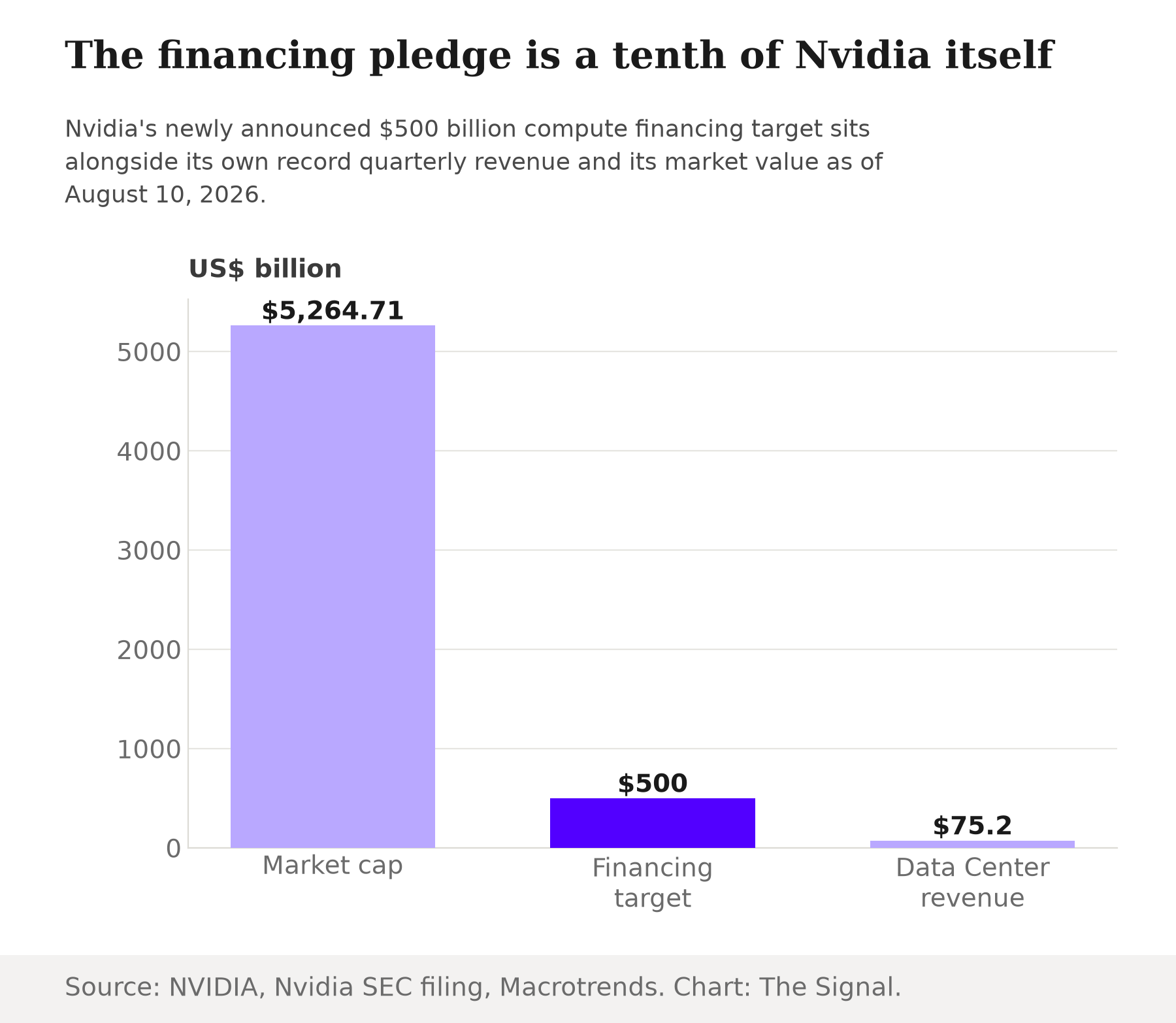
Source: NVIDIA newsroom; Macrotrends; Nvidia SEC filing. Chart: The Signal.
Nvidia has done this before
This is not the first time Nvidia has put its own money behind the customers buying its chips. NVIDIA's newsroom announced on September 22, 2025 that Nvidia agreed to invest up to $100 billion in OpenAI as OpenAI deploys at least 10 gigawatts of Nvidia systems, with the investment paid out progressively as each gigawatt goes live. That deal already tied Nvidia's balance sheet to a single customer's ability to keep building. The August 2026 platforms scale the same logic across the entire AI data center industry, with five asset managers and one bank now standing where OpenAI once stood alone.
What happened the last time a chip vendor financed its own demand
The dot-com telecom buildout ran on the same idea: sell the equipment, help finance the buyer, book the revenue now. Cisco Systems' SEC-filed fiscal 2001 annual report states its reserve against customer lease-financing losses jumped to $896 million by fiscal year-end 2001, from $195 million a year earlier, against $1.55 billion of gross lease receivables, as the customers it had financed began to default. Lucent Technologies' SEC-filed fiscal 2002 annual report states its customer-financing reserves climbed from $604 million to $2,109 million during fiscal year 2001, with $1,787 million charged to expense that year, as the telecom carriers it had financed went bankrupt. Between the two companies, financing-loss reserves grew by just over $3 billion within a single fiscal year, our calculation from the two filings, as the same customers who could not have bought the equipment without vendor credit stopped paying for it.
Cisco and Lucent both absorbed rising customer-financing losses in the same fiscal year.
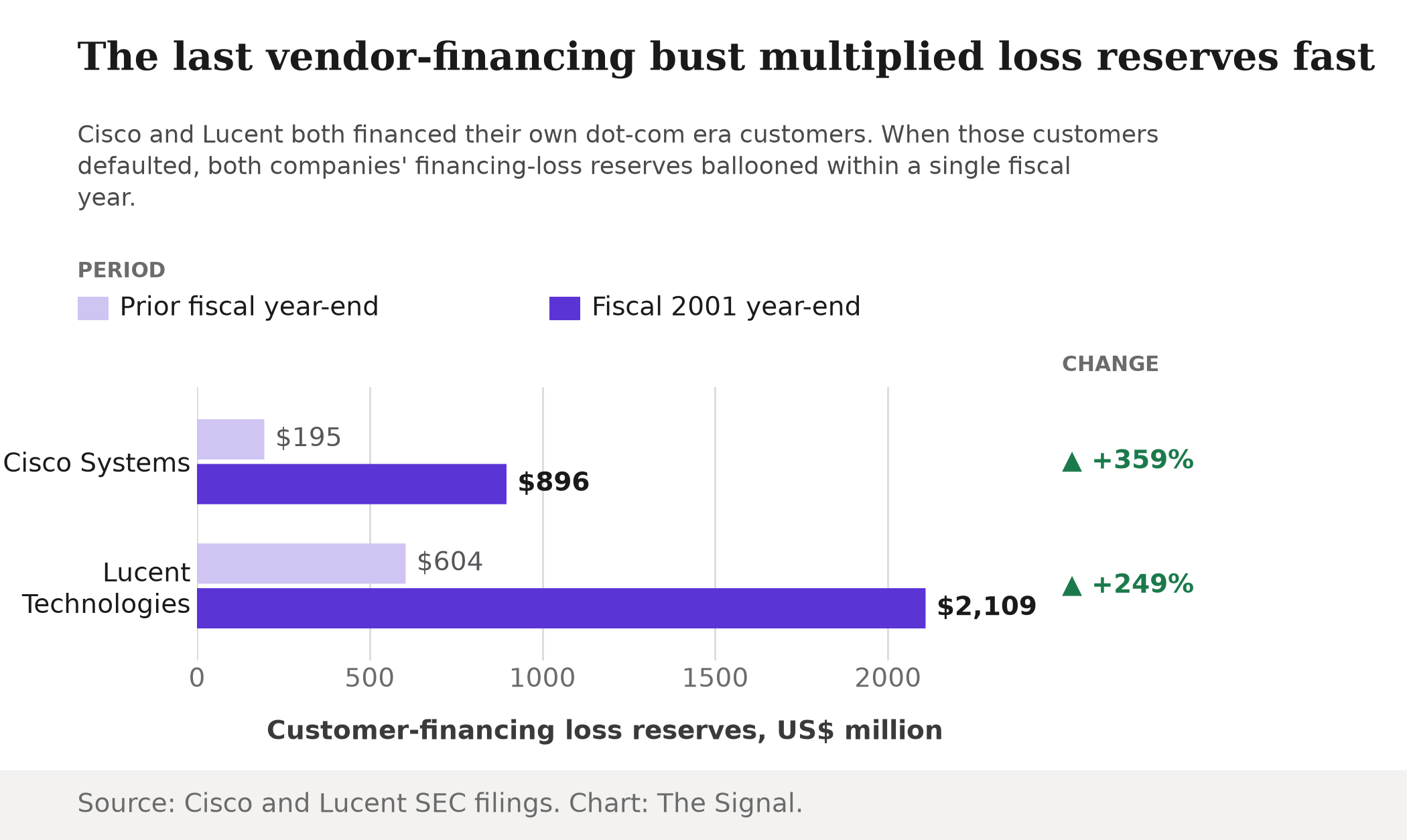
Source: Cisco Systems fiscal 2001 annual report; Lucent Technologies fiscal 2002 annual report. Chart: The Signal.
Neither company was reckless by the standards of 2000. Both were financing real demand from customers building real networks. The problem was not the financing itself; it was that the same downturn that slowed telecom spending also broke the customers Cisco and Lucent had financed, so the vendor absorbed the loss on both sides of the transaction at once.
India has already lived a domestic version of the same trap. A Press Information Bureau release states IL&FS, then India's largest infrastructure financier, was involved in many of the same infrastructure projects it had financed through equity and debt, lending to and investing in the roads, power and water ventures it helped build. That structure worked as a growth engine until it did not: the same government release states IL&FS could not service around ₹91,000 crore in debt, the outcome of mismanaged borrowings, forcing the government to supersede its board in October 2018. The mechanism was the same one that hit Cisco and Lucent: a financier whose own health depended on the success of the projects it financed had no distance left when those projects stopped paying.
The capex this financing sits inside
The AI buildout is larger than Nvidia's deal alone, and the numbers around it are already straining credit analysts. The IEA's Key Questions on Energy and AI report states that the largest technology companies' capital expenditure exceeded $400 billion in 2025 and is expected to jump by another 75% in 2026, driven largely by AI data center buildout. Moody's Ratings goes further: CNBC reports that Moody's, in a July 24, 2026 note, projects Big Tech AI-related capital expenditure will hit $785 billion in 2026 and about $1 trillion in 2027, warning that the sector's circular ecosystem of vendor-to-customer investment is eroding credit quality across the companies involved.
Big Tech's AI capital expenditure is set to keep climbing.
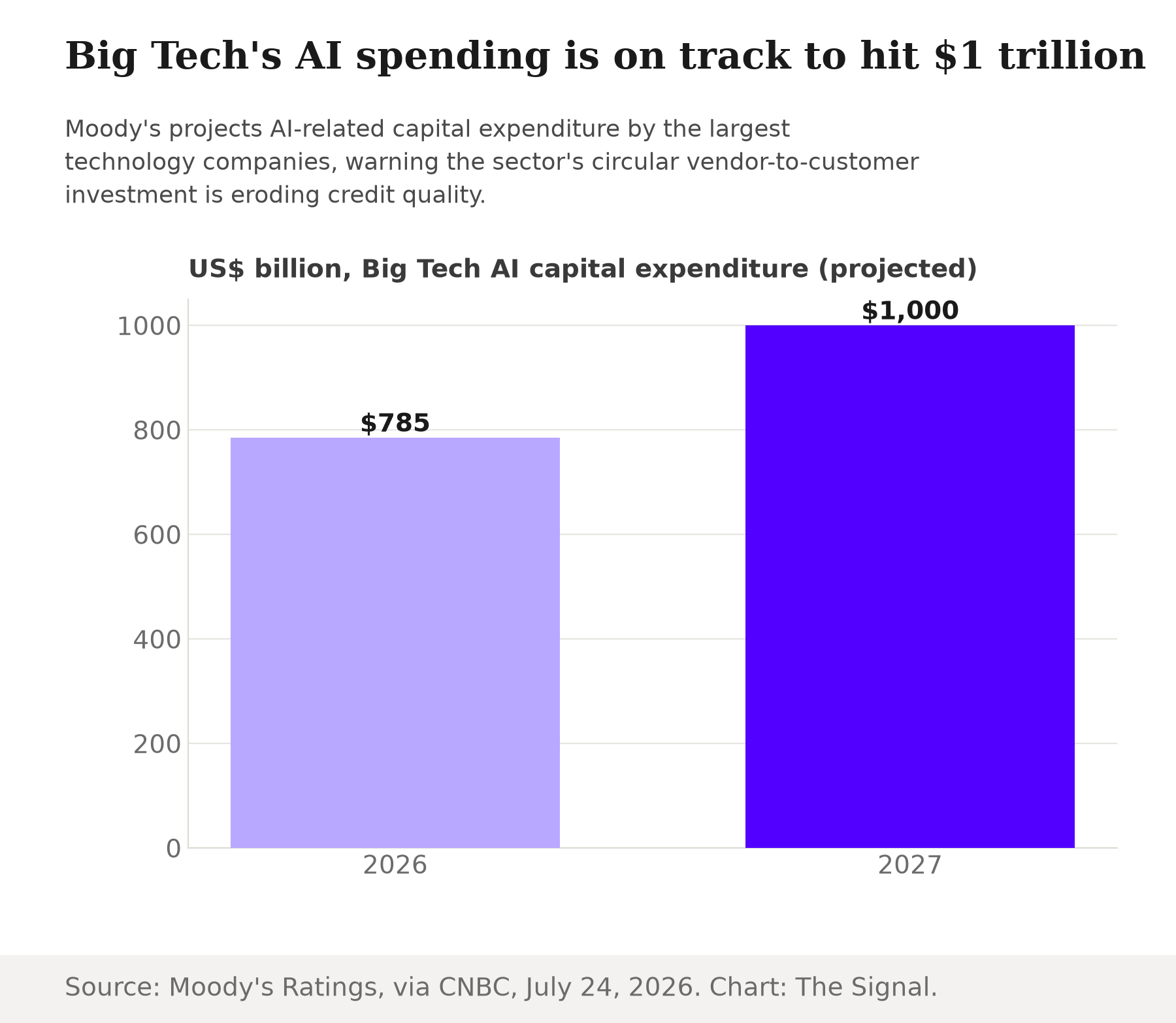
Source: Moody's Ratings, as reported by CNBC. Chart: The Signal.
Nvidia's $500 billion platform is not the whole of that spending. It is the financing layer sitting underneath a capex number that Moody's already projects to grow by more than a quarter in a single year.
The honest objection
The strongest case against calling this circular comes from the people closest to the deal. CNBC reports that Bank of America analyst Vivek Arya described the new platforms as "a pivot away from vendor-financing" that had drawn circularity criticism, in a note to clients the day after the announcement. The logic is real: unlike Cisco and Lucent, Nvidia is not putting its own balance sheet directly on the hook for every customer loan. Apollo, BlackRock, Blackstone, Brookfield, Goldman Sachs and KKR are raising and holding the capital, spreading the credit risk across six large, diversified institutions instead of concentrating it on one chipmaker's books.
That case holds for Nvidia's own balance sheet, and it is the honest reason Wall Street has not treated this as a repeat of 2001. But it does not remove the circularity, it relocates it. The same six firms are now financially exposed to whether the AI data center boom keeps generating revenue, which depends on whether Nvidia keeps selling chips into it. If AI capex growth slows from the pace Moody's and the IEA are both projecting, Nvidia's chip sales and its financing partners' loan books face the same downturn at the same time, just as Cisco's and Lucent's own books did in 2001.
The Signal
Nvidia's financing platforms did not create the AI buildout's dependence on Nvidia chips; they formalized it, and handed a piece of the credit risk to six firms that now need the buildout to keep succeeding as much as Nvidia does. The 2001 comparison is not a prediction that this ends the same way. Cisco and Lucent's customers were themselves under-financed telecom startups; Nvidia's financing partners are diversified institutions, not single points of failure. What carries over is simpler: a vendor's financing arrangement is only as sound as the demand it is financing, and nobody yet knows how much of 2026's AI data center demand would survive Nvidia's 92% year-on-year Data Center growth rate slowing sharply. Watch the next capex season, not this one. That is when the financing gets tested against actual usage, not announcements.
Reporting basis: the August 10, 2026 financing consortium and the September 2025 OpenAI commitment are per NVIDIA's own newsroom announcements. Nvidia's Data Center revenue is per its SEC-filed first-quarter fiscal 2027 earnings release, and its market capitalization is per Macrotrends. The Bank of America analyst note and Moody's Ratings' capital expenditure projections and credit-quality warning are as reported by CNBC, single reports of the respective third-party analyses, not the primary notes themselves. The Cisco Systems and Lucent Technologies financing-reserve figures are from each company's own SEC-filed annual report. The IEA figures are from its Key Questions on Energy and AI report. The annualized Data Center run rate and the combined Cisco-Lucent reserve growth are The Signal's calculations from those figures.