LiveLaw reports that the Bombay High Court granted Nitin Gadkari leave, on July 27, 2026, to sue Meta, X Corp and Google directly over AI deepfakes and defamatory posts that tied the Union minister to the rollout of E20 petrol. The order proceeds under Clause XII of the Letters Patent, a procedural step required because part of the cause of action sits outside the court's territorial jurisdiction. It is the kind of order that lets an Indian court reach three of the world's largest platforms at once. The surface read is straightforward: a sitting minister was defamed by synthetic video, and he is suing the companies that hosted it. That is a normal, defensible thing for anyone to do.
It is worth slowing down on which tool he reached for. Five months earlier, Gadkari's own government had already rebuilt the fast lane for content exactly like this.
The machine built for exactly this case
MeitY's February 2026 amendment to the IT Rules cut the mandatory window for a platform to act on a court order or a government notification flagging unlawful content from 36 hours to 3, attributed to MeitY's own consolidated text of the Intermediary Guidelines.
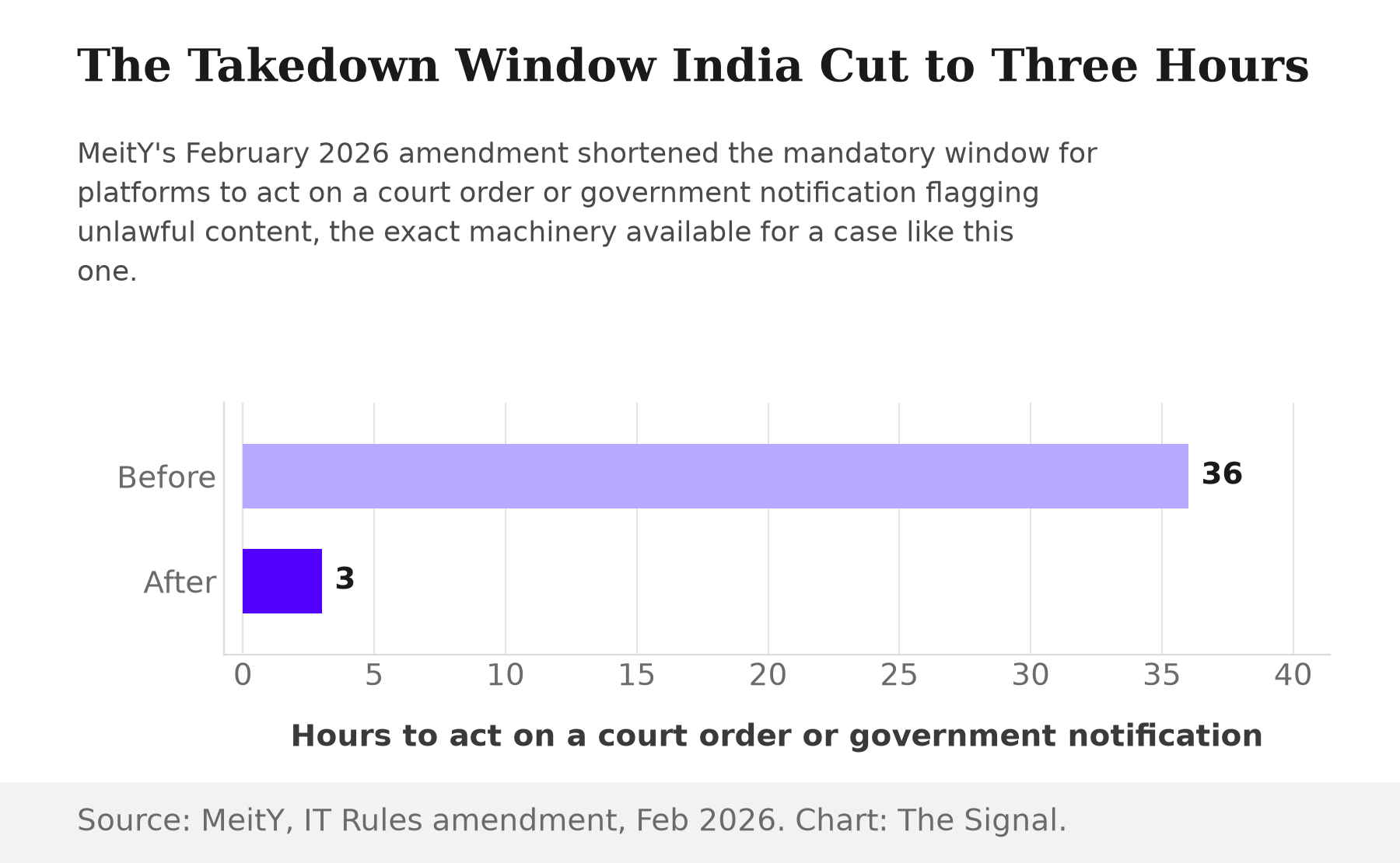
Source: MeitY's consolidated Intermediary Guidelines, February 2026 amendment. Chart: The Signal.
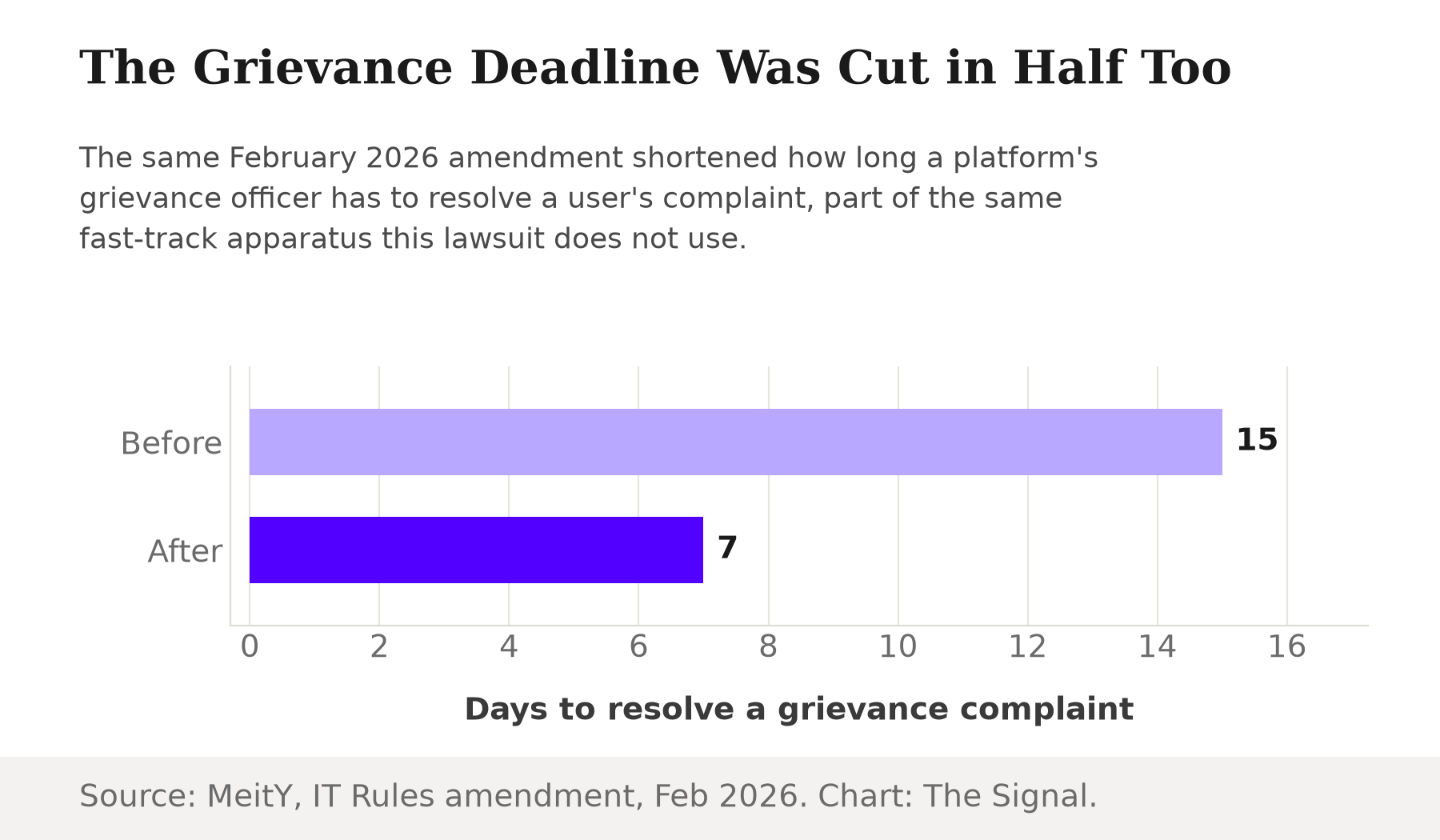
Source: MeitY's consolidated Intermediary Guidelines, February 2026 amendment. Chart: The Signal.
If a user is unhappy with how a platform's grievance officer rules, the IT Rules also built an appeal layer above it. The central government has established three Grievance Appellate Committees, the online appeal mechanism the rules created for a user unhappy with a platform's decision, per the GAC secretariat's own FAQ page. That count is current as of January 2023 and unchanged in every later reference to it. And the apparatus was still being extended toward this exact category of harm in 2025: MeitY's October 2025 draft amendment proposed that a label on synthetically generated content must cover at least 10 percent of a visual display's surface area, or the first 10 percent of an audio clip's duration. It is a rule aimed squarely at deepfakes, though it remained a proposal, not a finalized rule, as of that October 2025 draft.
Put together, that is a three-hour clock, a seven-day backstop, a national appeals body and a labeling regime under active construction, all pointed at the exact harm Gadkari says he suffered. None of it appears in the public record of this case. What appears instead is a High Court petition under a colonial-era procedural clause.
Three tracks, one dispute
The E20 backlash is actually running down three separate legal tracks, and Gadkari picked the one that does not touch the takedown machinery at all.
Only one of the three tracks in the E20 dispute takes the platforms to court as defendants.
| Track | Who it targets | Legal basis | Reach |
|---|---|---|---|
| Criminal FIR | Four influencers, including YouTuber Manish Kashyap | Nagpur City Cyber Police case | Domestic, named individuals only |
| IT Rules takedown | Meta, Google, X and other intermediaries | Court order or government notification, 3-hour compliance window | One piece of content per notice |
| Bombay HC civil suit | Meta, X Corp and Google, as defendants | Leave under Clause XII of the Letters Patent | The platforms' own conduct, extraterritorial |
Sources: The Federal on the Nagpur FIR; MeitY's Intermediary Guidelines on the takedown window; LiveLaw on the Bombay High Court order.
Nagpur City Cyber Police registered a case against four social media influencers, including Manish Kashyap, accusing them of spreading misinformation about E20 fuel to defame Gadkari by linking his name to alleged fraud without evidence, The Federal reports. That track reaches the people accused of posting the videos. It does not reach the platforms that hosted and spread them, which is what the takedown rule and the civil suit are both, in different ways, built for.
The difference between those two remaining tracks is what each can actually produce. A takedown notice under the 3-hour rule erases one video from one platform. Leave to sue under Clause XII of the Letters Patent gives an Indian court a basis to hear a case against Meta, X Corp and Google themselves, as defendants, not as intermediaries responding to a notice. One cleans up a post; the other, if it proceeds, argues with the company itself.
What the deepfakes are actually about
The dispute sits on top of a real number, not an imaginary one. India hit 20 percent ethanol blending in petrol in 2025, five years ahead of the original 2030 target, Akashvani News quotes Union Minister for Petroleum and Natural Gas Hardeep Singh Puri as saying. That is a genuine, ahead-of-schedule policy result, and it belongs to the Petroleum Ministry, not the Road Transport Ministry that Gadkari runs. The videos at the center of this case attach a Road Transport minister's face to a fuel-blending program run by a different ministry entirely, which is a small but telling sign of what disinformation-shaped content usually looks like: it borrows a recognizable name and grafts it onto a program the accusation does not actually require him to have any authority over.
The honest objection
There is a real case for why a minister would avoid his own government's fast lane for a personal defamation dispute, even one built for exactly this content. Triggering a government notification to force platforms into the 3-hour response window looks, at a minimum, like using state machinery to manage a minister's own reputation, precisely the kind of executive overreach critics of the takedown regime already warn about. A court order carries no such appearance problem. It is issued by an independent judge, not the ministry the content criticizes. And the appeal route tops out at three Grievance Appellate Committees for the entire country's user base, which is not obviously built for a fast, high-profile political dispute either.
That case is real, and it may be the whole explanation. But it sits oddly next to one plain fact: the 3-hour notification route exists precisely so the government does not need a private citizen, minister included, to trigger it. A government notification does not require Gadkari personally to file anything in court. Nothing in the public record shows one was issued in this dispute.
The Signal
The lawsuit will take years and Indian courts are not fast. The more immediate test is smaller and closer to home: does MeitY's own 3-hour clock, or the national appeals body it built, ever surface in this case at all, alongside the litigation, as a parallel track rather than a road not taken? If it does, the machinery works, and the lawsuit is simply the tool for the harm a takedown notice cannot reach; if it never does, the fast lane India built for content like this turns out to be one the government itself does not drive, not when the content is about one of its own. A rule that outruns the courts only means something if the people who wrote it are willing to use it on themselves.
Reporting basis: the mandatory takedown and grievance-resolution windows are from MeitY's own consolidated text of the Intermediary Guidelines, reflecting the February 2026 amendment. The draft synthetic-content labeling rule is from MeitY's October 2025 explanatory note on the proposed amendment, which had not been finalized as of that date. The ethanol-blending figure is per Akashvani News (All India Radio), quoting Union Minister Hardeep Singh Puri. The Grievance Appellate Committee count is from the GAC secretariat's own FAQ page, current as of January 2023. The Bombay High Court order and its procedural basis are per LiveLaw's reporting. The Nagpur Cyber Police case against the four influencers is per The Federal. No figure in this piece is a Signal calculation.