On July 24, 2026, the Delhi High Court declined Asian News International's request to stop OpenAI from training ChatGPT on the news agency's copyrighted output, letting the underlying suit continue without an interim block. The ruling is the first substantive court finding in India on whether AI companies can train large language models on copyrighted news without a licence, a question also being fought out in similar suits against OpenAI in the United States and Canada, Reuters reports. Read one way, this is India joining a queue of jurisdictions where an AI company has beaten back a publisher's claim.
It is worth slowing down on that comparison. Of the four places fighting the same underlying question, India is the one where a court has actually ruled on the substance of it so far. And the reasoning it used had almost nothing to do with copyright doctrine alone.
India is OpenAI's second-largest market, with 100 million weekly active ChatGPT users as of February 2026, TechCrunch reports, citing Sam Altman. That scale is not a side detail. It is the practical weight behind the court's finding that an interim injunction would cause irreparable injury not only to OpenAI but to the public at large, with the balance of convenience favouring OpenAI, LiveLaw reports. A court did not just rule that training on news content is lawful. It ruled that a product with this many domestic users is now hard to enjoin on a publisher's request alone, before a trial has even happened.
What the court actually decided
Justice Amit Bansal held that OpenAI's use of ANI's content to train ChatGPT falls under the fair-dealing provision of Section 52(1)(a) of India's Copyright Act, and does not amount to infringement under Section 51, Bar and Bench reports. That is narrower than "AI training is legal in India": ANI failed to show harm severe enough to justify blocking OpenAI before trial, on top of failing to show the use falls outside fair dealing.
The case itself predates ChatGPT's current scale in India by well over a year. ANI filed a 287-page suit against OpenAI on November 18, 2024, alleging OpenAI illegally used its content to train its AI models and that ChatGPT generated false information attributed to the news agency, TechCrunch reports. ANI is seeking Rs 2 crore in damages, alongside an injunction and deletion of its content from OpenAI's training data, per Mondaq. The Digital News Publishers Association, representing several Indian digital publishers, intervened on January 28, 2025, arguing that large language models including ChatGPT were trained on large volumes of copyrighted text without licences or permission, Tech Policy Press reports. The suit continues; only ANI's bid to freeze OpenAI's training pending that outcome ended on July 24.
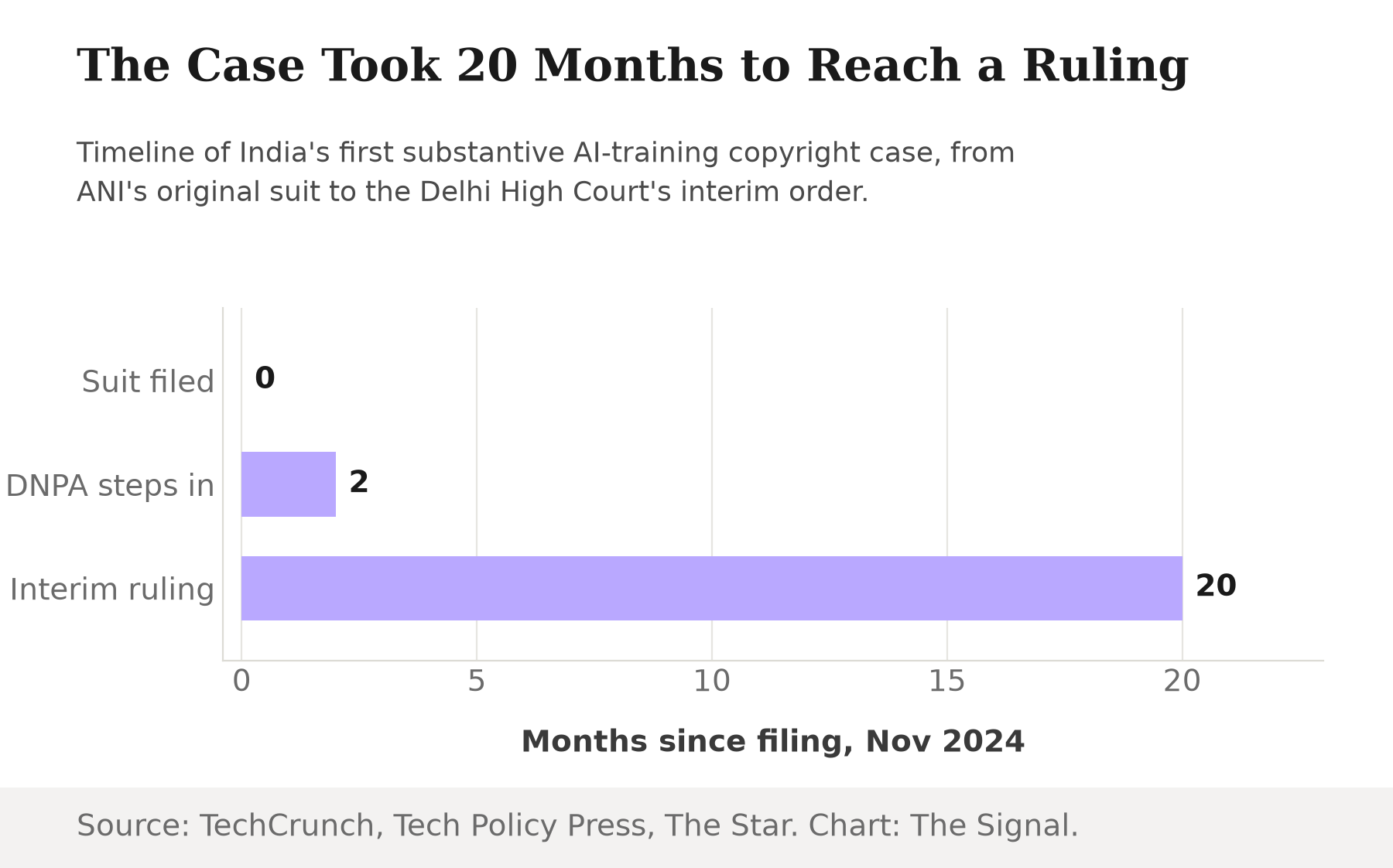
Source: TechCrunch; Tech Policy Press; The Star, citing Reuters. Elapsed months are The Signal's calculation. Chart: The Signal.
The scale argument
This is the part that does not fit the "OpenAI wins again" reading. The court was not just applying a copyright exception, it was weighing a publisher's request against the interests of a userbase bigger than the population of nearly every country on earth. That argument is different from the doctrinal question of fair dealing, and it only gets stronger for OpenAI as its Indian user base keeps expanding. A platform's scale, once large enough, becomes evidence in its own defence: the more embedded a product is in daily use, the harder it gets for any single plaintiff to argue that stopping it, even temporarily, serves the public interest.
That argument has not had to run its course anywhere else, because no other court has reached this stage yet.
Where the same fight stands elsewhere
India is currently the one jurisdiction with a substantive ruling on AI-training copyright; the US and Canada are still at earlier procedural stages.
| Jurisdiction | Forum and case | Latest development | Date |
|---|---|---|---|
| India | Delhi High Court, ANI v. OpenAI | Interim injunction declined; training held to be fair dealing under Section 52(1)(a) | July 24, 2026 |
| United States | Federal court, NYT-led suit v. OpenAI and Microsoft | Judge ordered production of 20 million de-identified ChatGPT logs; fair use undecided | January 7, 2026 |
| Canada | Ontario Superior Court, five news organizations v. OpenAI | Cleared to proceed on jurisdiction grounds; copyright merits undecided | November 7, 2025 |
| European Union | EU AI Act, Article 53 | General-purpose AI providers must honour publishers' opt-outs from the text-and-data-mining exception | December 2025 |
Source: The Star, citing Reuters; ABA Journal; Global News; European Commission.
The consolidated New York Times-led case against OpenAI and Microsoft remains in discovery, with no ruling yet on fair use; a federal judge affirmed on January 7, 2026 that OpenAI must produce 20 million de-identified ChatGPT logs to plaintiffs, the ABA Journal reports. An Ontario Superior Court of Justice ruling on November 7, 2025 allowed a copyright suit against OpenAI brought by five Canadian news organizations to proceed on jurisdiction grounds, a procedural win that left the copyright merits undecided, Global News reports. Neither case has reached the question India's court just answered.
The European Union has not waited for a ruling to set its own baseline. Under Article 53 of the EU AI Act, general-purpose AI providers must maintain a policy to identify and comply with copyright holders' opt-outs from the EU's text-and-data-mining exception, the European Commission's Digital Strategy site states, a more publisher-protective baseline than India's fair-dealing finding, set by regulation rather than case law. The OECD's AI Policy Observatory notes that existing intellectual-property laws, many of which predate modern AI, differ across jurisdictions in how they treat systems trained on scraped copyrighted data, which is exactly what this comparison shows: four legal systems, one shared question, and no convergence yet on the answer.
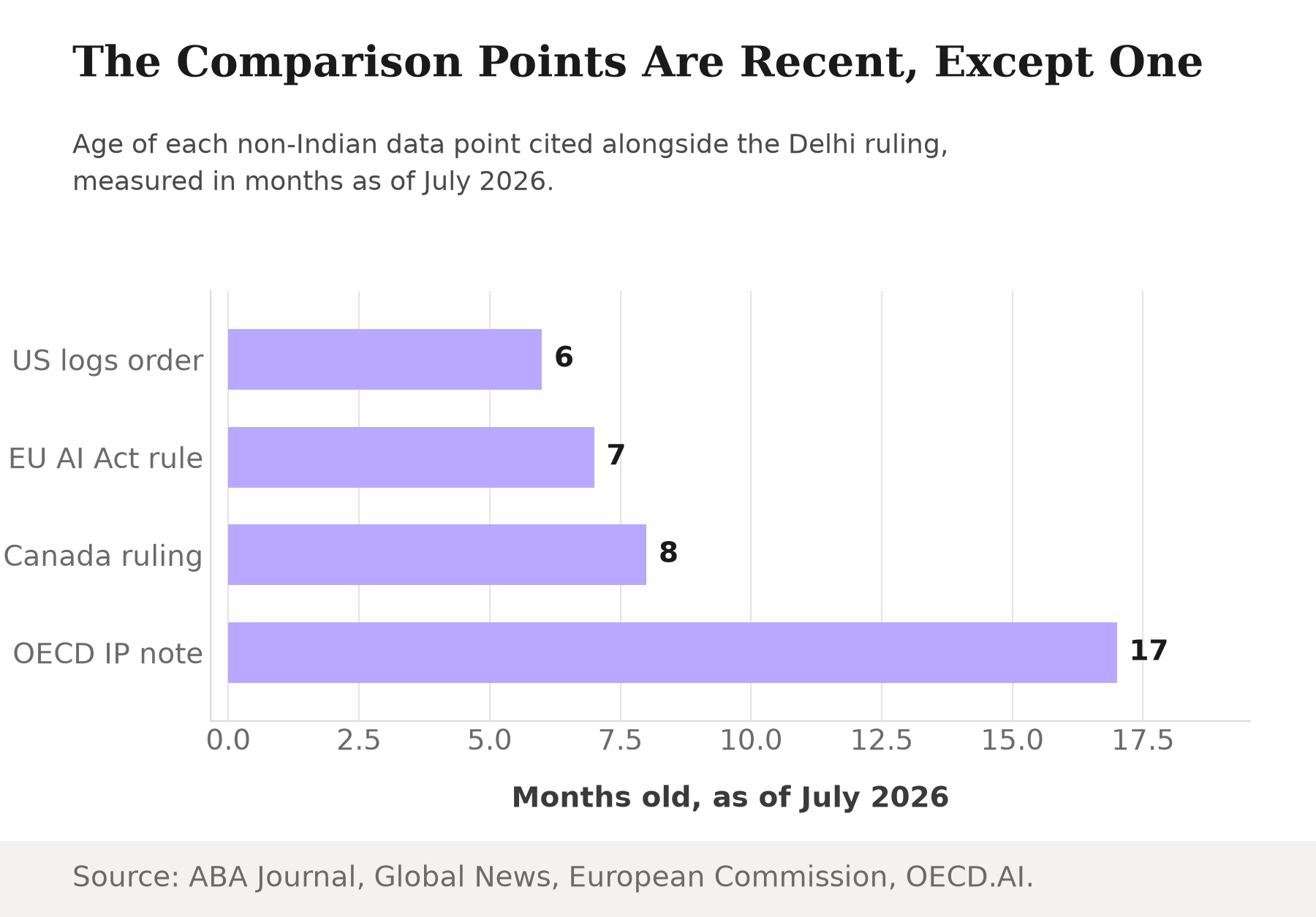
Source: ABA Journal; European Commission; Global News; OECD AI Policy Observatory. Ages in months are The Signal's calculation. Chart: The Signal.
Nearly all of what this comparison rests on is recent. The US and Canadian developments are both under nine months old, and the EU's compliance guidance is from December 2025. The OECD's note on diverging IP law is dated February 2025 and sits apart from the rest: it is included here as general background on how unsettled the law is worldwide, not as a live ruling.
The honest objection
The strongest case against reading too much into this ruling is that it settles nothing yet. It is an interim order, not a final adjudication. ANI's suit continues, and DNPA's member publishers remain parties to it. A trial court, or an appellate bench, could still hold that fair dealing does not stretch to cover commercial-scale AI training, whatever one interim ruling decided on injunctive relief. Publishers can reasonably argue that Section 52(1)(a) was written for narrow purposes like research and review, not wholesale ingestion of a newswire's output into a commercial product, and that one judge's interim view should not be mistaken for the law's final word.
That case is real, but it undersells what actually happened on July 24. The court did not deny the injunction on a technicality. It cleared two separate hurdles against ANI: the fair-dealing finding under Section 52(1)(a), and the independent finding that blocking OpenAI would harm the public at large. ANI now has to overturn both at trial. And whatever happens next in this specific suit, India remains alone among these four jurisdictions in having a court weigh these arguments on the record.
The Signal
The headline event here is not that OpenAI won. It is that a court, before any other court in this fight had to answer the same question, treated the size of an AI product's domestic audience as a reason to let it keep operating while a publisher's claim works through the system. The EU has chosen to protect publishers by rule, regardless of how large an AI platform gets. India's court, faced with the same underlying question, effectively let the platform's own scale argue on its behalf. Watch what happens as ChatGPT's Indian user base keeps expanding past the 100 million weekly users it already had in February 2026: the bigger that number gets, the harder any future Indian plaintiff's injunction request becomes. A newswire went to court over how its words were used. The court that heard it ended up ruling on how many people were listening.
Reporting basis: the Delhi High Court's ruling and its "first substantive finding" framing are per Reuters, as carried by The Star; the fair-dealing holding under Section 52(1)(a) is per Bar and Bench, and the public-interest and balance-of-convenience holding is per LiveLaw, two independent Indian legal-news origins covering different parts of the same July 24, 2026 order. ANI's original 2024 suit and its allegations are per TechCrunch's initial coverage; the damages figure is per Mondaq; the Digital News Publishers Association's intervention is per Tech Policy Press. India's ChatGPT user count is per TechCrunch, citing OpenAI chief executive Sam Altman. The US discovery-stage order is per the ABA Journal; the Canadian jurisdiction ruling is per Global News; the EU's Article 53 compliance obligation is per the European Commission's own Digital Strategy site; and the note on diverging global IP law is per the OECD's AI Policy Observatory. The elapsed-time figures in both charts, the case timeline and the age of each comparison point, are The Signal's own calculations from the dates each of those sources gave.