AMD spent this week's headlines the way a chipmaker in an AI boom is supposed to: with a very large number. AMD's investor-relations release announced a strategic partnership for Anthropic to deploy up to 2 gigawatts of AMD Instinct MI450 Series GPUs, alongside an AMD equity investment of up to $5 billion in Anthropic. Coverage read it as the latest entry in a familiar ledger: another lab, another multi-gigawatt chip order, another sign the compute build-out has no ceiling. That framing is not wrong. It is also not the number that matters.
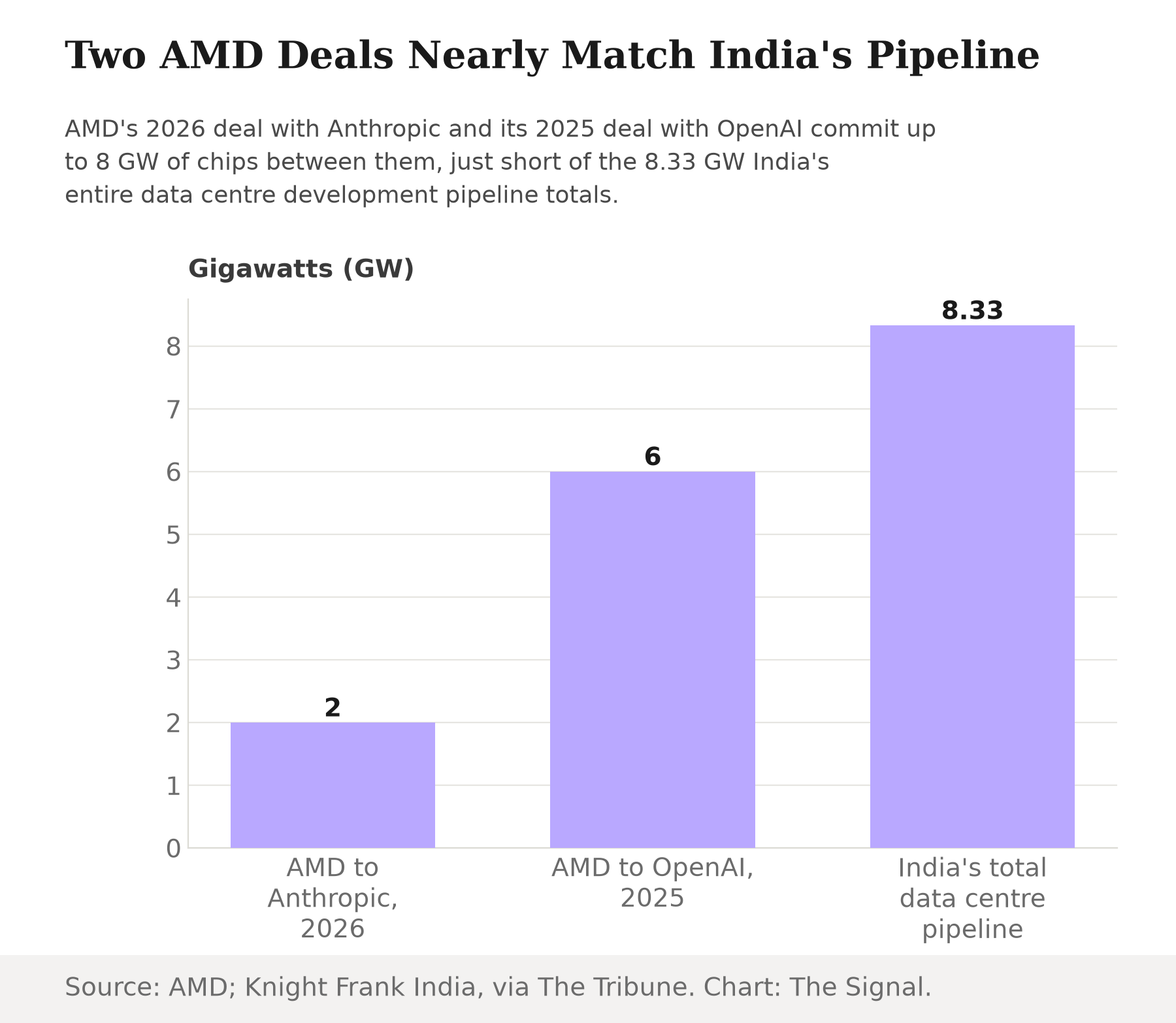
This was not AMD's first deal of this size. AMD's newsroom announced in October 2025 that OpenAI would deploy 6 gigawatts of AMD GPUs under a multi-year, multi-generation agreement, expected to deliver tens of billions of dollars in revenue for AMD. Add the two together and one company has committed up to 8 GW of chip capacity to two customers in ten months. That number does not stay inside the AI industry's own frame of reference. It reaches into India's.
Two AMD chip deals now sit within a whisker of India's entire data centre pipeline.
Knight Frank India's most recent industry report, carried by The Tribune, puts India's total data-centre development pipeline, across every operator and every kind of workload, at 8.33 GW as of that June 2026 report. AMD's Anthropic and OpenAI deals combined come to 8 GW, which by our calculation is 96 percent of that figure. One American chipmaker's contracted capacity for two customers is now within a whisker of matching everything India's data centre industry has under construction or on the drawing board.
Source: AMD; Knight Frank India, via The Tribune. Chart: The Signal.
One deal alone beats what India has built
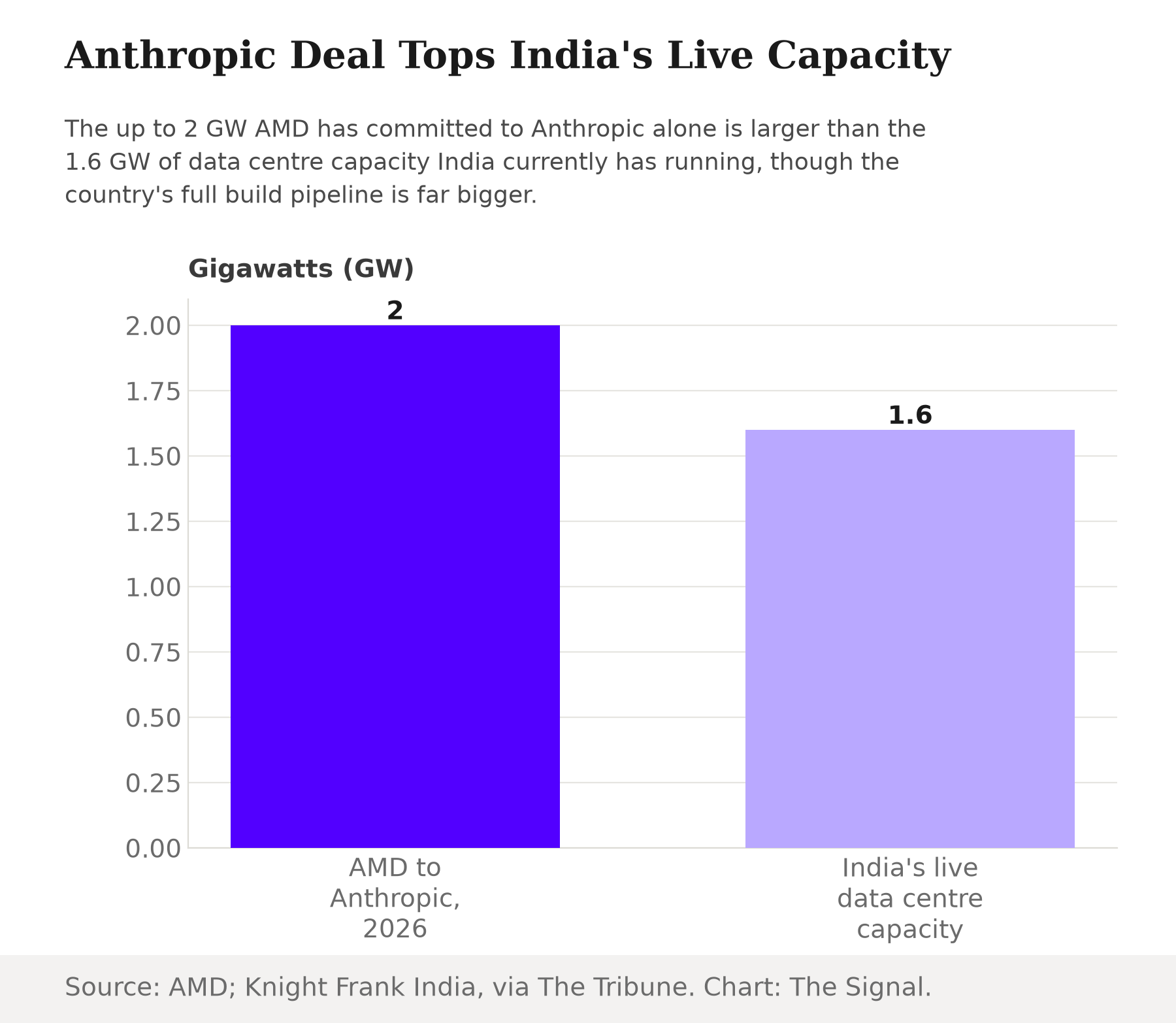
The comparison gets sharper before it gets fairer. India's 8.33 GW pipeline is what is planned or under construction, not what is running today. The same Knight Frank report puts India's current live, operational data centre capacity at 1.6 GW, about a fifth of the pipeline. Set the Anthropic deal alone against that number, and the up to 2 GW AMD has committed to a single lab already exceeds everything India's data centre sector, across banking, telecom, cloud and AI combined, currently has switched on.
Source: AMD; Knight Frank India, via The Tribune. Chart: The Signal.
That is not a knock on India's build-out, which is real and accelerating. The Ministry of Electronics and IT told the Rajya Sabha that the country's total data centre capacity grew from about 375 MW in 2020 to around 1,500 MW by 2025, and that the Ministry of Power estimates electricity demand from data centres will reach 13.56 GW by 2031-32. That is a four-fold expansion in five years, with a steeper climb projected for the next six, the kind of capacity two contracts inked by one chipmaker approach in under a year.
Capital was never the constraint
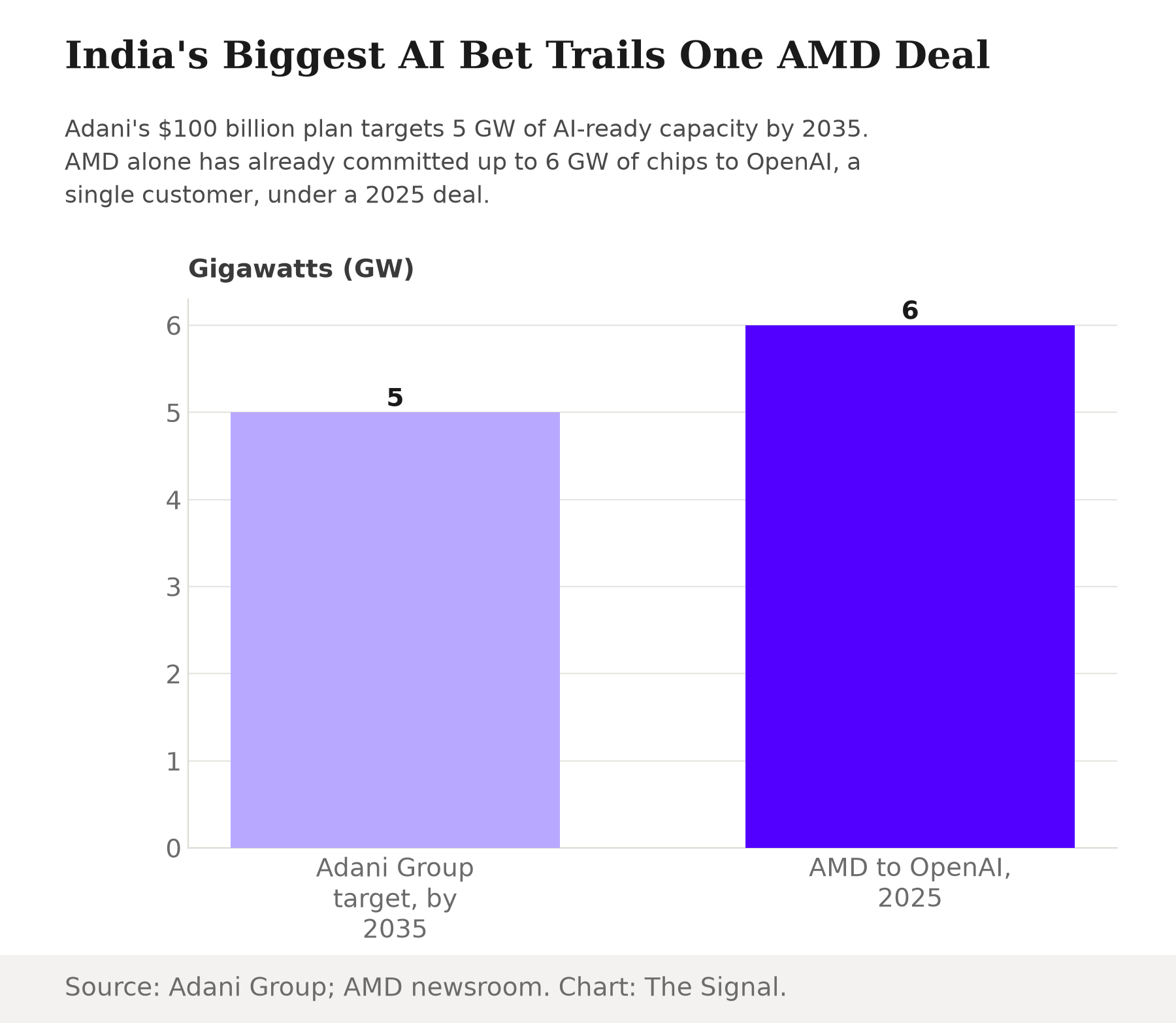
The instinct is to assume India's gap is a money problem, and Indian capital is trying to close it. Adani Group's newsroom states the conglomerate has committed USD 100 billion to build green-energy-powered, AI-ready data centre capacity by 2035, building on AdaniConnex's existing 2 GW national data centre platform toward a 5 GW target. That is India's single largest domestic bet on AI infrastructure, backed by one of the country's biggest conglomerates, aimed at a decade out. Even that 5 GW target trails the 6 GW AMD has already signed away to OpenAI alone.
Source: Adani Group; AMD. Chart: The Signal.
That gap is not about who can raise capital. A $100 billion commitment is not a small number by any measure. It is the difference between what one lab customer can contract for in a single announcement and what a national industry plans to build over a decade. Capital scales in large check sizes. National infrastructure does not.
The power behind the pipeline
If money is not the constraint, the honest next question is whether India can even generate the electricity a bigger pipeline would need. Here the picture is less bleak than the chip math suggests. The Ministry of New and Renewable Energy reports that India's total installed renewable energy capacity reached 220.10 GW as of 31 March 2025, against a national target of 500 GW of non-fossil capacity by 2030. That is a generation base roughly 27 times the size of AMD's combined Anthropic and OpenAI commitments, still growing toward more than double its current size within four years.
The constraint, in other words, is not raw national generating capacity. It is how much of that capacity gets sited, connected and allocated to data centres, on the timelines AI labs now expect. A chip order can be signed in a press release. A substation and a grid connection cannot.
The honest objection
The strongest case against this comparison is that gigawatts of chip deployment and gigawatts of data centre pipeline are not the same measure. AMD's own figures for Anthropic (2 GW) and OpenAI (6 GW) are ceilings on deployable chip capacity across multiple years, some of which may slip; India's 8.33 GW pipeline spans every industry that runs a server, not AI workloads alone. Comparing a corporate chip order to a national construction pipeline risks comparing two different kinds of number simply because they share a unit.
That case is real, and it is why this piece treats AMD's combined commitment against India's pipeline total as a scale comparison, not an equivalence. But it does not explain away the order of magnitude: even discounted for slippage and non-AI workloads, a single chipmaker's two-customer order book sitting within single digits of an entire country's data centre pipeline is a genuine, checkable gap, not an artifact of loose units.
The Signal
The AMD-Anthropic deal was covered as a story about compute. The more useful reading is about power. When one company can contract for capacity approaching what a G20 economy has in its entire data centre pipeline, and that economy's biggest private infrastructure bet still trails a single chip order, the limiting factor stops being who can write the check. Adani's $100 billion answers the capital question. India's renewable base answers the generation question. What is left is allocation: how fast power gets earmarked and connected to the specific sites AI compute needs, on AI's timeline rather than infrastructure's usual one. That is the lever India's policymakers actually control, and the one this deal just made harder to ignore.
Reporting basis: the AMD-Anthropic and AMD-OpenAI deal terms are per AMD's own investor-relations and newsroom releases, the origin for both. India's pipeline and live capacity figures come from a Knight Frank India report, as carried by The Tribune, the sole source for both numbers. India's capacity growth and the 2031-32 demand projection are per the Ministry of Electronics and IT's reply to the Rajya Sabha, via a Press Information Bureau release citing Ministry of Power estimates. India's renewable capacity and 2030 target are per the Ministry of New and Renewable Energy, via a separate Press Information Bureau release. Adani Group's investment and data centre targets are per the company's own newsroom announcement. The 8 GW combined AMD figure, its 96 percent share of India's pipeline, the four-fold data centre capacity growth from 2020 to 2025, and the renewable-capacity multiple are The Signal's calculations from those figures.