
OnePlus confirmed on July 16, 2026 that it will stop launching new phones in North America and Europe, folding the move into what it called a global strategy adjustment while promising to keep software updates, security patches, warranty coverage and after-sales support running for people who already own its phones. It is not a hard sign-off, and the market it is leaving was never a large one for the brand: TechCrunch, citing Counterpoint Research, reported that OnePlus's US shipment share had already fallen below 1 percent in 2025. Read only that far, the story writes itself: a brand that never broke through in the West is finally admitting it and pulling back to where it actually has scale.
It is worth slowing down on that framing. Bloomberg reported that OnePlus's own plan reaches further than North America and Europe: an eventual exit from the rest of the world, including India, sometime in 2027, while the brand stays active in China for now. India is not the rounding error the US shipment number makes OnePlus's global position look like. Smartphones were India's single largest exported product in calendar year 2025, worth $30.13 billion, as the country became the world's second-largest mobile manufacturing base, the Ministry of Electronics and Information Technology reported. A company quietly leaving a market where it barely existed is a tidy story. A company on an eventual clock to leave the market that anchors India's own phone-manufacturing ambitions is a different one.
Its Steepest Fall Was in Its Best Market
The number that actually carries this story is not from the West. Outlook Business reported that OnePlus's share of India's premium smartphone segment fell from 3.9 percent in 2024 to about 2.4 percent in 2025, a 38.8 percent drop, the steepest decline of any brand in 2025. That slide happened in India, the market OnePlus has not been confirmed to be leaving, and it happened before Bloomberg's 2027 timeline was even reported. The Western exit explains itself in one sentence. The India numbers do not.
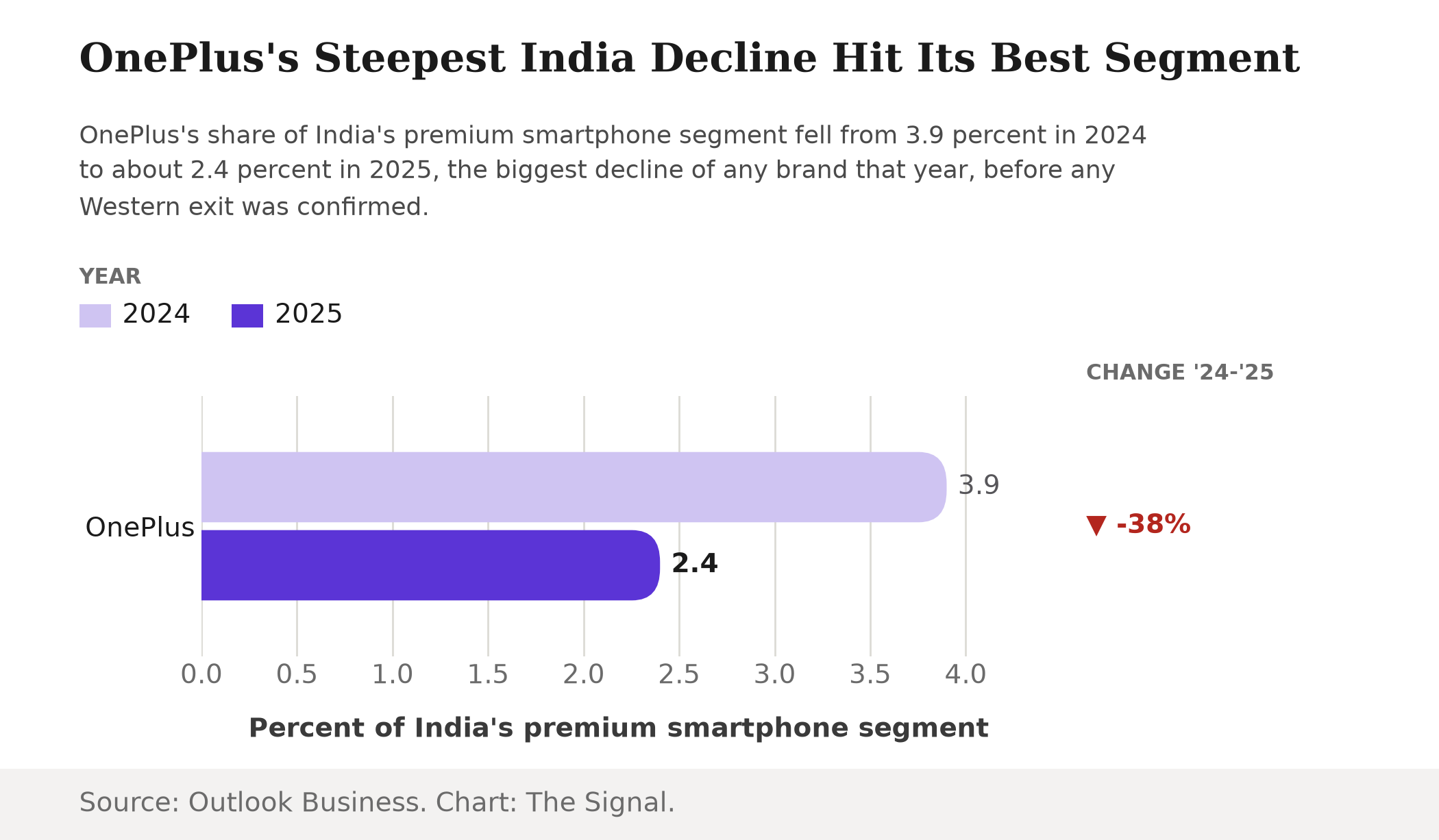
Source: Outlook Business. Chart: The Signal.
That was not the market dragging every brand down together. Omdia's data, reported by GSMArena, show India's overall smartphone market totaled 154.2 million units in 2025, a 1 percent decline from 2024. A market that barely moved does not explain a single brand losing more than a third of its position in its own best-margin segment. Something specific to OnePlus is happening inside a market that, in aggregate, held roughly steady.
China Isn't the Safety Valve Either
The "for now" in Bloomberg's reporting matters, because the market OnePlus is staying in is not exactly stable ground to retreat to. IDC reported that China's smartphone shipments fell 4.3 percent year on year to roughly 66 million units in the second quarter of 2026, the fifth straight quarterly decline, as rising memory-chip costs pushed vendors to raise prices. The market OnePlus has not left is shrinking for reasons that have nothing to do with OnePlus and everything to do with component costs across the whole industry.
Every market in OnePlus's recent numbers points the same way.
| Market | What happened | Period |
|---|---|---|
| United States | Shipment share fell below 1 percent | 2025 |
| India, premium segment | OnePlus's share fell from 3.9% to about 2.4%, the sharpest drop of any brand | 2024 to 2025 |
| India, overall market | Total smartphone sales fell 1%, to 154.2 million units | 2025 |
| China | Shipments fell 4.3% year on year, to about 66 million units, a fifth straight quarterly decline | Q2 2026 |
Source: TechCrunch, citing Counterpoint Research; Outlook Business; GSMArena, citing Omdia; IDC.
India Is Building for Whoever Shows Up
None of this is slowing India's own bet on phones. The Union Cabinet approved a Rs 62,500 crore Mobile Phone Manufacturing Scheme on the same day, July 16, 2026, running from FY2026-27 to FY2030-31 and targeting cumulative mobile phone production of about Rs 39 lakh crore. Converted to the same unit, that is roughly a 1-to-62 ratio between what the government is spending and what it wants the scheme to produce, by The Signal's calculation from those two figures.
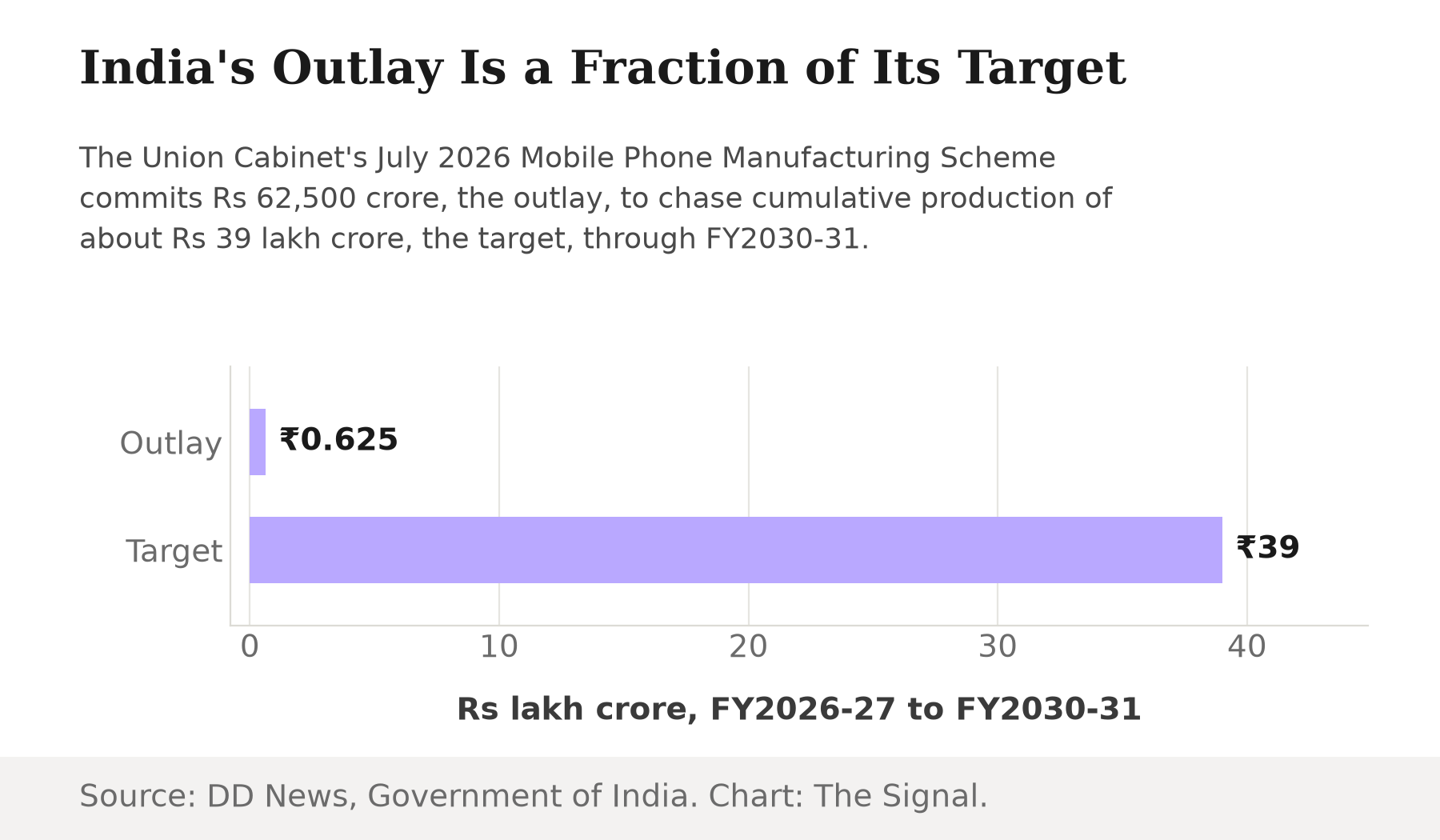
Source: Union Cabinet, via DD News. Conversion to a common unit is The Signal's calculation. Chart: The Signal.
The scheme does not name OnePlus, or any single brand. It is a bet on India's phone-manufacturing base as a whole, not on any one company's fortunes there. Brands still expanding capacity in India stand to benefit from that money; a brand shedding premium share two years running is not the one a production-linked scheme is designed to reward.
The honest objection
The strongest case against reading OnePlus's India numbers as an early warning is that the West exit has not been extended to India, or even fixed to a date. Bloomberg's own reporting describes an eventual exit, not a scheduled one, and pairs it with OnePlus staying active in China for now, which is a company choosing where to keep investing, not one in flight everywhere at once. On that reading, the India premium-share slide Outlook Business documented is a company-specific stumble, tied to a weak product cycle or pricing, not the leading edge of a wider retreat, and treating a 2027 report as a fixed exit date overstates what is actually confirmed.
That case holds for the timeline. It does not hold for the trend. Whatever the eventual date on any India exit, the erosion in OnePlus's best-margin segment already happened, before the West wind-down was even public. A confirmed exit date would make the risk explicit. Its absence does not make the risk disappear.
The Signal
OnePlus's Western retreat is the easy headline because a shipment share under 1 percent is easy to explain away. The harder number sits in India, where OnePlus lost more premium-segment ground than any other brand in 2025, in the one market it was supposed to be able to keep. Watch two things from here: whether that India premium share keeps falling through the rest of 2026, and whether the money behind the Cabinet's new manufacturing scheme follows the brands still gaining share rather than the one already sliding. A market a company has not officially left can still be a market it is quietly losing.
Reporting basis: the July 16, 2026 confirmation that OnePlus will stop new product rollouts in North America and Europe is per Business Today. The 2027 rest-of-world exit plan, and OnePlus remaining active in China for now, is per Bloomberg News, as reported by Digital Trends. OnePlus's sub-1-percent 2025 US shipment share is per Counterpoint Research, as reported by TechCrunch. Smartphones' status as India's top 2025 export category, and India's rank as the world's second-largest mobile manufacturer, are per the Ministry of Electronics and Information Technology, via the Press Information Bureau. The Rs 62,500 crore Mobile Phone Manufacturing Scheme and its production target are per the Union Cabinet, as reported by DD News. India's 2025 total smartphone market size and its 1 percent year-on-year decline are per Omdia, as reported by GSMArena. OnePlus's India premium-segment share and its 38.8 percent decline are per Outlook Business, the only source for that figure. China's second-quarter 2026 shipment decline is per IDC. The outlay-to-target ratio in the manufacturing scheme is The Signal's calculation from the Union Cabinet's own figures.