
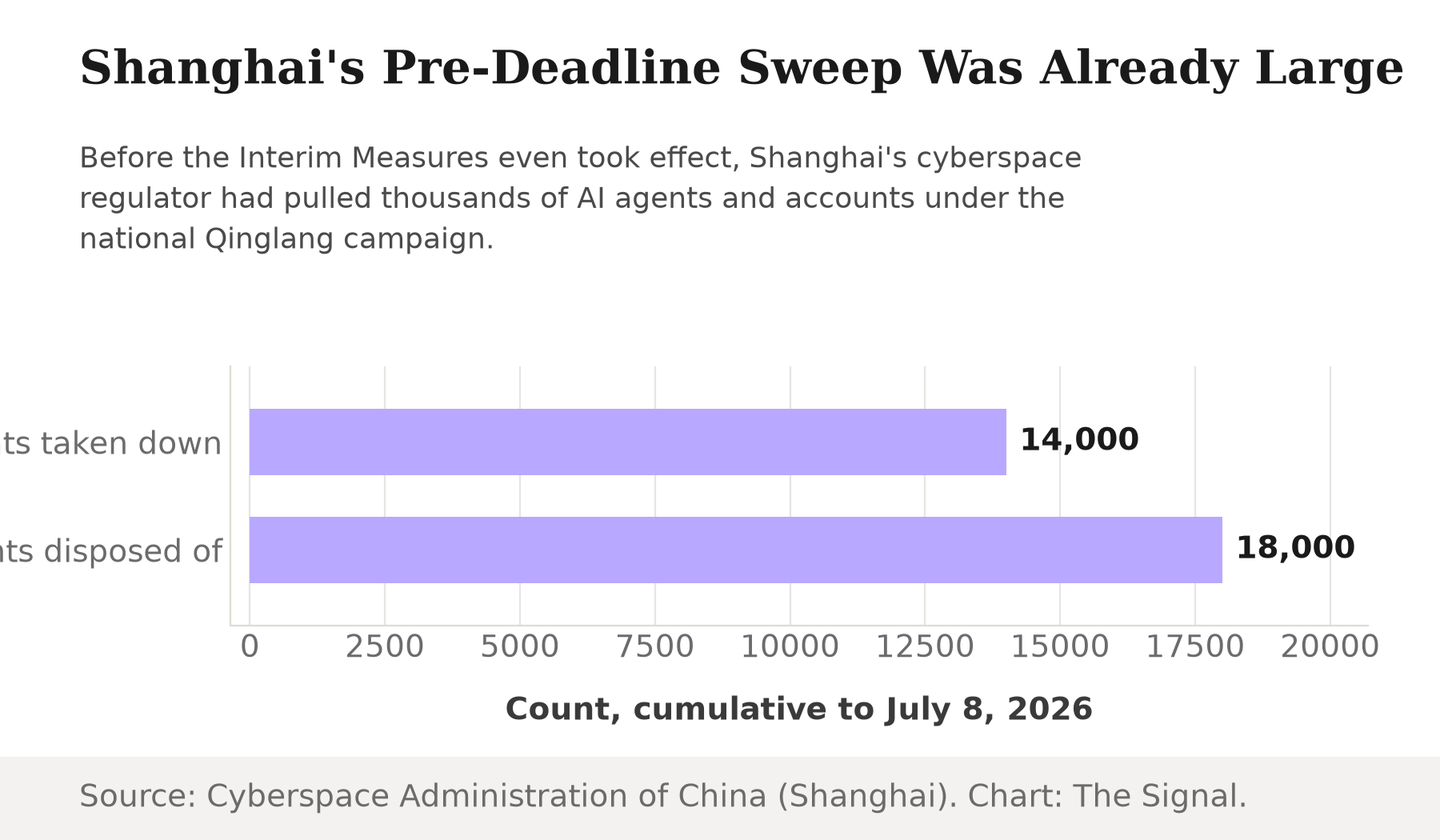
On July 15, 2026, China's Interim Measures for the Administration of AI Anthropomorphic Interactive Services took effect nationwide, jointly issued by the Cyberspace Administration of China with four other national agencies. Read as consumer protection, the law is straightforward. Article 14 bars any provider from offering a minor a "virtual relative" or "virtual companion" intimate-relationship service, and Article 22 forces any companion app with 1 million or more registered users, or 100,000 or more monthly active users, through a formal security assessment. Enforcement had already started before the deadline. Shanghai's cyberspace regulator took down more than 14,000 non-compliant AI agents and disposed of over 18,000 non-compliant accounts under the national "Qinglang" rectification campaign, part of a parallel push against face-swap and voice-cloning tools, data poisoning and AI-generated rumors. On its face, this reads like a government finally applying child-safety and platform-scale rules to a fast-growing app category, the same instinct behind AI chatbot rules taking shape elsewhere.
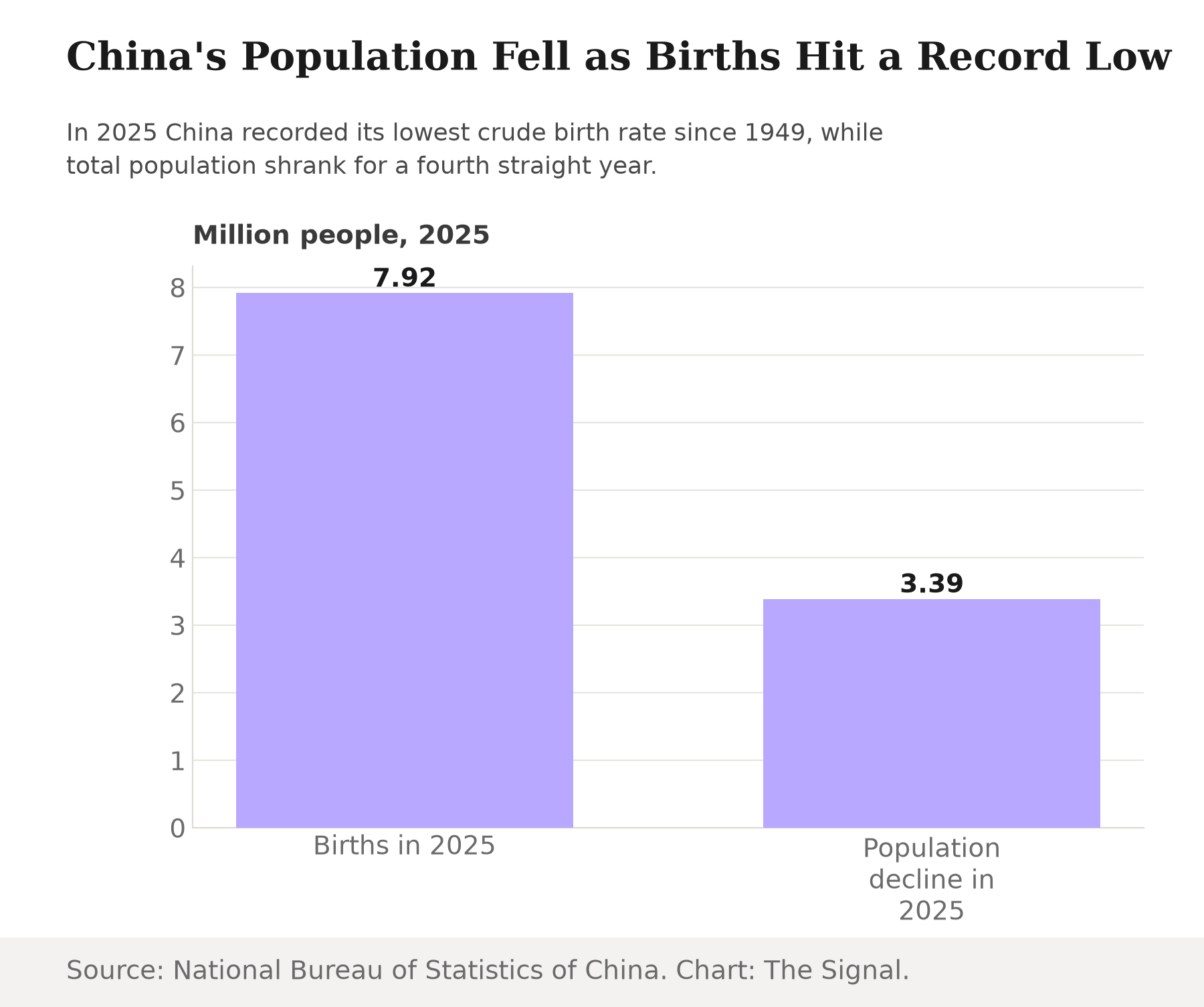
It is worth slowing down on the timing. China recorded 7.92 million births in 2025, a crude birth rate of 5.63 per 1,000 people, the lowest on record since 1949, and the country's total population fell by 3.39 million over the year, to 1,404.89 million by December. A regulation that singles out "virtual relative" and "virtual companion" products, specifically for minors, arrived in the same year the government published its worst birth data on record.
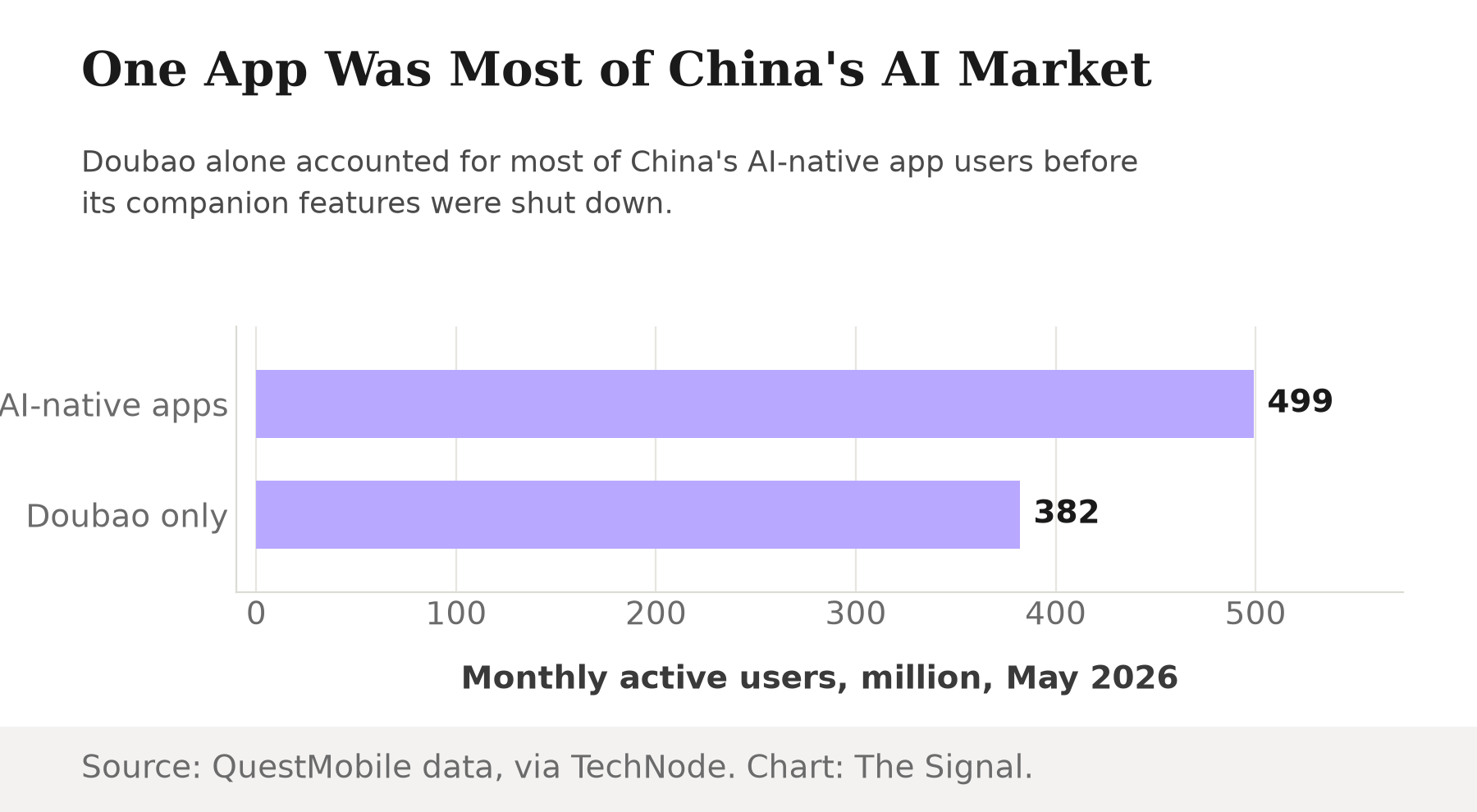
- That is the figure showing what is being curbed. ByteDance's Doubao alone carried an estimated 382 million monthly active users before its companion features were shut down, out of 499 million monthly active users across all of China's AI-native apps as of May 2026. This is not a crackdown on a fringe corner of the AI market. It reached into the single app most of China's AI-app users were already opening every month.
What the Interim Measures actually ban
The Interim Measures are narrower than a blanket AI crackdown. Article 14's ban applies specifically to minors and to products framed as a virtual relative or virtual companion, not to AI chatbots in general. Article 22's security-assessment trigger is a scale rule set at 1 million registered users or 100,000 monthly active users, a threshold designed to catch exactly the apps large enough to matter. The Shanghai numbers show the campaign already had teeth before the July 15 deadline: over 14,000 AI agents pulled and more than 18,000 accounts disposed of. That sweep was bundled into a broader push against deepfake and voice-cloning tools, data poisoning and fabricated content. Regulators are not describing this as demographic policy: nothing in the Interim Measures or the enforcement report names a birth-rate objective, and the text reads as consumer and minor protection.
The data the law landed next to
That is precisely what makes the timing worth noting rather than the stated rationale. This is not a one-year dip. China's crude birth rate has fallen for nearly a decade straight, from 11.99 births per 1,000 people in 2015 to 6.77 in 2024, and 2025 pushed both readings to a new low: a crude birth rate under six per thousand and a fourth straight year of net population loss. The law names "virtual companion" and "virtual relative" services specifically as the category needing the strictest limits, not AI chatbots or content generation broadly. A carve-out that specific invites a question: what else is it protecting against, beyond a minor's exposure to an inappropriate app?
Why this doesn't transfer to India
China's crackdown lands on a demographic edge that India has not reached.
| Country | Fertility measure | Figure | As of |
|---|---|---|---|
| China | Crude birth rate | 5.63 births per 1,000 people, the lowest since 1949 | 2025 |
| India | Total fertility rate | 2.0 children per woman, already at or below the replacement level of 2.1 | 2019-21 survey |
Source: National Bureau of Statistics of China; India's Ministry of Health and Family Welfare, via Press Information Bureau.
The two figures measure different things, a yearly crude birth rate against a lifetime fertility average, so they cannot be read as the same number on two scales. What they show together is a difference in urgency. India's fifth National Family Health Survey found the country's total fertility rate had already fallen to 2.0 children per woman, at or below the replacement level of 2.1, a gentle landing at the point where a population roughly replaces itself, not a collapse. China's government is responding to a population already shrinking for years running. India's regulators have no equivalent demographic emergency sitting behind any future AI-companion rule, because India has not reached the level of alarm China's own statistics office published for 2025. That is also why India's own companion apps sit unregulated by comparison: not because the case for child-safety rules is weaker, but because the demographic lever China may be reaching for has no matching demographic crisis to justify it here.
The honest objection
The strongest case against reading this as demographic policy is that every element of it has an ordinary child-safety explanation. Age-appropriate design rules for AI chatbots are spreading globally on their own logic, with no fertility angle required. The 1-million-user, 100,000-MAU threshold in Article 22 is a generic scale trigger, the kind of rule China's tech regulators have applied to platforms of every type for years, not something invented for companion apps. And Shanghai's enforcement sweep targeted far more than romantic chatbots, clearing face-swap tools, voice cloning, data poisoning and fabricated rumors in the same campaign. Read narrowly, this is a broad AI-safety rectification drive that happens to include a minors clause, nothing more.
That case is real, and no document in this law or its enforcement reporting names a birth-rate rationale. But it does not fully explain why Article 14 singles out "virtual relative" and "virtual companion" intimate-relationship products by name, rather than folding minors' protection into the same general content and safety rules applied to every other AI service. A narrow, named carve-out for relationship-substitute products, arriving the same year the state published its lowest birth rate on record, is a pattern this piece can point to. It is not proof of legislative intent, and it should not be read as one.
The Signal
The Interim Measures are being enforced as written: a minors ban, a scale-triggered security review, and a rectification campaign already running ahead of schedule. Whatever the government's internal reasoning, the practical effect is that China has now put its largest AI companion product through the same regulatory apparatus as everything else in its AI-safety drive. Watch whether future Chinese AI rules keep carving out relationship-coded products by name, distinct from AI regulation generally. India is the other one to watch: sitting close to replacement-level fertility with an unregulated companion-app market of its own, does it ever need to reach for the same lever? A country that posted its lowest birth rate on record for 2025 did not have to write "virtual companion" into a chatbot law by name. It chose to.
Reporting basis: the Interim Measures' effective date, its Article 14 minors ban and Article 22 security-assessment threshold are per the Cyberspace Administration of China's own published regulation. The Shanghai enforcement figures are per the Cyberspace Administration of China's report on that city's rectification campaign. China's 2025 birth and population figures are from the National Bureau of Statistics of China's official release. India's total fertility rate is from the National Family Health Survey-5, conducted by the Ministry of Health and Family Welfare, as released via the Press Information Bureau. The AI-native app user figures are QuestMobile data, as reported by TechNode. The reading of the law's timing against the birth-rate data is The Signal's own analysis; no cited source attributes a demographic motive to the regulation.