In October 2022, India's Competition Commission did something few antitrust regulators anywhere had managed at the time. It forced Google to loosen its grip on Android inside one of the company's biggest markets. The CCI fined Google ₹13.38 billion, about $161.95 million, for anti-competitive practices tied to an operating system that runs on 97% of India's 600 million smartphones. Within months, Google agreed to show Android users in India a choice screen for picking their default search engine when setting up a new phone, and the CCI's order stopped Google from blocking people who wanted to uninstall pre-loaded apps such as Chrome and YouTube. Android in India, the story went, had been pried open.
It is worth checking what that order actually reached. It touched the phone: the home screen, the default settings, the apps a buyer could remove. It never touched the thing that makes Google's search engine hard to compete with in the first place, which is the data behind the results. On 16 July 2026, the European Commission ordered exactly that. Google must start sharing search data with rival search engines and AI chatbots from January 2027, and open up Android to competing AI assistants from July 2027. India got Android open. Brussels just got the harder lever, the one India's regulator never pulled.
Android's opening was already old news in India
Google has been under the Digital Markets Act's Android rules since the Commission designated Alphabet a gatekeeper for the operating system on 5 September 2023. That is nearly a year after India's remedy was already running. The 2026 order is not Brussels catching up on the same ground; it is Brussels reaching past it. That gap in speed, not just in scope, is the more interesting number.
India moved from fine to remedy in three months. The EU took eleven times as long, and went further.
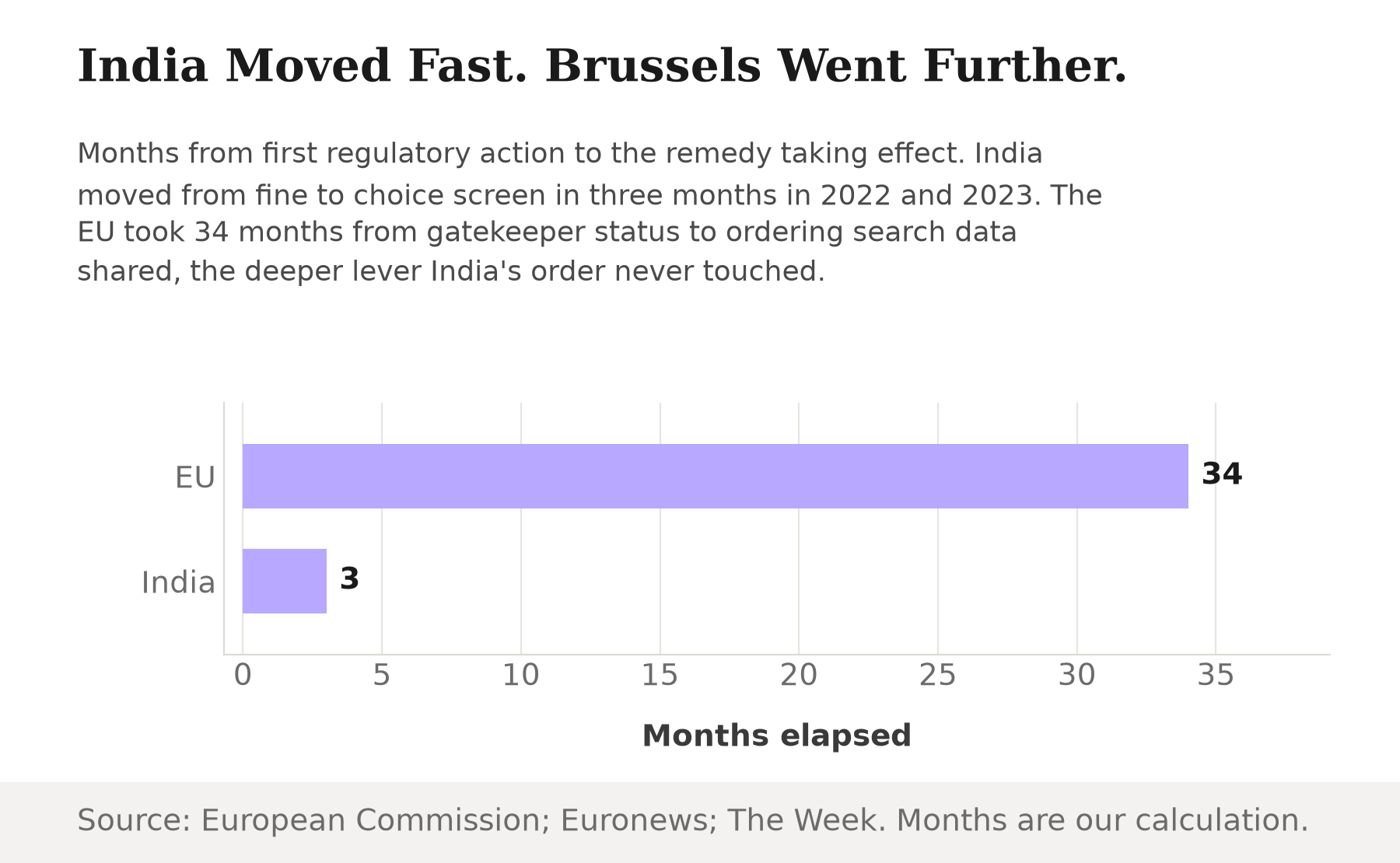
The three months is the gap between India's fine, dated 20 October 2022, and the choice screen it produced, which began appearing in January 2023. The 34 months is the gap between Google's gatekeeper designation in September 2023 and the July 2026 order that finally reaches search data (our calculation from those two timelines). India's regulator worked fast on a narrow fix. The EU's took years to build a case for a deeper one.
The lever India never had
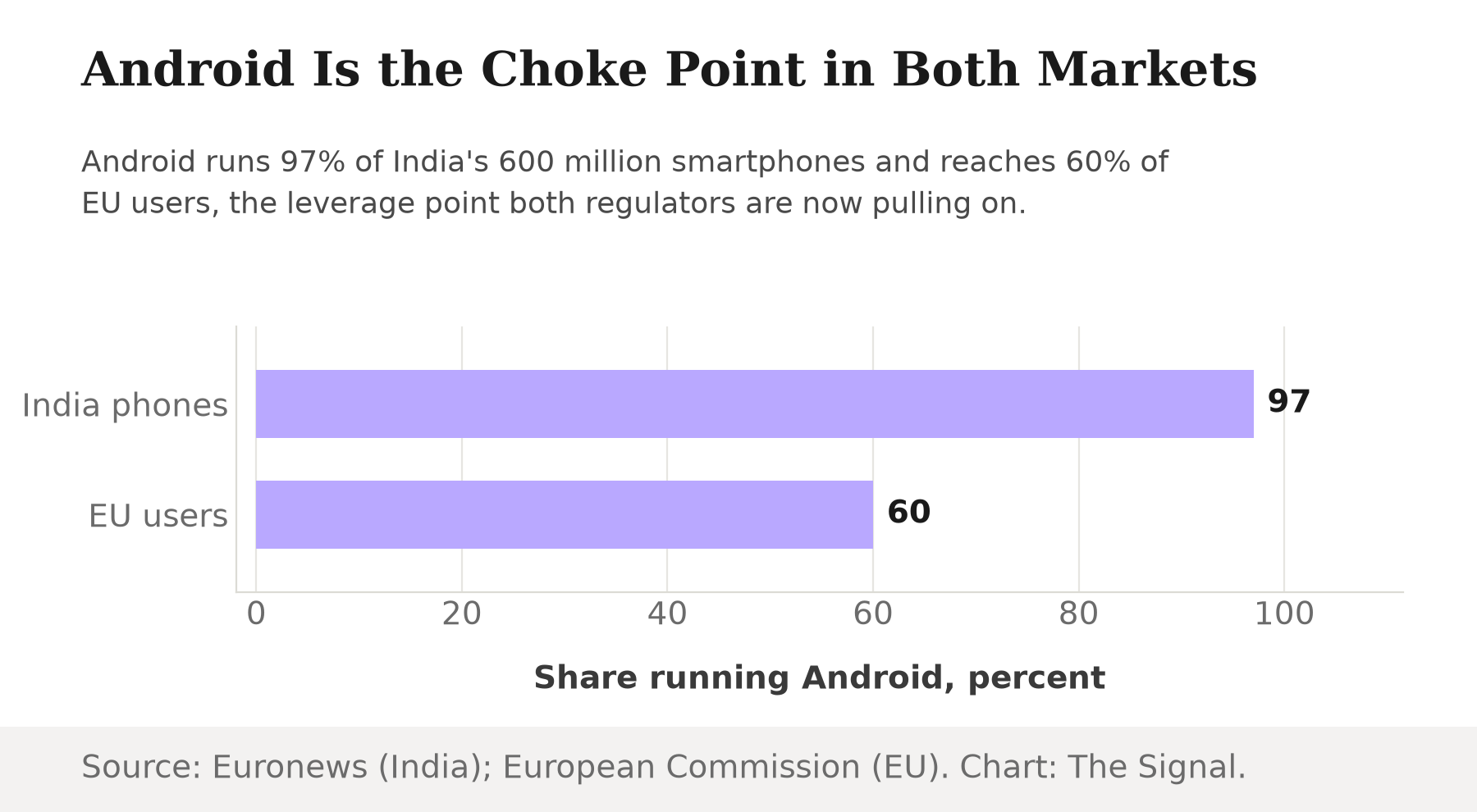
Android matters as a remedy target in both places for the same underlying reason: it is nearly everyone's phone. Android runs 97% of India's 600 million smartphones, and restricting rival AI assistants on Android makes them less attractive to the 60% of EU users who own an Android device.
Android is the choke point in both markets, which is exactly why both regulators went after it.
But identical leverage produced different remedies. India's order dealt with the surface of the phone, the choice screen and the uninstall rights. The EU's order deals with the substance underneath it. Rival search engines and AI chatbots get access to Google's search data from January 2027, and rival AI assistants get proper interoperability with Android from July 2027, and both requirements are legally binding. Search data is the harder ask by a wide margin. A choice screen costs Google a default setting. Sharing the index and query signals that its results are built on hands competitors the raw material Google spent two decades accumulating.
| India, CCI order (2022) | European Union, DMA order (2026) | |
|---|---|---|
| Order date | 20 October 2022 | 16 July 2026 |
| What Google must do | Show a default search engine choice screen; allow uninstalling pre-loaded apps | Share search data with rival search engines and chatbots; open Android to rival AI assistants |
| Compliance deadline | From January 2023 | Search data by January 2027; Android by July 2027 |
| Penalty at stake | ₹13.38 billion ($161.95 million) fine already imposed | Up to 10% of Alphabet's global turnover, 20% for repeat infringement |
Sources: Euronews, The Week, European Commission decision notice, Thurrott, European Commission DMA guidance.
The penalty structures make the same point in a different way. India's fine is a fixed, already-collected number for past conduct. The EU's penalty for failing to comply with the new order is open-ended: up to 10% of a company's total worldwide annual turnover, rising to 20% for repeated infringement. One is a bill Google has paid. The other is a standing threat scaled to Alphabet's entire global revenue, not just its India or EU business, which is what a regulator reaches for when it expects a fight over compliance rather than a one-time settlement.
The honest objection
The strongest case against reading too much into this gap is that India's search market may not need the EU's remedy at all. Europe still has search engines with real, if small, market share of their own, plus a wave of AI chatbots that want to plug into Android and into search results. Sharing data with rivals means something concrete there because rivals exist to receive it. India's search market has comparatively few homegrown alternatives positioned to use that same data even if the CCI ordered it tomorrow. On this view, the CCI was not shy about search data. It simply had a thinner field of beneficiaries to write the remedy for, so it used the tools that mattered in India: the choice screen and the uninstall right.
That is a fair account of why the CCI's order looked the way it did in 2022. It does not explain why the order still leaves search data untouched, four years into a global regulatory conversation that has moved decisively toward exactly that lever. Regulators borrow remedies from each other once a template exists and survives a legal fight. The EU has just built that template, tested against Google's own search engine. The next regulator that wants to open up a Google-dominated market, in India or anywhere else, no longer has to invent the mechanism from scratch.
The Signal
The 2022 CCI order was not a smaller version of what the EU just did. It was a different order, aimed at the parts of Android a phone buyer can see and touch. The EU's 2026 order is aimed at the part no user ever sees: the data a search engine is built on. That is the genuinely new precedent, and it is the one India has not yet set. Watch what happens once Google's compliance filings for January and July 2027 become public. If the EU's search-data sharing works in practice without collapsing into token access, it becomes the remedy every other regulator points to next. If it does not, India's narrower, faster fix from 2022 starts to look like a more durable model than the smaller one. Either way, the score is not settled by whoever moved first. It is settled by whichever side reached deep enough to matter.
Reporting basis: Google's Digital Markets Act gatekeeper designation and the terms of the July 2026 decision are per European Commission publications, including its official case summary and decision notice. The 16 July 2026 order's compliance dates and legal status are also carried by Euronews and by Thurrott, both drawing on the same Commission announcement. India's 2022 Competition Commission fine and the Android smartphone share it cites, from Counterpoint Research, are per Euronews's contemporaneous coverage. The choice screen remedy is per The Week, and the uninstall provision is per ThePrint's coverage of the CCI's order. The elapsed-time comparison between the two regulators' timelines is The Signal's own calculation from those sourced dates.