On 28 July 2026, the US Federal Communications Commission added foreign-produced power inverters to its Covered List, the mechanism it uses to block imports it judges a national-security risk. The same order added a list of advanced robotic devices. The FCC's order adding foreign-produced power inverters to its Covered List states that their remote connectivity creates vulnerabilities that could let foreign firms shut the devices down, exfiltrate data, or enable remote surveillance by a foreign government. Read from India, the news lands first as a story about Washington closing a door on Chinese hardware. It is also, more directly, a story about the box sitting between India's solar panels and its grid.
It is worth slowing down on what the ban actually covers. TechCrunch reports that the FCC said existing devices already in homes and installations are unaffected by the ban: the rule blocks only new, not-yet-authorised inverter and robot models. That distinction barely registers in the US, where grid-scale solar inverters are a small and recent import category. In India, it is closer to the whole story. India's utility-scale solar fleet already runs overwhelmingly on the equipment that the FCC has just decided a country its size should no longer import.
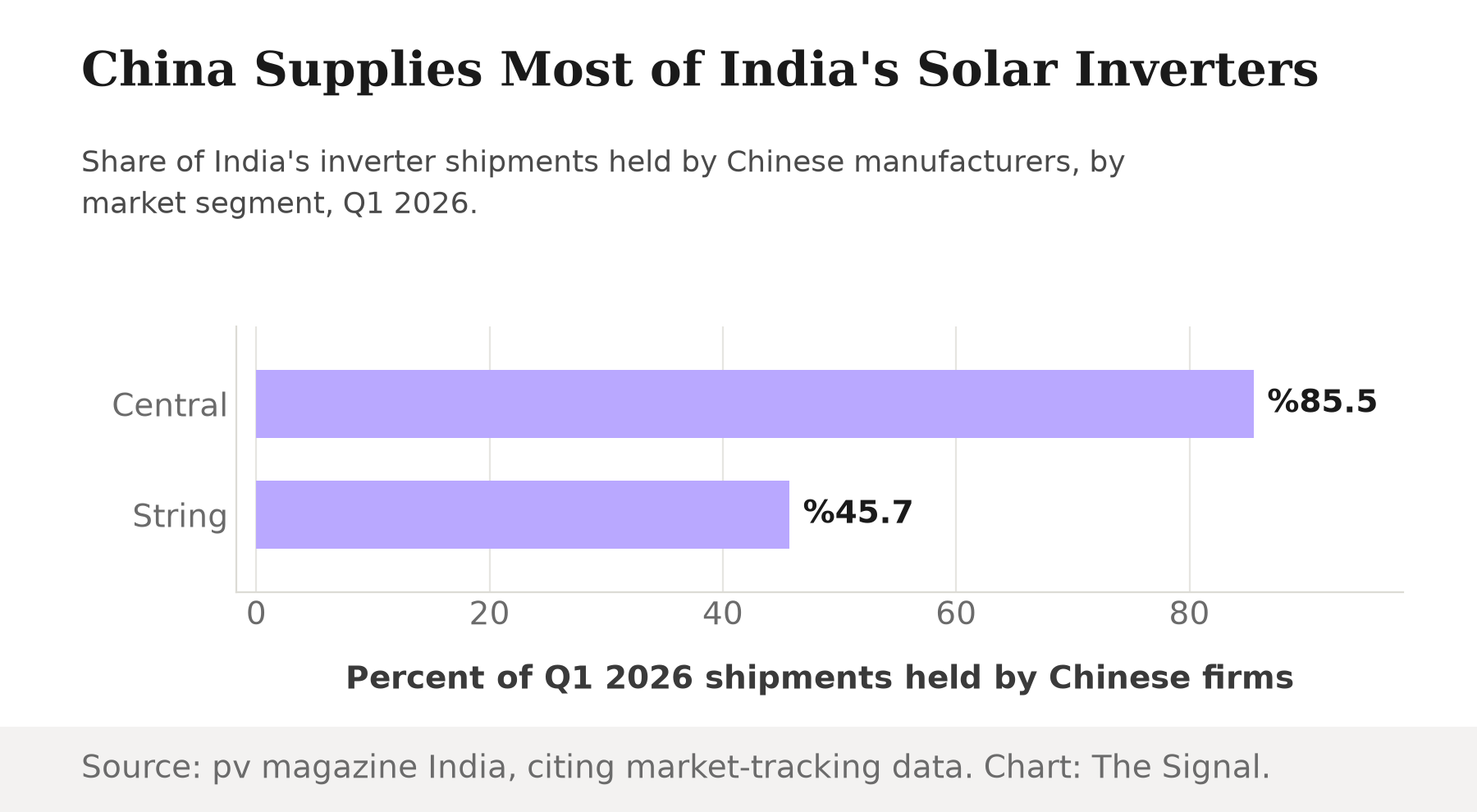
Chinese manufacturers supplied 85.5 percent of India's central-inverter shipments in the first quarter of 2026. pv magazine India reports, citing market-tracking data, that Sungrow, Sineng Electric and Hopewind together contributed nearly 85.5 percent of central-inverter shipments, while a separate trio, Sungrow, Sineng Electric and TBEA, held around 45.7 percent of the string-inverter market in the same quarter.
One company, more than a third of the market
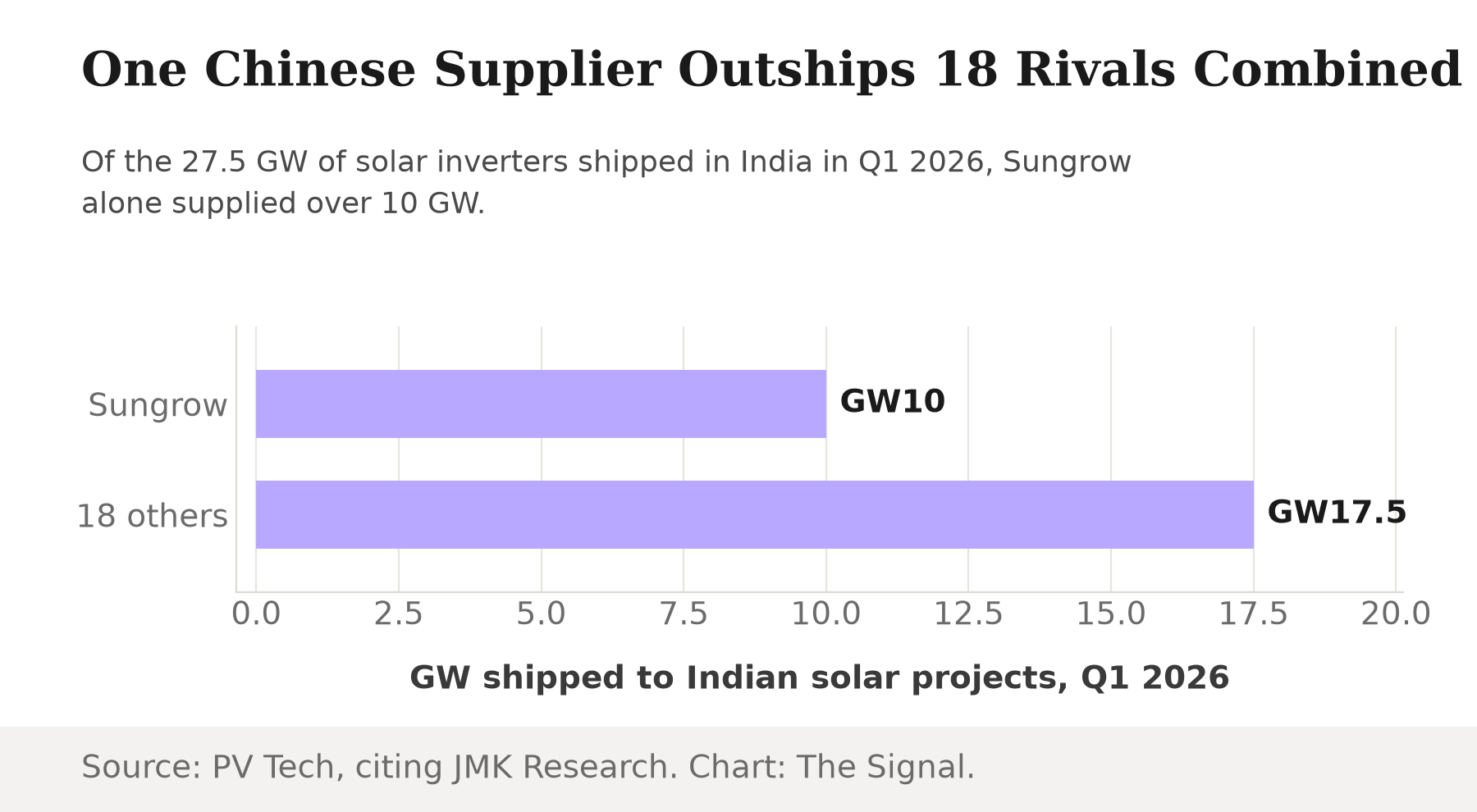
The concentration does not spread evenly across many vendors. PV Tech reports, citing JMK Research data, that of the 27.5 GW of inverter shipments recorded in India in the first quarter of 2026, Chinese producer Sungrow supplied over 10 GW, with the rest of the capacity split between 18 other suppliers. One Chinese company, on its own, shipped more inverter capacity that quarter than the other eighteen suppliers combined managed between them. That equipment is not going into a small grid. The Ministry of New and Renewable Energy's Physical Progress report shows India's cumulative installed solar capacity stood at 162.15 GW as of 30 June 2026, and every gigawatt of it needs an inverter to turn panel output into power the grid can use.
No rule requires that to change
Solar panels are not an import free-for-all in India. pv magazine reports that while India has not introduced an ALMM-style domestic content mandate specifically for inverters, government procurement increasingly favours local manufacturing, a reference to the Approved List of Models and Manufacturers that already steers government-linked purchases of modules and cells toward India-made panels. The panels themselves are increasingly required to carry an Indian pedigree. The box that turns their output into usable grid power carries no such requirement at all.
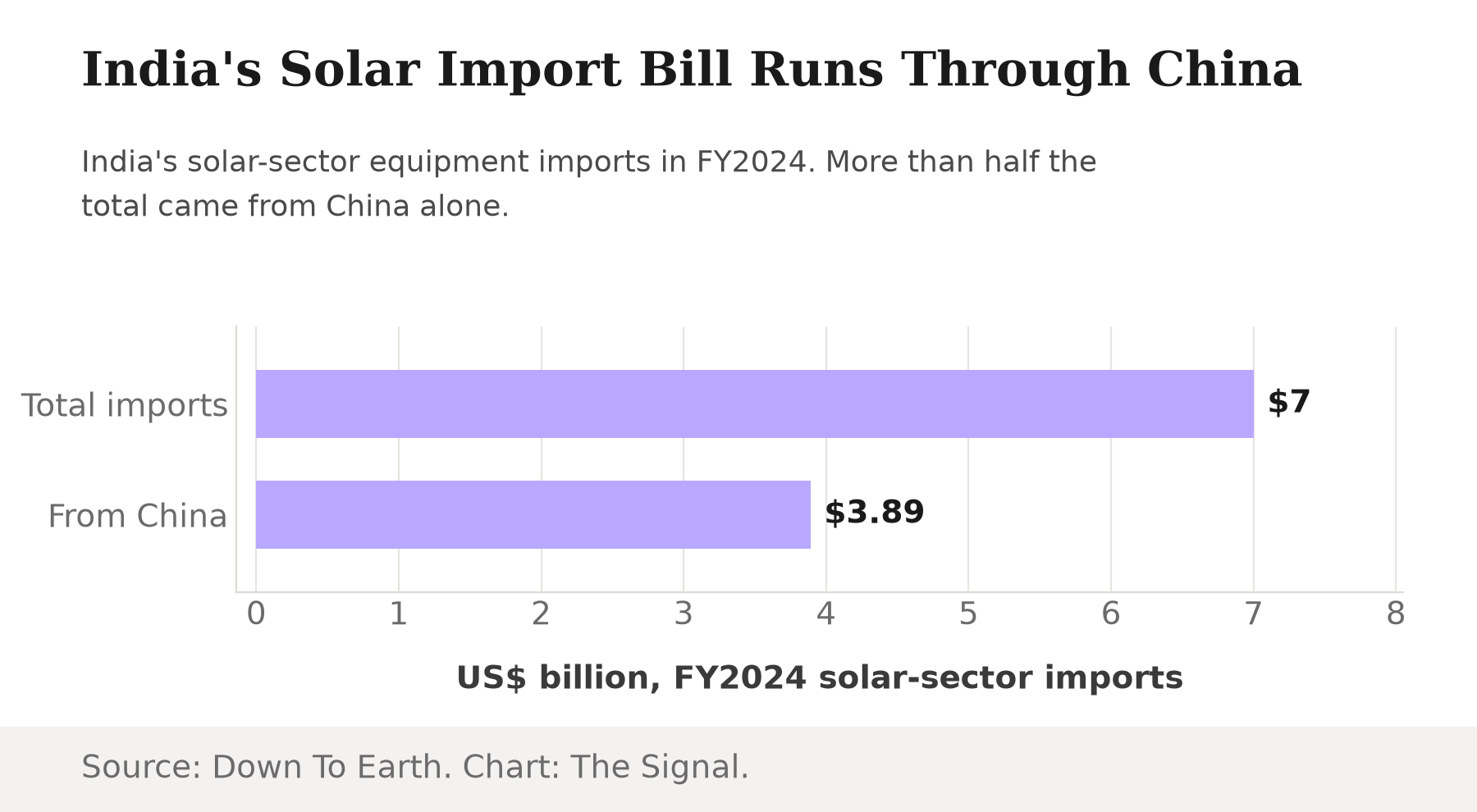
That gap sits inside a wider one. Down To Earth reports that India depends on imports for nearly 80 percent of its solar equipment, with China supplying over 60 percent of those imports; in FY2024, India's solar-sector imports reached $7 billion, with $3.89 billion, more than half, originating from China alone. Inverters are one line item inside that larger import bill. They are also the one line item the US has just decided is not merely a trade or manufacturing question, but a remote-access one.
The dependency is growing, not shrinking
The trend line makes the opposite case. Mercom India reports that inverter shipments to solar projects in India increased 40.8 percent in 2025 compared with 2024, with central inverters, the segment Chinese firms most dominate, accounting for 51 percent of total shipments. India is not gradually weaning itself off this supply chain while Washington tightens its own. It is buying more of it, faster, concentrated in the exact segment where Chinese suppliers already hold the largest share.
The honest objection
The strongest case for calm is that the FCC's own remedy targets only the front door: new, not-yet-authorised models, not the installed base. If the vulnerability inside working hardware were urgent enough to act on today, the argument goes, Washington would have ordered a retrofit rather than simply closing future imports. On that reading, regulators judge the next purchase, not the last one, to be the lever that actually works, and India could shift its own future procurement the same way, without touching a single inverter already bolted to a rooftop or a solar-park substation.
That case explains why the FCC left the installed base alone. It does not explain why India has left its own front door open too. Government procurement leans toward local manufacturing in practice, but inverters still carry no ALMM-equivalent mandate, even as Chinese suppliers keep taking a larger share of a fast-growing market. If the front door is the lever that matters, India has left it wide open in precisely the segment where the concentration is highest.
The Signal
The FCC's order is a story about what the United States will buy next. For India, the more consequential number is how much of what is already spinning inside its solar parks and rooftop systems is equipment nobody was ever required to build differently. A grid carrying 162.15 GW of installed solar capacity, running mostly through inverters supplied by a handful of Chinese firms, has effectively decided that the security question Washington just answered is one it will keep re-asking with every fresh gigawatt it connects. Watch whether the power ministry or MNRE moves to give inverters the kind of domestic-content lever modules already have. Until then, the number that matters is not how many countries have banned this hardware. It is how much of it is already switched on.
Reporting basis: the FCC's Covered List order is the primary regulatory text, fetched directly. The scope of the ban, that it exempts already-installed equipment, is per TechCrunch's report of the FCC's statement. India's Q1 2026 inverter market shares by manufacturer are per pv magazine India, citing market-tracking data; the Q1 2026 shipment volumes and Sungrow's supplier share are per PV Tech, citing JMK Research. The absence of an ALMM-equivalent mandate for inverters is per pv magazine. India's broader solar-import dependence and FY2024 China-sourced import figures are per Down To Earth. Cumulative installed solar capacity is from the Ministry of New and Renewable Energy's Physical Progress report. 2025 inverter-shipment growth and the central-inverter share of shipments are per Mercom India. The characterisation of Sungrow's Q1 2026 volume as exceeding the other eighteen suppliers' combined shipments, and China's FY2024 import share as more than half of the total, are The Signal's calculations from those figures.