
Airtel calls it a network upgrade. On 19 May 2026, Bharti Airtel launched Priority Postpaid, India's first commercial consumer product built on 5G network slicing, priced from ₹449 to ₹1,749 a month. The pitch is straightforward: 5G networks can be carved into virtual lanes, and a paying customer's slice gets reserved capacity when the tower is busy. Telcos have spent years and billions building 5G infrastructure, and slicing is the technology that lets them finally charge for its most valuable property, guaranteed speed when everyone else's connection slows down. Read as an engineering story, this is simply 5G maturing into a business model.
It is worth slowing down on that framing.
India already has a rule for exactly this situation, and it was not written lightly. TRAI's 2016 tariff regulation banned service providers from charging discriminatory data tariffs based on content, the order that killed Facebook's Free Basics in India and turned net neutrality into a settled national principle rather than a niche technical debate. A year later, TRAI's own recommendations went further, stating that internet access should never involve blocking, degrading, slowing down or granting preferential speeds or treatment to any content. Priority Postpaid does not touch content, Airtel is not slowing down a rival's app to sell you a faster one. But it is, by design, granting preferential speed to whoever pays more, on the same network, for the same content everyone else gets.
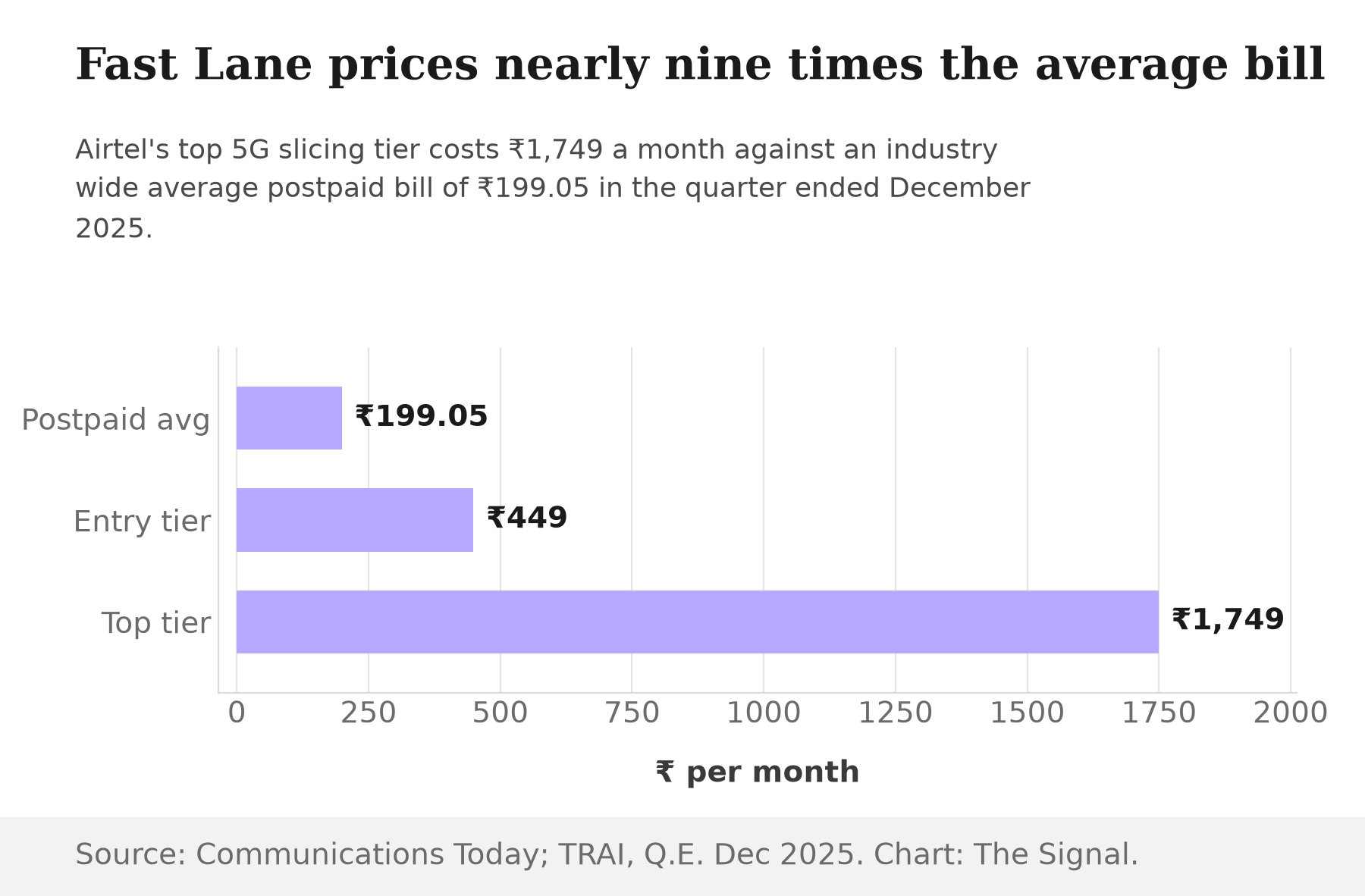
Source: Communications Today; TRAI's Quarterly Performance Indicator Report, Q.E. December 2025. Chart: The Signal.
India's average postpaid bill was ₹199.05 a month in the quarter ended December 2025, while Airtel's top Fast Lane tier prices at ₹1,749, nearly nine times that average for the same underlying mobile plan plus a promise of priority. That is a different pricing plane entirely, not a premium tier nudging the bill up at the margin, built on top of a network that, until 2026, sold speed as a flat, undifferentiated commodity to everyone.
The scale of that jump stands out even against India's own existing tiers. Postpaid customers already pay ₹199.05 a month on average against ₹194.12 for prepaid, a premium of about 2.5%, for a plan that is otherwise the same mobile service with a monthly bill instead of a recharge. Fast Lane's top tier prices nowhere near that scale of difference.
Markets that already sell network-slicing-based priority access price it very differently. T-Mobile in the US charges verified first responders $7.50 a month to add T-Priority, its own network-slicing product, to an already-discounted Essentials First Responder plan, a low-cost public-safety add-on aimed at emergency services, not a premium tier sold to any paying consumer. Fast Lane is built the opposite way: a general-consumer upsell from launch, open to anyone who can pay ₹449 to ₹1,749 a month.
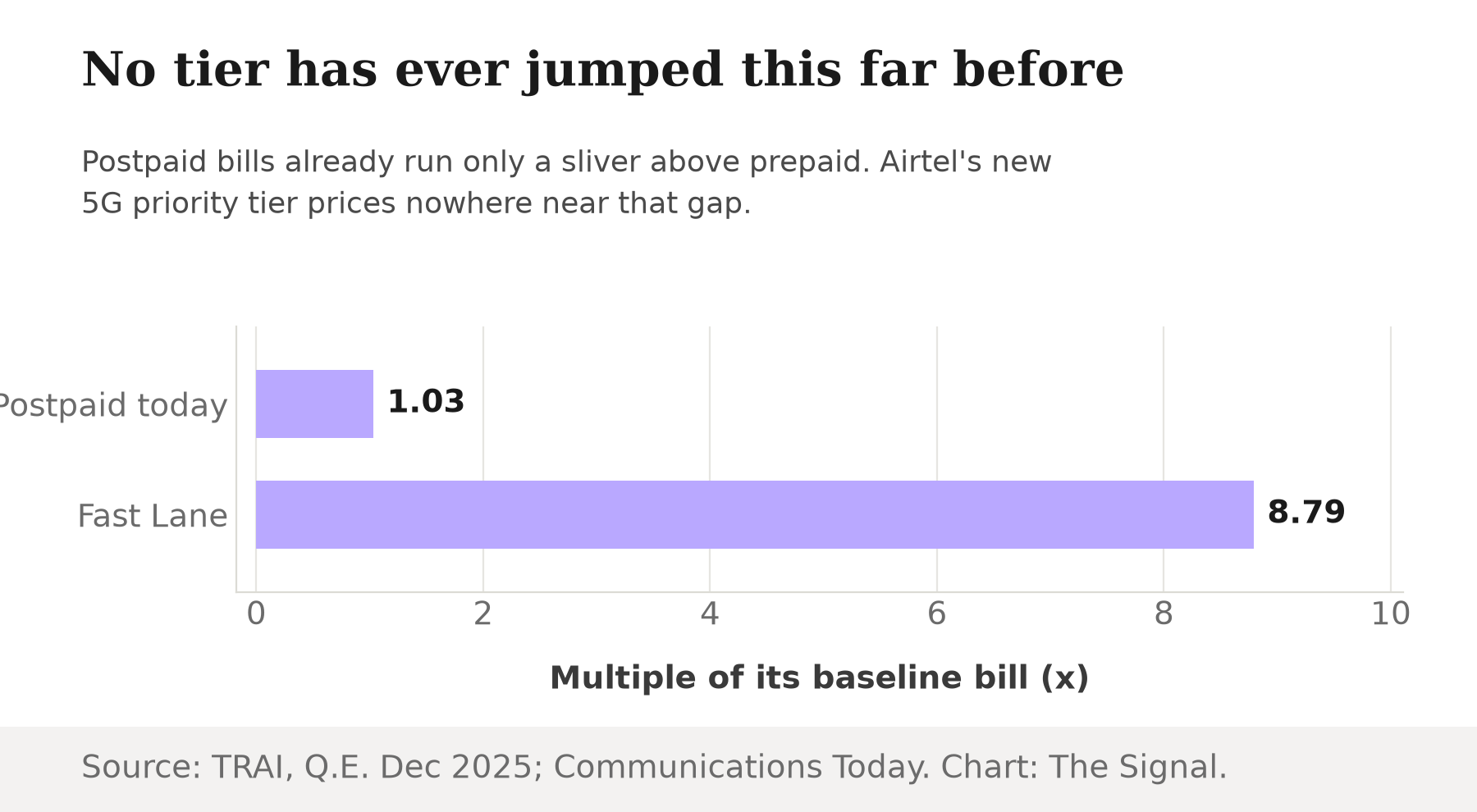
Source: TRAI's Quarterly Performance Indicator Report, Q.E. December 2025; Communications Today. Chart: The Signal.
The exact same idea, already banned once
This is not the first time an Indian telco has tried to sell priority speed to postpaid customers. In July 2020, TRAI directed Airtel and Vodafone Idea to halt their premium Platinum and RedX plans, which offered priority speeds to postpaid subscribers, ordering the telcos to first analyse the impact on other users before offering the plans again. That ban targeted the same mechanism Priority Postpaid uses now, not content discrimination: charge some customers more for faster access to an unchanged network. Six years ago, the regulator's answer was no.
A different answer this time
2026's answer has been more permissive, at least so far. TRAI's preliminary assessment, reported in June 2026, found no immediate net neutrality violation in Priority Postpaid, though the regulator sought further technical and quality-of-service data from Airtel and set no deadline for concluding the review. Nothing about the 2016 or 2017 rules changed in the meantime. What changed is the wrapper: network slicing is a 3GPP-standardised architecture, not a bespoke priority switch a telco built in-house, and that technical label is doing real work in how the same underlying trade, pay more for faster access, is being read this time.
The telcos do not agree with each other
The two biggest private operators in the review filed opposite positions with the Department of Telecommunications. Reliance Jio told the DoT that network slicing is a standardised, 3GPP-defined capability of 5G networks that is already permitted under India's existing regulatory framework, provided any deployment complies with the Unified Licence and TRAI's rules. Vodafone Idea told the DoT the opposite, that 5G slicing priority plans should be suspended until the DoT and TRAI provide clearer regulatory guidance. That is two of India's three private telcos, filing into the same regulatory review, unable to agree on whether the product a rival already launched is legal.
| Operator | Position filed with DoT | Source |
|---|---|---|
| Reliance Jio | Network slicing is a standardised, 3GPP-defined 5G capability already permitted under the existing licence and TRAI framework | TelecomTalk |
| Vodafone Idea | 5G slicing priority plans should be suspended until DoT and TRAI issue clearer regulatory guidance | Developing Telecoms |
Both operators' positions are as stated in their submissions to the Department of Telecommunications, reported above.
The scrutiny is not confined to industry filings, either. India's Parliamentary Standing Committee on Communications and Information Technology, chaired by Nishikant Dubey, met on 26 May 2026 and directed the DoT and TRAI to examine how 5G network slicing has been implemented in Singapore, the UK and other markets, giving both bodies 25 days to report back, over concern that a priority postpaid plan could compromise net neutrality for the far larger population of prepaid users. That is Parliament, not just a rival telco, asking whether a product Airtel had already sold matches what other regulators allow.
A new name, an old term
Under that same scrutiny, Airtel had rebranded Priority Postpaid as Fast Lane by 11 June 2026, dropping the language around priority access during network congestion while keeping the underlying slicing technology unchanged. The company's own reasoning is telling: an Airtel representative said the new name was chosen because "our descriptor to signal what we are doing, Fast Lane, captures the essence of what we offer." The rebrand keeps the substance intact: paid fast lane is the exact phrase that global net neutrality debates have used for a decade to describe the thing the rules exist to prevent.
Europe is writing the rulebook Airtel is testing
India is not the only place regulators are racing to catch up with network slicing. BEREC, the body of European telecom regulators, approved a draft annex to its Open Internet Guidelines specifically addressing 5G network slicing at its board meeting on 2 and 3 June 2026, opening it for public consultation before it takes effect. The contrast is procedural rather than substantive. Europe is publishing draft guidance with a defined consultation process before slicing products scale; India's review is running after a product already has paying customers, with TRAI still gathering data and no published timeline for a decision.
The honest objection
The strongest case for Airtel and Jio is that network slicing genuinely differs from the plans TRAI banned in 2020. Slicing is an open, standardised part of the 5G specification that any operator can implement under existing licence conditions, not a proprietary priority switch, and TRAI's own 2016 rule is written to bar discrimination by content, which Fast Lane does not do; it treats every website and app inside a customer's slice identically. On that reading, TRAI's preliminary no-violation finding is a defensible application of rules written for a content-blocking problem to a capacity-allocation product that never triggers them, not a loophole.
That case weakens once you compare it with 2020 rather than with 2016. The Platinum and RedX plans TRAI banned were also content-neutral, they charged more for faster access to the same open internet, not for special treatment of any app. If a content-neutral priority-speed plan was enough to get banned once, the fact that this one runs on newer plumbing does not obviously put it outside the same principle. The honest position is that nobody, including TRAI, has yet stated why the mechanism is different this time; it has stated that it wants more information before deciding.
The Signal
Airtel's Fast Lane is a test of whether India's net neutrality regime bans a kind of pricing or a kind of technology. If TRAI's final review lands on the same conclusion it reached with Platinum and RedX in 2020, the "5G slicing" label bought a paying product a year of runway before enforcement, and every telco now knows a new technical wrapper is worth trying on an old idea. Should TRAI instead let Fast Lane stand because slicing genuinely reads differently under the rules, India will have quietly redrawn where its net neutrality line sits, without a single line of the 2016 or 2017 rules being amended. Either way, watch what TRAI does with the data it asked Airtel for, not what Airtel calls the plan while waiting for the answer.
Reporting basis: the Priority Postpaid launch details and pricing are per Communications Today; TRAI's preliminary review findings are per Inc42's account of TRAI's assessment. Reliance Jio's and Vodafone Idea's DoT submissions are per TelecomTalk and Developing Telecoms, each covering a single operator's filing. The 2020 Platinum and RedX ban is per Business Today's contemporaneous account of TRAI's directive. The Fast Lane rebrand and Airtel's quoted rationale are per BestMediaInfo. BEREC's draft guidance and consultation timeline are from BEREC's own public consultation page. The 2016 tariff regulation and the 2017 net neutrality recommendations are TRAI's own published texts. Postpaid and prepaid average revenue per user figures come from TRAI's Quarterly Performance Indicator Report for the quarter ended December 2025. The Parliamentary Standing Committee's directive to the DoT and TRAI is per Daily Excelsior's report of the committee proceedings. T-Priority's pricing is per T-Mobile's own newsroom announcement. The nearly ninefold premium of the Fast Lane top tier over India's postpaid ARPU, and the comparison with the postpaid-to-prepaid premium, are The Signal's calculations from those figures.