
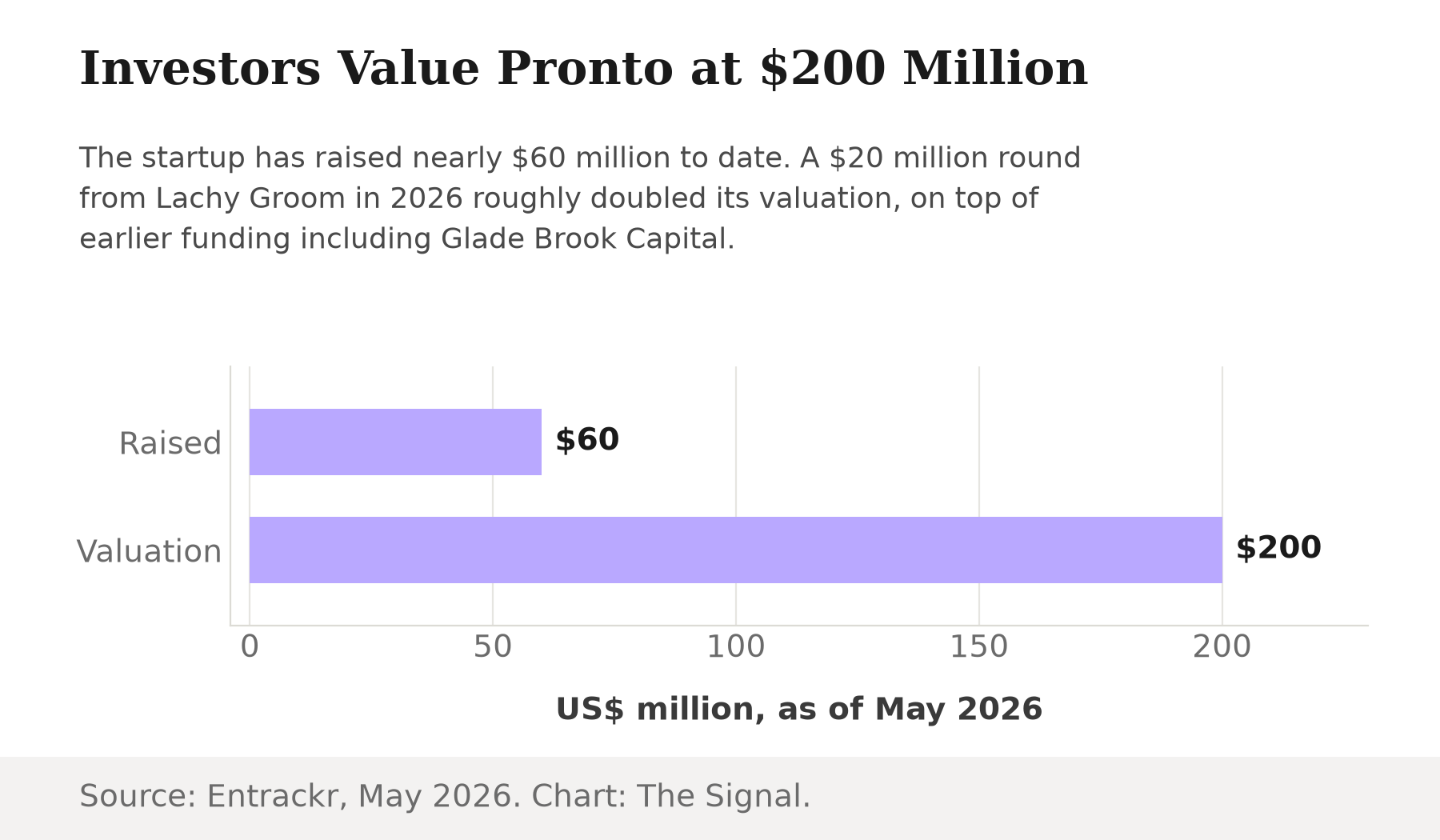
By late July 2026, Pronto was running 46,000 regular home-service bookings a day, plus thousands more Pronto Verified orders on top of that, Forbes reports. A Pronto Verified booking is camera-recorded, and the worker doing it earns roughly twice what a standard booking pays, according to Pronto, as CIOL reports. It is the worker, not the customer or a fixed room camera, who wears the device, and its footage is confined to the professional's own hands, forearms and work area, Entrackr reports, citing Pronto. The footage becomes training data for the company's AI systems. On the surface this reads like a clean deal for everyone involved: workers get a premium, Pronto gets a physical-world dataset most AI labs cannot buy at any price, and the startup's backers have already priced the arrangement at nearly $200 million, on close to $60 million raised, Entrackr reports.
Investors now value Pronto at more than three times the nearly $60 million it has raised.
It is worth slowing down on where the safeguards in this arrangement actually sit. Customers get a 48-hour window to review the anonymized recording before it enters Pronto's AI training dataset, after which the original footage is deleted, SiliconIndia reports. That is a real, documented privacy protocol, and it belongs to the person whose home appears on camera. Nothing in Pronto's own account of the program describes an equivalent review, veto, or data-ownership term for the worker whose labor, voice, and presence are captured in the same recording. The worker's entire stake in the arrangement, as the company describes it, is the paycheck.
The 48-hour window also does not cover everything the recording produces. Pronto has confirmed that it retains "derived datasets" from Verified recordings, including key-point mapping of body joints and hand movements, even after the original video is deleted, but the company declined to say whether those derived datasets could be monetized or shared with third-party AI or robotics firms, News9live reports. The video gets deleted. What the video was reduced to does not.
Two people, one recording, one protocol
Pronto built one privacy safeguard into every Verified recording, and gave it to only one of the two people in it.
| The worker doing the job | The customer whose home is filmed | |
|---|---|---|
| What they get | Roughly double the standard booking rate | A 48-hour window to review the anonymized recording |
| What happens after | Continues taking Verified bookings at the same premium | Footage is anonymized for them; the original is deleted once approved |
Sourced from CIOL's reporting of Pronto's stated pay structure and SiliconIndia's reporting of the review window. Table: The Signal.
That split is not necessarily unfair. A wage premium is a real, transparent form of compensation, and a documented review-and-delete process is a real procedural safeguard that many recorded interactions never get at all. But it is a split, and it runs along a predictable line, with control over the data going to the person paying for the service while the person performing it gets a rate card. One side negotiates the terms of its own image. The other side is paid to accept them.
Scrutiny arrived after the scale did
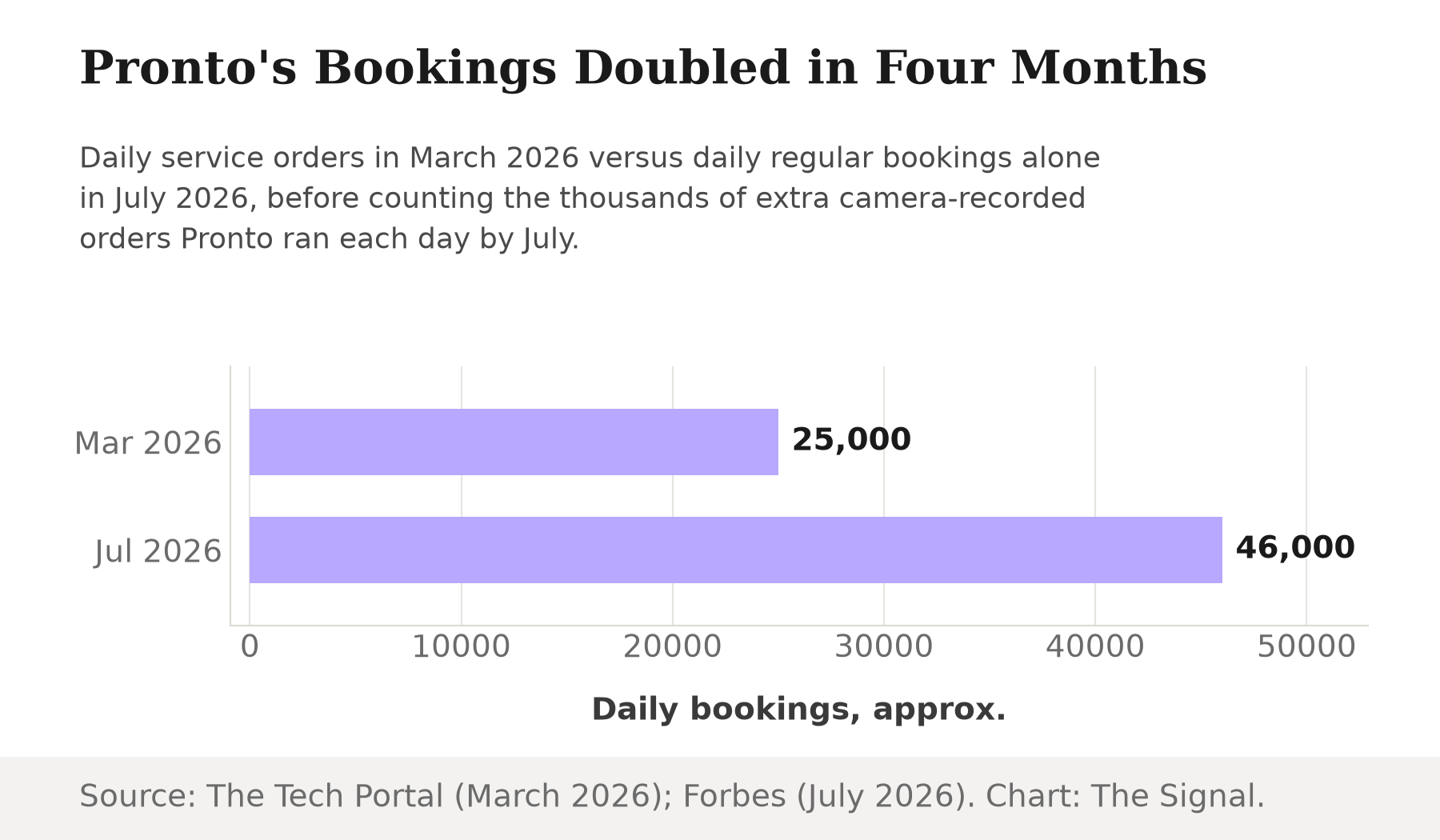
The timeline matters here. By March 2026, Pronto had already crossed 500,000 completed bookings and was executing around 25,000 service orders a day across multiple cities, The Tech Portal reported. Only after that scale was in place did India's IT ministry, MeitY, take cognisance of the controversy around Pronto's in-home recording pilot and start looking into the matter, Moneycontrol reports, citing government sources. By the time regulators engaged, the company had already raised its valuation to roughly $200 million on the strength of the same data pipeline now under review.
Growth did not pause for that scrutiny. Between March and July 2026, Pronto's reported daily volume kept climbing: from about 25,000 total service orders a day in March, per The Tech Portal, to 46,000 regular bookings alone by July, per Forbes, before counting the separate, growing stream of camera-recorded Verified orders.
The order in which these two things happened is the tell. The commercial machine, the pricing, the scale, the valuation, was built and proven first. The regulatory question of whether an in-home recording pilot needs a worker-side consent standard arrived only once press coverage forced it onto a ministry's desk.
The rule that does not exist yet
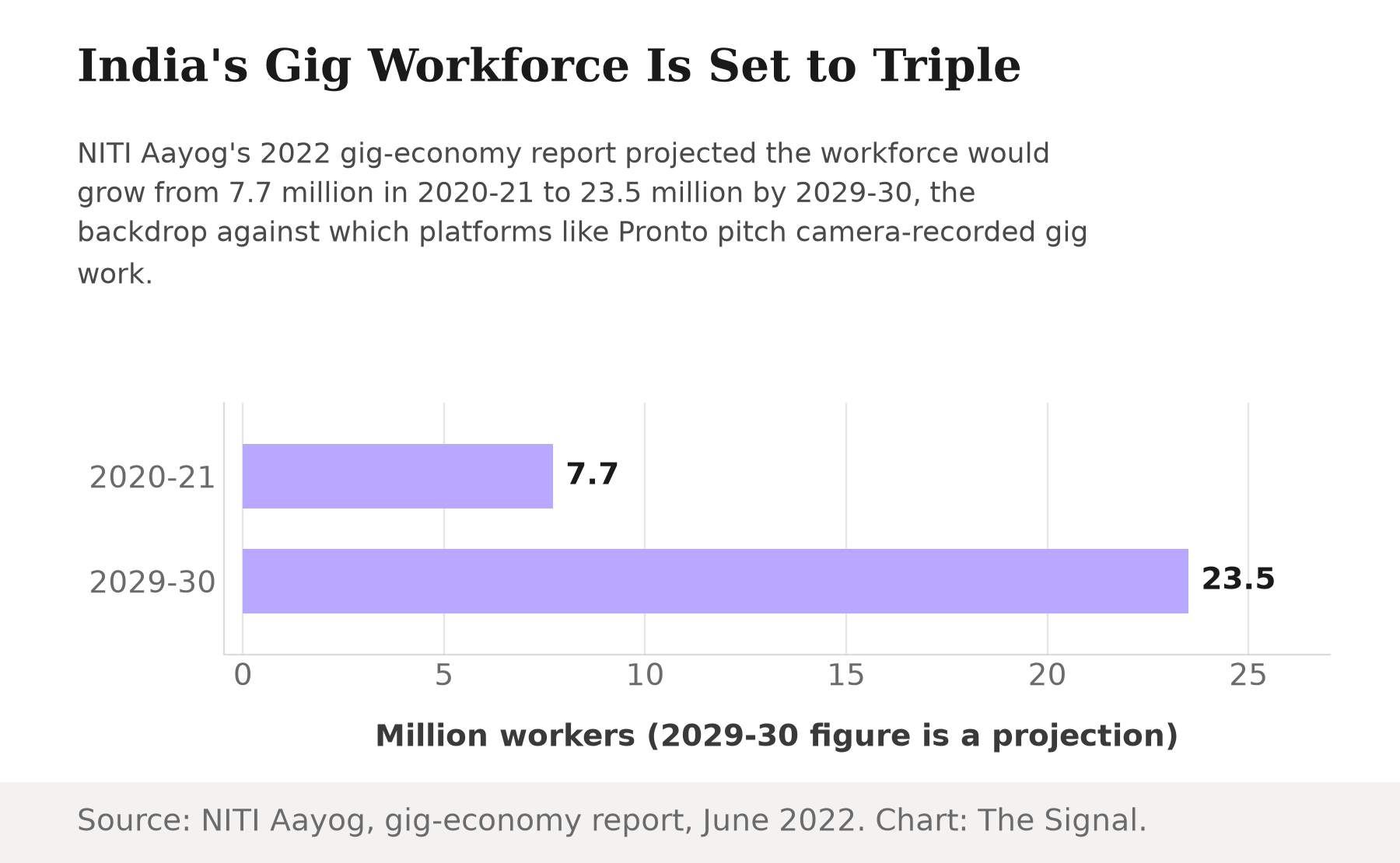
Pronto is not scaling into a vacuum. India's gig and platform workforce is projected to grow more than threefold, from 7.7 million workers in 2020-21 to 23.5 million by 2029-30, per NITI Aayog's 2022 gig-economy report. That projection is already tracking close to plan: the gig workforce had already reached 12 million workers by FY25, a 55% jump from 7.7 million in FY21, per the government's Economic Survey 2025-26, as Business Today reports. That is the backdrop against which a camera-recorded booking gets pitched as an upgrade, not a risk.
More than 90% of India's workforce is informal, the same 2022 NITI Aayog report notes, meaning most work in this economy already carries no wage floor, no standard contract, and no external body checking the terms. Against that baseline, Pronto's 2x rate for a Verified booking is a genuine premium over the informal norm. It is also a premium the company alone sets, for a category of labor, camera-recorded, data-generating gig work, that no regulator has yet defined a floor for. MeitY's inquiry is the first sign such a floor might get written. Nothing so far confirms it will be.
The honest objection
The strongest case for Pronto's structure is that it beats the alternative on offer, which is no structure at all. Doubling a worker's pay for a Verified booking, per Pronto's own account, as CIOL reports, is a concrete premium in an economy where more than 90% of the workforce is informal, per NITI Aayog's 2022 report, with no wage floor to speak of. The 48-hour anonymize-and-review process before footage enters training data, per SiliconIndia, is a real procedural safeguard, whatever its blind spot on the worker's side. Judged against that informal baseline, Pronto's pilot looks like progress: real money, a documented process, a company that can at least describe its own rules when asked.
That case is genuine, but it does not prove as much as it seems to. Being better than an absent standard is not the same as being adequate. Pronto is currently the sole author of the rules covering both sides of a recording it profits from either way. A wage premium a company sets on its own can be lowered on its own, once it has done its job of building adoption. A privacy review handed to one party and not the other is not a compromise between two interests; it is a decision about whose interest counted.
The Signal
Pronto has built a new, nationally scaled category of labor, camera-recorded, data-generating home visits, faster than anyone outside the company has built a rule for it. The two numbers that matter now are not the valuation or the booking count. They are whether MeitY's inquiry produces an actual worker-side standard, a review window, a data term, an audit, to sit alongside the customer's, or whether it quietly closes once the press cycle passes. And they are whether the wage premium Pronto pays for a Verified booking holds once Pronto's training set is mature enough that it no longer needs to buy adoption from workers who have already shown up. A wage premium that shrinks once the dataset is built was never a share of what the footage is worth. It was the price of getting the camera through the door.
Reporting basis: Pronto's current daily booking volume is per Forbes' July 2026 reporting; its March 2026 booking and order totals are per The Tech Portal. Its funding and valuation figures are per Entrackr, which also reported the camera's placement and framing, citing Pronto's own account. The worker pay premium is per CIOL, citing Pronto's own account; the customer review-and-deletion window is per SiliconIndia. Pronto's retention of derived, non-video datasets and its declining to address third-party sharing of them is per News9live. The regulatory ministry's engagement is per Moneycontrol, citing government sources. The gig-workforce growth projection and the informal-workforce share are both from NITI Aayog's 2022 gig-economy report; the more recent FY25 gig-workforce headcount is per Business Today, citing the government's Economic Survey 2025-26. The characterization of the timeline, that regulatory scrutiny followed the company's scale and funding rather than preceding it, is The Signal's own reading of the dated sequence in that reporting.