
India's space regulator IN-SPACe, working with ISRO and the Department of Telecommunications' Wireless Planning and Coordination wing, has found Reliance Jio's proposed constellation of about 1,600 low-earth-orbit satellites "technically sound" and comparable to global systems such as Starlink. Read on its own, this is a straightforward technical sign-off: a regulator confirming an ambitious plan can fly, in the same season India's biggest telecom operator is racing to catch up with SpaceX and Amazon in orbit. Jio has designed the constellation for 4.5 to 5 terabits per second of throughput over India, more capacity than Starlink's approved 0.6 terabits per second and above Amazon Leo's proposed, not yet authorised, 3 Tbps. The fourth satcom entrant is smaller still: Eutelsat OneWeb, which already has 648 satellites in orbit, is slated to provide only about 21 gigabits per second over India, a fraction of even Starlink's approved capacity, let alone Jio's.
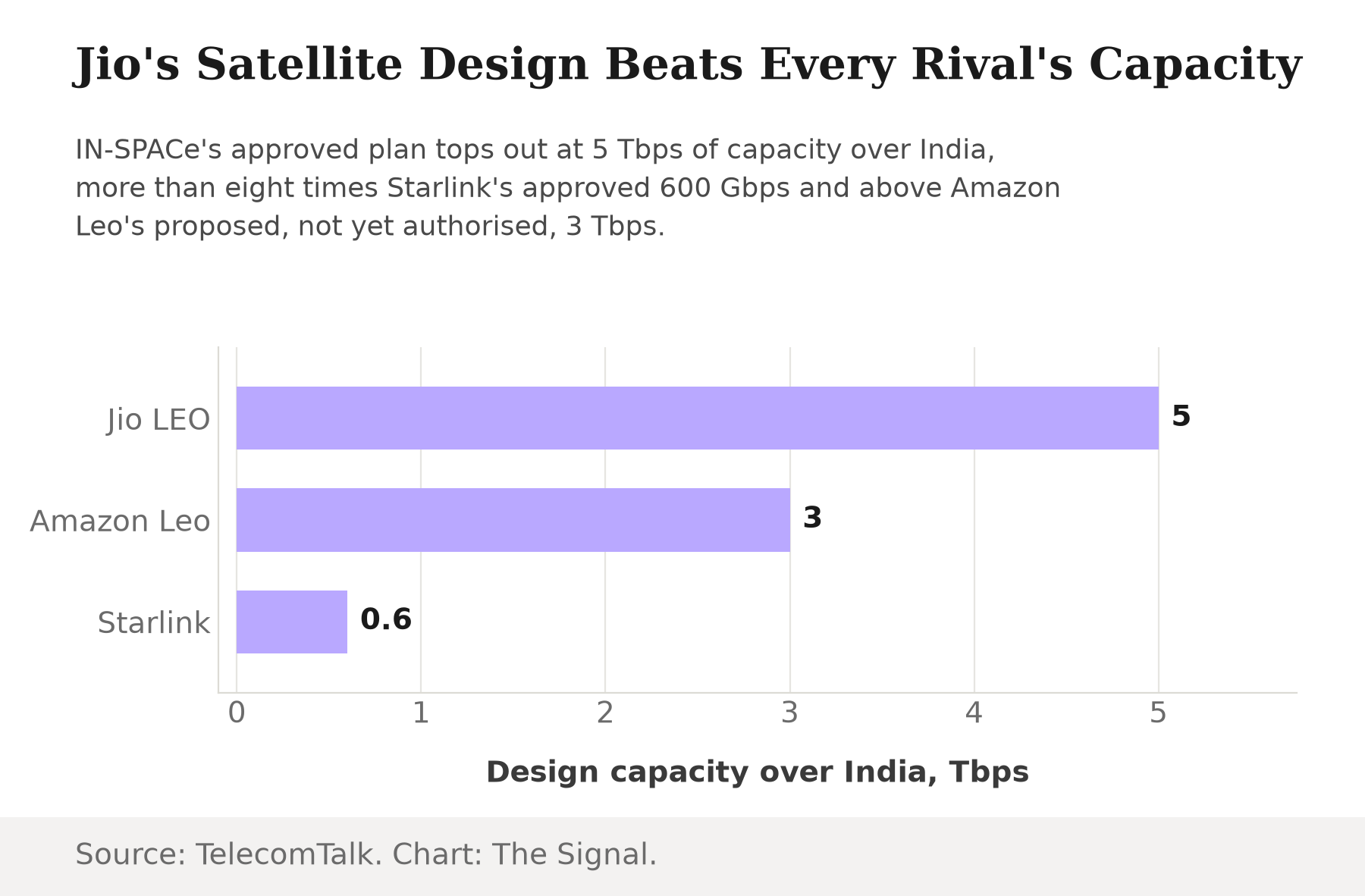
No other approved satellite plan in India carries as much capacity.
It is worth slowing down on that comparison, because what IN-SPACe actually cleared is not just a satellite design. It is a fleet on its way into India's administrative, non-auction spectrum queue, the queue Jio's own trade body was telling the government just over a year earlier would create an unfair market if it stayed as cheap as it was proposed.
The letter Jio's own lobby sent
COAI, the industry body that represents Reliance Jio, Bharti Airtel and Vodafone Idea, wrote to the Department of Telecommunications on 29 May 2025 that TRAI's satellite spectrum pricing "will undermine competition and create a non-level playing field," pointing out that terrestrial operators carry auction-determined spectrum costs equal to 18 percent to 53 percent of Adjusted Gross Revenue. The complaint was not about satellites flying. It was about what satellite operators, chiefly Starlink and OneWeb as of that May 2025 letter, would pay for spectrum compared with what Jio, Airtel and Vodafone Idea already pay.
The mechanism, not the auction
TRAI had recommended, in May 2025, that spectrum for satellite broadband and mobile services be assigned administratively rather than auctioned, for up to five years and extendable by two more, at 4 percent of Adjusted Gross Revenue subject to a minimum of Rs 3,500 per MHz per year, plus Rs 500 per subscriber per year in urban areas for the broadband service. That mechanism is not a regulator's improvisation. Section 4(4) of the Telecommunications Act, 2023 requires spectrum to be auctioned except for a First Schedule of services assigned administratively instead, and that Schedule explicitly names satellite services such as Direct-to-Home, VSAT and Mobile Satellite Service. Parliament, not TRAI alone, decided satellites would not go to auction.
The pricing formula itself is still unsettled. More than a year after TRAI's May 2025 recommendation, the Department of Telecommunications' own draft spectrum-assignment rules, released in June 2026, still do not implement any of TRAI's proposed terms. IN-SPACe's technical clearance moves Jio's constellation toward orbit; it does not settle what Jio, or any satcom operator, will actually be charged for the spectrum underneath it.
What the auction actually costs
In June 2024, India's telecom operators together paid Rs 11,340.78 crore for 141.4 MHz of terrestrial mobile spectrum in a public auction. Reliance Jio itself paid Rs 973.62 crore for a 14.4 MHz allocation in the 900 MHz band, about Rs 67.6 crore per MHz. That is the price Jio itself has paid, in the mechanism its lobby defends as the fair one.
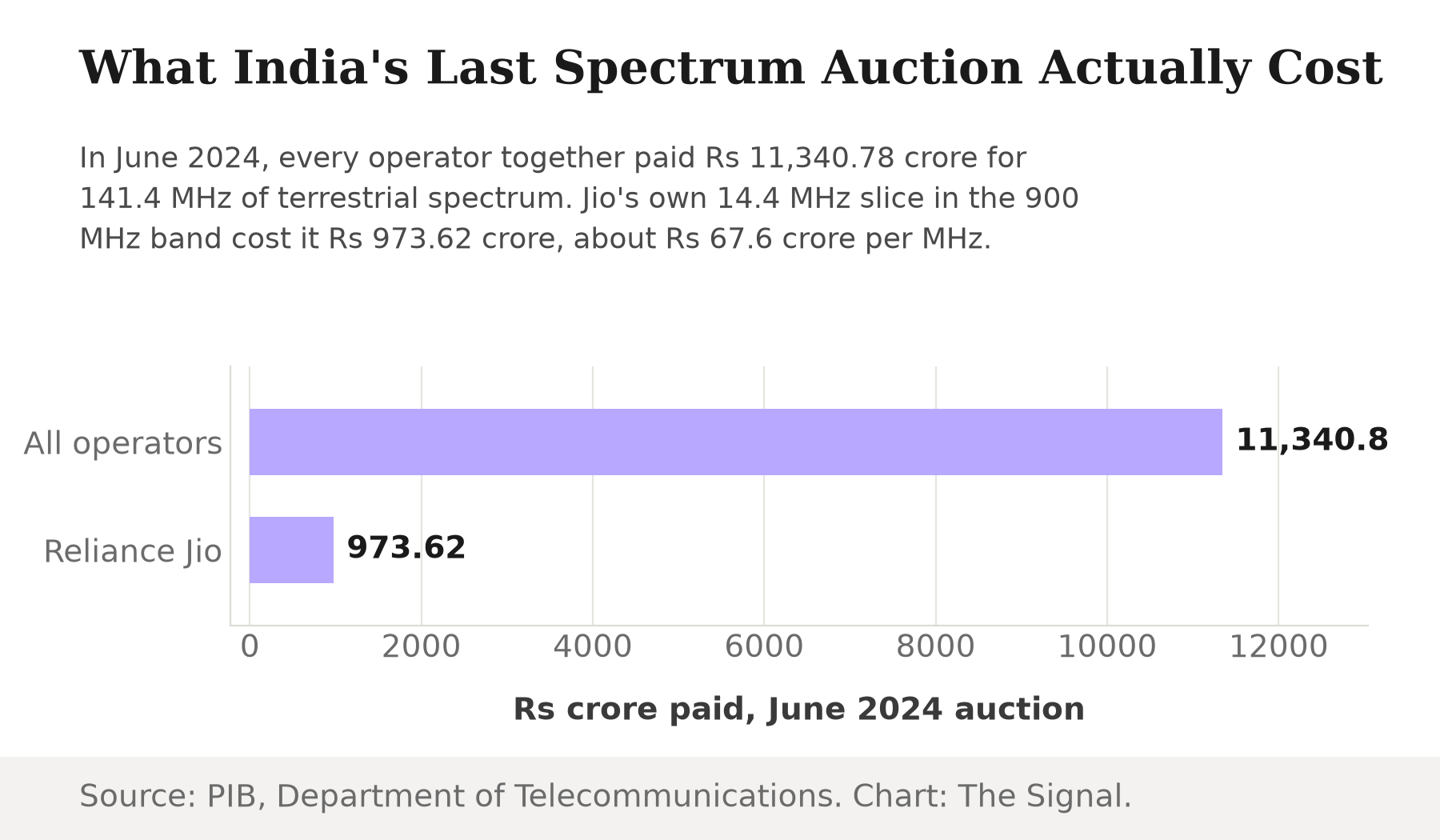
The two spectrum regimes price access on entirely different logics.
| Basis | Terrestrial mobile spectrum (auctioned) | Satellite spectrum (administrative) |
|---|---|---|
| Legal basis | Auctioned, under Section 4(4) of the Telecommunications Act, 2023 | Administratively assigned, under the Act's First Schedule for satellite-based services |
| What operators pay, on TRAI's and COAI's own figures | 18% to 53% of Adjusted Gross Revenue in auction-determined cost, per COAI | 4% of Adjusted Gross Revenue, minimum Rs 3,500 per MHz per year, plus Rs 500 per subscriber per year (urban, satellite broadband), per TRAI |
| Assignment period | Multi-year exclusive right | Up to five years, extendable by two more |
| A concrete data point | Jio paid Rs 973.62 crore for 14.4 MHz in June 2024, about Rs 67.6 crore per MHz | Formula only; no operator has yet been billed under it |
Source: Press Information Bureau (June 2024 auction); Press Information Bureau (TRAI recommendation); SatNews, citing COAI's letter; Telecommunications Act, 2023. Per-MHz figure is The Signal's calculation.
Jio's lobby, Jio's constellation
The principle both sides invoke traces back further than either the 2023 Act or TRAI's 2025 pricing paper. The Supreme Court, cancelling 122 telecom licences in its February 2012 judgment, held that "a duly publicised auction conducted fairly and impartially is perhaps the best method" for allocating a resource like spectrum, a ruling written directly against the first-come-first-served allocation at the centre of the 2G scandal. That is the exact standard COAI's May 2025 letter was reaching for when it argued satellite spectrum was priced too cheaply relative to what Jio, Airtel and Vodafone Idea pay at auction.
None of that changes because IN-SPACe has now cleared a constellation carrying Reliance's own name. The satellite fleet designed for the most capacity of any operator cleared in India will draw its spectrum through the identical administrative process, at whatever the eventual satcom charge turns out to be, that COAI's letter said was unfair to companies exactly like Jio. A trade body's position on fair pricing is supposed to describe a principle, not a beneficiary.
The honest objection
The strongest case for treating satellite spectrum differently is technical, not competitive. NGSO satellite spectrum is coordinated internationally and can be used by multiple operators across the same geography simultaneously, in ways a geographically exclusive 900 MHz mobile licence is not. That is a real engineering distinction, and it is why Parliament wrote satellite services into the Telecommunications Act's own First Schedule for administrative assignment rather than auction, not a workaround invented for any single applicant.
But that technical case was exactly as true in May 2025, when COAI argued the opposite conclusion on competitive grounds rather than technical ones. If shared, internationally coordinated spectrum justifies a different pricing logic, it justified that logic for Starlink and OneWeb exactly as much as it now does for Jio's own fleet.
The Signal
Jio's constellation is not being cleared into a loophole built for it. Section 4(4)'s First Schedule and TRAI's 2025 pricing formula were written for the whole category of satellite operators, Starlink, OneWeb and Amazon Leo among them. What has changed is which company now has the largest approved reason to want that formula kept cheap. Watch what COAI's members say about satellite spectrum pricing once Jio's own fleet is earning revenue on it, and watch whether the charge Jio eventually pays looks anything like the Rs 67.6 crore per MHz it paid for terrestrial spectrum in June 2024, or the far smaller administrative minimum TRAI proposed for satellites in May 2025. A company's real position on fair pricing shows up in what it pays, not in what its lobby writes to the ministry.
Reporting basis: IN-SPACe's technical clearance and Jio's satellite capacity figures are as reported by Outlook Business and TelecomTalk, each independently describing the same approval. OneWeb's India throughput figure is as reported by The Register. TRAI's satellite spectrum pricing recommendation and the June 2024 spectrum auction results are from Press Information Bureau releases carrying the regulator's and the Department of Telecommunications' own figures. COAI's objection to that pricing is as reported by SatNews, carrying Financial Express's account of COAI's letter to the Department of Telecommunications. The status of DoT's own draft spectrum rules as of June 2026 is as reported by Outlook Business. The 2012 Supreme Court holding on auctions is from the judgment text hosted by Indian Kanoon, and the administrative carve-out for satellite services is from the text of the Telecommunications Act, 2023. The per-MHz cost figure is The Signal's calculation from the PIB auction data.