Two announcements, two months apart, made India's AI ambitions look like a straightforward compute race. The Adani Group said in February 2026 it would invest $100 billion directly in renewable-powered, AI-ready data centres by 2035, expecting the commitment to catalyse a further $150 billion across the supporting ecosystem. Google followed with roughly $15 billion committed over 2026 to 2030 for its first AI hub in the country, a gigawatt-scale campus in Visakhapatnam, Andhra Pradesh. Read only the press releases and the story is simple: India is buying its way into the AI compute race, one hyperscale campus at a time.
Adani's $100 billion pledge and Google's $15 billion commitment are the two largest India AI infrastructure pledges announced in 2026.
| Investor | Commitment | Window |
|---|---|---|
| Adani Group | $100 billion direct (plus an expected $150 billion ecosystem) | By 2035 |
| Approximately $15 billion | 2026 to 2030 |
Source: Adani Group; Google. Combined figure in the text is The Signal's calculation.
Add Adani's pledge to Google's and roughly $115 billion in direct commitments is now on the table for Indian AI infrastructure, before Adani's own projected $150 billion ecosystem multiplier even lands (our calculation, summing the two pledges above). That is real money, aimed at real chips.
It is worth slowing down on that framing. Shriram AMC's analysis, cited by BusinessToday, found that GPUs account for nearly 60% of an AI data centre's capital cost, yet concluded that power, not chip supply, is the ultimate constraint on how much of this gets built: a single AI-grade data centre with one gigawatt of capacity can consume as much electricity as 750,000 homes.
A single 1 GW AI data centre can draw as much power as 750,000 homes.
The scale is not hypothetical. India's total data centre capacity already crossed 1,700 MW in 2025 and is projected to grow another 30% in 2026, with Telangana, Maharashtra, Tamil Nadu, Andhra Pradesh and Uttar Pradesh expected to lead the buildout. Every megawatt of that is a megawatt the grid, not a chip supplier, has to deliver.
The grid is already running hot
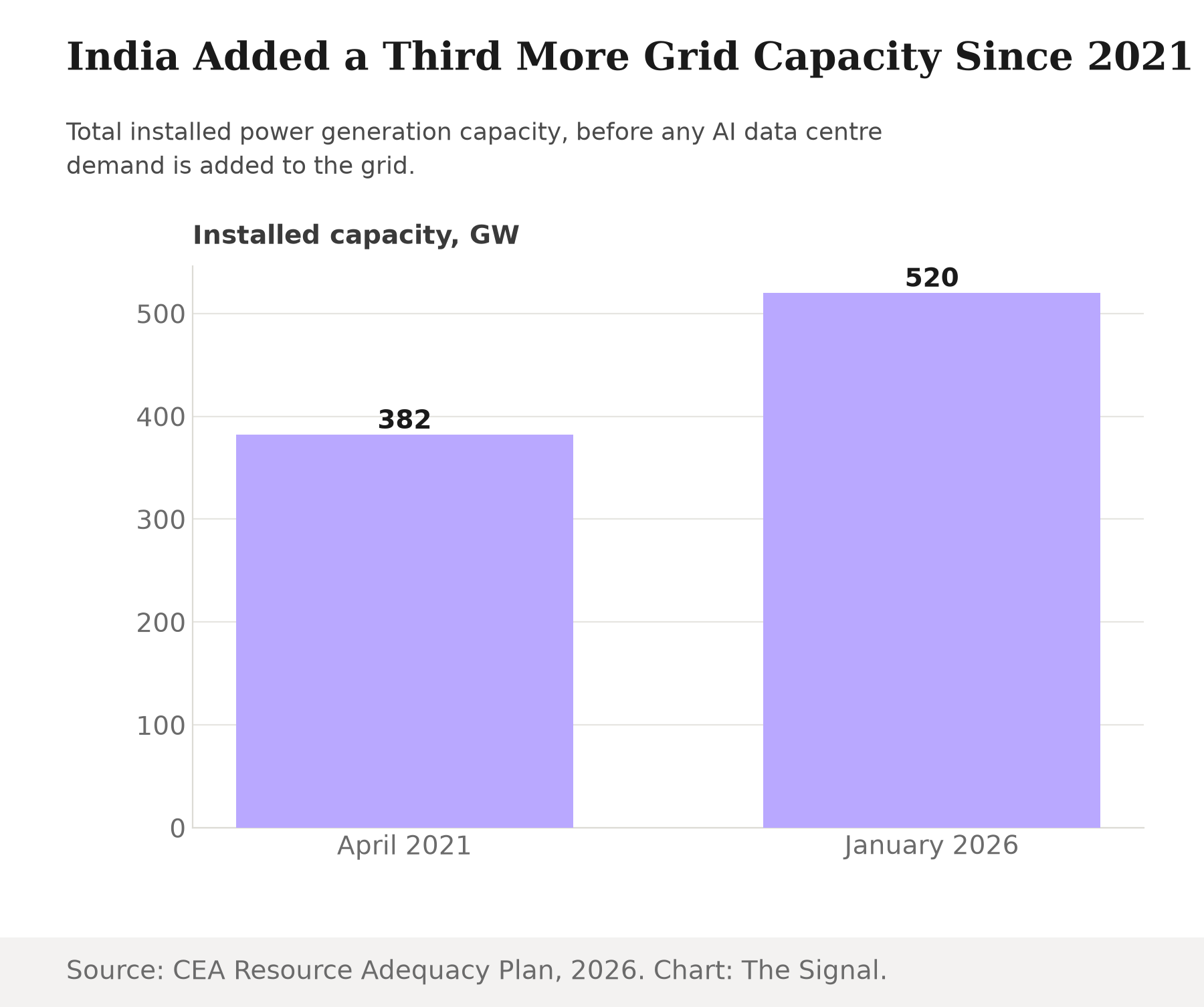
India's power system has not stood still. The Central Electricity Authority's Long-Term National Resource Adequacy Plan, published in March 2026, records total installed generation capacity growing from about 382 GW in April 2021 to over 520 GW by January 2026, a rise of nearly 36% in under five years.
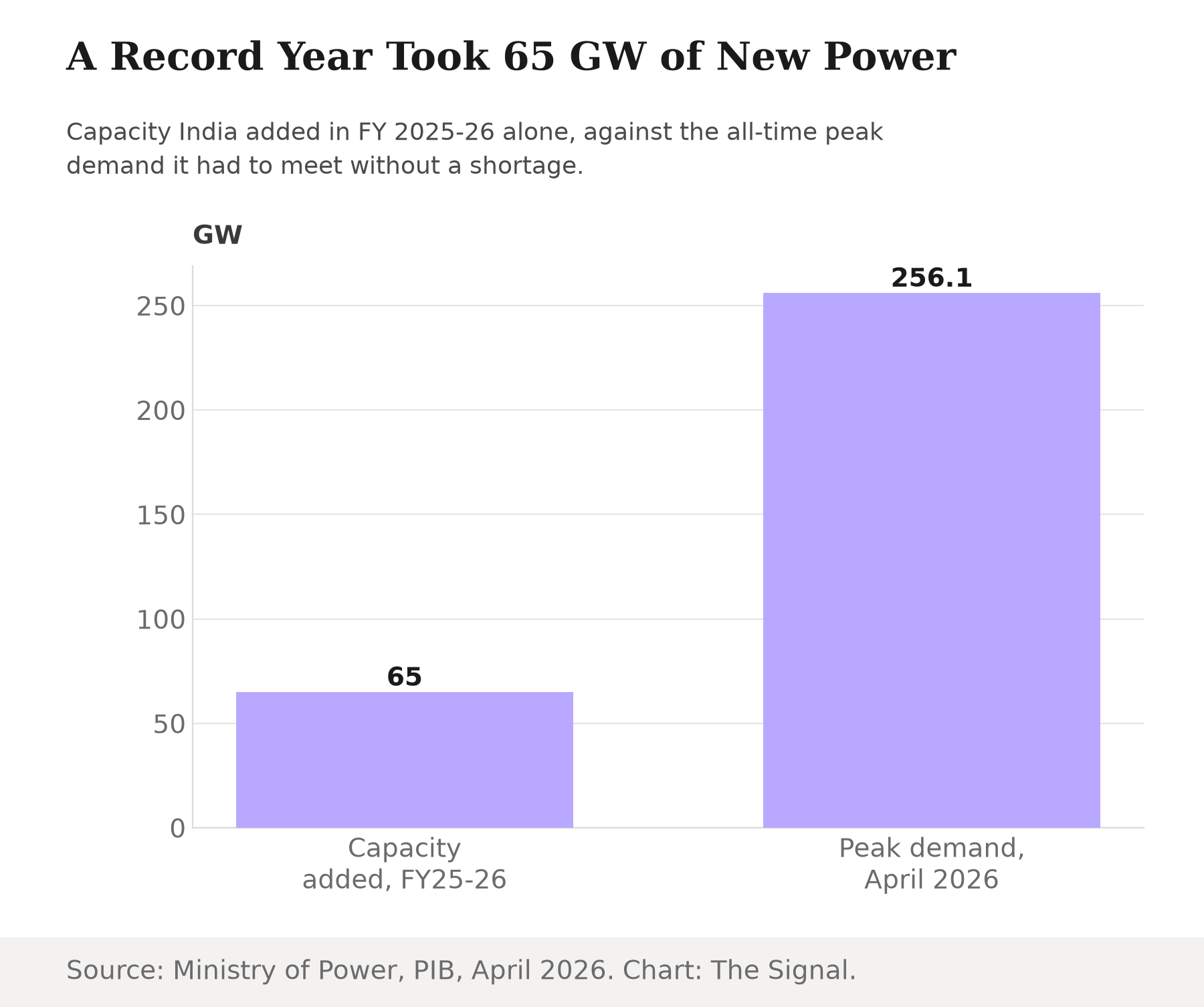
That growth has not been idle headroom. India needed roughly 65 GW of new generation capacity in FY 2025-26 alone to meet a record summer peak demand of 256.1 GW on 25 April 2026 without any shortage: new capacity equal to roughly a quarter of that same peak, added in a single year just to keep the lights on.
The CEA's own long-range planning does not expect that pace to ease. It projects peak electricity demand growing at a 5.58% compound annual rate from 2024-25 to 2035-36, reaching 459 GW by the end of that decade. And the planners are not treating AI infrastructure as an afterthought: the CEA's own methodology lists data centres as an emerging load requiring a separate demand-projection adjustment, alongside green hydrogen production and efficiency effects, when it builds these state-wise forecasts. The grid planner has already put a line item for this on its own balance sheet.
The water question nobody priced in
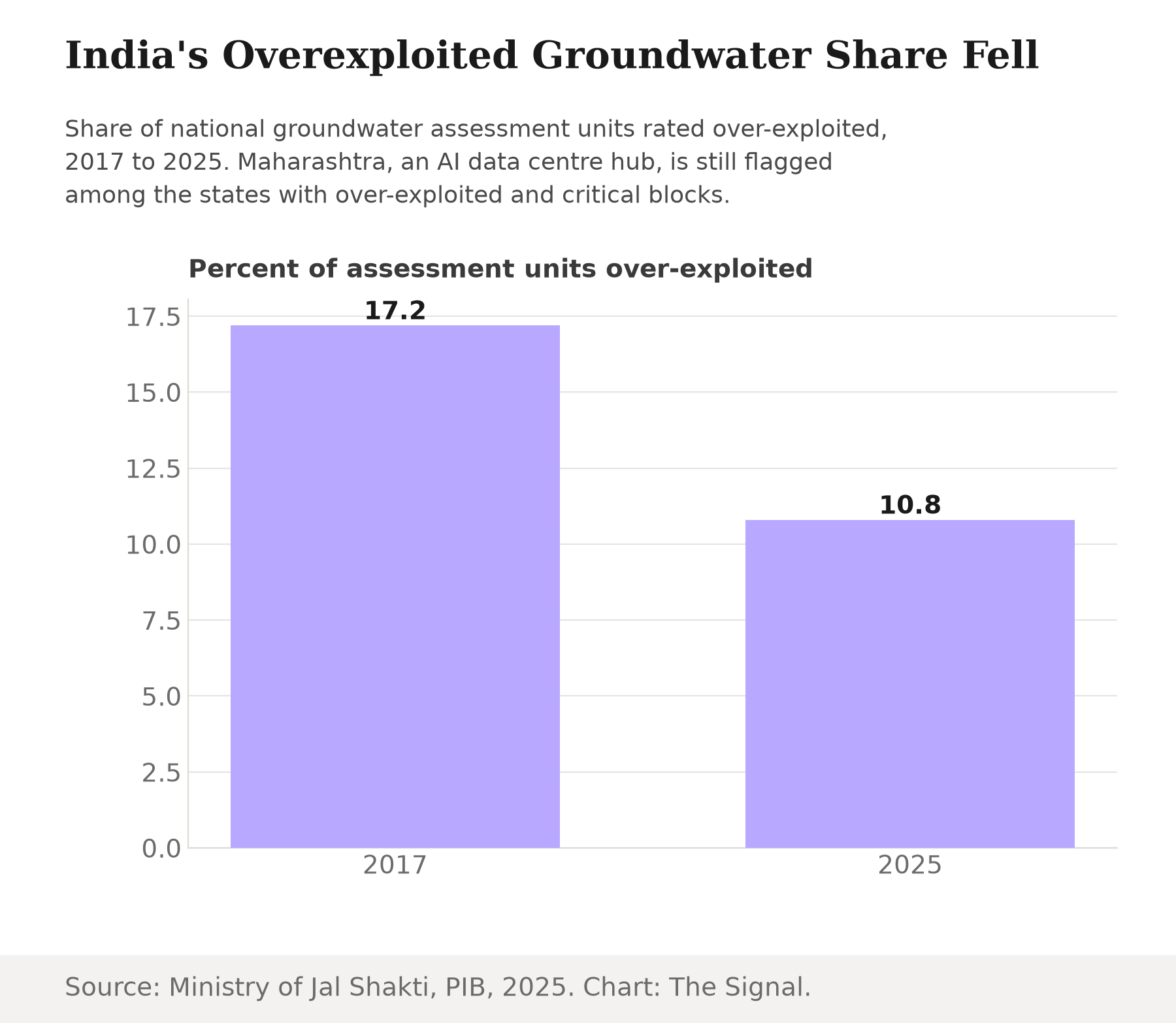
A hyperscale data centre does not just need power. It needs water, continuously, to keep the chips cool. CEEW and SYSTEMIQ estimate that a typical 100 MW hyperscale facility can draw around 2 million litres of water a day for on-site cooling alone, and that India's data centres already accounted for roughly 150 billion litres of annual water use in 2025, a figure they expect to more than double by 2030. The Ministry of Jal Shakti's 2025 national groundwater assessment found the share of over-exploited assessment units nationally fell to 10.8%, down from 17.2% in 2017, a genuine improvement. But that same assessment explicitly names Maharashtra, one of the states where hyperscale AI data centres are now clustering, among those still carrying over-exploited, critical and semi-critical groundwater blocks. Next door in Telangana, the picture is sharper still: 11 of Hyderabad district's 16 mandals are already categorised as over-exploited for groundwater, with four more critical and one semi-critical, and Hyderabad is one of the metro hubs anchoring the state's own AI data centre buildout.
The scale of the ask is not small elsewhere either. A 2026 preprint by researchers at UC Riverside, Caltech and RIT estimates that, if 2024 water-use intensity persists, US data centres could collectively require 697 to 1,451 million gallons a day of new water capacity through 2030, a volume the researchers compare to New York City's entire daily water supply. That estimate is American, not Indian, and cooling technology and local climate vary by site, so it is not a substitute for India's own numbers above. But it is the same class of machine India is now building at scale, in the same handful of states, Telangana, Maharashtra, Tamil Nadu, Andhra Pradesh and Uttar Pradesh, that are expected to lead the investment, the same map on which Maharashtra and Telangana already carry groundwater flags of their own.
The honest objection
The strongest case against treating power and water as a binding constraint is that India's system has absorbed extraordinary strain before and kept working. Installed capacity has grown nearly 36% since 2021, and the country met an all-time peak demand of 256.1 GW in April 2026 without a shortage anywhere on the grid. Groundwater over-exploitation, at the national level, has fallen by more than a third since 2017. And CEA's planners already model data centres as a known load, not a surprise input. On this reading, India's institutions have shown they can plan for exactly this kind of growth, and the AI buildout is simply the next line item in a system built to expand.
That case is real, and the national numbers back it up. But national averages are the wrong lens for a load that is not national. The AI data centre boom is landing in five specific states, and one of those states, Maharashtra, is also named on the list of places where groundwater has not caught up with the national recovery; in a second, 11 of Hyderabad district's 16 mandals in Telangana are already over-exploited outright. A grid that needed 65 GW of new capacity in one record year to meet ordinary demand, layered onto a groundwater map that has only partly healed in the exact states drawing the new load, is not proof that the system will fail. It is proof that the margin for a new, concentrated, always-on industrial load is thinner than a $100 billion press release suggests.
The Signal
The AI investment numbers coming out of India in 2026 are real, and so is the compute they will eventually buy. But GPUs are a purchase order; power and water are a construction timeline measured in years, sited in specific states, competing with agriculture, industry and households that were there first. Shriram AMC's own framing of the trade-off is blunt: it is power, not chip supply, that will set the pace of AI expansion. Watch where the next data centre announcement is actually sited, not how large its dollar figure is. If it lands in a state with spare grid capacity and a healthy aquifer, the buildout is sustainable. If it lands in Maharashtra or Telangana anyway, the number that ends up mattering will not be the investment. It will be the load-shedding notice.
Reporting basis: the Adani and Google investment figures are from each company's own announcements. The GPU cost share, the 750,000-homes power-draw comparison, and the framing of power over chip supply as the binding constraint are from a Shriram AMC report, as cited by BusinessToday. India's installed capacity, its peak-demand projections and its data centre planning methodology are from the Central Electricity Authority's Long Term National Resource Adequacy Plan; the FY 2025-26 capacity addition and the record April 2026 peak demand are from the Ministry of Power's National Load Despatch Centre, via the Press Information Bureau. The national groundwater assessment and its Maharashtra flag are from the Ministry of Jal Shakti's 2025 report, also via the Press Information Bureau. The Hyderabad district mandal breakdown is from the Ministry of Jal Shakti's district-wise groundwater categorisation, as reported by Telangana Today. The data centre capacity and state-clustering figures are from a CBRE Group report, as cited by BusinessToday. The per-facility and national water-use figures for India's data centres are from a CEEW and SYSTEMIQ report. The US water-demand figure is from a 2026 preprint by researchers at UC Riverside, Caltech and RIT, and is presented as an illustrative American figure alongside India's own numbers, not a substitute for them. The combined $115 billion investment total is The Signal's calculation from the Adani and Google announcements.