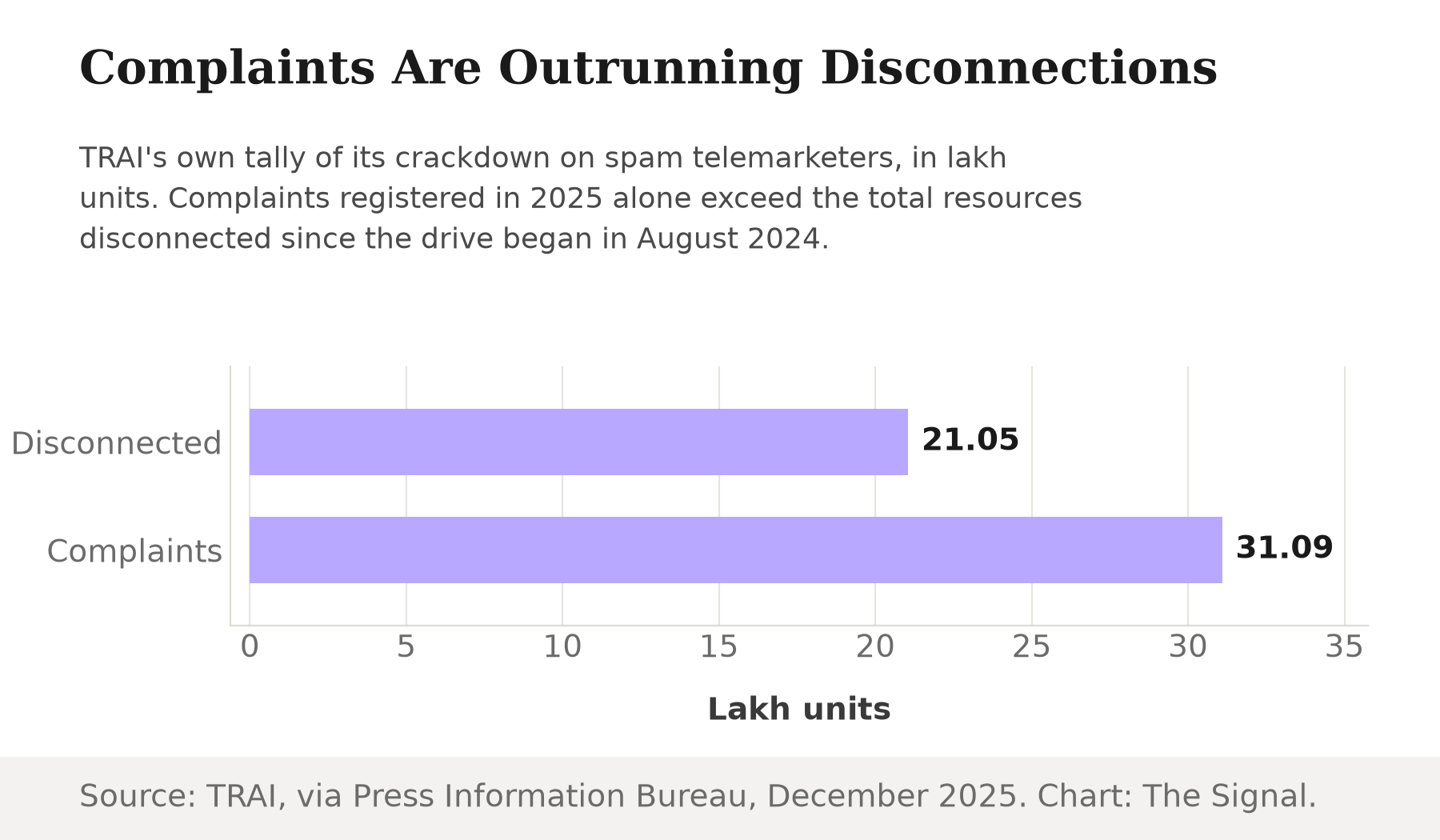
By the numbers, India's regulator looks like it is winning its war on spam calls. Cumulatively, since August 2024, TRAI's enforcement drive has disconnected over 21.05 lakh telecom resources, while 31.09 lakh unsolicited-commercial-communication complaints were registered in 2025 alone. Read as a scoreboard, it looks like a regulator working overtime to shut spammers down.
It is worth slowing down on that framing. In December 2024, the Department of Telecommunications carved out the "1600" number series exclusively for government and BFSI (banking, financial services and insurance) callers, with TRAI directing all IRDAI-regulated insurers to complete migration onto it by 15 February 2026. The point of the series was to give legitimate institutional callers, your bank, your insurer, a government office, a recognisable, trustworthy prefix. That migration is still catching up to its own deadlines: as of 19 November 2025, only about 485 BFSI entities had adopted the 1600 series, subscribing to a total of over 2,800 numbers, before TRAI mandated timebound completion running from January through March 2026. The series that is supposedly too trustworthy to screen was, as of November 2025, barely populated at all. To make that prefix worth trusting, TRAI's February 2025 amendment to its telecom-customer-preference rules legally bars call-management apps from tagging, blocking or filtering incoming calls from the designated commercial and government number series. An app like Truecaller cannot mark a 1600-series call as spam, whatever the call actually is. The series built to be recognisably safe is also, by law, invisible to the software millions of Indians rely on to screen their calls.
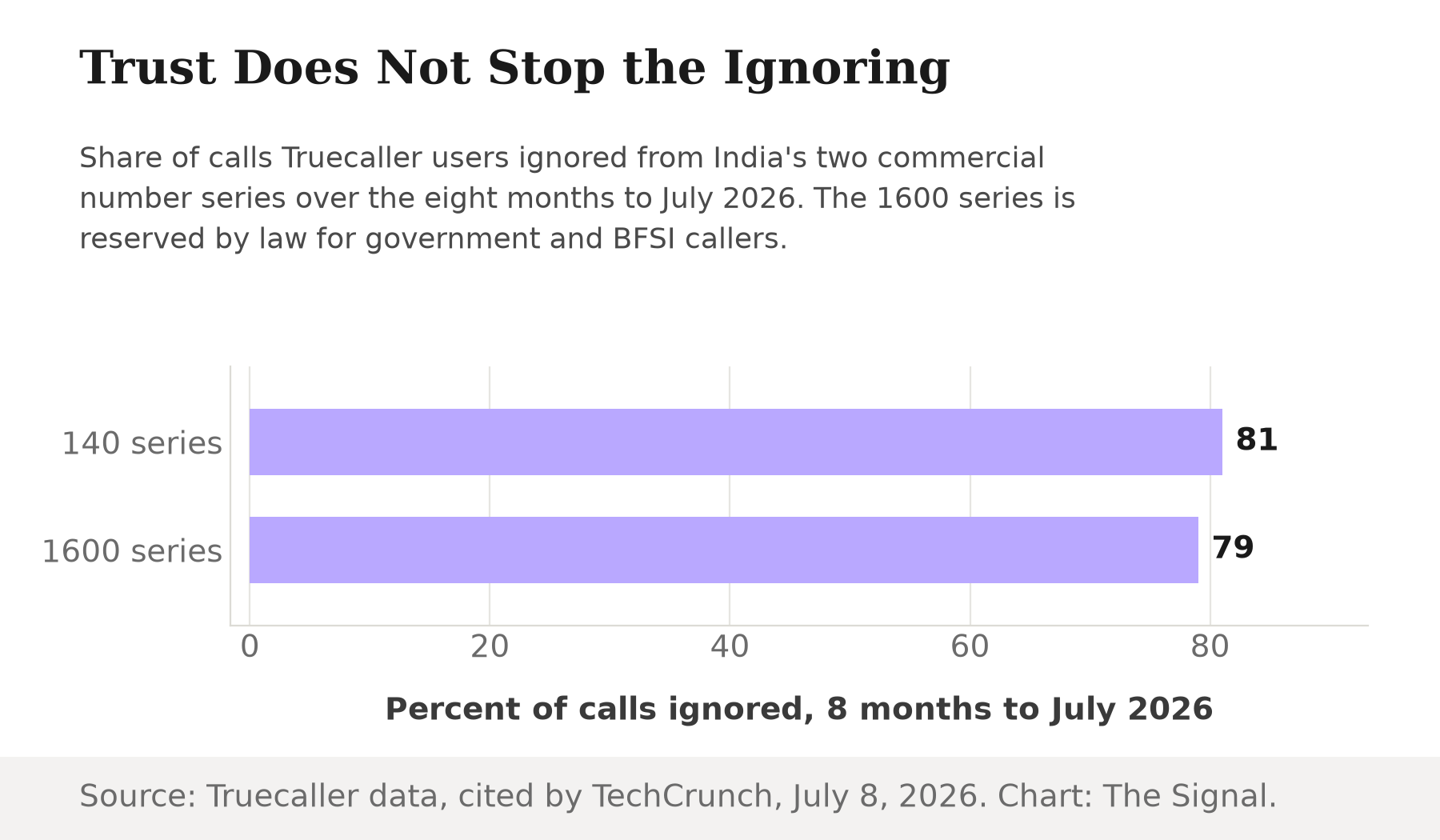
Nearly as many people ignore the "safe" series as the ordinary one.
Truecaller users ignored 81% of calls from India's 140 commercial number series and 79% of calls from the 1600 series over the eight months to July 2026, a two-point gap between a series the app can flag and one it legally cannot.
A shield with no alarm
The logic behind the February 2025 rule is straightforward enough: before it, a bank's legitimate service call or a government department's transactional message could get swept up in the same spam-tagging that catches telemarketers, undermining the very calls the 1600 series exists to protect. Stopping apps from tagging the designated series was meant to guarantee that a call from it always reaches the user looking like what it claims to be.
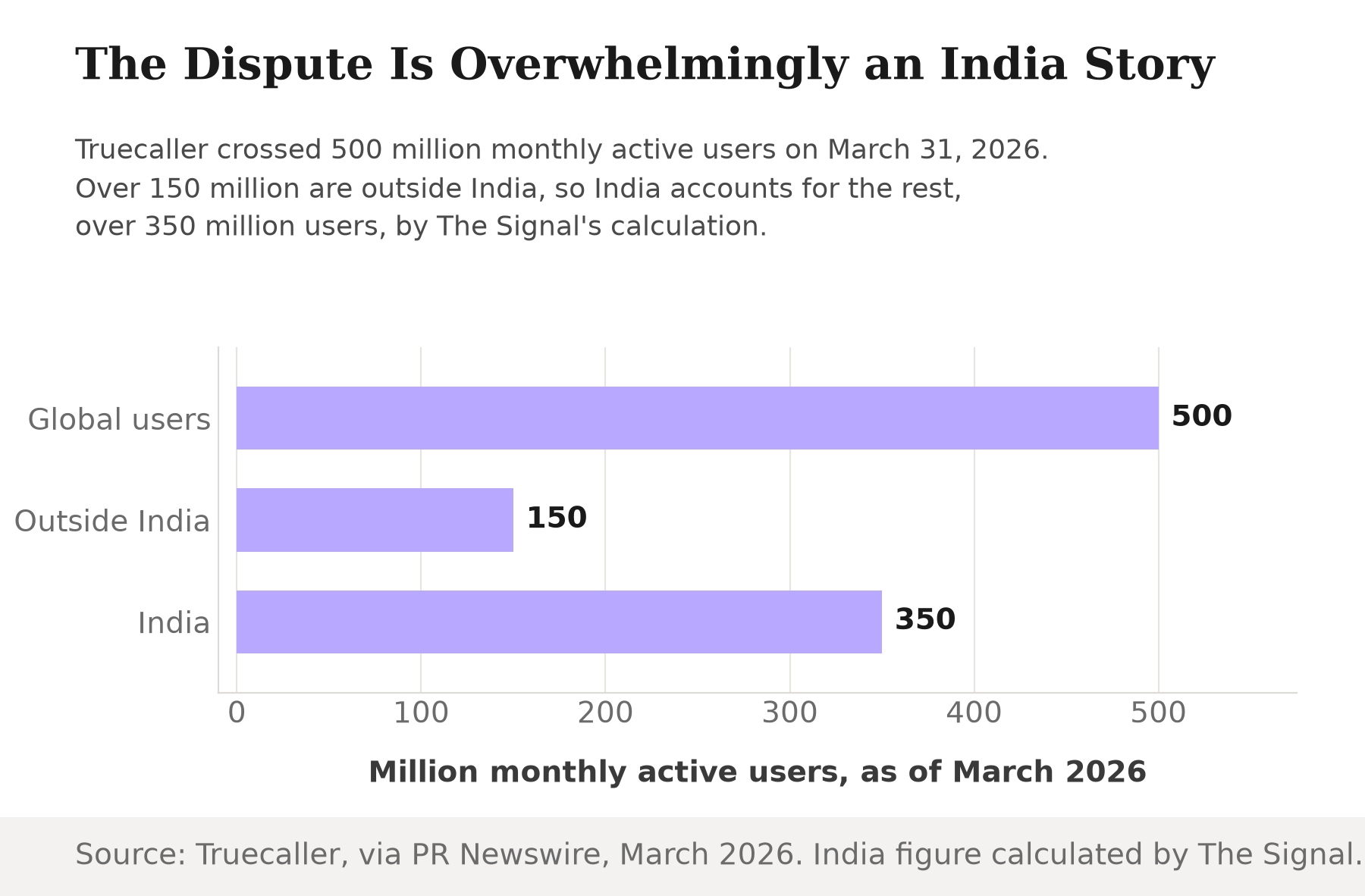
What it also did was remove the one layer of automated scrutiny India's roughly 500-million-plus caller ID user base has come to depend on. Truecaller crossed 500 million monthly active users on 31 March 2026, with more than 150 million of them outside India, which puts India's share of that base at well over 350 million users, by The Signal's calculation. This is, overwhelmingly, an Indian dispute playing out over an Indian regulatory design.
The number that gives the shield away
If the 1600 series worked as intended, its calls should be answered, not screened out, at a rate closer to zero than to the 140 series. Instead, the two are two points apart, and the gap is moving in the wrong direction. Daily blocking actions against 1600-series numbers have more than tripled since October 2025, even as users can no longer rely on the app itself to warn them. Nobody warns users this series is risky. They learn it the hard way, call by call, and then reach for the manual block button themselves.
Put a number on that trend line and it looks worse, not better. Daily blocking of the 1600 series rose 208% between October 2025 and July 2026, which works out, by The Signal's calculation, to roughly 40,600 blocks a day back in October climbing to the 125,000 a day Truecaller counts now. That is not a shield settling in. It is a shield that users are manually reinforcing at three times the rate they were in October 2025.
Truecaller's own numbers make the same point from a different angle. Its CEO, Rishit Jhunjhunwala, said users have taken 7.4 crore, or 74 million, manual blocking actions against the 140 and 1600 series combined over the eight months to July 2026, and that users currently block 400,000 calls a day from the 140 series and 125,000 a day from the 1600 series. A number series that exists specifically because it is off-limits to spam-tagging software is generating 125,000 manual blocks a day, entirely on user judgment, with no institutional flag to guide it.
| 140 series | 1600 series | |
|---|---|---|
| Reserved for | General commercial callers | Government and BFSI entities only, since Dec 2024 |
| Can Truecaller tag or block it automatically? | Yes | No, barred by TRAI's Feb 2025 rule |
| Share of calls ignored, 8 months to Jul 2026 | 81% | 79% |
| Manual user blocks per day | 400,000 | 125,000 |
Source: TRAI's Feb 2025 regulation; TechCrunch; Free Press Journal.
TRAI wants a different kind of power
TRAI has not conceded the point that its own carve-out created a blind spot. Instead, it has asked to be designated an "authorised agency" under India's IT Act so it can act directly against caller ID apps such as Truecaller, Hiya and Whoscall for labeling 140 and 1600-series calls as spam. Read against the ignore-rate numbers, this is a regulator asking for enforcement teeth over the apps that are, in practice, the only thing standing between users and the numbers TRAI itself has ruled off-limits to those same apps.
A rule meant to protect legitimate institutional callers from wrongful spam-tagging has produced a request for more regulatory control over the spam-detection industry, not less. TRAI's enforcement machinery disconnected over 21.05 lakh telecom resources cumulatively since August 2024, against 31.09 lakh UCC complaints registered in 2025 alone, a gap of roughly ten lakh, by The Signal's calculation, even before accounting for the newer, legally shielded channel.
The honest objection
The strongest case for TRAI's design is that a false-positive problem is a real problem too. A bank's OTP call or a government department's transactional message getting auto-tagged as spam has its own cost, in missed payments, missed appointments, and eroded trust in exactly the institutions the 1600 series is meant to protect. On this view, banning apps from touching the designated series was the correct trade: accept a temporary detection gap in exchange for guaranteeing that legitimate institutional calls always land clean. India ranks fifth among the world's most-spammed countries, after Indonesia, Chile, Vietnam and Brazil, out of more than 68 billion spam and fraud calls Truecaller identified worldwide in 2025, so no single design choice was ever going to solve the underlying volume problem on its own.
That case explains why the rule was written. It does not explain why the ignore rate on the protected series sits within two points of the unprotected one, or why blocking actions against it are tripling months into the fix rather than falling. A rule built to protect trust in a channel should widen the gap between that channel and an ordinary commercial one over time. Fourteen months after the shield went up, the gap has not widened. It has barely opened at all.
The Signal
TRAI solved a real problem, wrongful spam-tagging of legitimate institutional calls, by making an entire number range legally invisible to the software that screens for spam. It did not solve who watches that range once something abusive gets onto it, because nothing is allowed to watch automatically. What is left is 74 million manual blocking actions over the eight months to July 2026 and a regulator now asking for the legal standing to go after caller ID apps directly. Watch two things: whether IRDAI-regulated insurers actually completed their move onto the 1600 series by the 15 February 2026 deadline, which has already passed, and whatever comes of TRAI's bid for authorised-agency status. If the ignore rate on the 1600 series falls well below the 140 series once that migration is complete and the traffic is genuinely institutional, the shield is working as designed. Short of that, the number series meant to signal trust will keep functioning as the safest address spam can have.
Reporting basis: the enforcement disconnection and complaint totals, the 1600-series migration deadline and progress, and the ban on apps tagging the designated number series are all from TRAI's own releases and regulations, via the Press Information Bureau and TRAI's own published Direction, Regulation and Press Release. The ignore-rate and blocking-trend figures are Truecaller's internal data as reported by TechCrunch. The CEO's manual-blocking figures are as reported by the Free Press Journal, and the precise rise in 1600-series blocking is as reported by FoneArena, each a single source for those specific numbers. Truecaller's global user count and its global spam ranking are from the company's own press releases, distributed via PR Newswire, and represent the company's self-reported data rather than an independent audit. India's share of Truecaller's user base, the gap between complaints and disconnections, and the October 2025 daily-blocking baseline implied by the reported rise are The Signal's calculations from those figures.