An Indian court cited case law that did not exist. In the Essel Infraprojects insolvency dispute, the Supreme Court set aside a National Company Law Tribunal ruling after finding it relied on hallucinated, AI-generated citations, and directed the Bar Council of India to constitute a committee to examine the problem. Read as a single event, it looks like the system working exactly as it should: a court catches an error, refers it to the right body, and moves on. Widen the lens to 2026 and the same story repeats in three more places that have nothing to do with the Bar Council. A ministry has already changed platform-takedown law twice, an industry lobby has stood up its own AI council, and a global business body is pushing its own framework at the WTO and the UN. India does not yet have a single AI law passed by Parliament. It already has several bodies acting as if it does.
It is worth slowing down on that. These are not four committees feeding one law. They are four institutions, of different kinds, each producing a different kind of rule, on parallel and largely separate timelines.
MeitY already sits inside the Supreme Court's new AI body, and still runs its own separate AI rulebook.
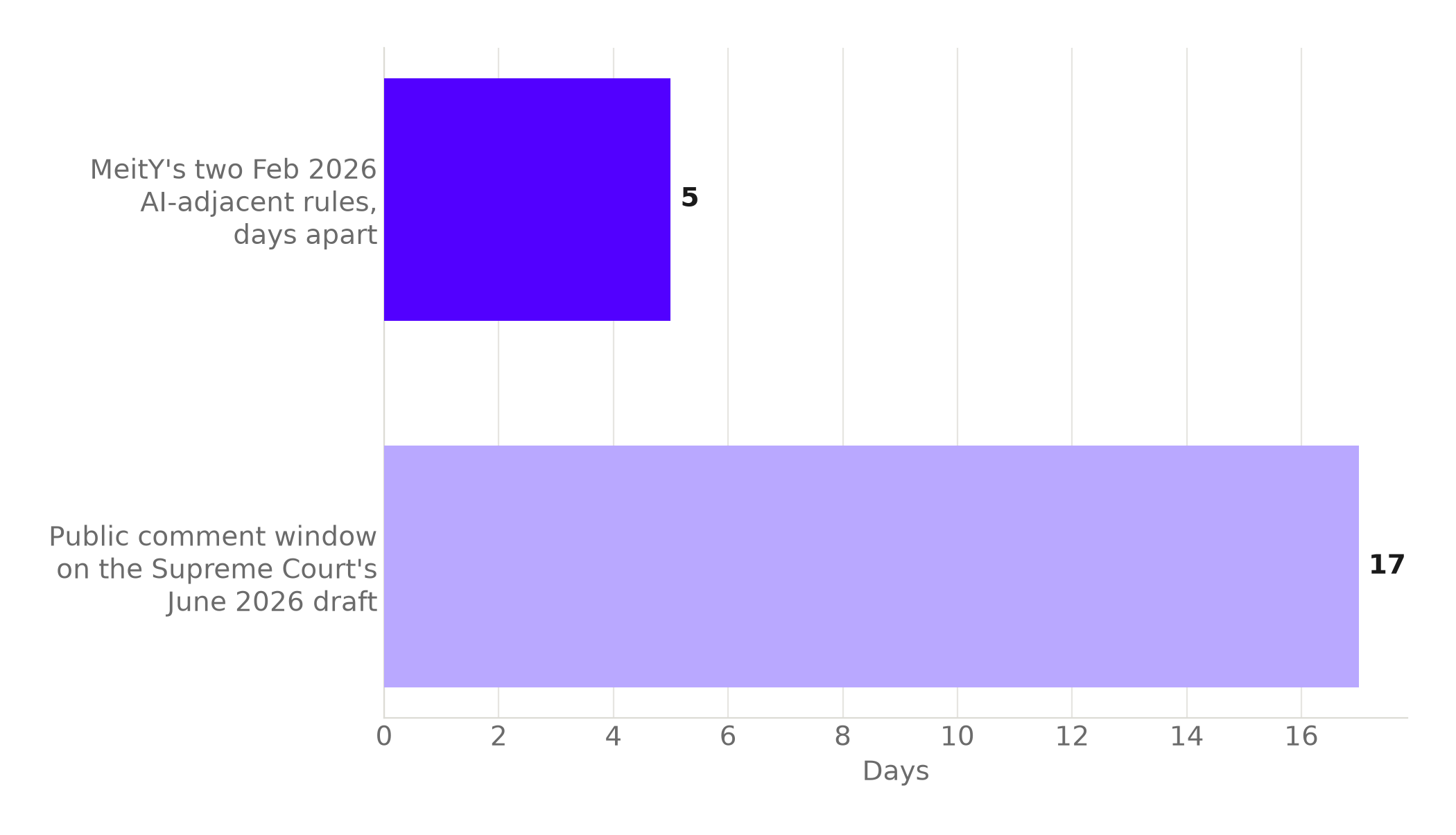
The Supreme Court's Artificial Intelligence Committee published a preliminary draft of the "Regulations for Use of Artificial Intelligence (AI) in Courts, 2026" on 3 June 2026 and invited public comment, with submissions due by 20 June 2026. Buried in that draft is this: the regulations would create a permanent Apex Body seated at the Supreme Court whose ex officio members include an officer not below Joint Secretary rank from the Ministry of Electronics and Information Technology. The one ministry with a formal seat inside the judiciary's AI body is, at the same time, writing an entirely separate set of AI-adjacent rules of its own, on its own calendar, answerable to no one at the Supreme Court.
Four institutions, four different kinds of rule
| Institution | Kind of instrument | Status as of mid-2026 | Binds |
|---|---|---|---|
| Supreme Court's AI Committee | Procedural regulation for courts | Preliminary draft published 3 June 2026, comments due 20 June 2026 | Courts and litigants using AI |
| MeitY | Binding subordinate law (IT Rules amendment) plus non-binding guidelines | Amendment in force from 10 February 2026; guidelines released 15 February 2026 | Platforms (binding); voluntary adopters (guidelines) |
| IAMAI | Industry council (AI Council of India) | Launched, organised around three focus areas | Member companies, voluntarily |
| ICC | Global advocacy framework | Ongoing, represented at the WTO, the UN and the Council of Europe | Non-binding |
None of the four needs the others' sign-off to act, and none is Parliament.
The ministry is already moving, just not on the big law
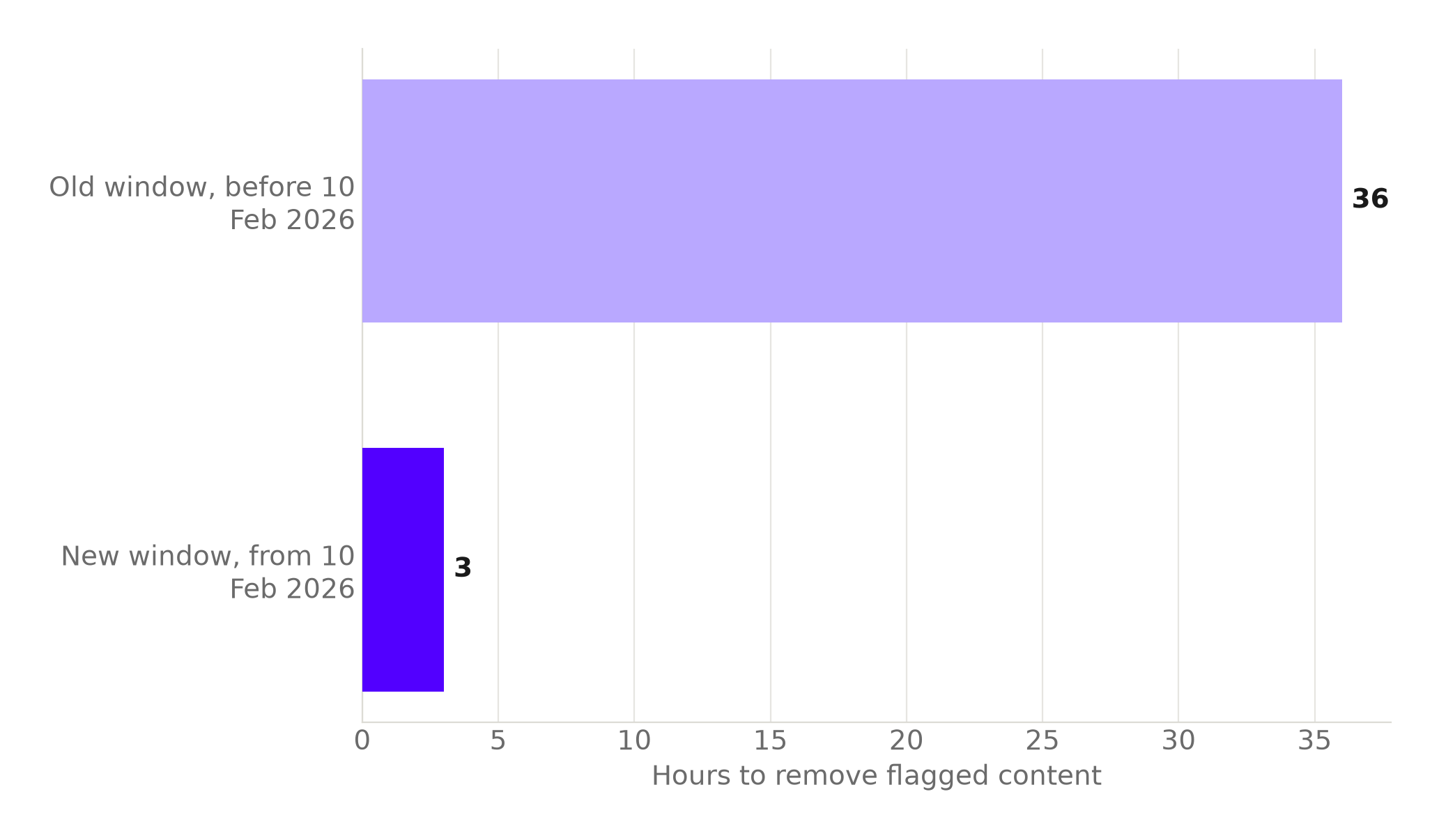
MeitY has not been waiting for a dedicated AI act to touch AI at all. Its Information Technology (Intermediary Guidelines and Digital Media Ethics Code) Amendment Rules, 2026, dated 10 February 2026, legally define "synthetically generated information" as audio, visual or audio-visual content that is artificially created or altered to appear real, the working legal description of a deepfake. The same amendment did something sharper: it cut the takedown window for unlawful content flagged with "actual knowledge", meaning a court order or an authorised government notice, from thirty-six hours to three hours.
The compliance clock for flagged content just got twelve times shorter.
Thirty-six hours was already a tight compliance window by global standards. Three hours is a different order of urgency entirely, and it took effect through a subordinate-law amendment, not a new statute.
Source: Information Technology (Intermediary Guidelines) Amendment Rules, 2026. Chart: The Signal.
That amendment was not sprung on the public without process. A MeitY notice dated 22 October 2025 had already invited stakeholder feedback on the draft rules, with submissions due by 6 November 2025, a fifteen-day window not far off the Supreme Court's own seventeen-day window on its draft. The final rule was not notified until more than three months later. The ministry did consult. It just consulted on its own clock, months ahead of the rule taking effect, rather than in the days immediately before.
Five days after that amendment took effect, MeitY published a second, entirely different kind of document. A drafting committee it had constituted in July 2025 produced the India AI Governance Guidelines, released 15 February 2026 and anchored in seven guiding "sutras": Trust is the Foundation, People First, Innovation over Restraint, Fairness and Equity, Accountability, Understandable by Design, and Safety, Resilience and Sustainability, timed ahead of the AI Impact Summit 2026. One instrument is binding law with teeth measured in hours. The other has no enforcement mechanism at all: a set of voluntary principles. Both came from the same ministry, five days apart, and neither is the comprehensive AI statute that would eventually supersede them.
Industry is not waiting either
The two non-government bodies in this picture are not lobbying Parliament to hurry up. They are building their own structures now. The Internet and Mobile Association of India launched the AI Council of India as a national platform organised around three focus areas, including localised AI benchmarks for India's more than 500 million non-English internet users, a population most mainstream, English-first AI benchmarks were never built to measure. The other two focus areas go well beyond that one benchmark: AI Infrastructure and Compute, aimed at expanding GPU-cluster access and cutting compute costs for startups and MSMEs, and Applied AI and Lean Innovation, aimed at scaling cost-effective, open-source-led AI across healthcare, agriculture, manufacturing, financial services and education. This is not a single working group with one output. It is an industry body building infrastructure and application policy alongside its benchmarking work, before any of the three government tracks has finished its own.
Source: MeitY's amendment rules, PIB and the Supreme Court's AI Committee notice. Day counts are The Signal's calculations from those dates. Chart: The Signal.
The gap between how MeitY moves and how the Supreme Court moves is itself telling: a ministry issuing two AI-adjacent instruments five days apart, against a court inviting the public to weigh in on its own draft for seventeen days. Neither number is wrong on its own. Together they show two branches of the same government running on entirely different clocks for the same underlying subject.
Meanwhile the International Chamber of Commerce advocates a four-pillar approach to global AI governance, built on principles and codes of conduct, regulation, technical standards, and industry self-regulation, and represents business at AI governance forums including the WTO, the UN, and the Council of Europe's AI Committee. ICC is not an Indian body, but it is one more institution with an active AI-governance position that Indian firms and Indian trade negotiators encounter before India's own Parliament has legislated.
The honest objection
The strongest case for calling this normal, not fragmented, is that many large jurisdictions regulate AI this way early on. Courts write their own procedural rules for AI in litigation, ministries update existing platform law to cover new harms, and industry bodies self-organise, all before a legislature passes a single comprehensive act. On this view, India is not chaotic, it is early, and parallel institution-building is what precedes a good law rather than what replaces one.
That case gets real support from an unlikely source. A January 2026 white paper from the Office of the Principal Scientific Adviser to the Government of India already argued for a "techno-legal" approach that embeds AI-governance compliance directly into technical system design, integrating legal instruments, regulatory oversight and technical enforcement mechanisms within the architecture itself. If the Supreme Court's Apex Body, MeitY's rules, IAMAI's benchmarks and ICC's framework were all being built against that shared technical blueprint, four tracks converging on one design would look less like fragmentation and more like division of labour. But nothing in the Supreme Court's draft, MeitY's amendment, IAMAI's launch or ICC's framework references that white paper or any other shared technical standard connecting them. A good idea for coordination existed in writing five months before the Supreme Court's own draft. It does not yet appear to have been used.
The Signal
The test is not whether India eventually passes a central AI law. It almost certainly will. The test is which of these four tracks becomes the default before that law arrives, because defaults are hard to unwind. If platforms build their compliance systems around MeitY's three-hour takedown clock, if courts standardise on the Supreme Court's Apex Body, and if industry settles into IAMAI's and ICC's voluntary frameworks, a future Parliament will be legislating on top of four working systems rather than into an empty field, and reconciling them afterward will cost extra effort that a single law built from the outset would not have. Watch whether the eventual law absorbs these four tracks or has to overrule them. A rule written first is a rule that has to be unwritten later.
Reporting basis: the Essel Infraprojects ruling and the Bar Council referral are as reported by Bar and Bench. The Supreme Court AI Committee's draft regulations, their comment deadline, and the Apex Body's MeitY seat are from the Committee's own published notice and draft text. MeitY's takedown-window change and its definition of synthetically generated information are from the ministry's own amendment rules; the ministry's October 2025 comment window is from its own public notice; the India AI Governance Guidelines and their sutras are from a Press Information Bureau release. The AI Council of India's launch and its non-English-user benchmark focus are as reported by BestMediaInfo, and its other two focus areas as reported by Adgully. The ICC's four-pillar framework and its forum representation are per the ICC's own published position. The techno-legal white paper is from the Office of the Principal Scientific Adviser. The five-day, seventeen-day and fifteen-day intervals, and the twelvefold reduction in the takedown window, are The Signal's calculations from the dates and figures in those primary documents.