The Yamuna is back before the Supreme Court this November, and the question in the room is a familiar one: where did the money go? It is a fair question. A Ministry of Jal Shakti reply in the Rajya Sabha on 1 December 2025 put Delhi Jal Board spending to keep the Yamuna clean at about Rs 5,536 crore over the previous three financial years. The same reply said the Delhi Pollution Control Committee still counted a sewage-treatment gap of 414 MLD (million litres a day) in August 2025. Read that way, the story is simple: Delhi has not built or run enough sewage plants, and the river pays for it.
That reading is half right, and the missing half decides whether any amount of spending can work. Stand at the two ends of Delhi's stretch of the river and the problem changes shape.
Clean at the gate, sewage at the exit
In the Delhi Pollution Control Committee's (DPCC) sampling on 3 June 2026, the Yamuna at Palla, where it enters Delhi, recorded a biochemical oxygen demand (BOD) of 3.0 mg/l, right at the 3 mg/l limit for bathing-class water. BOD measures how much oxygen microbes need to break down the organic waste in water; the higher it is, the more sewage the water carries. On the same day, at Asgarpur, where the river leaves Delhi, BOD was 64 mg/l, about 21 times the limit, and dissolved oxygen was nil. Faecal coliform, the standard marker of human waste, rose from 2,800 per 100 ml at Palla to 390,000 at Asgarpur, roughly 140 times as much.
So the river does not arrive in Delhi as a sewer. It becomes one inside the city.
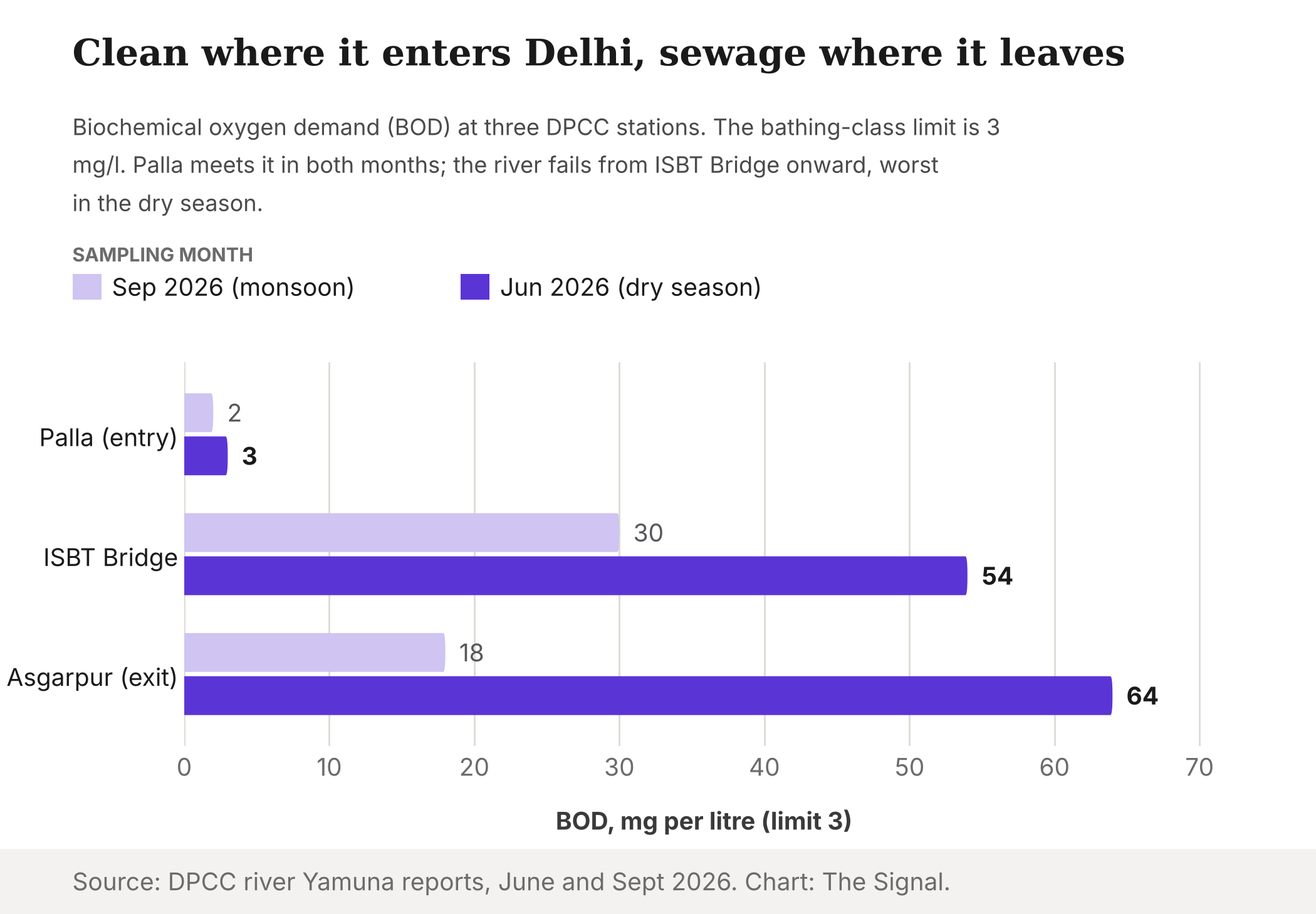
Source: DPCC river Yamuna report, sampled 3 June 2026 and DPCC river Yamuna report, sampled 7 September 2026. Chart: The Signal.
The natural conclusion is that the city's drains are doing the damage, and they are. DPCC's September 2026 drain report found the Najafgarh Drain at 62 mg/l BOD, the Shahdara Drain at 120 mg/l and the Barapulla Drain at 125 mg/l, against a 30 mg/l standard for drains outfalling into the Yamuna. That is two to four times the limit.
But look at the number in the standard itself. A drain that fully met DPCC's 30 mg/l limit would still carry ten times the 3 mg/l BOD the river is allowed for bathing, per the June 2026 river report. The plants upstream of those drains are held to a tighter bar, but not a bathing one: DPCC's September 2026 sewage treatment plant report lists the STP standard as 10 mg/l BOD and 230 faecal coliform per 100 ml, so even fully compliant treated effluent carries more than three times the river's BOD limit. Compliant discharge only produces a compliant river if there is clean water to dilute it. Below Wazirabad, for most of the year, there is not.
The river that is not there
The Delhi government's River Rejuvenation Committee action plan, filed before the National Green Tribunal in February 2020, states that for nearly nine months of the year the river has no fresh water downstream of Wazirabad, and the only flow is sewage, treated and untreated, from the drains that join it. The same plan says the 22 km from Wazirabad to Okhla, less than 2% of the river's length, accounts for about 76% of its pollution load. Haryana releases 10 cumecs at Hathnikund in the lean season, the plan notes, but most of it evaporates or percolates before it reaches Wazirabad.
The water is taken long before Delhi's drains touch the river. The NGT-appointed Yamuna Monitoring Committee's June 2020 final report, reproducing a National Institute of Hydrology study, found that in the non-monsoon season 78.5% of the inflow at Haryana's Hathnikund barrage goes to the Western Yamuna Canal and 13% to the Eastern Yamuna Canal, leaving only 8.5% for the river.
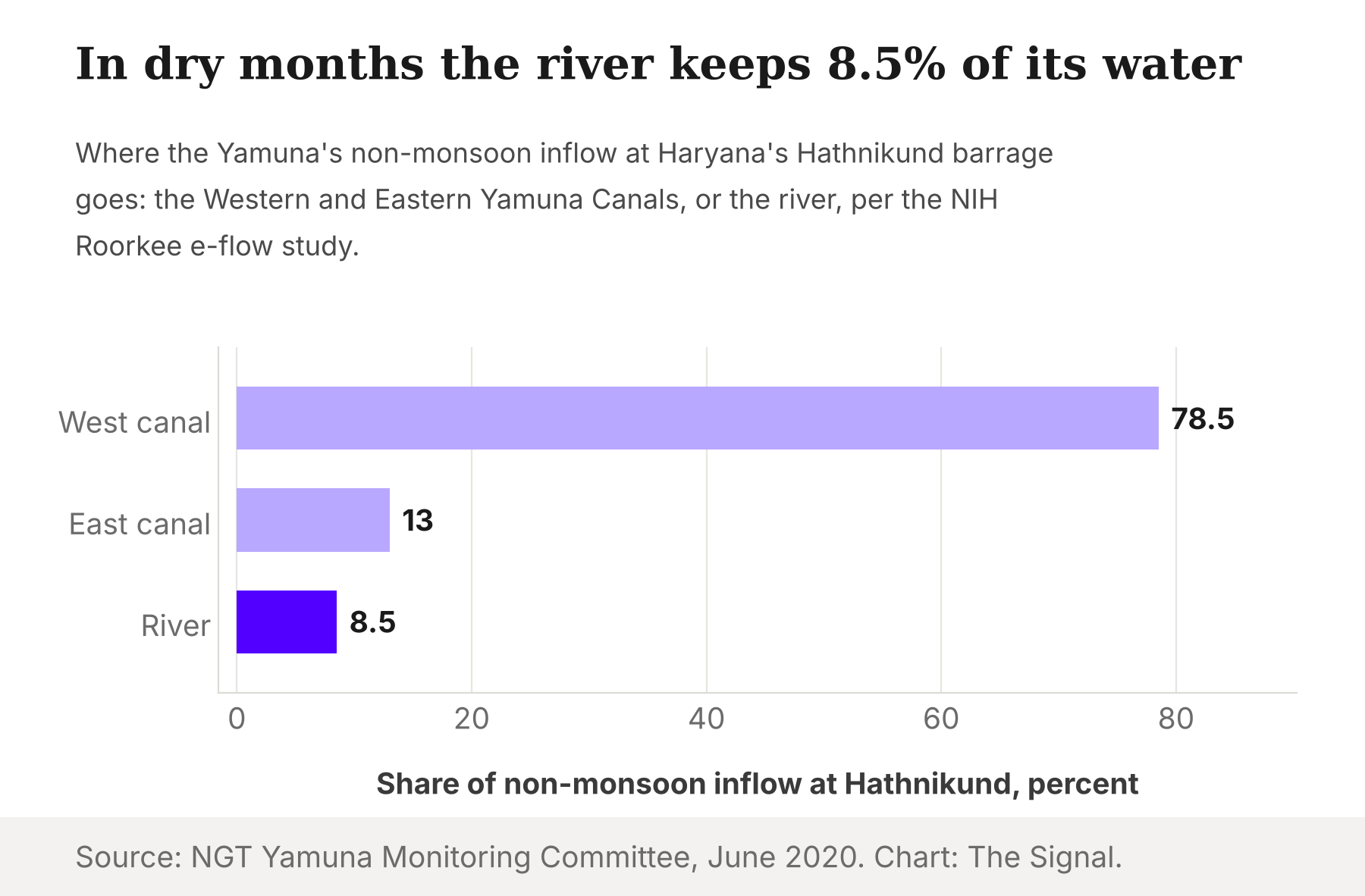
Source: NGT Yamuna Monitoring Committee final report, June 2020, reproducing a National Institute of Hydrology study. Chart: The Signal.
Delhi then takes its own share at Wazirabad. The Economic Survey of Delhi 2021-22 lists Yamuna water as the Delhi Jal Board's largest single raw-water source, 389 MGD (million gallons a day) of the 953 MGD it produced, about 41%. Those 2020 and 2021-22 documents describe a design rather than a single season: irrigation upstream, drinking water at the barrage, drains below it.
What the monsoon proves
The seasonal data is the cleanest test of that design.
The same drains, with and without dilution: DPCC readings at three Yamuna stations, 2026
| Station | BOD, Jun 2026 (mg/l) | BOD, Sep 2026 (mg/l) | Dissolved oxygen, Jun 2026 (mg/l) | Dissolved oxygen, Sep 2026 (mg/l) | Faecal coliform, Jun 2026 (MPN/100 ml) | Faecal coliform, Sep 2026 (MPN/100 ml) |
|---|---|---|---|---|---|---|
| Palla (entry) | 3.0 | 2.0 | 4.8 | 6.5 | 2,800 | 1,100 |
| ISBT Bridge | 54.0 | 30.0 | Nil | 2.9 | 170,000 | 35,000 |
| Asgarpur (exit) | 64.0 | 18.0 | Nil | Nil | 390,000 | 38,000 |
Source: DPCC river Yamuna report, sampled 3 June 2026 and DPCC river Yamuna report, sampled 7 September 2026. Bathing-class limits: BOD 3 mg/l or less, dissolved oxygen 5 mg/l or more, faecal coliform 2,500 maximum.
In DPCC's September 2026 report, sampled on 7 September and the latest it has published, BOD at Asgarpur was 18 mg/l and faecal coliform 38,000, against 64 mg/l and 390,000 in June. The drains are the same drains in both months; what the monsoon adds is water. The table also shows the limit of dilution: even in September, dissolved oxygen at Asgarpur was nil and BOD sat at six times the bathing limit.
A caution on fairness: Palla is not pristine either. In June 2026 its dissolved oxygen of 4.8 mg/l was just under the 5 mg/l floor and its faecal coliform of 2,800 just over the 2,500 maximum. The river arrives marginal, and Delhi tips it over.
The honest objection
The strongest case against this argument is that Delhi's sewage system is still failing on its own terms, so blaming missing flow lets the city off the hook. The numbers support that case. A Ministry of Jal Shakti reply in the Lok Sabha on 31 July 2025, citing Delhi Jal Board data, put sewage generation at 3,596 MLD against 3,474 MLD of installed capacity in 37 plants. As of June 2025, only 2,955 MLD was treated, and only 2,014 MLD from 23 plants met DPCC discharge standards, with 14 plants non-compliant. About 641 MLD went into the river or drains untreated.
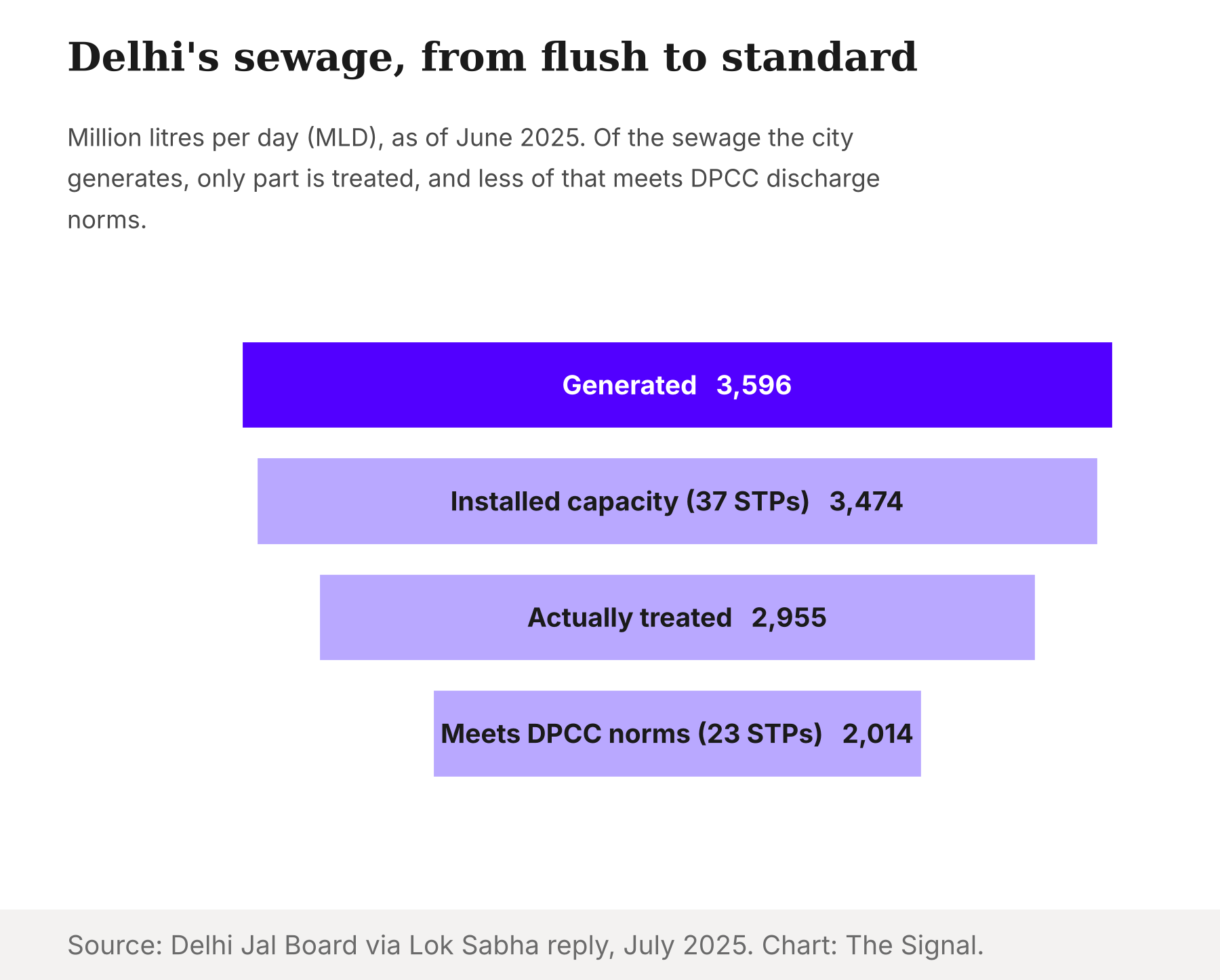
Source: Delhi Jal Board data via a Ministry of Jal Shakti Lok Sabha reply, 31 July 2025. Chart: The Signal.
Add the 641 MLD left untreated to the 941 MLD that was treated but missed the standard, and about 1,582 MLD, some 44% of what Delhi generated, reached the drains below standard in mid-2025, on the Jal Board's own figures. That is a real failure, and fixing it would cut the load at Asgarpur.
But the objection answers a different question. It explains why the river is as bad as 64 mg/l; it does not show that perfect treatment gets it to 3. A river whose dry-season flow below Wazirabad is mostly effluent inherits the effluent's quality, and even the treatment-plant standard sits at more than three times the bathing limit, the drain standard at ten times. Both levers are real. Only one of them is in the sewage budget.
The Signal
The Yamuna in Delhi has two problems that look like one. The first is dirty discharge, and it can be fixed with plants, pipes and enforcement. The second is that the river's own dry-season water is diverted to canals at Hathnikund and to taps at Wazirabad before it reaches the city's drains, and no plant fixes that. Penalties and fresh capital spending will move the Asgarpur numbers, but they cannot by themselves turn a channel of treated wastewater into a bathing river.
That makes the decision a political one: a minimum flow below Hathnikund and Wazirabad means less water for Haryana's fields or Delhi's taps, and someone has to say which. Watch whether the court's next orders speak of drains and plants only, or of cumecs released. A river cannot be cleaned if it is not allowed to exist.
Reporting basis: river readings at Palla, ISBT Bridge and Asgarpur are from the Delhi Pollution Control Committee's monthly river Yamuna reports for samples taken on 3 June 2026 and 7 September 2026, drain readings are from DPCC's September 2026 drain analysis report, and the STP discharge standard is from DPCC's September 2026 STP analysis report; all four are one origin, the DPCC water laboratory. Sewage generation, capacity, treatment and compliance figures are Delhi Jal Board data, via a Ministry of Jal Shakti Lok Sabha reply published by PIB; the spending figure and the August 2025 treatment gap are Delhi Jal Board and DPCC figures via a Rajya Sabha reply, also published by PIB. The Hathnikund diversion shares are from the National Institute of Hydrology e-flow study as reproduced in the NGT Yamuna Monitoring Committee's 2020 final report. The no-fresh-water and 76% pollution-load findings are from the Delhi government's 2020 River Rejuvenation Committee action plan, which draws on the Monitoring Committee's work, so the two flow documents are not fully independent. Raw-water sources are Delhi Jal Board figures via the Economic Survey of Delhi 2021-22. No figure from the Supreme Court's November 2026 proceedings is used. The ratios between stations and against the bathing and drain limits, the ten-fold gap between the drain standard and the bathing limit, the more-than-three-fold gap between the STP standard and the bathing limit, and the 1,582 MLD below-standard total and its 44% share are The Signal's calculations from those figures.