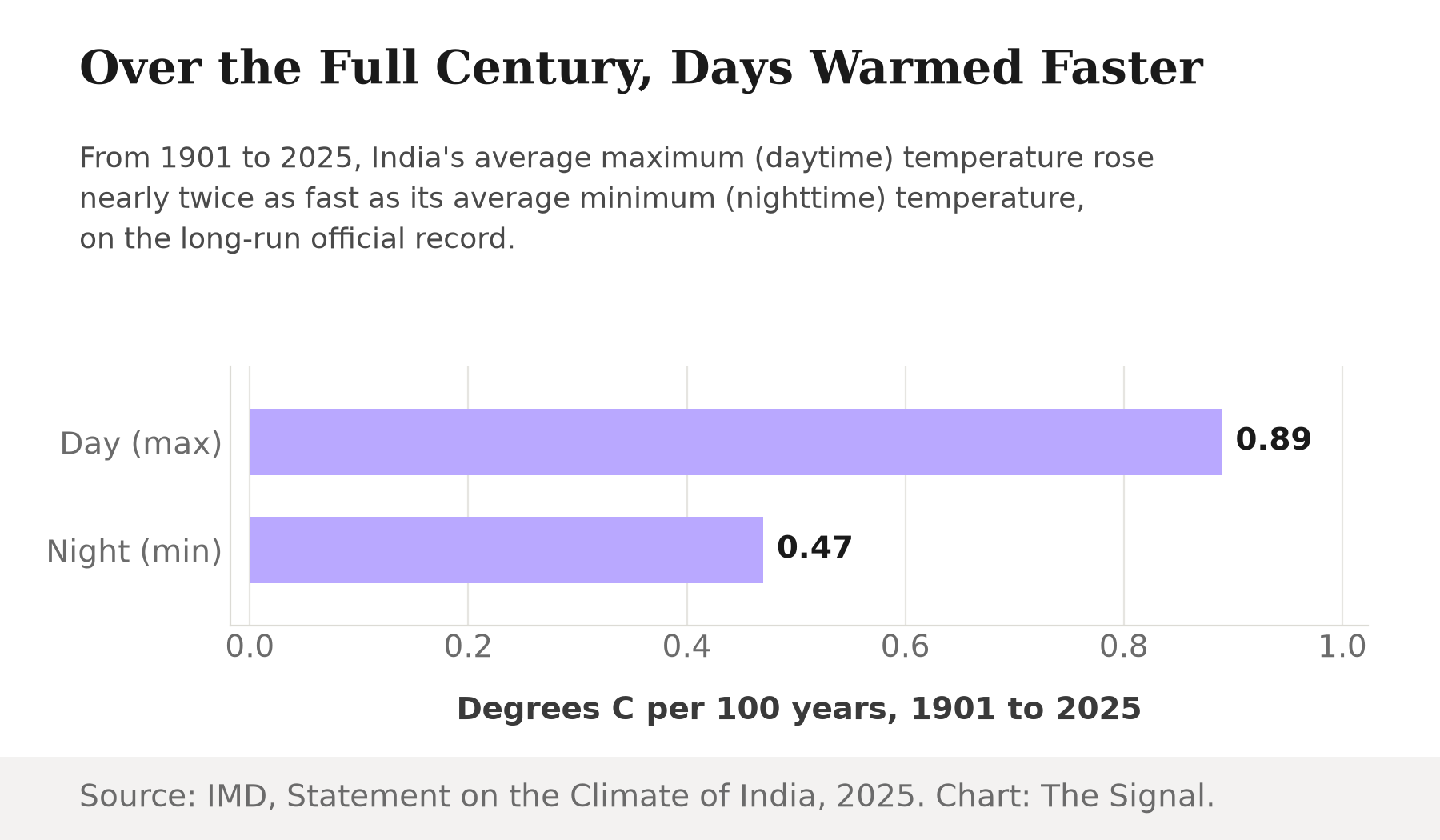
Every heat warning India issues names an afternoon number. The heatwave bulletins, the hospital admissions, the headline temperature on the evening news: almost all of it is about the daytime high. That habit tracks a real, long-run pattern. From 1901 to 2025, India's country-averaged maximum (daytime) temperature rose 0.89 degrees Celsius per hundred years, nearly twice the 0.47-degree rise in the average minimum (nighttime) temperature over the same span, according to the India Meteorological Department's Statement on the Climate of India during 2025. On the full century record, the day genuinely has warmed faster than the night.
It is worth slowing down on that number, because a hundred-year average can hide a recent reversal inside it, and this one does. Zoom in to the last decade or two and four separate, independently produced datasets now point the same way: India's nights are heating up faster than its days.
The night that set the record, not the day
Start with the clearest single case. In February 2025, India's average night-time temperature hit an all-time high for the month, the warmest since national records began in 1901, while that month's average daytime temperature was only the second-highest February on record. The night broke a 125-year record, while the day, that same month, did not even top its own chart.
Warm nights are spreading across more of the country than hot days are.
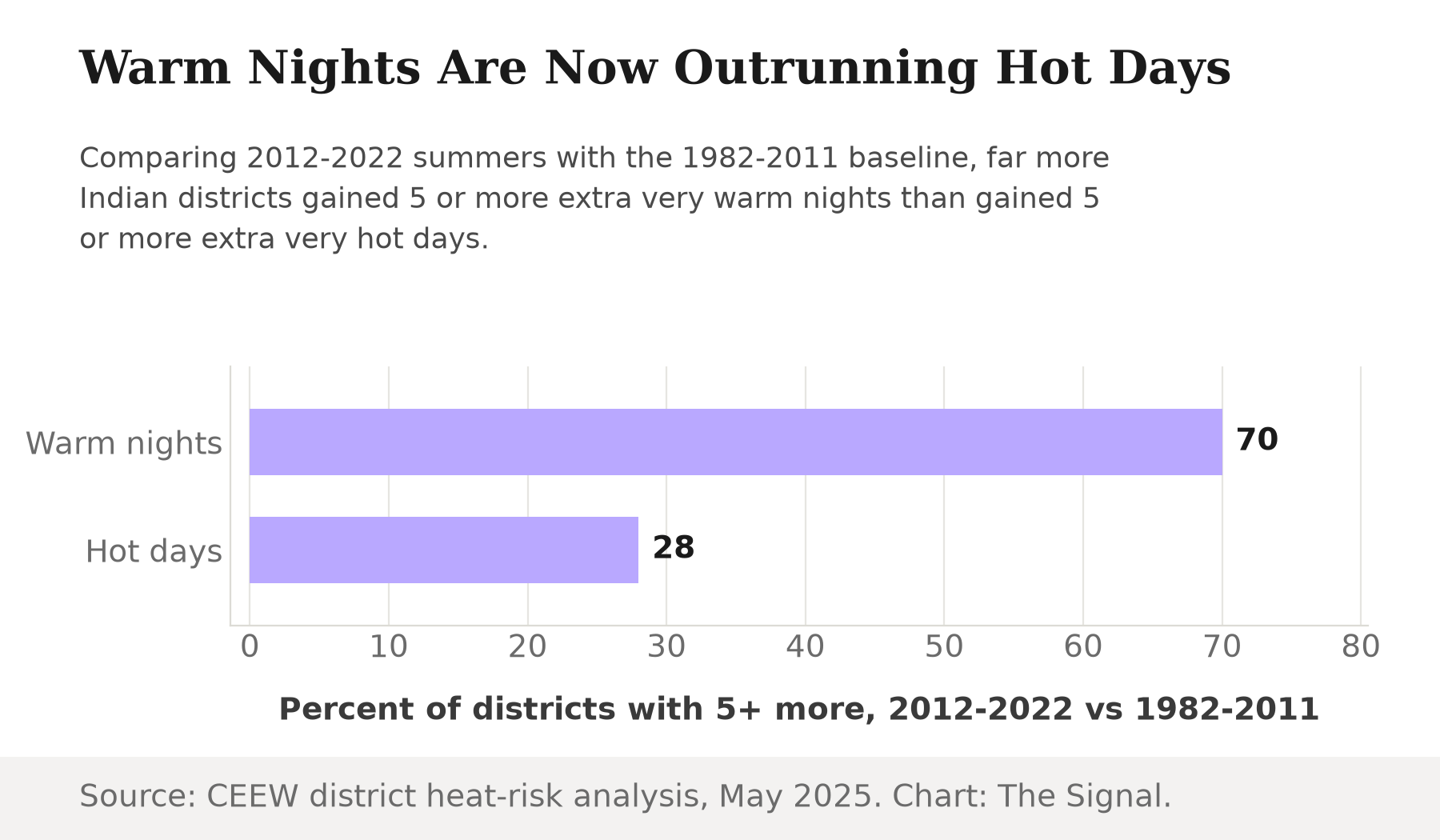
That February was not a one-off. Comparing 2012-2022 summers with the 1982-2011 baseline, nearly 70 percent of India's districts saw five or more additional very warm nights, versus only about 28 percent of districts seeing a similar rise in very hot days, per a May 2025 district-level heat-risk analysis from the Council on Energy, Environment and Water. Two and a half times as many districts are gaining warm nights as are gaining hot days.
Cities are the amplifier
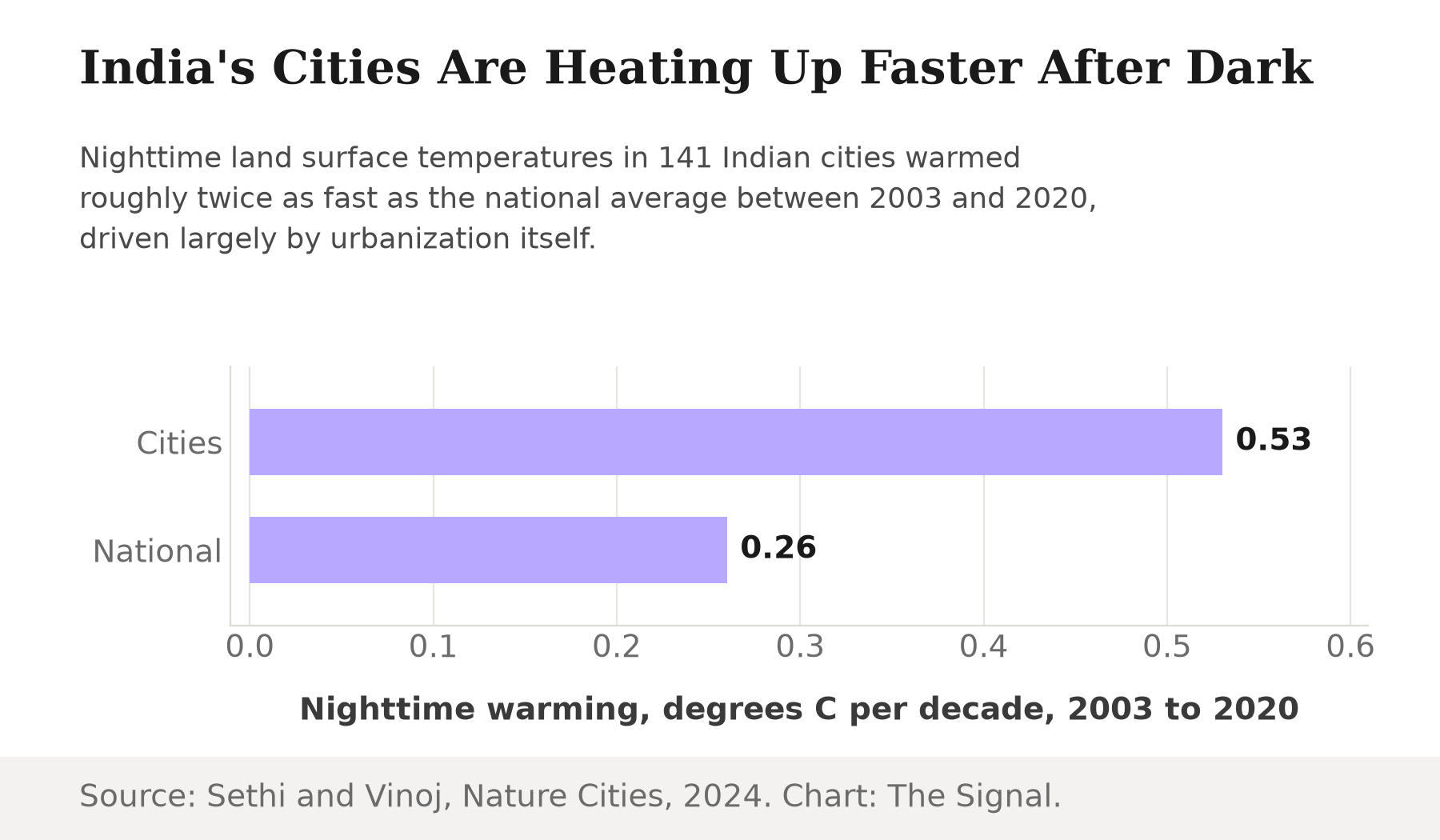
Cities show the same shift, more sharply. Nighttime land surface temperatures across 141 Indian cities warmed 0.53 degrees Celsius per decade between 2003 and 2020, roughly double the 0.26-degree national average, according to a 2024 study in Nature Cities by Soumya Satyakanta Sethi and V. Vinoj. The same study attributes most of that extra heat to the cities themselves: urbanization alone accounts for a 60 percent enhancement of nighttime warming in Indian cities, concentrated in eastern Tier-II cities.
That matters because concrete, asphalt, and traffic hold heat after sunset in a way open farmland does not. As India urbanizes, that effect reaches a larger share of the population every year, not a smaller one.
The peer-reviewed record agrees
This is not just two recent reports converging by coincidence. A 2018 study in Scientific Reports by Sourav Mukherjee and Vimal Mishra of IIT Gandhinagar, using India Meteorological Department gridded data from 1951 to 2016, finds that night-time extreme heat events are increasing more rapidly than daytime extreme heat events. The same paper projects that combined hot-day, hot-night events will occur roughly six times more often than today's level once global warming reaches 2 degrees Celsius.
| Evidence | Period covered | What it shows |
|---|---|---|
| IMD monthly climate summary | February 2025 | Record night, only second-highest day |
| Nature Cities, Sethi and Vinoj | 2003-2020 | Urban nights warm nearly twice the national rate |
| CEEW district analysis | 2012-2022 vs 1982-2011 | 70% of districts gain warm nights, 28% gain hot days |
| Scientific Reports, Mukherjee and Mishra | 1951-2016 | Night extremes rising faster than day extremes |
The recent reversal, four independent ways.
What a warmer night actually costs
Nights are not supposed to be the dangerous half of the day. They are when bodies, soil, and buildings are meant to shed the heat the afternoon loaded onto them. When the night stays warm, that recovery shrinks, and the effect shows up in outputs that have nothing to do with a thermometer's afternoon reading.
In farming, night and day temperatures pull the same crop in opposite directions. Across 227 irrigated rice farms in six Asian rice-producing countries, including India, higher minimum (night) temperature reduced rice yield, while higher maximum (day) temperature raised it, a 2010 study in the Proceedings of the National Academy of Sciences finds. A warmer day, within limits, can help a rice plant, but a warmer night, by nearly every measure in that study, hurts it. Night temperature is the one now rising faster, and that is the wrong side of the trade to be losing.
The economic toll is already visible at national scale. Heat exposure cost India an estimated 247 billion potential labour hours and US$194 billion in lost income in 2024, with the average Indian exposed to 19.8 heatwave days in 2024, the 2025 Lancet Countdown India data sheet reports. That figure captures daytime labour lost to heat. It does not count the added cost of a body that never gets a cool night to recover in before the next hot day starts. The daytime-only bulletin culture is not built to track that second cost.
The honest objection
The strongest case against making too much of this is that a 125-year national record, built from thousands of daily station readings, is a far sturdier basis than fifteen to twenty years of newer instruments and a handful of studies. Urban heat-island effects can inflate a city-only trend that says more about concrete than about the atmosphere. A run of unusually warm winters can look like a turning point before it is one. And the century-scale gap between day and night warming, cited above from the IMD's own climate statement, is wide enough that a single warm decade should not overturn it on its own.
That case is real, but it does not survive four independent lines of evidence, produced by different institutions using different methods over different windows, all pointing the same direction: a government meteorological bulletin for a single record month, a satellite land-surface study of 141 cities across nearly two decades, a ground-station district analysis spanning forty years of summers, and a peer-reviewed paper built on 65 years of gridded national data. None of them contradicts the century-scale IMD record; each of them describes a more recent chapter inside that same long record, not a rewrite of it. The day still owns the twentieth century. The night appears to be winning the twenty-first.
The Signal
India's heat monitoring is built around the daytime number because, for a hundred years, the daytime number was the one moving quickest. That is no longer obviously true. A record set at night in February 2025, a district map where warm nights are outrunning hot days two and a half to one, cities warming after dark at twice the national rate, and a peer-reviewed record of nighttime extremes overtaking daytime ones all point the same recent direction from four separate angles. What to watch next is not another daytime heatwave bulletin. It is whether IMD's own future climate statements start naming a nighttime heat trend as prominently as they name the afternoon one, because the temperature doing the most damage may be the one nobody in the warning is naming.
Reporting basis: the century-scale warming rates for India's maximum and minimum temperature are from the India Meteorological Department's Statement on the Climate of India during 2025, released in January 2026. The February 2025 record minimum temperature is per Down To Earth's reporting of the IMD's Monthly Climate Summary for that month. The urban nighttime warming rates and the urbanization-attribution figure are from a 2024 peer-reviewed study by Sethi and Vinoj in Nature Cities, using MODIS satellite land-surface-temperature data from 2003 to 2020. The district-level counts of warm nights and hot days are from a May 2025 Council on Energy, Environment and Water analysis of ground-station data. The finding that night-time extreme heat events are increasing faster than daytime ones, and the sixfold projection under 2 degrees of warming, are from a 2018 peer-reviewed study by Mukherjee and Mishra in Scientific Reports, using IMD gridded data from 1951 to 2016. The rice-yield finding is from a 2010 study in the Proceedings of the National Academy of Sciences covering 227 irrigated farms across six Asian countries. The labour-hours and income-loss figures for 2024 are from the Lancet Countdown on Health and Climate Change's 2025 India data sheet. No figure in this piece is The Signal's own calculation.