A team from JNCASR, IISc and the University of Sydney has done something conventional physics says a crystalline solid should not be able to do. Working with magnesium-doped, highly compensated epitaxial scandium nitride thin films, the group measured a Seebeck coefficient of -124 millivolts per Kelvin near room temperature. A Seebeck coefficient is the voltage a material generates for every degree of temperature difference across it, and conventional transport theory caps its magnitude at a few millivolts per Kelvin in any crystalline material. The paper, led by Bivas Saha's group, ran in Science in August 2026. The easy read is that India has just cracked one of the hard limits standing between waste heat and usable power.
It is worth slowing down on that. A record-breaking number in a physics journal is not the same thing as a machine you can bolt onto a factory. The Seebeck coefficient measures a material's raw voltage response to a temperature gradient, not how much of that heat it actually turns into delivered electricity, and it says nothing about cost, durability, or whether the material exists in quantities anyone could use.
A Seebeck coefficient of -124 millivolts per Kelvin in magnitude, against a conventional ceiling of only a few.
That gap is the whole story's opening hook, and the honest next question is what stands between this lab result and a power plant.
What today's thermoelectric devices actually deliver
Even before asking whether this specific material can be manufactured at scale, it is worth pricing the technology category it belongs to. A 2023 review in iScience puts the conversion efficiency of the best commercial thermoelectric chips sold today at about 5%: for every 100 units of heat that pass through a commercial thermoelectric generator, roughly 5 come out as electricity. A larger Seebeck coefficient is one input into a better device, alongside electrical conductivity and thermal conductivity, but the Science paper is a measurement of one property in a lab sample, not a demonstrated device efficiency. The path from "colossal Seebeck coefficient in a thin film" to "thermoelectric generator that beats 5%" is itself years of engineering, and nothing in the JNCASR-IISc-Sydney paper claims otherwise.
Where the heat is actually going to waste in India
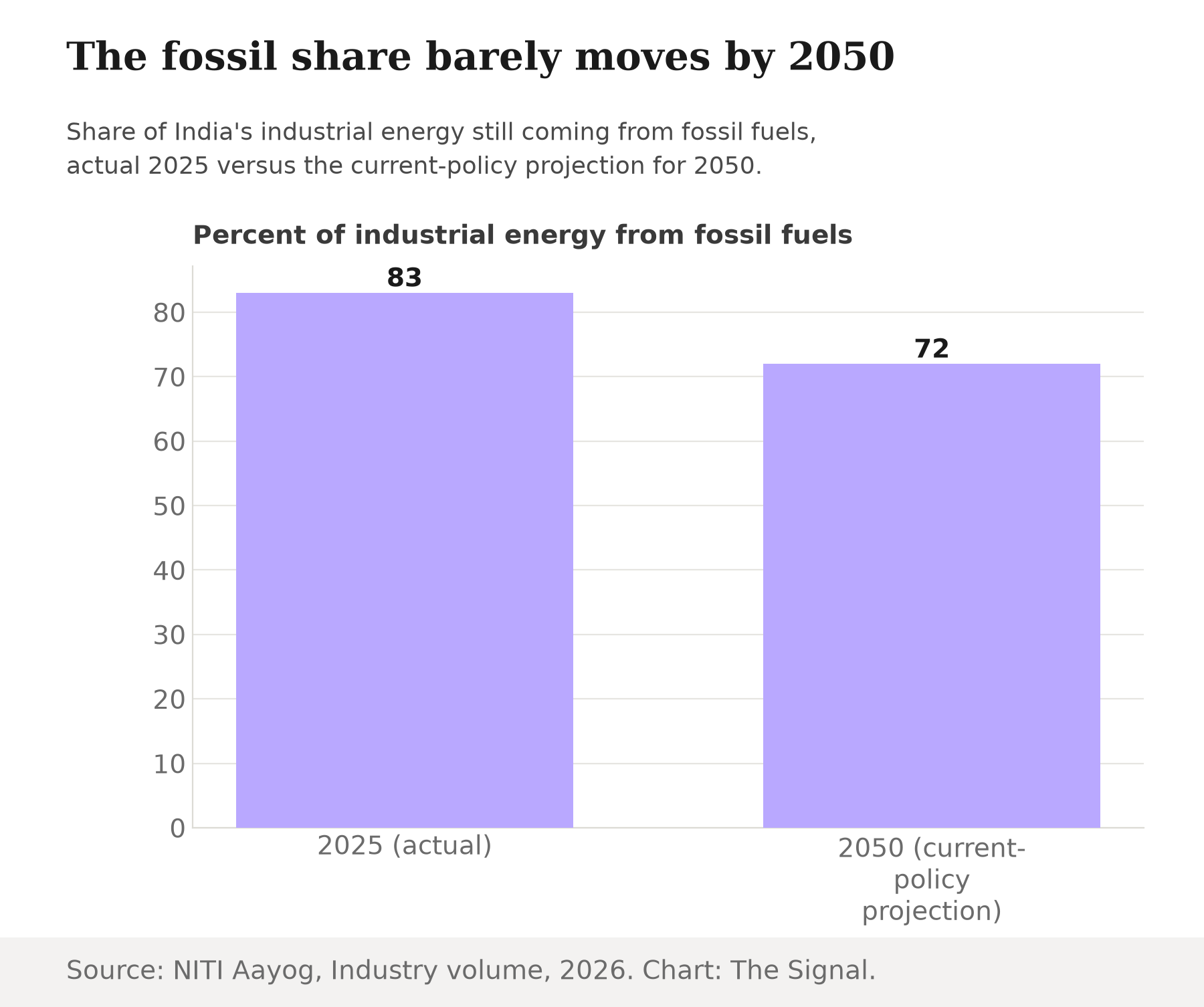
The reason this result is worth an India-anchored second look at all is that the country's industrial base is a large, durable source of exactly the kind of waste heat thermoelectric generators are built to capture. NITI Aayog's 2026 industry sector report states that India's industrial sector still drew around 83% of its energy from fossil fuels in 2025, and that dependence is not projected to break quickly. Under India's current-policy trajectory, the same report projects industrial energy demand rising to 980 million tonnes of oil equivalent by 2050 and 1,150 Mtoe by 2070, with fossil fuels still supplying 72% of the 2050 total. Eighty-three percent today against 72% a quarter-century out, on the government's own current-policy numbers, is a wall of combustion heat that keeps growing even as it slowly, marginally recedes.
Cement is the clearest single example of heat going unrecovered today rather than in some projected future. NITI Aayog's 2026 report states that only about 70% of India's 250 large cement plants, roughly 175 plants, have waste-heat-recovery systems installed, per 2021 data. That leaves about 75 large plants, three in ten, running kilns without capturing the heat that leaves the process.
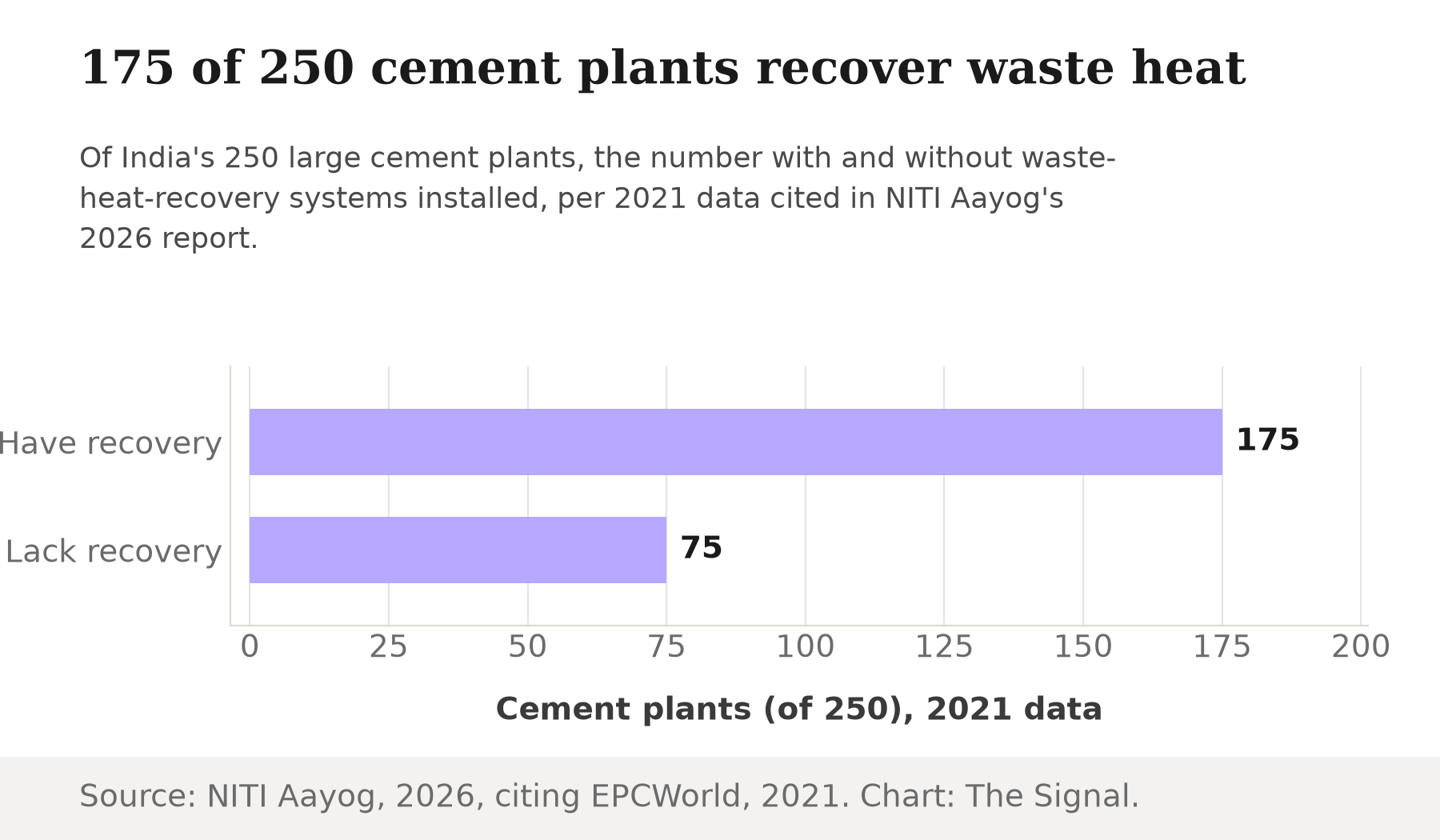
That 75-plant gap is real demand for a technology that turns industrial heat into power, sitting in the ground right now. It is also a reminder that waste-heat recovery does not require a colossal Seebeck coefficient. It requires equipment that is affordable and provable enough for a cement plant's balance sheet, which is a different bar than a record in Science.
The element the breakthrough runs on is also its bottleneck
The material that produced this result is scandium nitride, a compound built on scandium, one of the least available metals a materials scientist can choose. The US Geological Survey's 2026 Mineral Commodity Summary reports that scandium metal traded at roughly $5,200 per kilogram in 2025, that the United States is 100% import-reliant on it, and that there is no commercial recycling of the metal. That is a metal priced like a precision instrument, sourced entirely from abroad, with no recovery stream once a device using it reaches the end of its life.
This raw-material hurdle applies to any scandium-based technology at scale, in the USGS's own framing of the metal's supply picture, whether the end use is a jet-engine alloy, a solid-oxide fuel cell, or a thermoelectric thin film. A thin film uses far less material than a bulk part, which softens the constraint for a lab sample, but that constraint is still there for a coating meant to run across a cement kiln's surface area.
The honest objection
The strongest case against dwelling on scandium's cost is that early breakthroughs in an unfamiliar materials class routinely look economically absurd before they mature. Silicon photovoltaics and lithium-ion batteries both went through decades of expensive, low-volume lab demonstrations before manufacturing scale and substitute chemistries brought costs down, and no one judged those technologies dead on arrival because their first working versions used exotic or costly inputs. If the mechanism behind this compensated-doping effect, rather than scandium nitride specifically, turns out to be the transferable discovery, a cheaper host material could inherit the physics without inheriting the price tag.
That case is real, and it is the reason this result belongs in a physics journal rather than a product announcement. But it is a research roadmap, not a deployment timeline, and nothing in the published record says a cheaper substitute host exists yet or reproduces the same effect. Until it does, the only material actually shown to break the Seebeck ceiling is the one the USGS prices at $5,200 a kilogram with zero recycling behind it.
The Signal
This is a genuine physics result: a measured voltage response to heat that clears the ceiling conventional transport theory sets, published in Science in August 2026. It is not yet an answer to the 75 large Indian cement plants running without waste-heat recovery today, or to the fossil fuels that NITI Aayog's own current-policy numbers say will still supply 72% of industrial energy in 2050. What to watch next is not another headline Seebeck number. It is whether a follow-up paper reproduces the compensated-doping mechanism in a host material the world does not have to import 100% of at $5,200 a kilogram. Until then, the ceiling broke in the lab. The metal to build past it has not been found.
Reporting basis: the Seebeck coefficient measurement and the JNCASR, IISc and University of Sydney collaboration are per the team's own paper in Science, published August 2026. Commercial thermoelectric conversion efficiency is from a 2023 iScience review by a National Taipei University of Technology-affiliated team. India's industrial fossil-fuel share, the current-policy demand projections to 2050 and 2070, and the cement-plant waste-heat-recovery figures are all from NITI Aayog's 2026 industry sector report, with the cement figure itself originating in 2021 EPCWorld data that NITI Aayog cites. Scandium's price, US import reliance and recycling status are from the US Geological Survey's 2026 Mineral Commodity Summary. The gap between plants with and without waste-heat recovery, and the percentage-point comparison between 2025 and 2050 fossil shares, are The Signal's calculations from those figures.