In 2025, the Indian Space Research Organisation analysed more than 150,000 close-approach alerts issued by US Space Command for its orbiting satellites. It used them to fly 18 collision-avoidance manoeuvres, including one for the NISAR earth-observation mission it operates with NASA, according to ISRO's Indian Space Situational Awareness Report (ISSAR) 2025. That is India's satellite fleet, the one NavIC navigation, weather forecasting and a fast-growing private launch industry all now depend on, doing exactly what it is supposed to do: watching the sky and getting out of the way. Read only that number and the story is a maturing space agency handling more traffic with more precision.
It is worth slowing down on what ISRO is actually dodging. It did not all arrive last year, and it was not, in large part, ever a working satellite.
ESA's Space Debris Office puts a number on that: across everything currently in low Earth orbit, inactive objects, dead satellites and the rocket stages that carried them up, account for 96 percent of the cumulative risk of a collision, with the single largest share coming from spent rocket bodies. Active satellites, the kind a new constellation adds, are close to a rounding error by comparison.
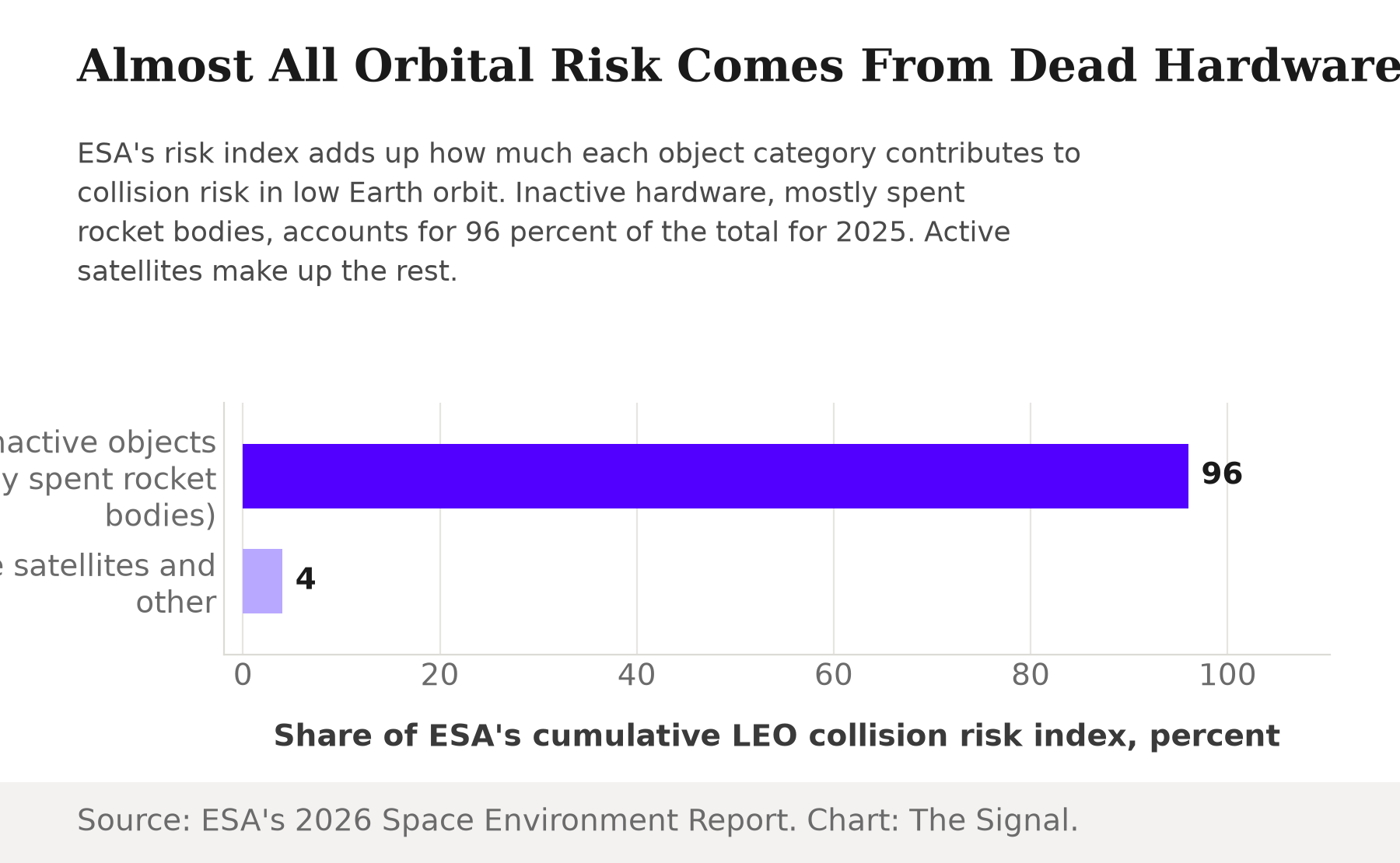
Source: ESA 2026 Space Environment Report, risk index by object category. Chart: The Signal.
The junk inventory
By the end of July 2026, ESA's tracking network had 46,950 individually catalogued objects in Earth orbit, weighing more than 17,000 tonnes combined, the freshest snapshot ESA's DISCOSweb database has published. That mass is not evenly spread. Most of the risk it carries, per the 96 percent figure above, sits with hardware nobody has actively controlled in years.
New debris keeps arriving too. Non-deliberate fragmentations, spacecraft and rocket stages breaking apart on their own from stored energy, battery failures or leftover propellant, have added to the population at an average rate of 9.8 events a year over the last two decades, and remain the dominant source of new space debris, ESA's 2026 Space Environment Report finds, ahead of deliberate collisions or intentional break-ups.
More satellites, not more cleanup
2025 alone saw more than 300 orbital launches carry over 4,000 new payloads into the space environment, the start, ESA says, of systematic deployment of several new large low-Earth-orbit constellations. Only 1,200 intact objects reentered the atmosphere and burned up the same year, even with rising launch traffic and unusually high solar activity pulling more debris down than usual. Orbit gained far more objects than it shed.
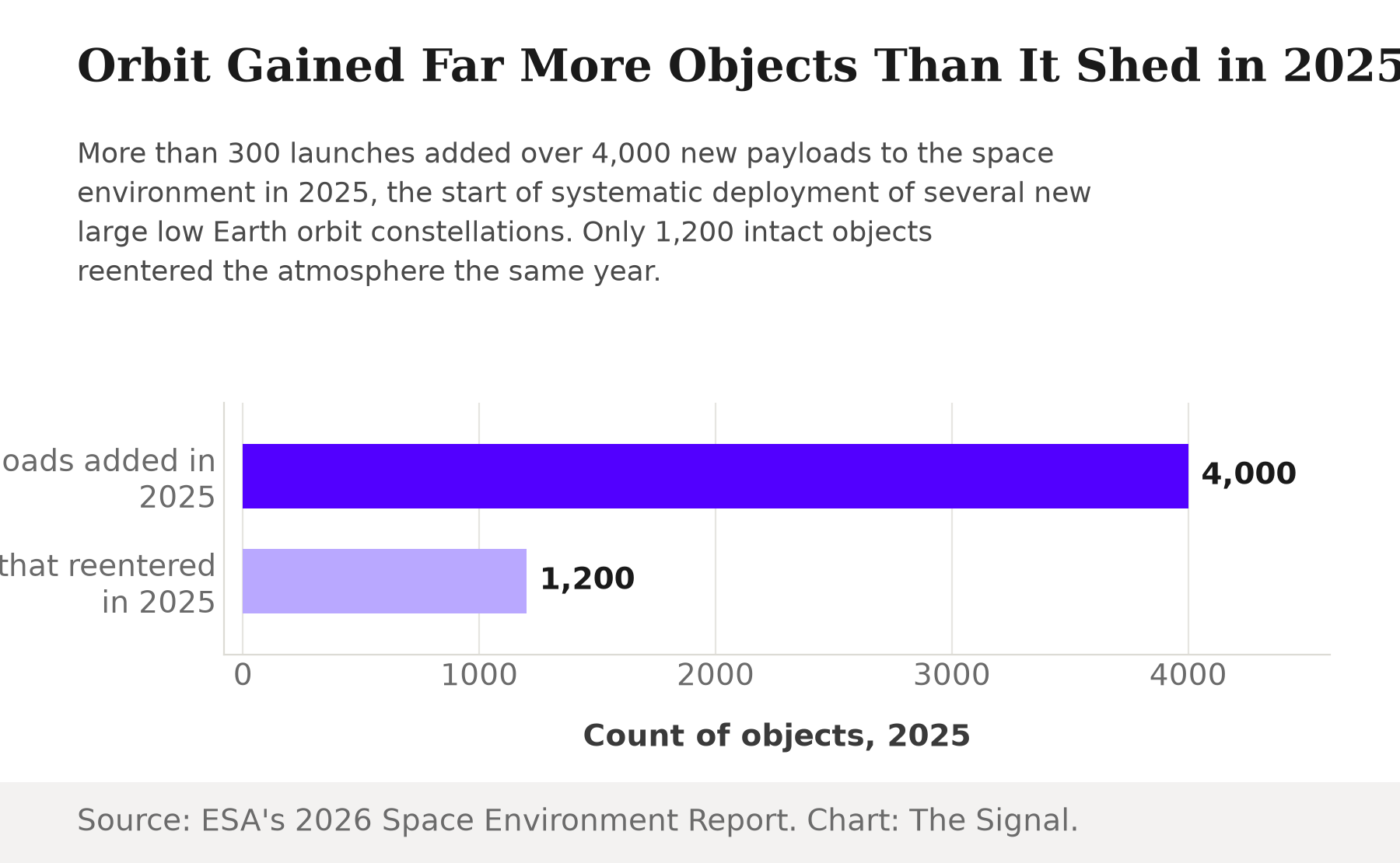
Source: ESA 2026 Space Environment Report, launch and payload traffic; 2025 reentries. Chart: The Signal.
India's own manoeuvre bill
ISRO's collision-avoidance workload nearly doubled in the space of a single year. That workload now protects a fleet of 56 operational Indian satellites in orbit, out of 135 the country has launched across Earth observation, communication, navigation, space-science and technology-demonstration missions, according to a February 2026 Lok Sabha reply from the Department of Space.
| Metric | 2024 | 2025 |
|---|---|---|
| Close-approach alerts analysed (USSPACECOM) | more than 53,000 | more than 150,000 |
| LEO collision-avoidance manoeuvres | 6 | 14 (incl. 1 for NISAR) |
| GEO collision-avoidance manoeuvres | 4 | 4 |
| Total collision-avoidance manoeuvres (LEO + GEO) | 10 | 18 |
Source: ISRO's ISSAR 2025; ISRO's ISSAR 2024.
In 2024, ISRO's flight dynamics teams analysed just over 53,000 such alerts and flew ten manoeuvres across its LEO and GEO fleet, plus one further manoeuvre for the Chandrayaan-2 orbiter. A year later, the alert volume had grown to more than 150,000 while the manoeuvre count rose only to 18: nearly triple the alerts, less than double the manoeuvres. That gap is a clue, not just a workload number: it points to better tracking catching more of what was already there, not only a faster-filling sky.
The honest objection
The strongest case against reading any of this as an eroding environment is that more alerts do not automatically mean more danger. IS4OM, ISRO's space situational awareness unit, is simply analysing more of what USSPACECOM already tracks, and every one of the roughly 150,000 alerts it reviewed in 2025 resulted in either a manoeuvre or a judgment that none was needed: the system caught everything it was asked to catch. And the same rising solar activity that helped pull 1,200 objects out of orbit in 2025 is itself a natural cleaning mechanism, one that works faster in years the sun is more active, not evidence of decay.
That case holds for a single year. It does not survive ESA's own long-run modelling. Running the environment forward at business as usual, ESA projects low Earth orbit's collision-risk index at 50 times the level it treats as the first acceptable milestone for a sustainable orbit, a projection built on exactly this kind of natural atmospheric drag and reentry. Better tracking explains why ISRO caught more in 2025, not why the modelled risk, decades out, keeps climbing regardless.
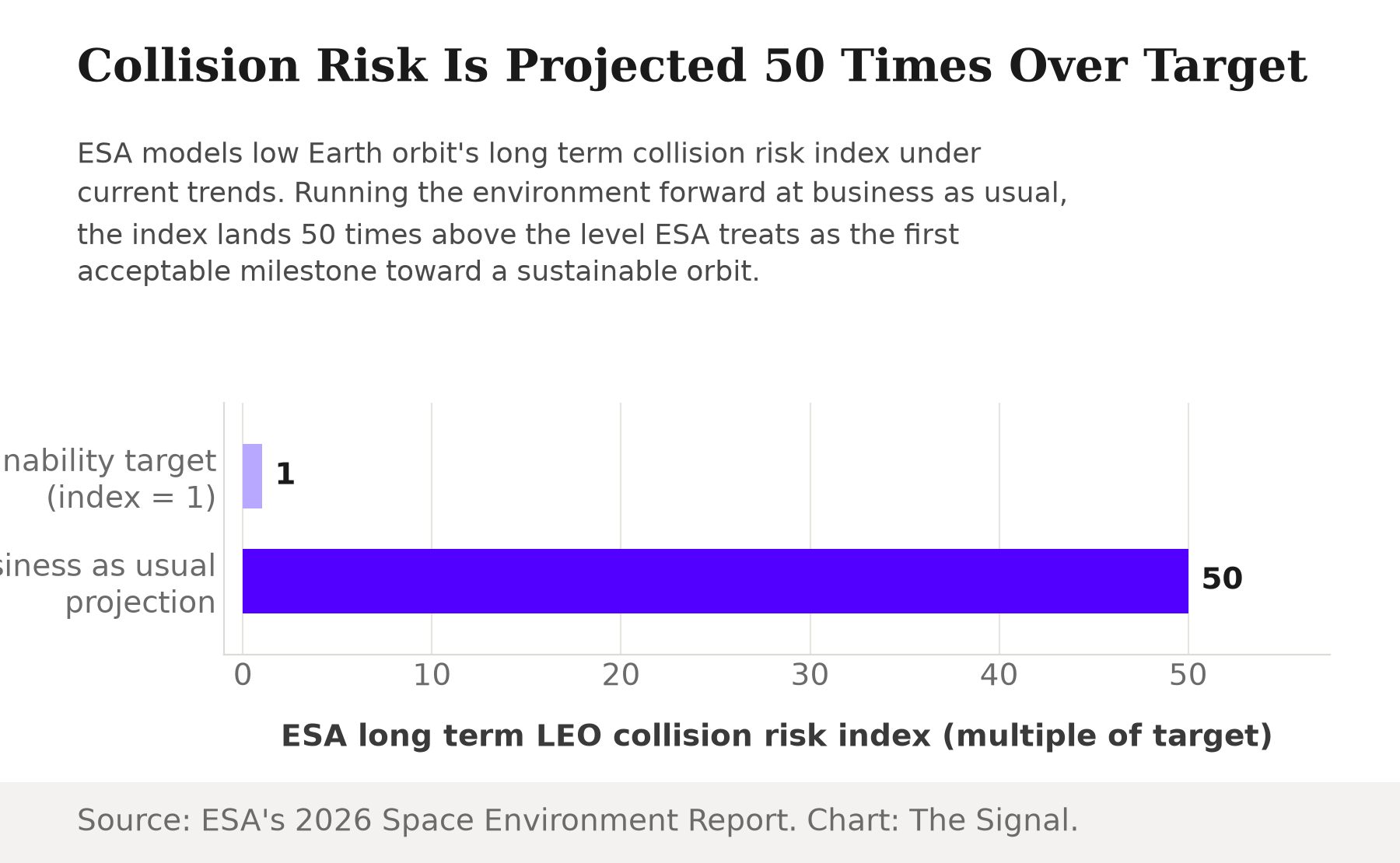
Source: ESA 2026 Space Environment Report, long-term collision-risk projection. Chart: The Signal.
The Signal
A 2006 study by NASA scientists J.-C. Liou and Nicholas Johnson, published in Science, concluded that the debris population in low Earth orbit had already reached a point where the environment was unstable, and that collisions, not launches, would eventually become the dominant source of new debris. Two decades later, that specific prediction has not literally arrived: non-deliberate fragmentations, not collisions, are still the more common way debris gets added, at close to ten events a year. But the ingredients Liou and Johnson described are now measured rather than projected: 96 percent of the collision risk sitting in dead hardware nobody is removing, and a sustainability index Europe's own space agency expects to run 50 times past its safety line if nothing changes. ISRO's rising manoeuvre count is the cost of operating inside that math; it does not mean the math is wrong. Every launch that adds to the 4,000-plus payloads of 2025 buys its way into the same traffic jam it is trying to avoid. Watch whether the reentry count starts closing the gap on the launch count. If it does not, low Earth orbit gets more crowded whether or not another rocket body ever breaks apart.
Reporting basis: the tracked-object mass and catalogue count are from ESA's DISCOSweb statistics, current as of end-July 2026. The 2025 launch, payload, reentry, fragmentation-rate and collision-risk-index figures are all from ESA's 2026 Space Environment Report (Edition 10), published by the European Space Agency's Space Debris Office in September 2026. ISRO's 2025 and 2024 alert and manoeuvre counts are from its own Indian Space Situational Awareness Report for 2025 and Indian Space Situational Assessment Report for 2024. India's operational satellite count is from a February 2026 Lok Sabha reply from the Department of Space, via PIB. The 2006 Kessler-syndrome finding is Liou and Johnson's peer-reviewed Science paper, as reproduced in a NASA Orbital Debris Program Office lecture; the underlying journal article itself was not independently re-checked beyond that reproduction. The alert-to-manoeuvre growth comparison and the payload-to-reentry comparison are The Signal's calculations from those figures.