On August 31, 2026, Bihar's Dairy, Fisheries and Animal Resources Department told the state's residents to stop catching, selling or eating fish they did not recognize. The advisory was direct: unknown and unusual fish had reached parts of Bihar riding floodwater from Nepal, and eating them was harmful until the water and the fish themselves were verified safe. Read as a headline, it sounds like a routine monsoon precaution: strange fish show up, officials say wait it out. People in East and West Champaran, Gopalganj, Bagaha and Saran districts had already reported catching large, strange-looking fish in the days before, so the warning matched what was showing up in nets and markets.
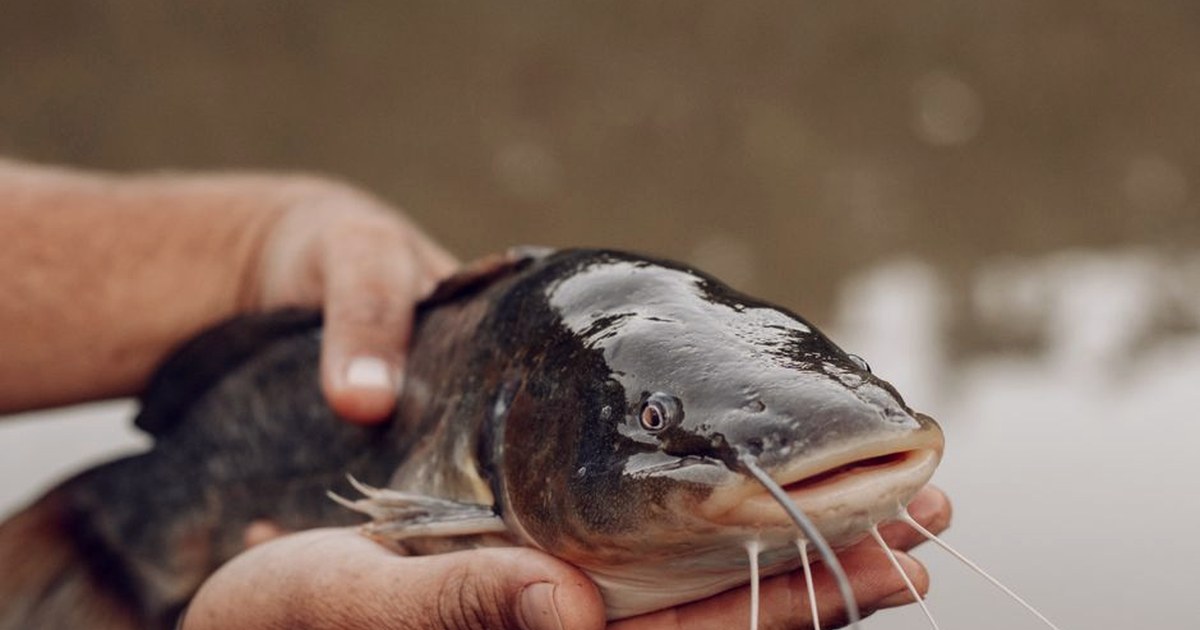
It is worth slowing down on what the advisory actually contains, and what it does not. Nowhere in it is a fish named, a contaminant specified, or a test proposed. Bihar's fisheries minister, Nand Kishor Ram, described the fish only by what they are not: not local, visibly distinct from anything people recognize. The closest thing to a name came not from the state but from outside it: Sameer Kumar Sinha, director of the Wildlife Trust of India, told the Times of India that many of the fish entering the Gandak were likely goonch catfish, Bagarius bagarius, locally called "Gochita", a species already known from fast-flowing rivers across India and Nepal. A tentative field call from an independent biologist is not the same thing as an official identification, and the government's own advisory still names nothing. Compare that with how the same state government is describing the water those fish arrived in.
What Bihar can measure
Bihar's Water Resources Department runs a flood-forecasting bulletin that is updated multiple times a day, and it deals in the kind of precision the fish advisory never touches. At 8am on September 2, 2026, discharge at the Gandak river's Valmikinagar barrage in West Champaran stood at 1,39,400 cusecs, against a design capacity of 850,000 cusecs, and the department's bulletin carried an explicit warning that observed glacial lake outburst flood, or GLOF, activity near the Nepal-China border meant an extreme event could still follow: a high alert. The same morning, discharge at the Kosi river's Birpur barrage in Supaul was 1,83,625 cusecs against a design capacity of 950,000 cusecs.
Both rivers were still running well under what their barrages are built to handle. The state's hydrologists were not waiting for the water to actually threaten the structures before saying so. They had already flagged a high alert, keyed to a specific event upstream, published to the cusec, twice a day.
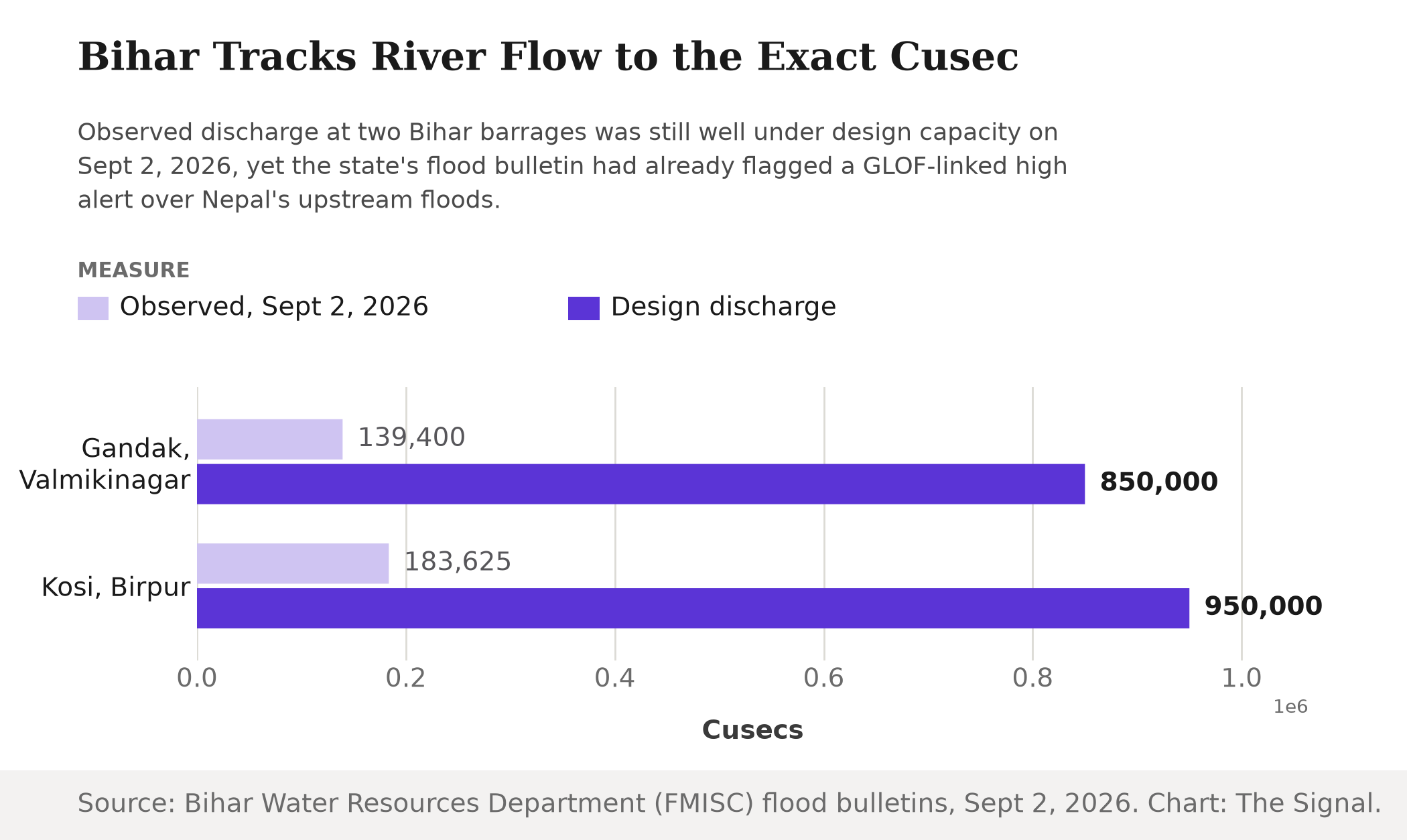
Source: Bihar Water Resources Department flood bulletins for the Gandak and Kosi barrages, Sept 2, 2026. Chart: The Signal.
That capability exists because the trigger upstream is well understood. An ice-rock avalanche on the Nepali side of the border dammed the Lhende River on August 26, 2026, and the resulting debris flow travelled nearly 100 kilometres down the Bhote Koshi-Trishuli corridor, destroying villages, bridges and hydropower projects along the way. By August 27, Nepal's foreign ministry had confirmed 359 bodies recovered from the river areas, with 596 people from 33 countries still missing. This was a well-documented catastrophe with a known cause, tracked hour by hour by Nepali and Indian agencies alike.
Design capacity and observed flow, two Bihar barrages, September 2, 2026
| Barrage | River | Observed discharge | Design discharge |
|---|---|---|---|
| Valmikinagar | Gandak | 1,39,400 cusecs | 850,000 cusecs |
| Birpur | Kosi | 1,83,625 cusecs | 950,000 cusecs |
Source: Bihar Water Resources Department flood bulletins, Sept 2, 2026.
What it cannot
None of that instrumentation reaches the fish. Bihar's food-safety apparatus for aquatic produce is built to screen for pesticide residue and chemical adulterants in known species moving through known markets. It has no protocol for a species nobody on staff can name, arriving from a river system with no baseline catalogue of what lives upstream of the border.
That gap is why the state's only tool was a blanket order rather than a targeted one. The advisory's own language put the burden on time, not testing: wait until the environment stabilises and disease-causing agents are naturally eliminated. That is a reasonable thing to say when you cannot say anything more specific. It is also, by construction, not a finding about the fish. It is an admission that no finding exists yet.
The river system explains why this keeps happening rather than being a one-off. A joint ICIMOD-UNDP assessment identified 47 glacial lakes across Nepal's Koshi, Gandaki and Karnali basins as potentially dangerous, and 42 of those sit in the Koshi basin alone, the same basin now carrying floodwater, sediment and fish into Bihar's Kosi and Gandak systems.
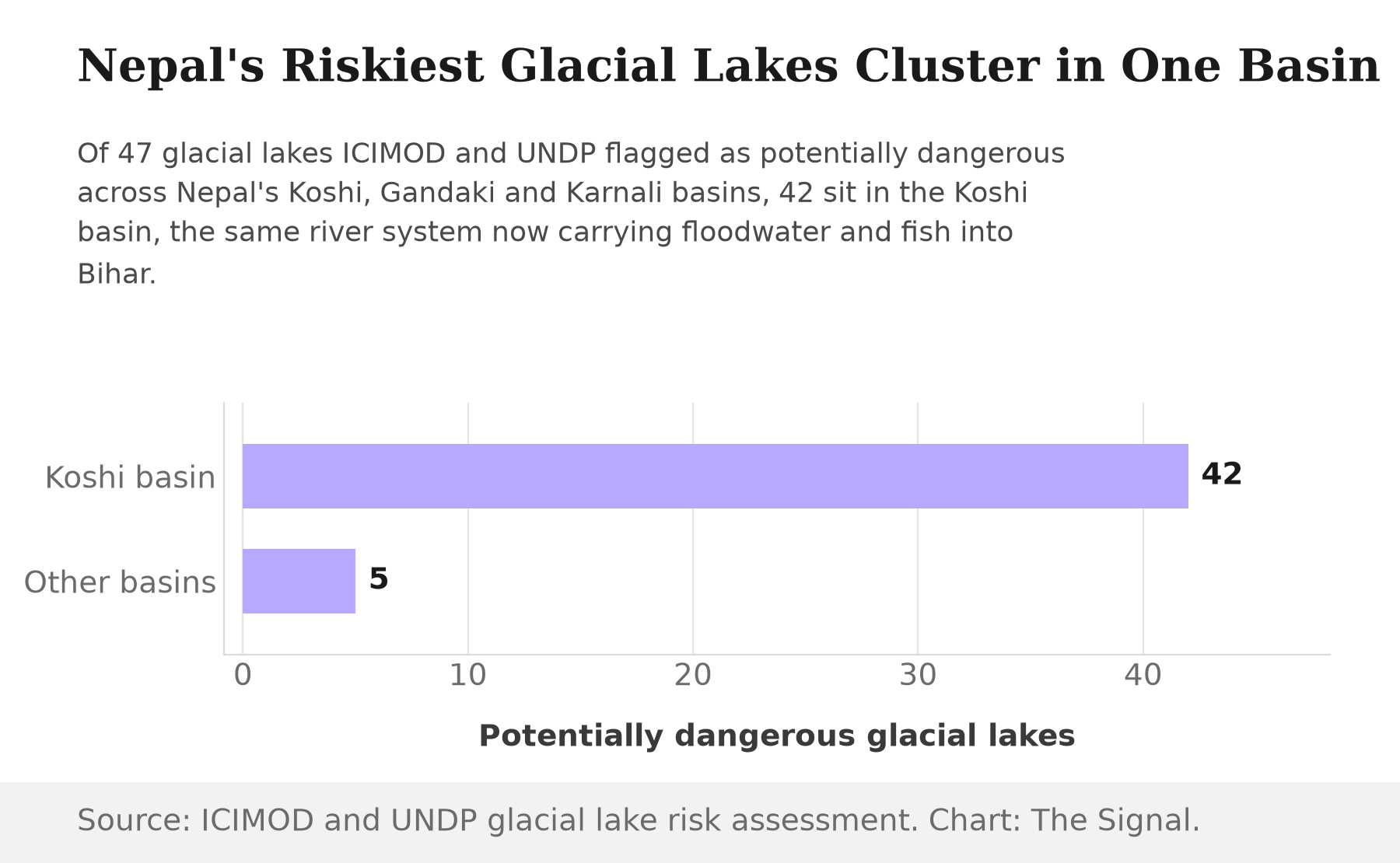
Source: ICIMOD and UNDP joint glacial lake risk assessment. Chart: The Signal.
That concentration sits on top of a longer structural trend. Hindu Kush Himalaya glaciers lost about 12 percent of their total area and 9 percent of their estimated ice reserves between 1990 and 2020, the retreat that feeds the meltwater lakes now sitting behind unstable moraine dams. Forty-two of the region's most dangerous lakes sit in the one basin that already flooded once this year. The odds that this is the last time a Nepal-origin flood puts an unrecognized fish on a Bihar riverbank are not good.
The honest objection
The strongest case for Bihar's approach is that a blanket ban is the only responsible move when you genuinely do not know what you are looking at. Floodwater does not just carry displaced fish; it carries sewage overflow, dead animals, agricultural runoff and debris from destroyed settlements upstream, and Bihar's fisheries minister was explicit that people should avoid the fish specifically because of how they arrived, not because a specific toxin had been found. Waiting for the water to settle before eating anything that swam through it is precautionary, and precaution is not a failure of science; sometimes it is the correct application of it under uncertainty.
That case holds for the first few days. It does not explain why, a week after the fish began appearing, reporting still described people in four districts catching them with no state identification effort attached to the advisory: no samples reported sent for taxonomic identification, no interim testing protocol, nothing beyond "wait and do not eat." A precautionary pause and a standing capability gap produce the same instruction in week one. Only one of them looks the same in week four.
The Signal
Bihar's flood bulletins prove the state can build precise, fast, publicly issued instrumentation when the risk is a known one: a river, a barrage, a threshold in cusecs. The fish crossing that same border expose the instrument the state does not have: a way to identify a new species and test it for actual risk, rather than default to a ban that treats "unfamiliar" as a synonym for "unsafe" until the calendar decides otherwise. Watch what happens once the water recedes. If Bihar's fisheries department follows the advisory with actual species identification and toxicology results, the state will have closed a real capability gap under pressure. If the ban simply lapses as the rivers recede and nobody ever publishes what the fish were, the lesson is that the state can price a flood in cusecs long before it can name what the flood brought with it.
Reporting basis: the Nepal-China border flood's origin and scale are per ICIMOD's disaster briefing; the casualty and missing-persons count is per Nepal's Ministry of Foreign Affairs. Bihar's river discharge figures are from the Bihar Water Resources Department's own flood bulletins for the Gandak and Kosi barrages. The glacial lake count is from a joint ICIMOD-UNDP risk assessment, and the long-run glacier loss figure is from a separate ICIMOD publication; both describe structural background rather than the current event. Bihar's fish advisory and the minister's description of the fish are per The Federal and The Week respectively, the district-level catch accounts are per The Tribune, and the tentative species identification is per an independent wildlife biologist, as reported by the Times of India and recarried by The Independent. The comparison between the precision of the discharge data and the absence of any identification or testing protocol for the fish is The Signal's own analysis of those sources.