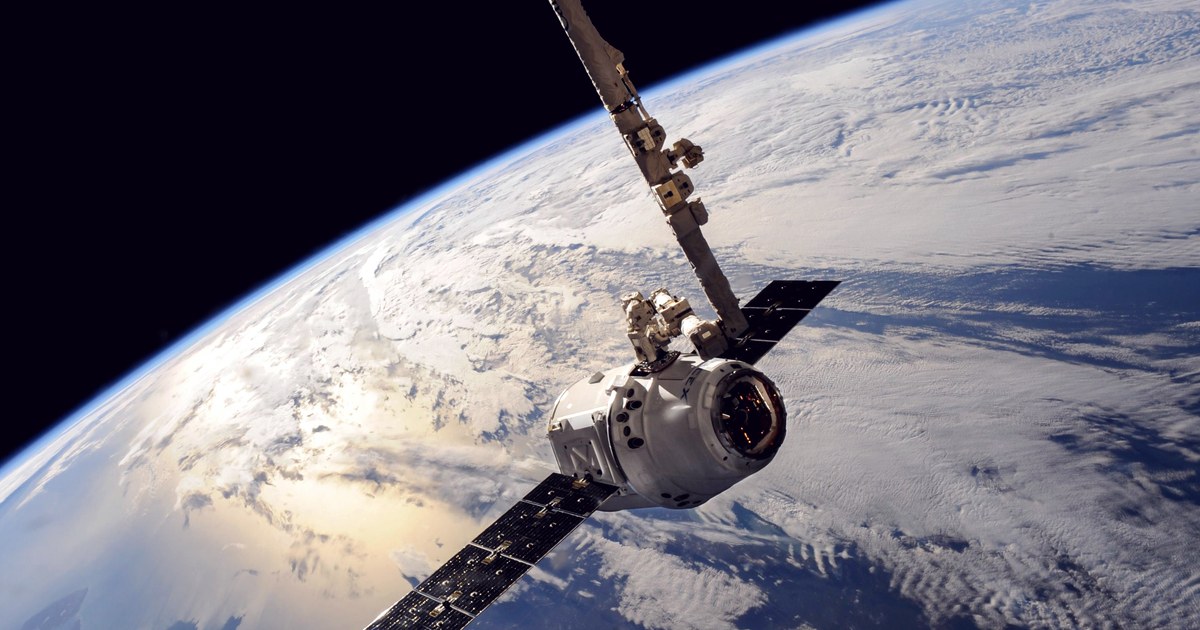
In July 2026, a study backed by the European Southern Observatory recommended capping the world's satellites at 100,000 objects too faint to see with the naked eye, to keep megaconstellations and proposed space mirrors from brightening the sky enough to blind ground-based telescopes. That cap has real headroom before it binds: space surveillance networks track about 40,000 objects in Earth orbit as of ESA's 2025 Space Environment Report, of which only about 11,000 are active satellites, roughly a tenth of the proposed limit. It is a tidy villain: a swarm in orbit, a headline number, a proposed limit. It also happens to be the smaller of the two problems with how the world tracks its vanishing night sky.
It is worth slowing down on the bigger one. The instruments meant to monitor light pollution from space, the same satellites now being asked to police themselves, cannot properly see the LED light now replacing older streetlamps worldwide, the exact kind spreading across cities fastest. That is not a metaphor. It is a wavelength problem, and it means the official record of how the sky is brightening has been running behind reality for years, in India as much as anywhere.
The clearest evidence is a straight comparison of two measurement methods over the same years. A 2024 study reconciling the two records found satellite radiance data (VIIRS-DNB) rising about 2.2 percent a year worldwide, against citizen star counts from the Globe at Night project rising about 9.6 percent a year: the sky, measured by people looking up, is brightening nearly four times faster than the sky measured by machines looking down. The finding surfaced first in 2022, when Kyba et al.'s original Globe at Night analysis found sky brightness at citizen-observing sites rising 9.6 percent a year from 2011 to 2022, against roughly 2 percent a year from satellites over the same decade. Two independent looks at the same gap, two years apart, land on the same order of magnitude.
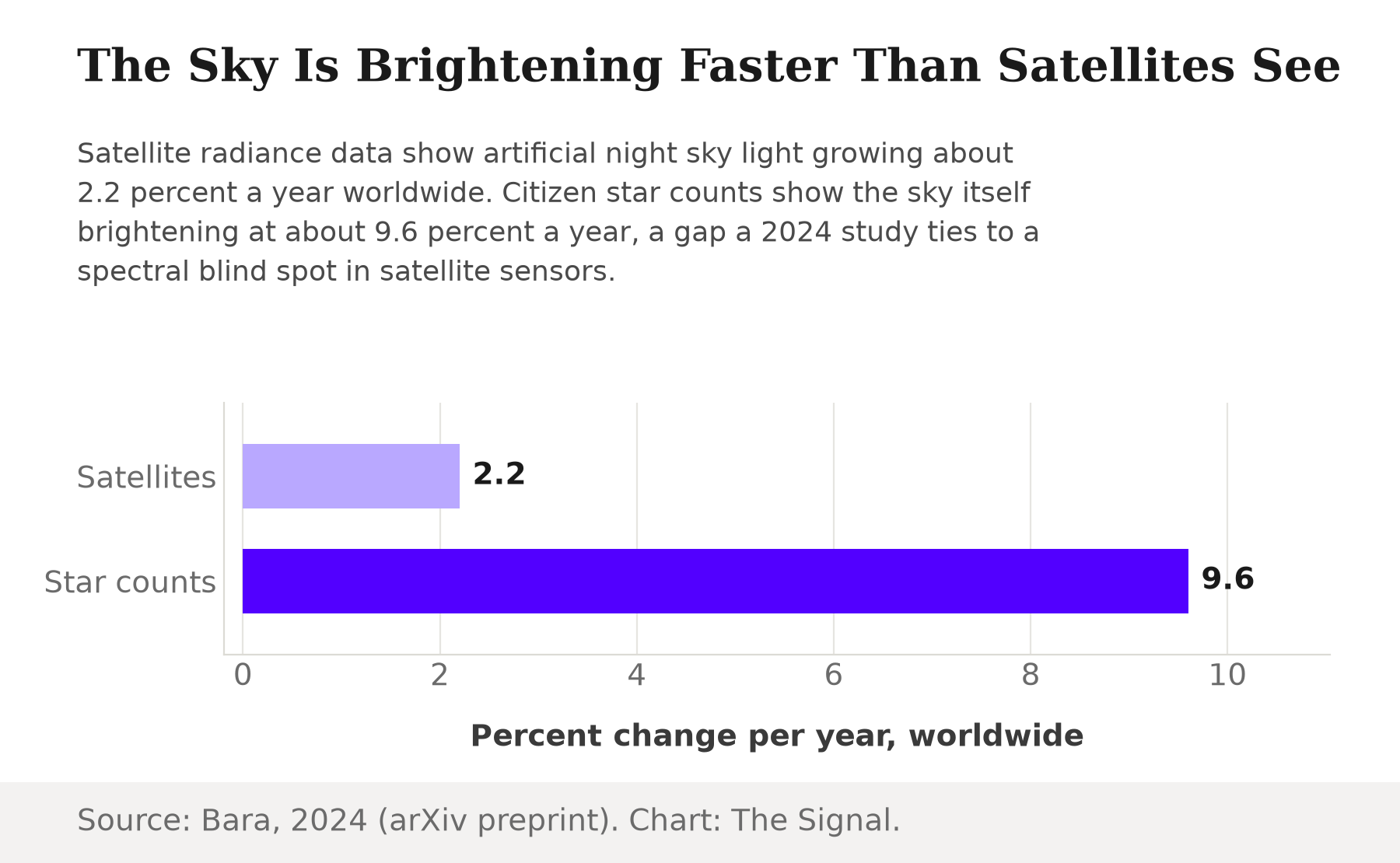
The wavelength satellites cannot see
The gap has a specific, checkable cause. No satellite currently monitors the whole Earth at wavelengths shorter than 500 nanometers, the cyan and blue band where white LEDs peak in emission, between 400 and 500 nanometers. That band matters more than its size suggests, because shorter wavelengths scatter more efficiently in the atmosphere, so a given amount of blue-rich light produces disproportionately more skyglow than the same amount of older, longer-wavelength light. A 2022 review of fifty years of satellite nighttime-light imaging confirms the blind spot is not new or incidental: DMSP and VIIRS, the two sensor families that have supplied the entire satellite record of Earth's night lights for decades, have no sensitivity to blue wavelengths at all. As cities everywhere swap sodium-vapor streetlights for LEDs, the light itself is shifting into exactly the part of the spectrum the satellite record cannot register. The instruments are not malfunctioning. They were built for a different kind of light, and the world changed the light on them.
India is inside the same blind spot
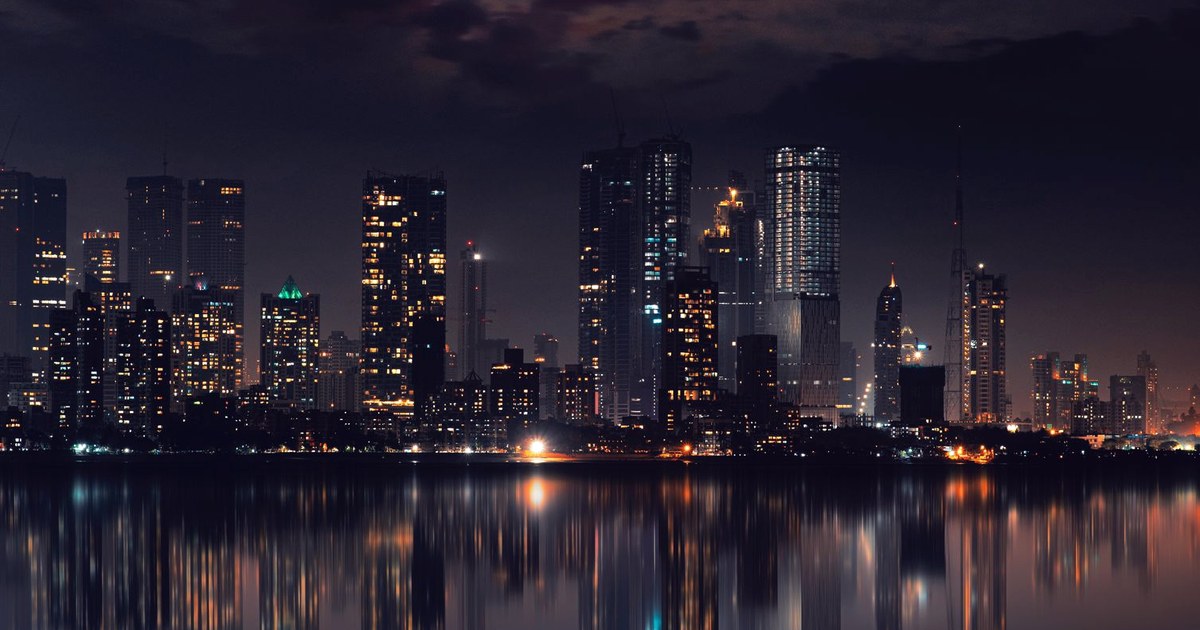
This is not a problem India can watch from a distance. The Ministry of Power reports that Energy Efficiency Services Limited has installed around 1.30 crore, about 13 million, LED streetlights across the country under the Street Lighting National Programme, as of December 2023. Every one of those replacements is a small, real shift toward the same blue-rich spectrum satellites cannot fully track. None of this shows up as a scandal in any single city's data. It shows up as a structural undercount in the national and global picture, one LED at a time.
The stakes are concrete at one specific site. Ladakh's Hanle Dark Sky Reserve, India's first, was notified by the Government of Ladakh in December 2022, centred on the Indian Astronomical Observatory, and has since drawn a steady stream of astro-tourism. A reserve like Hanle is a bet that dark skies stay dark, at a site the country is actively marketing on that promise. If the light polluting India's skies is growing at the citizen-observed rate rather than the satellite-reported one, any national monitoring built solely on satellite data will keep underselling the pressure on that reserve, and on every dark-sky site like it, until ground observers notice first.
India's night sky, in two official numbers.
| Metric | Detail | Date |
|---|---|---|
| LED streetlights installed nationwide (Street Lighting National Programme) | About 1.30 crore (13 million) installed | December 2023 |
| Hanle Dark Sky Reserve, India's first | Notified by the Government of Ladakh | December 2022 |
Source: Ministry of Power, via PIB; Department of Science and Technology, Government of Ladakh, via PIB.
Most of the world already lost the sky
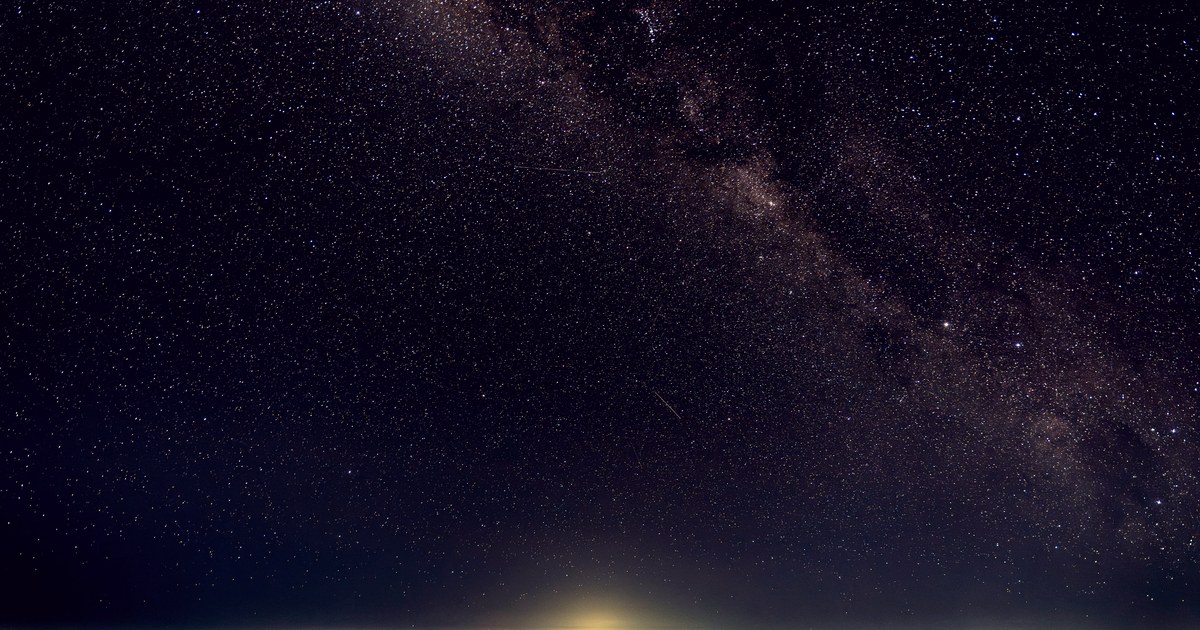
The scale of what is already gone predates this decade's LED rollout entirely. A 2016 world atlas of artificial night sky brightness found that more than 80 percent of the global population, and more than 99 percent of the US and European population, already lived under light-polluted skies, with the Milky Way hidden from more than a third of humanity. That is a decade-old snapshot, not a current one, and it describes a world before the LED transition accelerated. Every mechanism this piece has described only pushes that 2016 baseline higher, faster than the satellites tracking it can confirm.
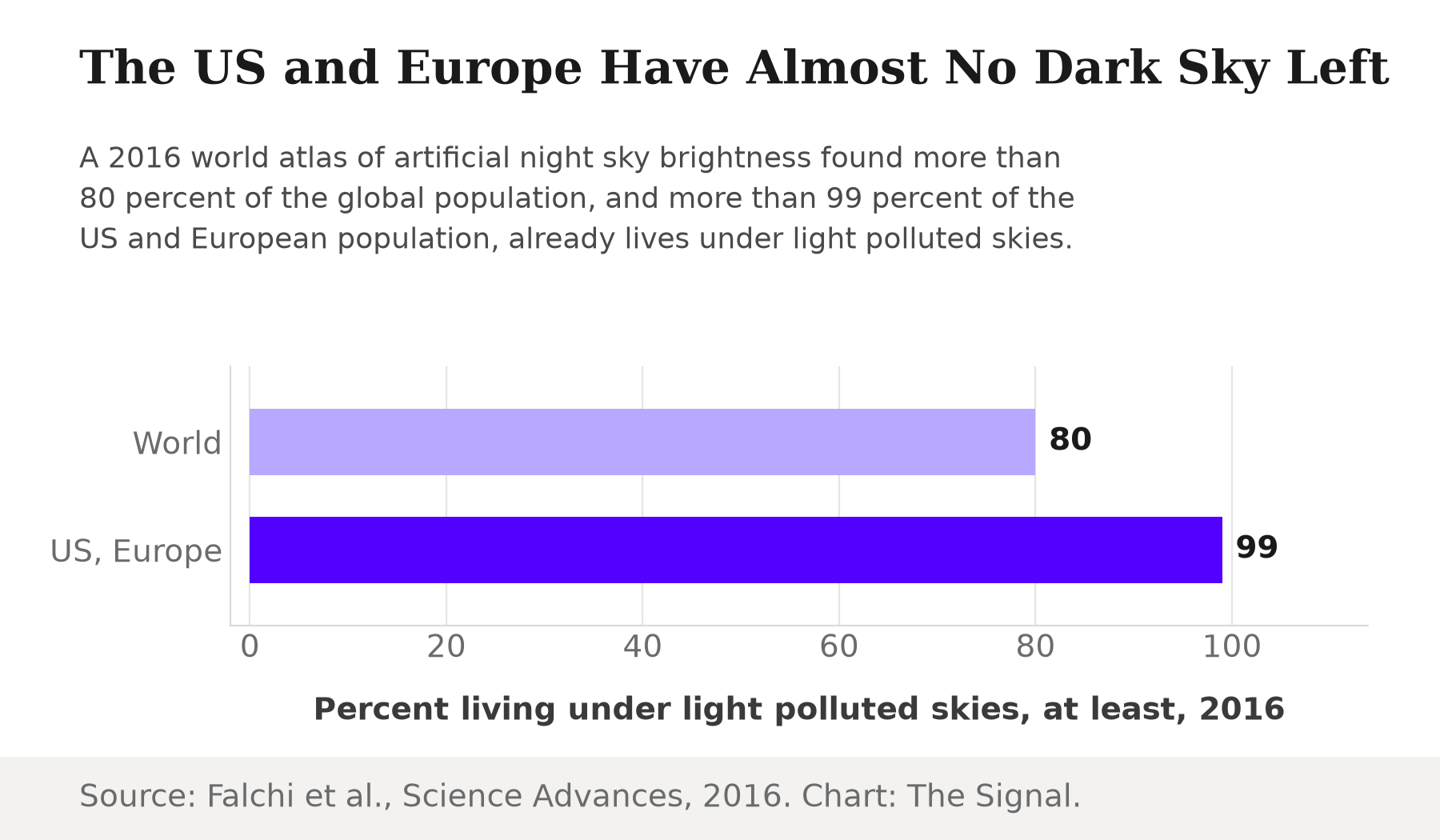
The honest objection
The strongest case against leaning on the citizen-science number is that it is exactly that: citizen science. Globe at Night relies on volunteers comparing the sky to star charts with the naked eye, a method vulnerable to clouds, moonlight, local mood, and whether anyone bothers to submit an observation at all. A single noisy crowd-sourced dataset diverging from a calibrated satellite sensor is, on its own, a reason for caution rather than alarm. That objection is weaker than it sounds once the sample size is on the table: the 9.6-percent figure rests on 51,351 individual naked-eye observations, submitted worldwide on cloud- and moon-free nights between 2011 and 2022, not a handful of enthusiastic backyards.
That case would be stronger if the citizen number stood alone. It does not. A dedicated 2024 study built specifically to reconcile the two records still found the same near-fourfold gap using the standard satellite dataset directly, and a separate, independent review of the satellite hardware itself explains why a gap of roughly that size should exist: the sensors have no sensitivity to blue light at all. A noisy crowd-sourced number that happened to run high would not also come with a specific, hardware-level mechanism for why the calibrated instrument should be reading low. The two lines of evidence answer different objections: one says the gap is reproducible, the other says why it exists.
The Signal
The July 2026 satellite cap treats orbit as the problem: too many objects reflecting too much sunlight into telescopes below. That is real, and worth capping. But the ground is doing more damage than orbit, and the tools built to prove it are looking at the wrong color of light to see it happening. A monitoring system with a known, decades-old blind spot is not a small technical footnote. It is the reason the sky can keep brightening for years past whatever limit satellites certify as safe, in any country still swapping streetlights for LEDs, India included. Watch what gets measured next: a satellite record that adds instruments sensitive to blue wavelengths would be the honest fix. A cap on orbiting objects that leaves the ground-based blind spot untouched is fixing the part of the problem that photographs well, not the part that is actually growing.
Reporting basis: the satellite-versus-citizen brightening gap is per NOIRLab's 2022 press release on Kyba et al.'s Globe at Night study in Science, and a 2024 reconciliation preprint by Bara published in the Journal of Quantitative Spectroscopy and Radiative Transfer. The 51,351-observation sample size behind that study is per GFZ German Research Centre for Geosciences' press release on the same study. The satellite spectral blind spot is per the same NOIRLab release and, independently, per a 2022 Frontiers in Remote Sensing review of the DMSP and VIIRS sensor record. India's LED streetlight count is per the Ministry of Power, via the Press Information Bureau; the Hanle Dark Sky Reserve's notification date is per the Government of Ladakh's Department of Science and Technology, also via PIB. The 2016 global light-pollution figures are per Falchi et al.'s World Atlas of Artificial Night Sky Brightness in Science Advances. The July 2026 satellite cap recommendation is per the European Southern Observatory; the current count of tracked and active satellites is per ESA's Space Environment Report 2025. The near-fourfold comparison between citizen and satellite brightening rates is stated directly in the 2024 reconciliation study; no other figures in this piece are derived.