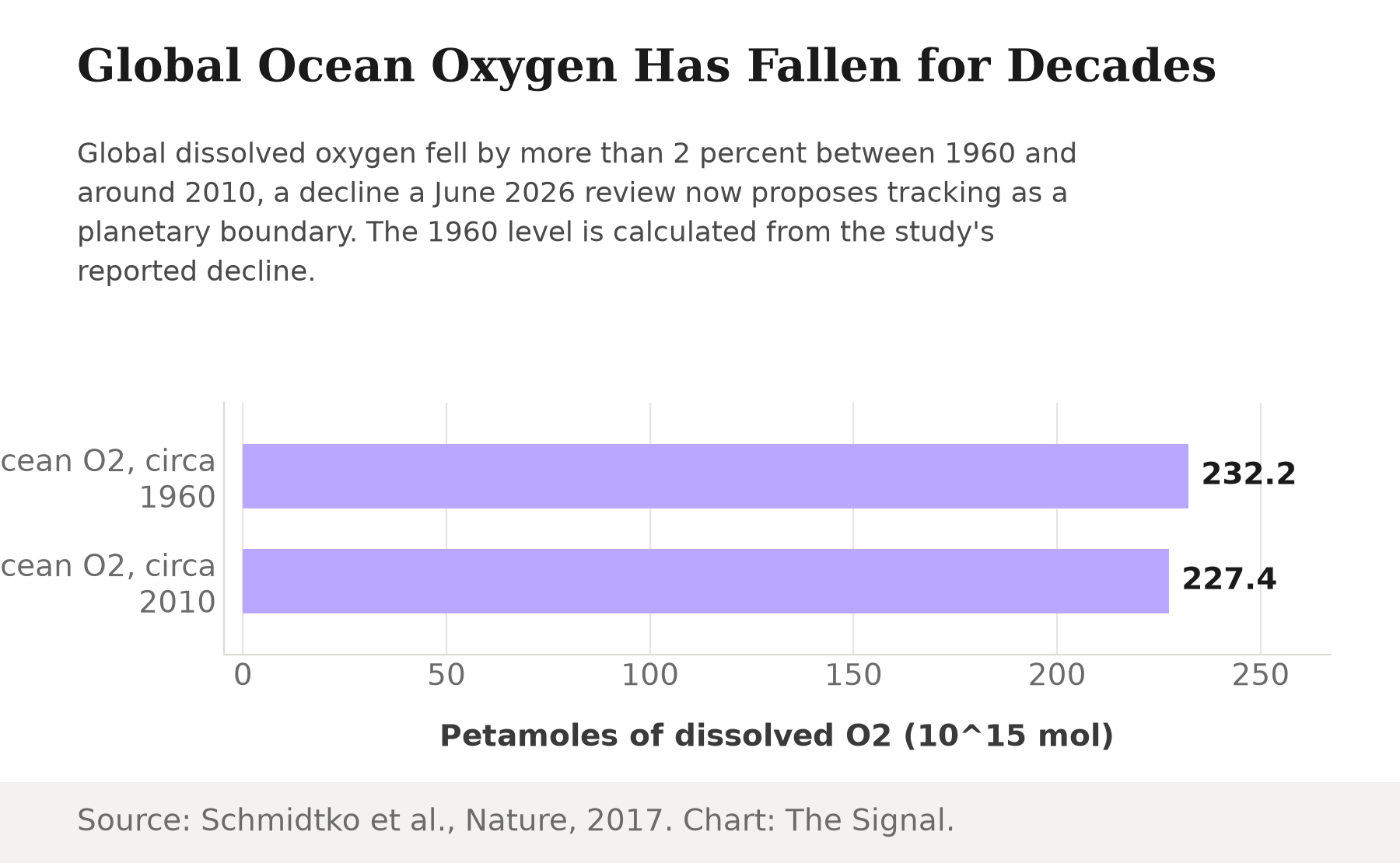
In June 2026, a review led by the Scripps Institution of Oceanography argued that the ocean's dissolved oxygen belongs alongside carbon and biodiversity as a tenth Planetary Boundary, warning that deoxygenation is pushing aquatic ecosystems toward an "unsafe space" for the planet's stability. The case rests on a genuinely global pattern: global oceanic oxygen content fell by more than 2 percent between 1960 and around 2010, according to a Nature study by Schmidtko and colleagues. Read on its own, the news reads like the start of an emergency the world is only now learning to measure.
Roughly a sixth of the world's entire oceanic nitrogen loss happens in one sea.
It is worth slowing down on that framing. Off India's west coast, the Arabian Sea has held one of the most severe oxygen minimum zones on the planet for decades, not as a preview of what oxygen loss might do to an ocean, but as a record of what it already has done. A 2009 Nature study by Ward and colleagues found the Arabian Sea to be the largest and most intense oxygen minimum zone in the world ocean, with up to half of the roughly 35 percent of global oceanic nitrogen that these zones destroy lost there alone, roughly a sixth of the world's total. That "largest" claim carries a footnote worth keeping: set against the world's other open-ocean oxygen minimum zones, in the eastern tropical Pacific and eastern tropical Atlantic, the Arabian Sea's own horizontal footprint is comparatively small; what makes it one of the most intense is depth, not breadth, with oxygen-depleted water reaching concentrations as low as roughly 3 micromoles per kilogram through an unusually thick vertical column.
Built on the monsoon's clock, not the news cycle
The Arabian Sea's oxygen minimum zone does not move to any single year's headlines. A Biogeosciences modeling study reports that it expands and deepens on a decades-long timescale, tracking the intensifying winds of the Indian monsoon, far slower than the 3-to-5-year cycle in which the sea's own surface productivity responds to those same winds. The same study found that Arabian Sea productivity rises and its oxygen minimum zone expands and deepens together, in response to that same monsoon wind intensification: the sea's richest fishing conditions and its most oxygen-starved water are driven by the same wind system, on the same slow clock.
The most oxygen-starved water on the subcontinent
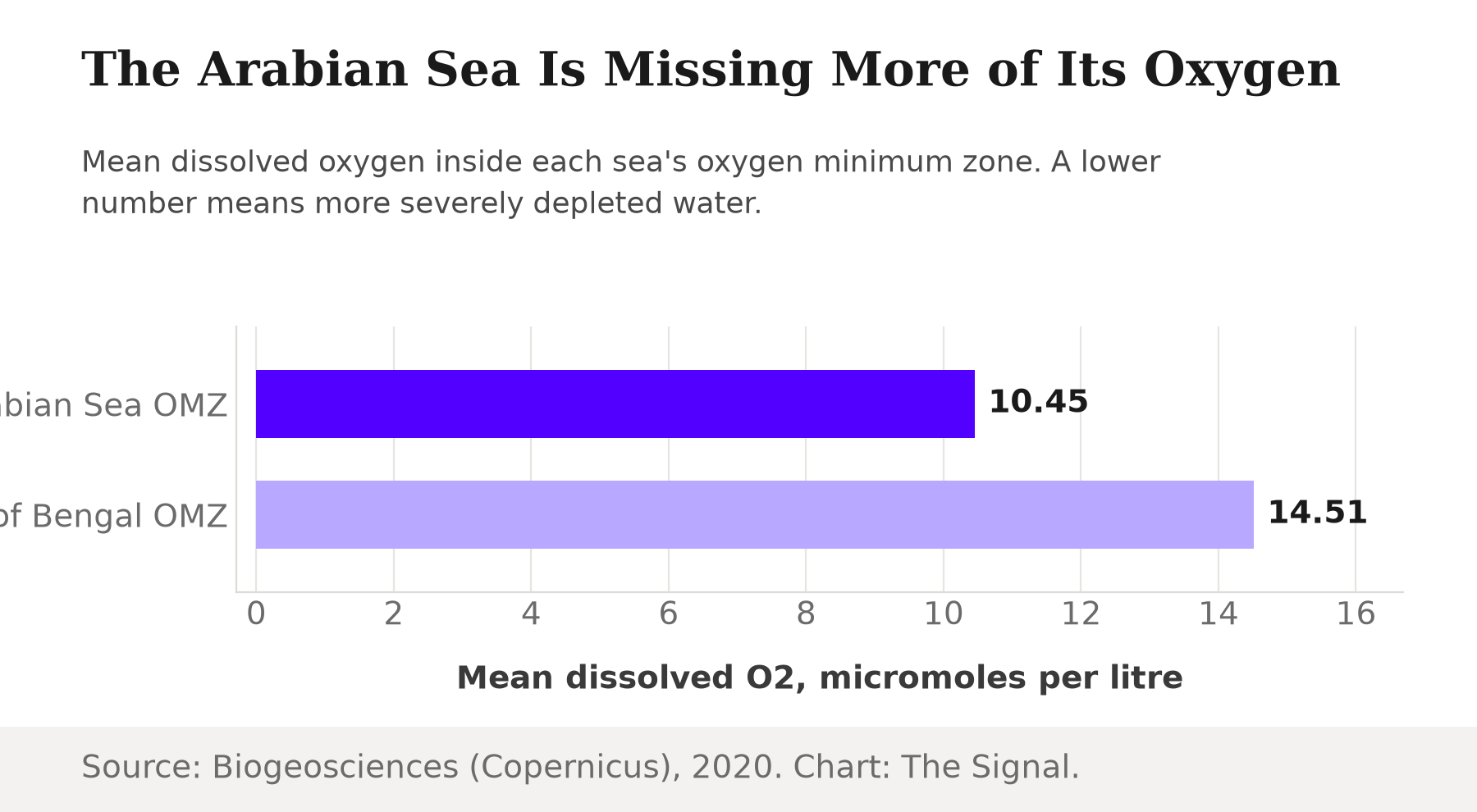
A Biogeosciences review of the northern Indian Ocean's oxygen minimum zones found that the Arabian Sea's low-oxygen water is more severely depleted than the Bay of Bengal's on India's other coast: a mean dissolved oxygen concentration of 10.45 micromoles per litre against 14.51 micromoles per litre.
This is not a new discovery. The same review notes that mass mortality of fish along the Arabian and Indian coasts, later identified as most likely triggered by oxygen depletion, was already described in the scientific literature in 1959, citing Carruthers and colleagues' original account. The Arabian Sea's oxygen problem is not a 2026 finding. It has a paper trail running back to before India's own green revolution.
The coast that fishes despite it
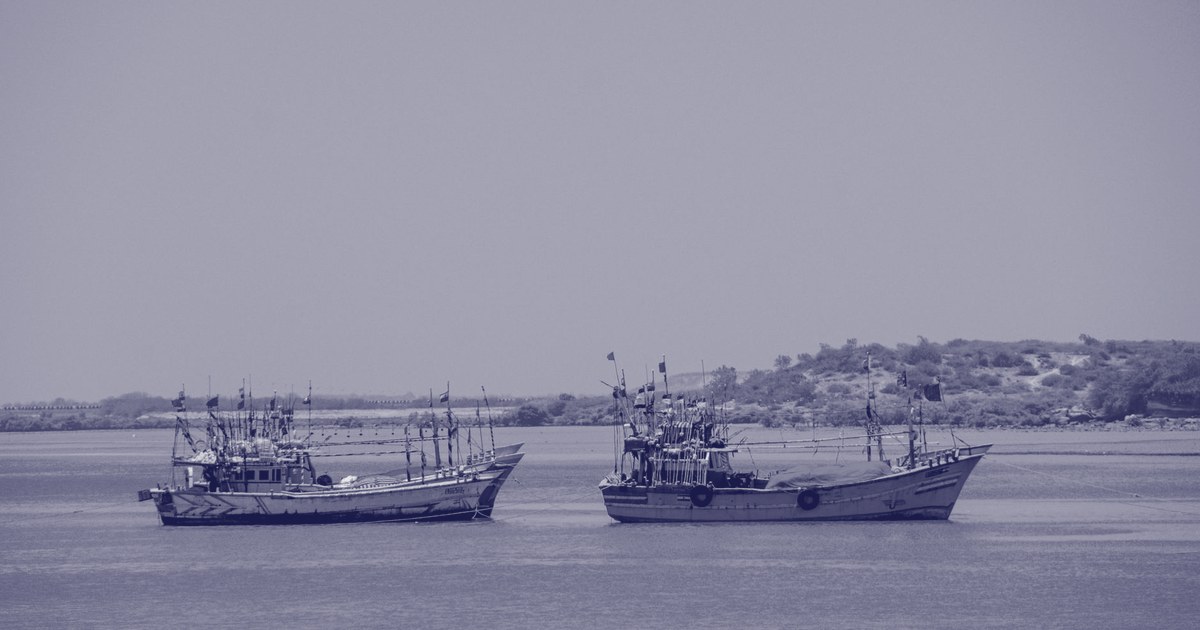
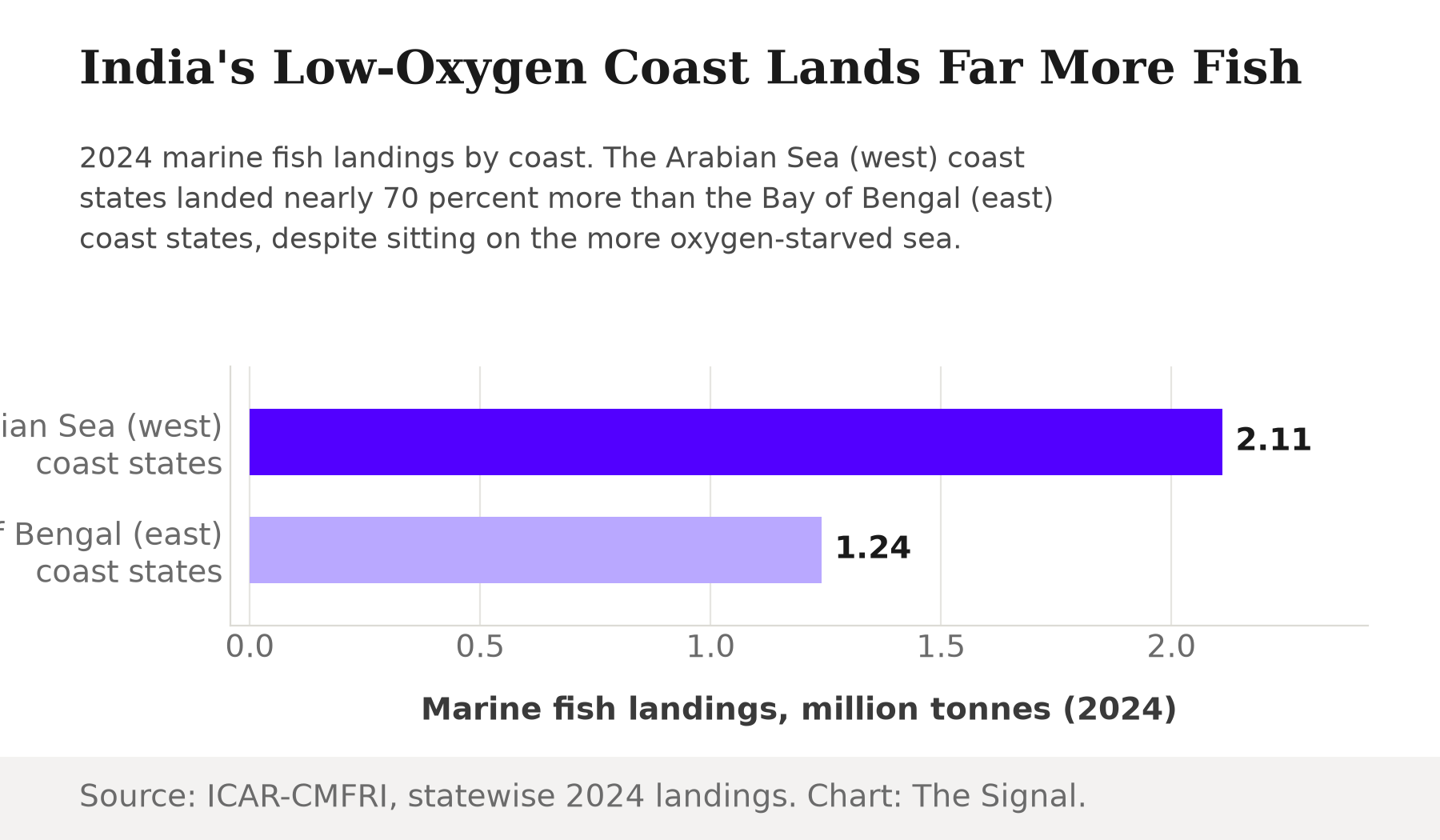
Here is the part that complicates a simple story of decline. India's Arabian Sea coast states landed about 2.1 million tonnes of marine fish in 2024, against 1.24 million tonnes landed by the Bay of Bengal coast states, according to ICAR-Central Marine Fisheries Research Institute's official statewise data, nearly 70 percent more from the more oxygen-starved sea than from the better-oxygenated one.
That gap does not mean low oxygen helps a fishery. It means the relationship between an oxygen minimum zone and the catch above it is not the straight line a reader might assume. Around 120 million people live on the coasts of the Arabian Sea and depend on its fisheries, Mongabay India reports, a population put under direct, recurring stress by the seasonal hypoxia and dead-zone events the region's oxygen minimum zone produces. The fishery and the dead zone are not opposites. They sit on top of each other.
That stress is not only a population count. Kerala's marine fish landings alone, on the Arabian Sea coast, were valued at an estimated Rs 12,665 crore at the landing-centre level in 2025, part of a national landing-centre value of Rs 69,254 crore, CMFRI's own data show: real money riding on a sea that keeps fishing around its low-oxygen water rather than despite it. That work has a documented cost at the level of a single species. Low oxygen in the Arabian Sea's inshore upwelled waters was one of the reasons that hurt recruitment of the Indian oil sardine, one of the west coast's most economically important catches, in 2013, a Frontiers in Marine Science study found. The same oxygen minimum zone that has not stopped the aggregate catch from growing can still crash a single season's most valuable species.
The honest objection
The strongest case against reading the Arabian Sea as a finished forecast for the rest of the world's oceans is that its own oxygen minimum zone has stopped following the global script. A 2025 Copernicus study built on a 2024 research cruise and the GLODAPv2 dataset found that the Arabian Sea's oxygen minimum zone tracked the global deoxygenation trend and expanded for decades, but that this reversed after 2013, with the zone shrinking since. That reversal is not just a change of direction; it now has a second, independent number attached. Biogeochemical-Argo float data show the zone's core dissolved oxygen concentration nearly tripled between 2013 and 2022, from about 0.63 to about 1.68 micromoles per litre, while its thickness shrank by 13 percent, a separate 2024 study found. If the world's most severe oxygen minimum zone is contracting even as a Scripps-led review proposes tracking global deoxygenation as a planetary boundary, the Arabian Sea's decades of low oxygen could read less like a preview of where the rest of the world's oceans are heading and more like a regional outlier that is now correcting itself.
That case is real, but it complicates the comparison rather than closing it. The zone's own response to monsoon winds runs on a decades-long clock, far slower than the 3-to-5-year cycle its own surface productivity works on, so a shrinkage that began in 2013 is itself a wind-driven, decade-scale signal, not proof the underlying system has stabilized for good. The Arabian Sea remains, on the same evidence, the largest and most intense oxygen minimum zone in the world ocean, still measurably more depleted than the Bay of Bengal beside it. A sea this severely and this persistently oxygen-starved, whose own fish kills and fisheries have already lived inside it for six decades of recorded science, is still the closest thing the rest of the world's oceans have to a completed trial run, reversal included.
The Signal
Global ocean oxygen loss is what a June 2026 review is only now proposing to track as a planetary boundary. The Arabian Sea has been running that experiment since before satellites could watch it happen. Its record does not say deoxygenation quietly empties a fishery: the low-oxygen west coast still out-lands the higher-oxygen east coast by nearly 70 percent, and 120 million people still depend on Arabian Sea fisheries sitting inside the world's most severe oxygen minimum zone. What the record says instead is that the zone moves on its own decades-long, monsoon-driven clock, not on the calendar of a scientific review. The number worth watching next is not whether the fish disappear. It is whether the zone's post-2013 shrinkage holds, or whether it is only that same slow clock resetting for another decades-long swing the other way.
Reporting basis: the June 2026 planetary-boundary proposal is per Scripps Institution of Oceanography's own release describing the review published in Limnology and Oceanography. Global ocean oxygen decline since 1960 is from Schmidtko and colleagues, published in Nature. The Arabian Sea's standing as the world's largest and most intense oxygen minimum zone, and its share of global oceanic nitrogen loss, is from a 2009 Nature study by Ward and colleagues; its comparatively small horizontal footprint against other world oxygen minimum zones is from an Ocean Science (Copernicus) study. The decades-long, monsoon-linked expansion and deepening of the zone is from a Biogeosciences (Copernicus) modeling study. The zone's post-2013 shrinkage rests on a 2025 Copernicus (EGUsphere) preprint built on a 2024 research cruise and the GLODAPv2 dataset, and is independently corroborated on the direction and scale of that reversal by a separate 2024 Geophysical Research Letters study using Biogeochemical-Argo float data. The Arabian Sea to Bay of Bengal oxygen comparison and the 1959 fish-mortality record are from a Biogeosciences (Copernicus) review citing Carruthers and colleagues' original 1959 account. The 2024 statewise fish-landing figures are ICAR-Central Marine Fisheries Research Institute's own official data; Kerala's 2025 landing-centre value figure is from CMFRI's 2025 landing-data release. The 2013 oil sardine recruitment finding is from a Frontiers in Marine Science study. The 120-million-person coastal population figure is per Mongabay India's reporting, the only source for that number. The west-coast and east-coast landing totals, and the percentage gap between them, are The Signal's calculations from CMFRI's statewise figures.