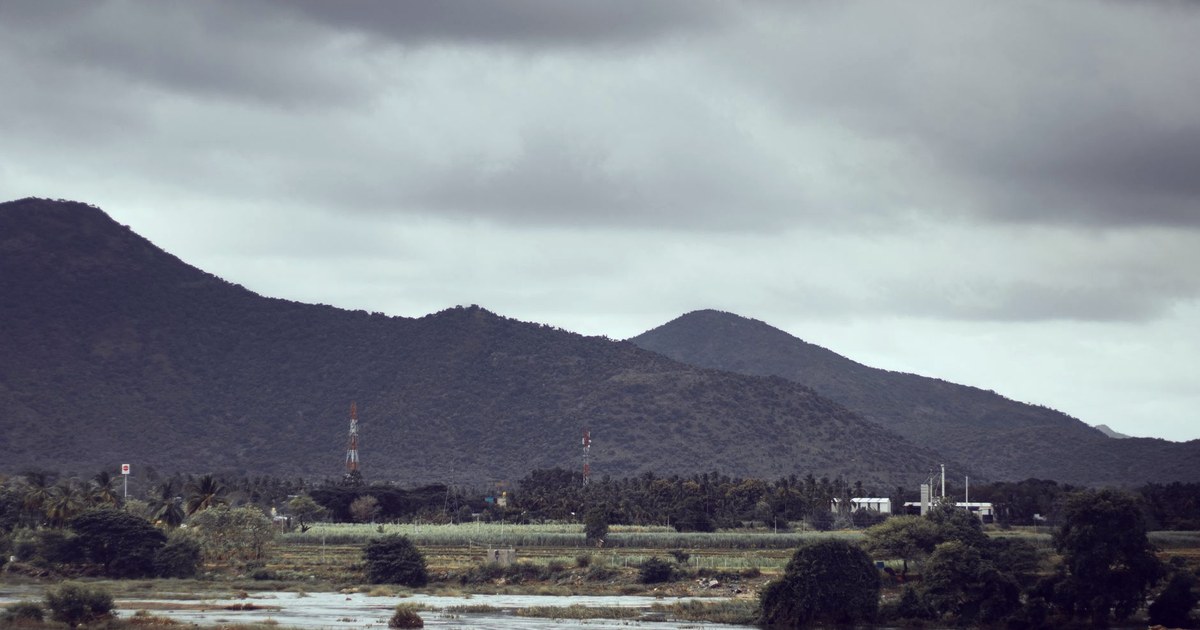
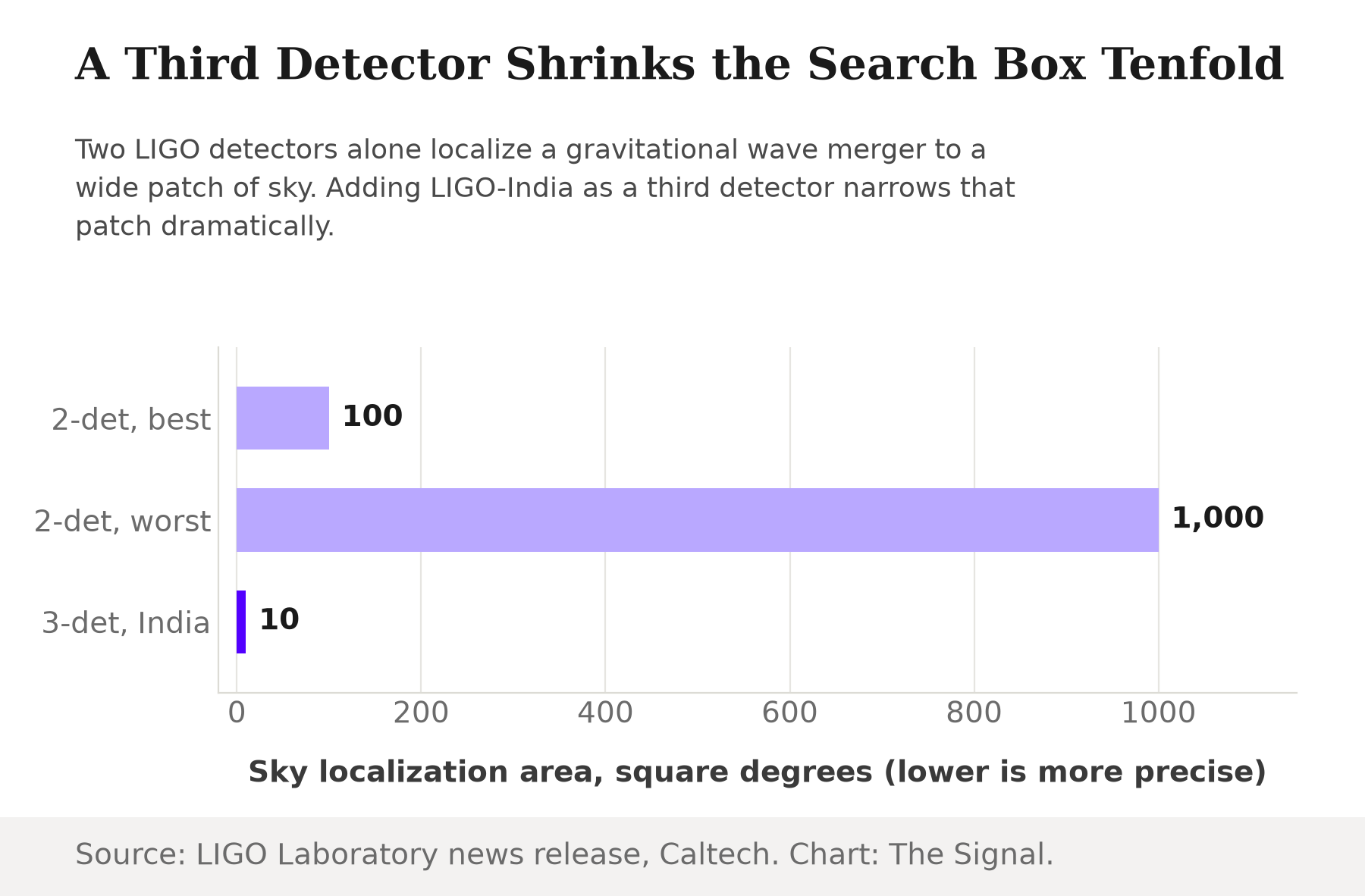
LIGO-India is meant to be gravitational-wave astronomy's third eye. The project was formally sanctioned by the Government of India on April 6, 2023, with a budget of ₹2,600 crore ($315 million), and construction at the Aundha site in Maharashtra is currently planned for completion in April 2030, according to a LIGO Laboratory roadmap white paper hosted by the NSF. The scientific case is concrete rather than symbolic. A LIGO Laboratory news release from Caltech states that two LIGO detectors alone can localize a merging pair of neutron stars to somewhere within 100 to 1,000 square degrees of sky, and that adding LIGO-India as a third detector narrows that patch to about 10 square degrees, turning a vague smear across the sky into a box other telescopes can actually search.
It is worth checking exactly what LIGO-India is being built to see, and when the rest of the network will actually be seeing at that level too.
The tier that matters
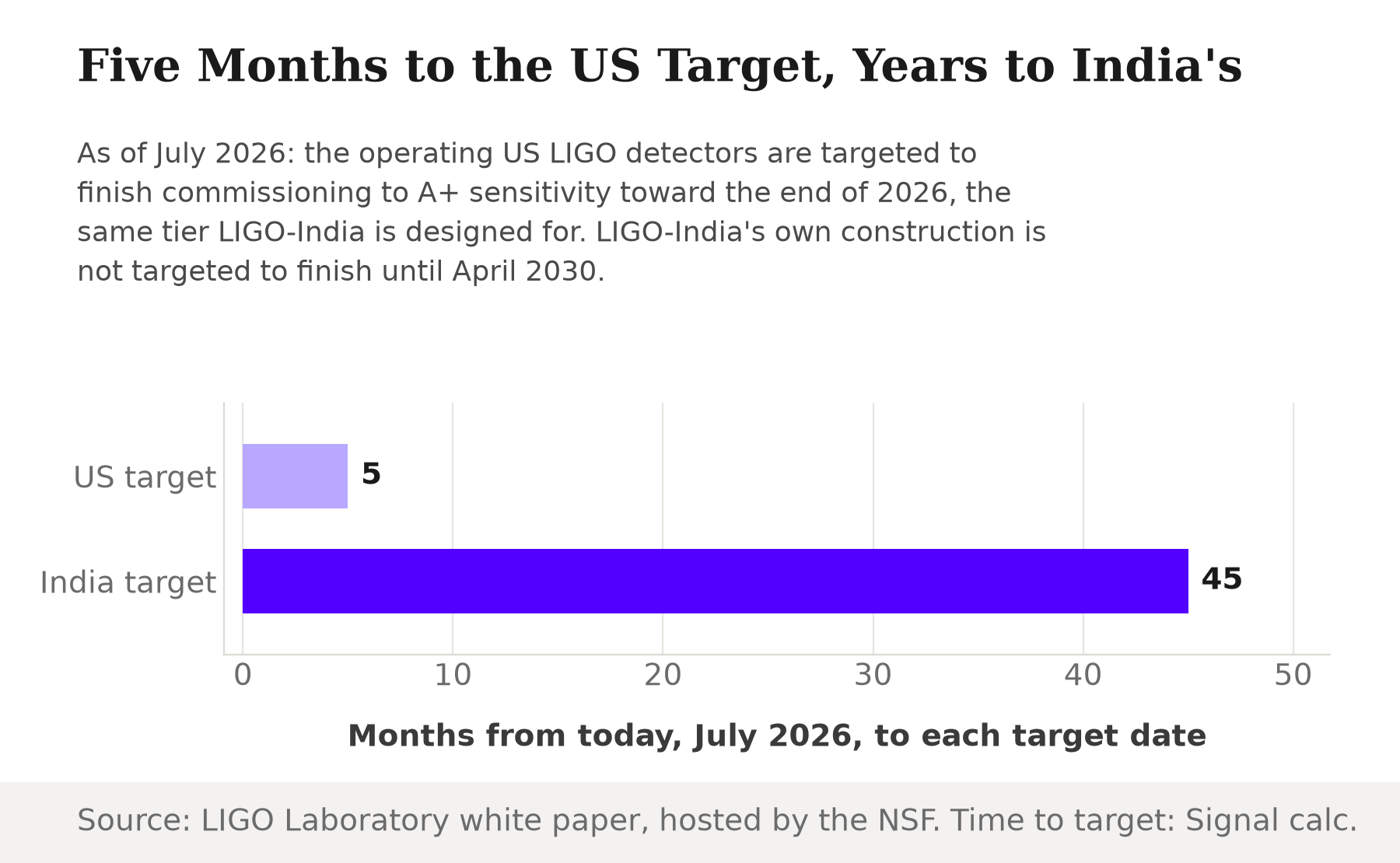
The Aundha detector is not being built to a stripped-down or dated design. The same LIGO Laboratory roadmap white paper states that the LIGO-India Project aims to bring its detector into operation with A+ (O5) sensitivity, the same upgraded tier the two operating US detectors are themselves racing to finish. The white paper also reports that following the O4 observing run, which ended at the end of 2024, the US interferometers are undergoing final A+ upgrades meant to roughly double their O4-era sensitivity, with commissioning targeted toward the end of 2026, before the O5 observing run begins.
As of today, July 2026, that puts the two milestones on very different clocks. The US network's own target is months away: commissioning toward the same A+ tier by the end of 2026. LIGO-India's target, by contrast, does not land until April 2030, years further out, roughly nine times as far from today by The Signal's calculation.
What A+ actually took
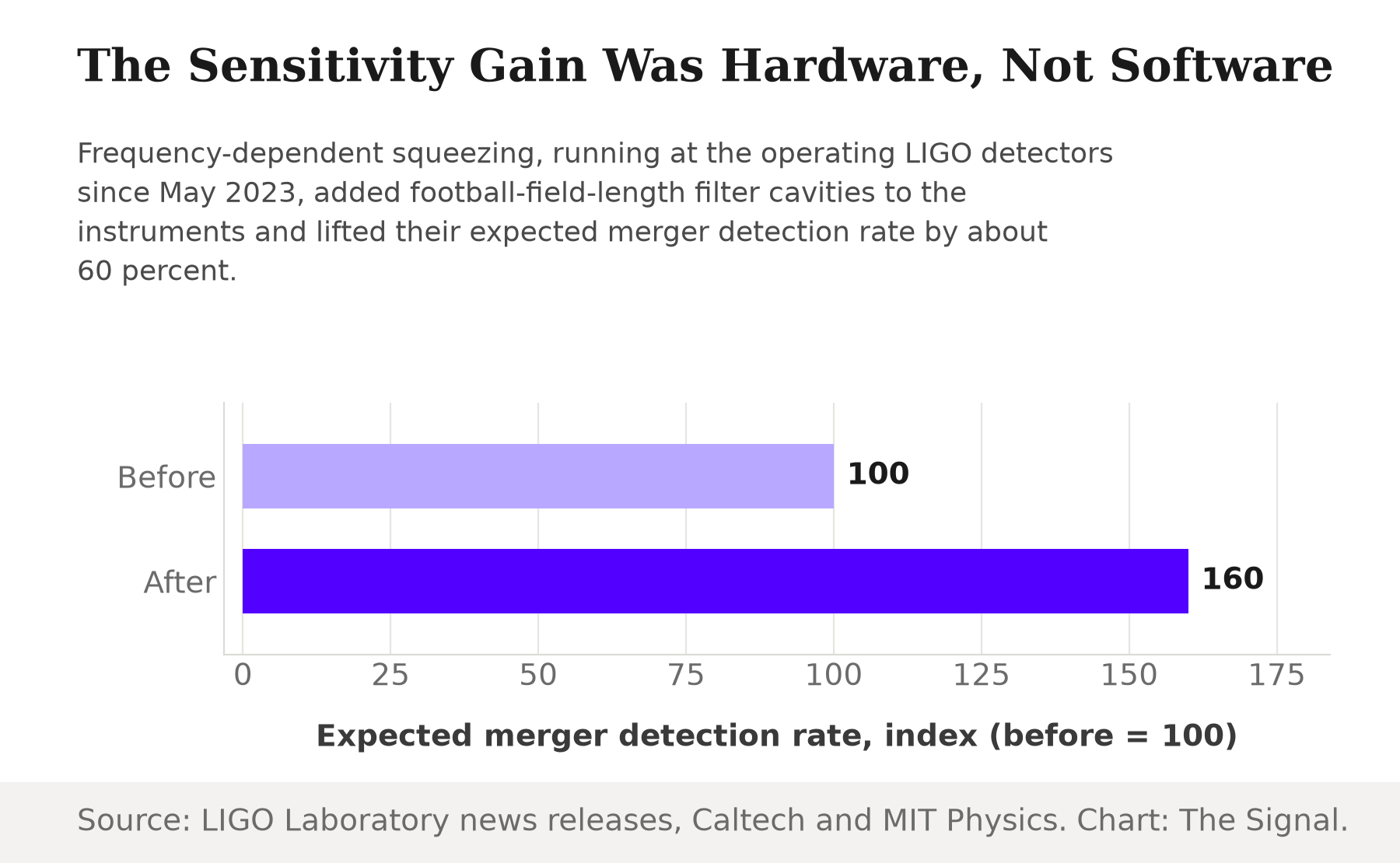
The A+ upgrade is not a settings change pushed to existing hardware. The clearest example of what it requires is squeezing, the noise-reduction technique already running at the operating US detectors. A LIGO Laboratory news release from Caltech reports that frequency-dependent squeezing, in operation at LIGO since it turned back on in May 2023, lets the detectors probe a larger volume of the universe and is expected to detect about 60 percent more mergers than before. A companion LIGO Laboratory release published by MIT Physics is specific about the mechanism behind that gain: new frequency-dependent optical cavities, tubes about the length of three football fields, let the team squeeze light differently depending on the gravitational-wave frequency of interest, reducing noise across the whole LIGO frequency range. That is poured concrete and precision optics work, well beyond anything a firmware update could deliver.
Whatever sensitivity gain LIGO-India inherits from the new frequency-dependent optical cavities the US detectors run, it has to inherit as physical infrastructure built into the Aundha instrument itself, on India's own construction timeline, not as something adopted after the fact.
The bar keeps moving
Even if LIGO-India's construction stays exactly on schedule and opens matching A+ sensitivity in 2030, the US roadmap does not stop at A+. The same LIGO Laboratory white paper explains that a further upgrade, called A♯, has already been recommended for the US detectors and pushes several key technologies beyond A+ levels: higher laser power and more squeezing, heavier test masses and improved suspensions, and better seismic isolation. A recommendation is not the same as a funded, dated build, the way A+ and the O5 run already are in the same document. But the roadmap's own logic is plain: the same document already names the tier after the one LIGO-India is being built to match.
What three detectors still buy
None of this makes LIGO-India pointless, because the sensitivity-tier question and the localization question are different problems, and the second does not care which upgrade generation the network happens to be running. The hundredfold improvement at the wide end, from up to 1,000 square degrees with two detectors down to about 10 square degrees with three, comes from geometry and triangulation, not from matching any particular sensitivity tier. A 10-square-degree box is something a wide-field camera can cover in a single pointing to hunt for an optical counterpart; a 1,000-square-degree box is not.
The network LIGO-India is joining is also no longer a proof of concept. The LIGO-Virgo-KAGRA Collaboration's GWTC-5.0 catalog paper reports that the network had catalogued over 300 confirmed gravitational-wave candidates by the end of the O4b observing run in January 2025, a tally built almost entirely without an Indian detector in the network. LIGO-India is adding a third eye to a network that already finds these events routinely, at whatever sensitivity tier it happens to be running, not a first eye to a young field.
The honest objection
The strongest case against reading this as India building toward an aging target is that matching A+ on schedule would itself be a real achievement, and the localization gain is worth having regardless of which upgrade generation is current when it arrives. A♯ is a recommendation in the roadmap, not a funded build with a target date the way A+ and O5 have, and large physics upgrades routinely slip, shrink, or wait years for budget before they are real. On this view, arguing about the tier after A+ before LIGO-India has even finished pouring concrete for the tier it is targeting now is premature.
That case is real, and it may well be right about A♯ specifically. But it does not need A♯ to happen for the underlying gap to matter. On the roadmap's two firm, dated milestones alone, the US network's A+ commissioning target sits toward the end of 2026 while LIGO-India's construction target sits in April 2030. That gap exists whether or not the next US upgrade after A+ is ever funded. A♯ only makes it worse if it happens. It cannot make it better if it does not.
The Signal
On paper, LIGO-India is aimed at the same sensitivity tier the operating US detectors are themselves still finishing, a live target rather than a stale design frozen years ago. The problem is the clock, not the target. A detector sanctioned in 2023 and due in 2030 is chasing a bar the rest of the network expects to clear within months of today, and the US roadmap has already named what comes after that bar. What LIGO-India buys regardless, a tenfold sharper fix on where a merger happened, does not wait on any of this. But it buys no certainty that the tier it eventually matches will still be the frontier when it turns on. Watch the Aundha construction schedule against the 2030 target as closely as any physics result: on this roadmap, the timeline is the story, not the design.
Reporting basis: LIGO-India's sanction date, budget, construction timeline, its A+ sensitivity target, the US detectors' O4-to-O5 upgrade schedule, and the recommended A♯ upgrade are all from a single LIGO Laboratory roadmap white paper hosted by the NSF, so those figures share one origin. The frequency-dependent squeezing figures are from two separate LIGO Laboratory news releases, one distributed via Caltech and one via MIT Physics, describing the same upgrade. The sky-localization improvement from a third detector is from a LIGO Laboratory news release via Caltech. The gravitational-wave catalog total is from the LIGO-Virgo-KAGRA Collaboration's own GWTC-5.0 paper. The months-to-target figures and the ratio between them are The Signal's calculations from the roadmap's stated target dates and today's date.