Between January and July 2026, ISRO has been narrating a brain drain in real time. Isro sources conservatively put the toll at up to roughly 120 Group A scientific and technical staff who resigned or took voluntary retirement in these months. About 80 of them came from the U R Rao Satellite Centre (URSC) in Bengaluru and at least 20 from the Vikram Sarabhai Space Centre (VSSC) in Thiruvananthapuram, both tied to the Gaganyaan human spaceflight programme. The easy read is a familiar one: trained government scientists are cashing out into a private space industry that barely existed a decade ago.
That read skips past the more interesting fact, which is what the Department of Space did next.
It is worth slowing down on that response. A Department of Space memorandum dated July 14, 2026 bars the routine acceptance of resignation and VRS requests from staff linked to Gaganyaan, and it reverses a November 2020 rule that had let Isro's own centre directors and unit heads approve such exits themselves, up to the rank of Scientist/Engineer-SG. Read plainly, the department running India's human spaceflight programme just pulled back a power its own centres had held for six years, in the same week its centres were losing people the fastest.
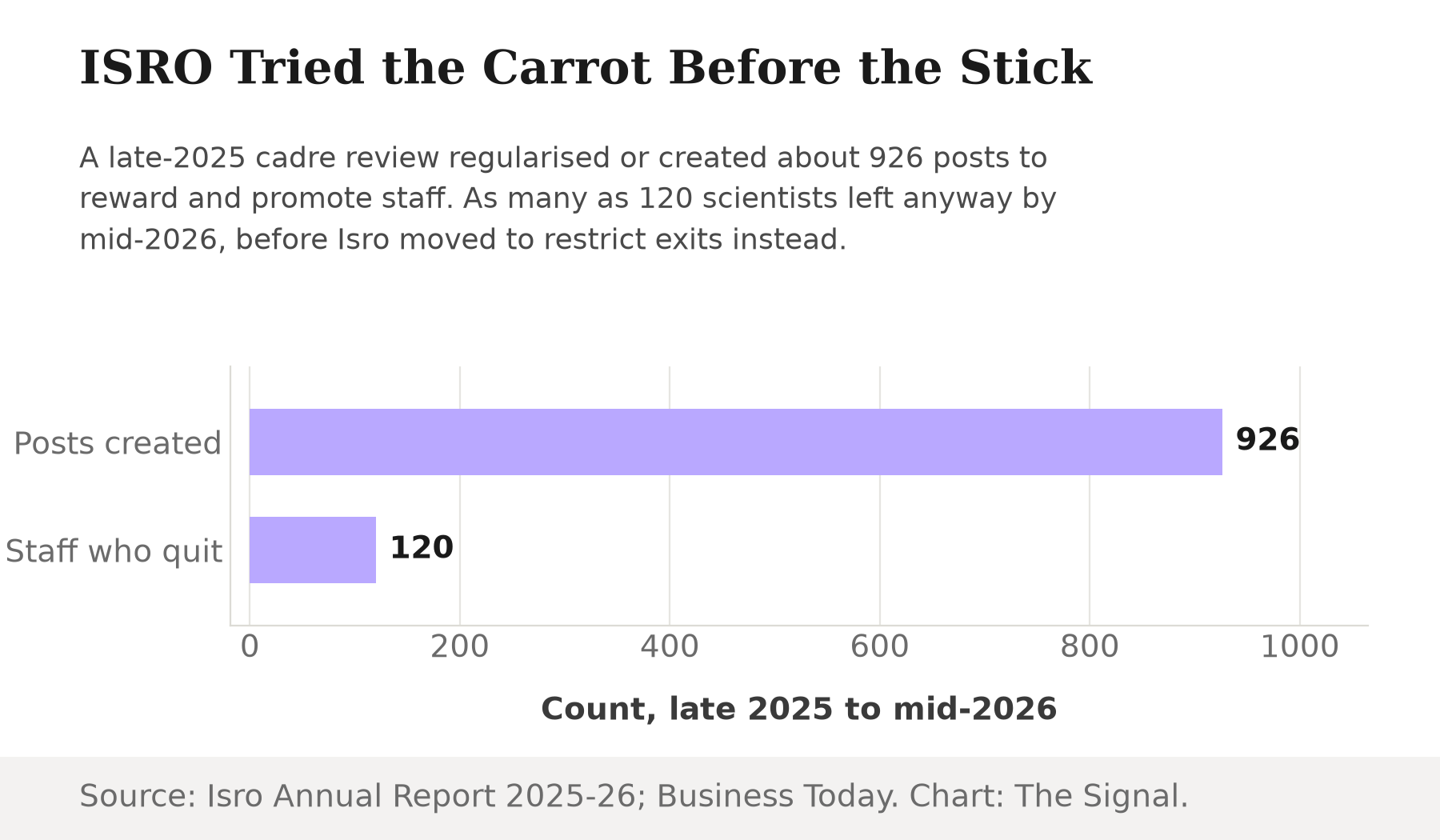
Look past the headcount who left, to the headcount of jobs the department had already tried to open for them. A cadre review approved in late 2025 regularised 466 project posts, 31 at the Department of Space and 435 at Isro, and created roughly 460 posts at higher grades to clear a path for promotion. Combine those and the department opened about 926 better career slots within the year, close to eight times the number of scientists reported to have quit since, a ratio The Signal calculates from those two filings. The carrot did not stop the exodus. The department's next move was a lock on the door, not a bigger one.
The exodus, concentrated
The 100 to 120 departures are not spread evenly. Isro and the Department of Space together employed 14,637 people in 2025-26, including 1,339 at URSC and 4,577 at VSSC. Against those totals, the roughly 80 who left URSC amount to nearly 6 percent of that centre's entire staff, not only its scientists, in a few months, against well under half a percent of VSSC's much larger workforce for the roughly 20 who left there (our calculation from the two filings above).
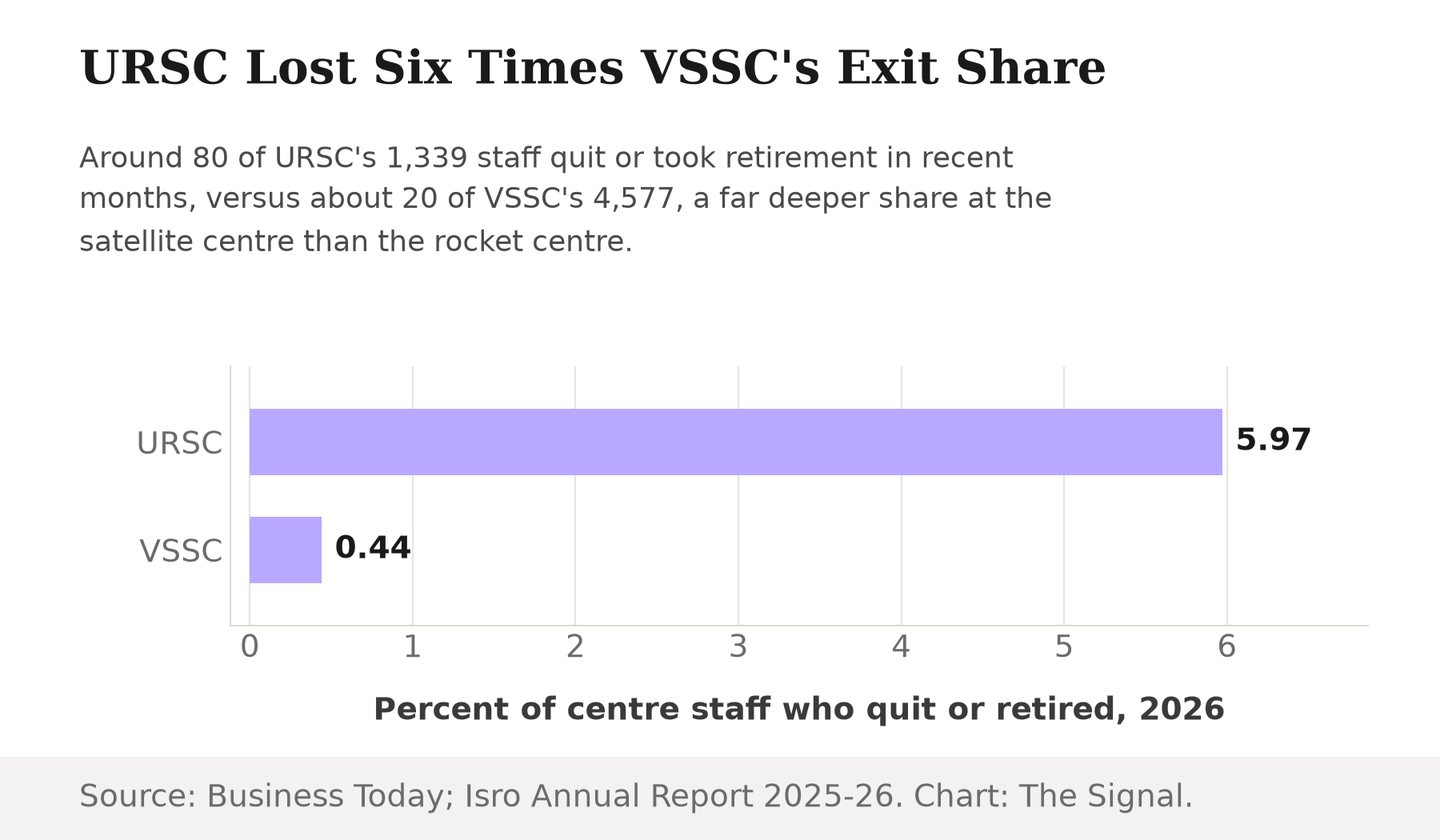
That gap matters because URSC builds and integrates the satellites and sensors that are harder to restaff quickly than a launch centre's larger, more standardised workforce. A centre losing one in twenty of its people in a single stretch is a sharper problem than a much bigger centre losing a handful.
It is also a break from ISRO's own baseline, not a continuation of it. Official data show that around 700 employees resigned across the twelve years from 2012 to 2024, an average of roughly 58 a year. An earlier spike was sharper: nearly half of the agency's newly recruited employees reportedly left between 2004 and 2007. Against that baseline, 100 to 120 departures concentrated into a few months of 2026 compress several years of normal attrition into one, far outside ordinary churn.
The stakes are a launch schedule
Isro's first uncrewed Gaganyaan precursor flight, G1, is targeted for late 2026, with two further uncrewed flights, G2 and G3, to follow before the first crewed flight, H1, currently planned for 2027, only after all three succeed. Every one of those milestones depends on the same integration and testing teams now thinnest at URSC. A slower spacecraft-readiness cycle does not show up as a headline the week it happens; it shows up as a slipped launch date the following year.
The vacancy the department was already carrying
The cadre review and this year's exits both landed on a workforce that was short-staffed before either happened. As of February 2026, the Department of Space told the Lok Sabha it had 1,636 vacant Science and Technology posts, 11.5 percent of its sanctioned strength, and 977 vacant administrative posts, 24 percent of sanctioned strength.
The Department of Space's staffing position, February 2026
| Category | Sanctioned posts | In position | Vacant | Vacancy rate |
|---|---|---|---|---|
| Science & Technology | 14,108 | 12,472 | 1,636 | 11.5% |
| Administrative | 4,034 | 3,057 | 977 | 24% |
Source: Press Information Bureau, Department of Space reply to the Lok Sabha, February 2026.
A workforce already running an 11.5 percent Science and Technology vacancy rate before this year's departures has less slack to absorb 100-plus more exits than the headline count alone suggests.
The pull side
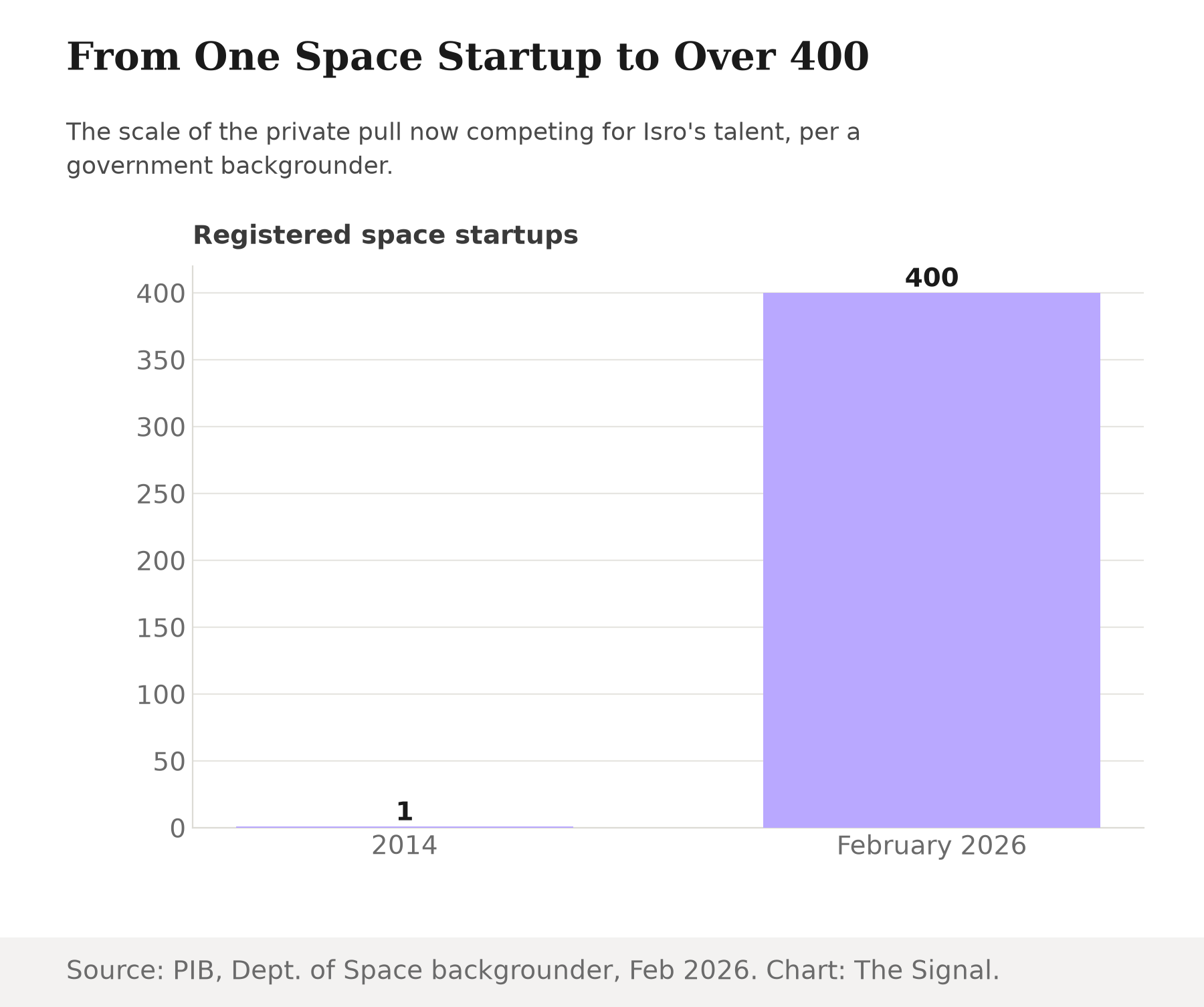
India's private space sector has grown from a single registered startup in 2014 to more than 400 as of February 2026, by the Department of Space's own account. That is the market now competing for Isro's trained engineers. The department's response was a memo restricting exits, not a raise or a faster promotion track that could close the gap with that market. That choice reads as treating the exodus as a compliance problem, not a pay problem.
The honest objection
The strongest case for the department's approach is that Gaganyaan is not an ordinary programme to run short-staffed. Losing trained engineers mid-integration on a human-rated launch vehicle is a safety question, not only a staffing one. A temporary brake on approvals, while the department assesses how thin its Gaganyaan teams have become, is a defensible, even prudent, stopgap. The 2020 delegation being reversed was itself a discretionary rule, not a right, and the department may yet announce pay or promotion moves that simply have not landed yet. ISRO's own leadership frames it that way: Chairman V Narayanan has said the organisation is equipped to handle the departures, that employee exits are common to every organisation, and that the new rules exist to keep sudden resignations from disrupting key missions, a continuity argument, not a denial that people are leaving.
That case explains the urgency. It does not explain the shape of the fix. The Department of Space had already tried the promotion route, regularising 466 posts and creating roughly 460 more only months before this year's exits continued anyway. A memo that makes leaving harder does not close the gap that a 400-fold growth in private space startups represents, and it does nothing about the Science and Technology vacancy rate the department was already carrying before this year's departures began. Making the exit slower can buy time. It is not a substitute for making the job more worth staying in.
The Signal
Isro's scientists are not simply leaving a government job. They are leaving it for a private space sector that its own parent department says has grown 400-fold in twelve years. Confronted with that gap, the Department of Space's most visible response is a rule that makes the exit itself slower, not a bigger paycheck or a faster promotion, both of which it had already tried months earlier. That is a revealed preference: when a talent problem collides with a human-spaceflight deadline, the department has chosen to control the door rather than compete for the person walking through it. Watch whether the freeze is followed by an actual pay or grade announcement in the coming months. If it is not, the memo is not a bridge to a fix. It is the fix, and its bet is that the door matters more than what is waiting on the other side of it.
Reporting basis: the resignation and voluntary-retirement count, and its centre-wise split, comes from Business Today, relaying Isro sources quoted by The Times of India. The exit-rules memorandum and its reversal of the earlier delegation to centre directors is per Free Press Journal, quoting the internal Department of Space memorandum directly. The Gaganyaan mission timeline is per The Week. Centre-wise staff strength and the cadre review's new and regularised posts sit in Isro's own annual filing for the year. The private space-startup tally and the vacancy snapshot come from two separate Press Information Bureau releases attributed to the Department of Space. ISRO's historical resignation baseline is per The Federal, citing official data; Chairman V Narayanan's comments are per India.com, relaying remarks he made to The Times of India. The centre-level exit shares and the new-posts-to-departures ratio are The Signal's own arithmetic on those figures.