The headline from the Reserve Bank of India's latest reserves report reads like a quiet act of national housekeeping. At end-September 2026 the RBI held 880.52 tonnes of gold, of which 740.13 tonnes sat in India and 140.39 tonnes were in safe custody with the Bank of England and the Bank for International Settlements. That is 84 percent at home. Two years earlier, at end-September 2024, the split was 510.46 tonnes at home out of 854.73, or about 60 percent. The easy reading is that India has brought its gold back where it belongs, out of reach of any foreign government that might one day freeze it.
That reading is right about the risk it removes. It says nothing about the risk it adds. Gold is a reserve asset because it can be turned into dollars when nothing else can, and the RBI's own history records the one time India had to do exactly that. The lenders would only take the gold in London.
The move was relocation, not accumulation
Start with what the RBI did not do. It did not buy much gold. Holdings were 880.18 tonnes at end-September 2025 and 880.52 tonnes a year later, a rise of 0.34 tonnes. What changed was the address.
At end-March 2025, 348.62 tonnes were with the Bank of England and the BIS. By end-September 2026 that was down to 140.39 tonnes. Roughly 208 tonnes, about 60 percent of the overseas stock, came home in eighteen months. The pace has picked up: at end-March 2026 the domestic figure was 680.05 tonnes, so 60.08 tonnes moved in the April to September half alone.
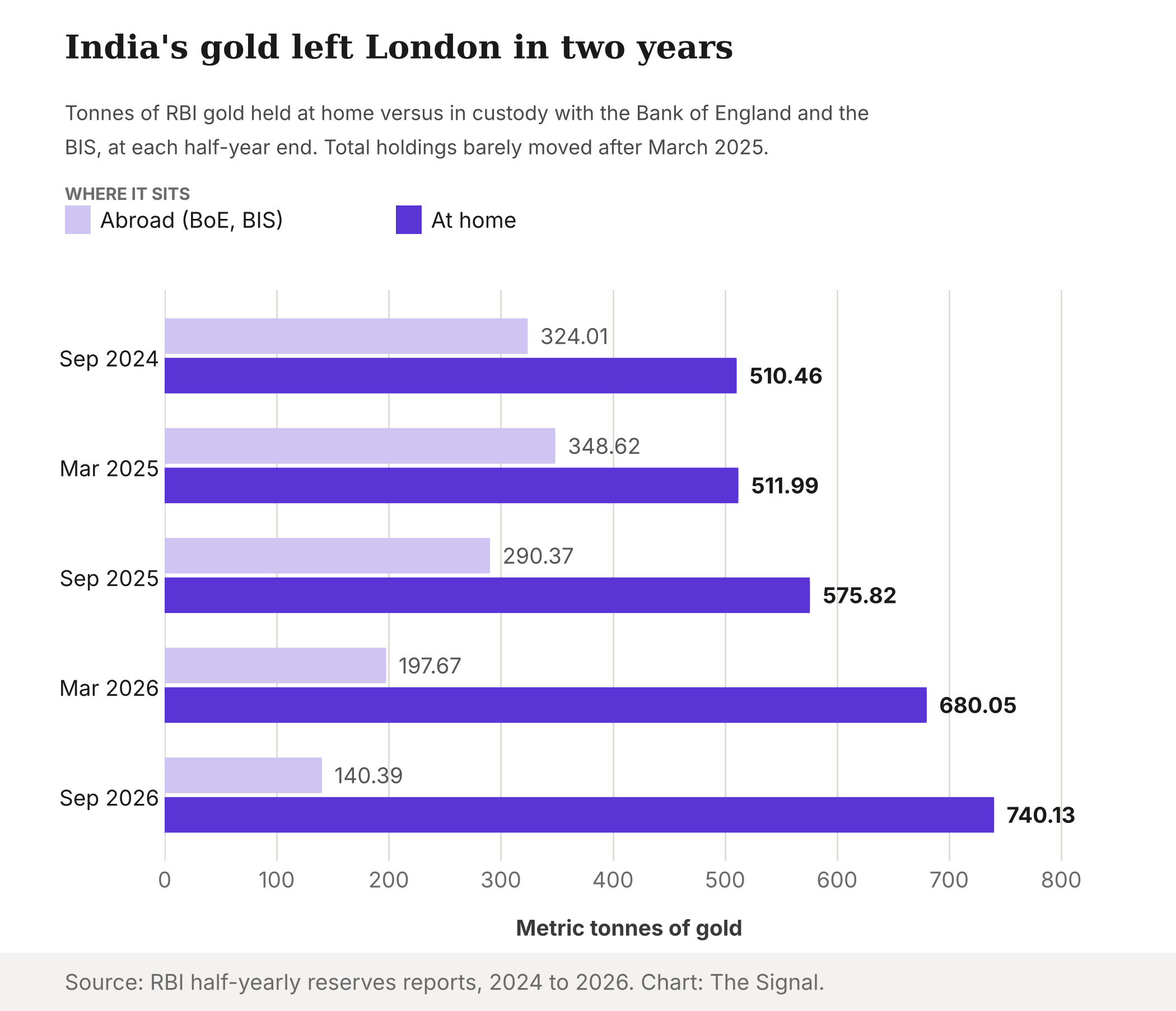
A second, smaller change rode along. The RBI used to place some gold on deposit, where it earns a return. That was 20.26 tonnes at end-September 2024 and 2.80 tonnes at end-March 2026. The September 2026 split of 740.13 tonnes at home plus 140.39 tonnes abroad adds up to the full 880.52, which leaves no gold on deposit at all. Gold in a domestic vault earns nothing.
Why London still matters
In July 1991, in the middle of a balance of payments crisis, the RBI pledged 46.91 tonnes of gold with the Bank of Japan and the Bank of England and raised a loan of US$405 million, according to its official history. The same account records the condition that mattered. Both central banks would lend only against physical transfer of the gold, and they refused the RBI's proposal to keep it in India on the grounds that it was an IMF depository. So the RBI airlifted it.
The reason is structural, and it has not changed. The Bank of England says it looks after about 400,000 bars for governments and central banks, and that storing gold there gives them easy access to the market because it can change the name of the owner in its records without moving any bars. Gold in London can be sold, swapped or pledged by a ledger entry. Gold in India has to be flown out first, which takes time, logistics and, as in 1991, secrecy.
Other central banks are reading the same trade-off the other way. De Nederlandsche Bank moved about 86 tonnes of gold from New York and Ottawa to London between March and August 2026, specifically to improve the liquidity and tradability of its reserves and its preparedness for severe crises, the World Gold Council reports. In the Council's 2026 survey of central banks, 57 percent vault gold at the Bank of England and 49 percent hold at least part at home. India now sits at the far end of that range.
Gold now moves the headline number
The second consequence is less dramatic and more immediate. Because the RBI stopped adding tonnes, every change in gold's weight in the reserves is now a price story. Gold was 8.15 percent of reserves by value at end-March 2024. It reached 16.70 percent at end-March 2026 before slipping to about 14.38 percent at end-September, as the international price fell from about US$4,721 an ounce in April 2026 to about US$4,319 in September.
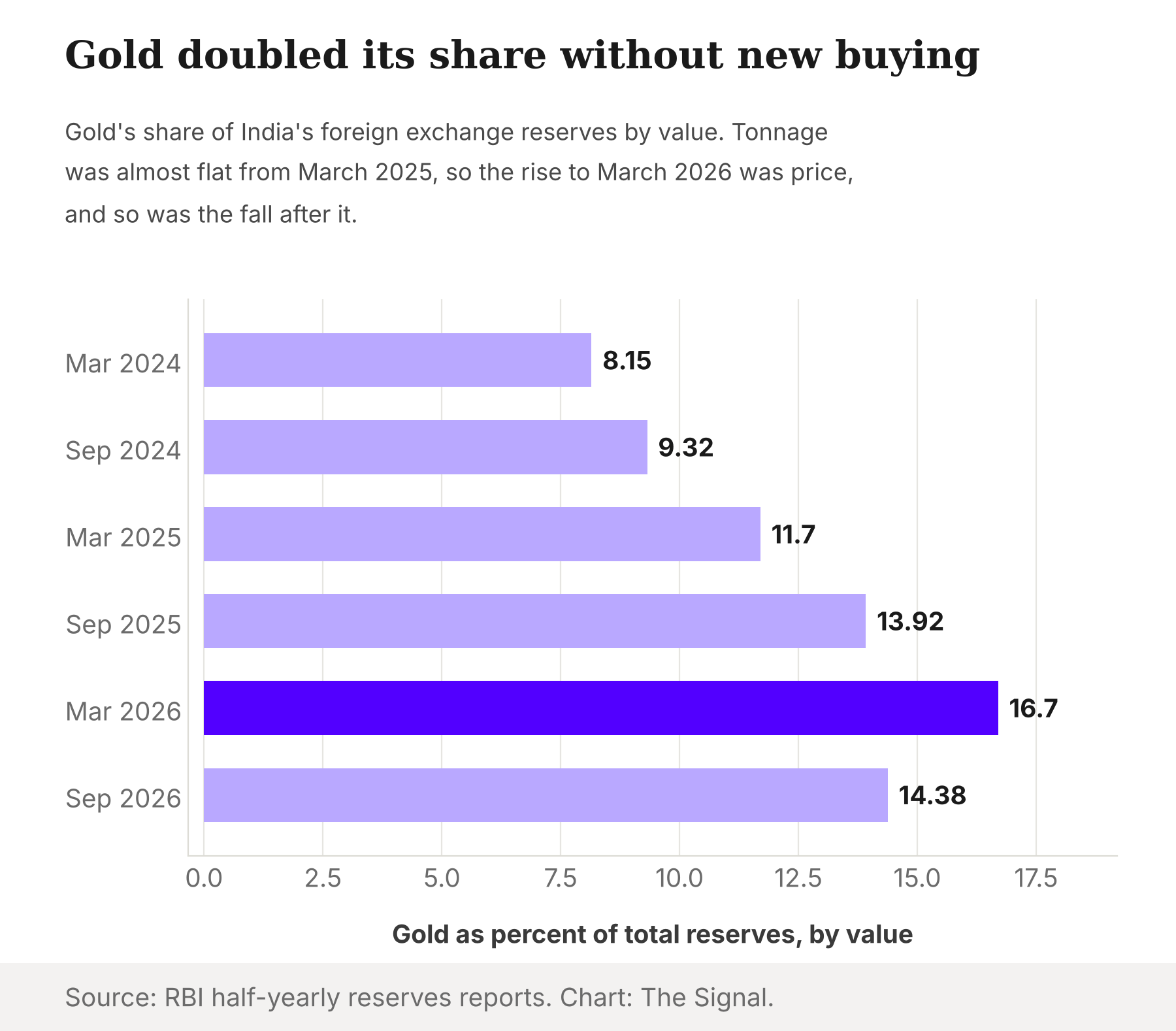
That price now swings India's reserves by amounts the RBI's own dealing never touches. In the RBI's monthly table, gold was worth US$115.4 billion at end-March 2026, US$102.6 billion at end-June, US$116.3 billion at end-August and US$106.1 billion at end-September, with the tonnage unchanged across the half. In April to June 2026, reserves fell US$8.1 billion on a balance of payments basis but US$22.5 billion once valuation was included.
The latest week shows the effect at full size. In the week to November 13, 2026, the latest the RBI has reported, total reserves fell US$14.2 billion to US$705.3 billion, and gold alone fell US$6.2 billion to US$98.6 billion. Gold accounted for about 44 percent of the week's drop. Since end-March its value is down US$16.8 billion.
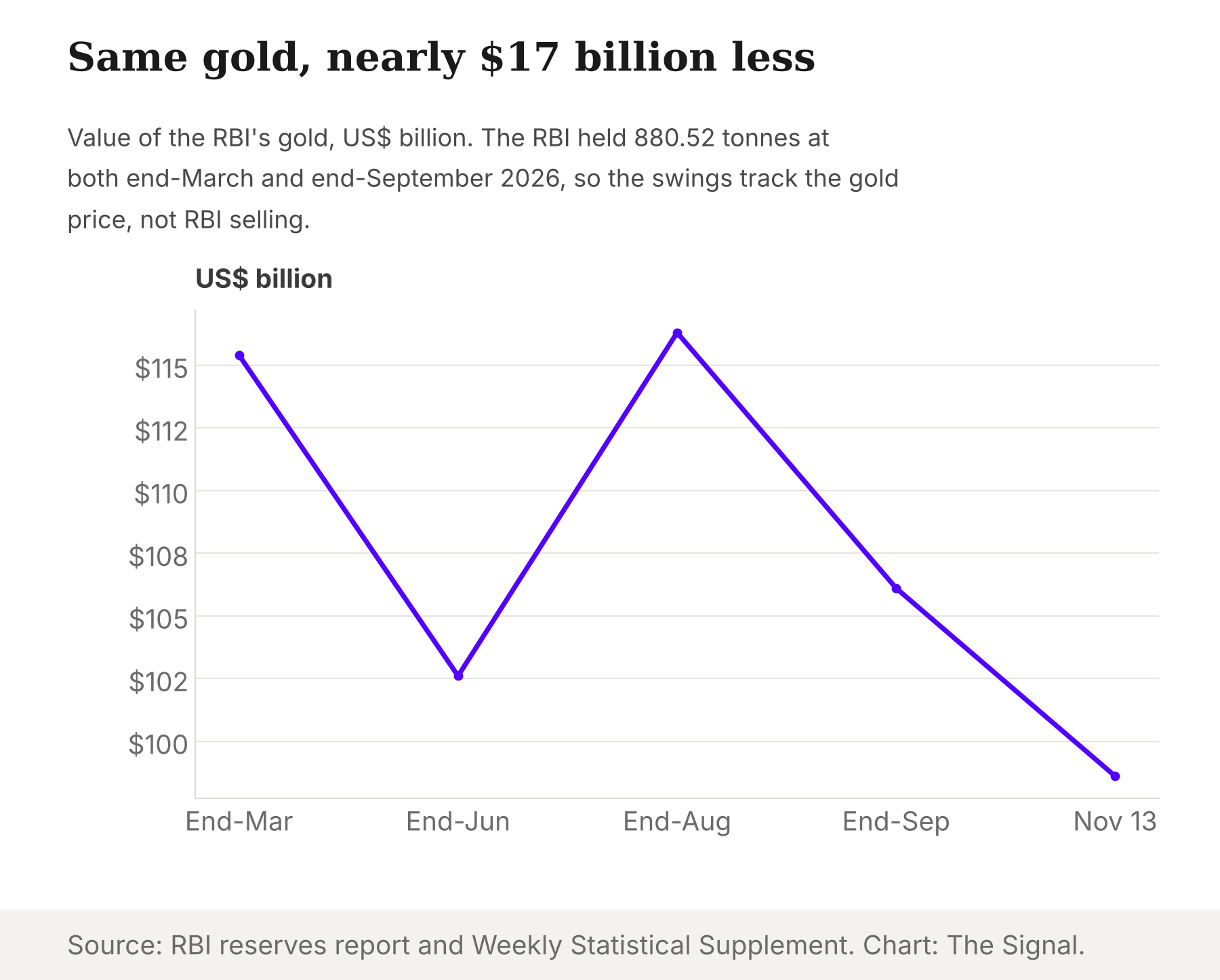
Anyone reading a weekly reserves drop like the one to November 13 as the RBI selling dollars to defend the rupee now has to strip out gold first. A larger, more volatile gold slice makes the headline number a noisier signal of intervention.
The honest objection
The strongest case for repatriation is that the threat has changed since the 1991 pledge. The danger a reserve manager worries about today is not a shortage of willing lenders but a custodian or its government delaying or blocking access to assets in a political dispute. Gold in India cannot be frozen by anyone else. Seen that way, the RBI is buying insurance against the scenario that would hurt most.
It is also true that gold is not where India's crisis liquidity lives. At end-September 2026 foreign currency assets were US$608.3 billion out of total reserves of US$737.8 billion, and reserves as a whole rose from US$691.11 billion to US$737.78 billion over April to September 2026. Any near-term defence of the rupee would be fought with dollars, not bars. And the RBI has not emptied London: 140.39 tonnes is about three times the 46.91 tonnes pledged in 1991.
Those points hold. They narrow the cost rather than remove it. Gold earns its place in reserves for the tail case, when dollars run short, and the 1991 record is the only Indian evidence of how that case plays out. Short-term debt rose to 23.0 percent of reserves at end-June 2026 from 21.6 percent at end-March, and import cover slipped to 9.8 months from 10.6. Neither is alarming, but these are the ratios that would matter if the tail ever arrived.
The Signal
The RBI has made a clear choice: gold that cannot be frozen over gold that can be traded by a change of name. It has paid for that choice twice, in the small yield it gave up on gold deposits and in the speed it gave up for a 1991-style emergency. Neither cost is visible in the weekly reserves number.
What to watch is whether the remaining 140.39 tonnes held with the Bank of England and the BIS also come home. Below that line, any future pledge would start with a cargo flight. The safest gold is not always the most useful gold.
Reporting basis: gold tonnages, custody locations, gold deposits, gold's share of reserves, the monthly gold values, the gold price path, the April to June balance of payments and valuation figures, foreign currency assets and the adequacy ratios are from the Reserve Bank of India's 43rd to 47th half-yearly reports on management of foreign exchange reserves (latest: the 47th report), with the April to September reserves total also stated in the RBI's press release; the November 13 figures are from the RBI's Weekly Statistical Supplement. All of these are one origin, the RBI. The 1991 pledge and the lenders' insistence on physical transfer come from the RBI's official history as excerpted by Business Standard, which we did not verify against the original volume. The custody mechanics of the London market are per the Bank of England. The 2026 central bank survey results and the De Nederlandsche Bank transfer are per the World Gold Council; the Dutch move is relayed by the Council from the bank's announcement. Domestic shares, tonnes moved, the gold share of the weekly reserves drop and the ratio of today's overseas holdings to the 1991 pledge are The Signal's calculations from those figures.