On November 23, 2026, SEBI issued press release No. 75/2026, an advisory on the grey market premium, or GMP: the informal price at which IPO shares change hands before they list. The ask is broad. SEBI's advisory states that all registered intermediaries and market participants should refrain from publishing GMP figures on websites, platforms, email, SMS and social media, and it tells investors not to treat GMP as an indicator of listing price or returns. The case for it is easy to make. SEBI says these trades run outside the exchange framework, with no settlement guarantee, no investor protection and no formal price discovery.
Read that way, the regulator is pulling an unreliable number off the screens of first-time investors. That is true as far as it goes.
It is worth slowing down on what the number actually does. GMP is a guess at the listing gain. SEBI's own research shows that the listing gain, once it arrives, is what decides whether an IPO investor sells. Removing the guess leaves the decision, and the trade that front-runs it, exactly where they were.
Half the allotment is gone in a week
The best evidence on IPO flipping in India comes from SEBI itself. A September 2024 SEBI study of 144 main board IPOs listed between April 2021 and December 2023 found that about 54 percent of IPO shares by value, excluding anchor investors, were sold within a week of listing. The study tracked holdings account by account, using allotment data from the exchanges and holdings from the depositories.
The split by investor type is sharper. The study found that individual investors sold 50.2 percent of their allotted shares by value within a week, retail-category applicants sold 42.7 percent and non-institutional investors (NIIs, the larger individual and corporate bids) sold 63.3 percent.
Half of what individuals are allotted is sold within seven days of listing.
| Investor group (April 2021 to December 2023) | Share of allotment sold within a week, by value |
|---|---|
| All investors, excluding anchors | 54% |
| Non-institutional investors (NIIs) | 63.3% |
| Individuals | 50.2% |
| Retail category | 42.7% |
Source: SEBI, Analysis of Investor Behavior in IPOs, September 2024.
The selling also has a direction. SEBI estimates that in the first week after listing, individuals sold shares worth about ₹15,000 crore across these IPOs while mutual funds bought about the same amount. The IPO, for a large share of individual applicants, is a one-week trade that hands stock to institutions.
The trigger is the gain, not the quote
SEBI found that individuals sold 67.6 percent of their allotted shares within a week when the first-week return was above 20 percent, against 23.3 percent when the return was negative. That is nearly three times the selling when the stock pops. For retail-category investors the study reports a correlation of 0.7 between the first-week listing gain and the share of allotments sold within a week.
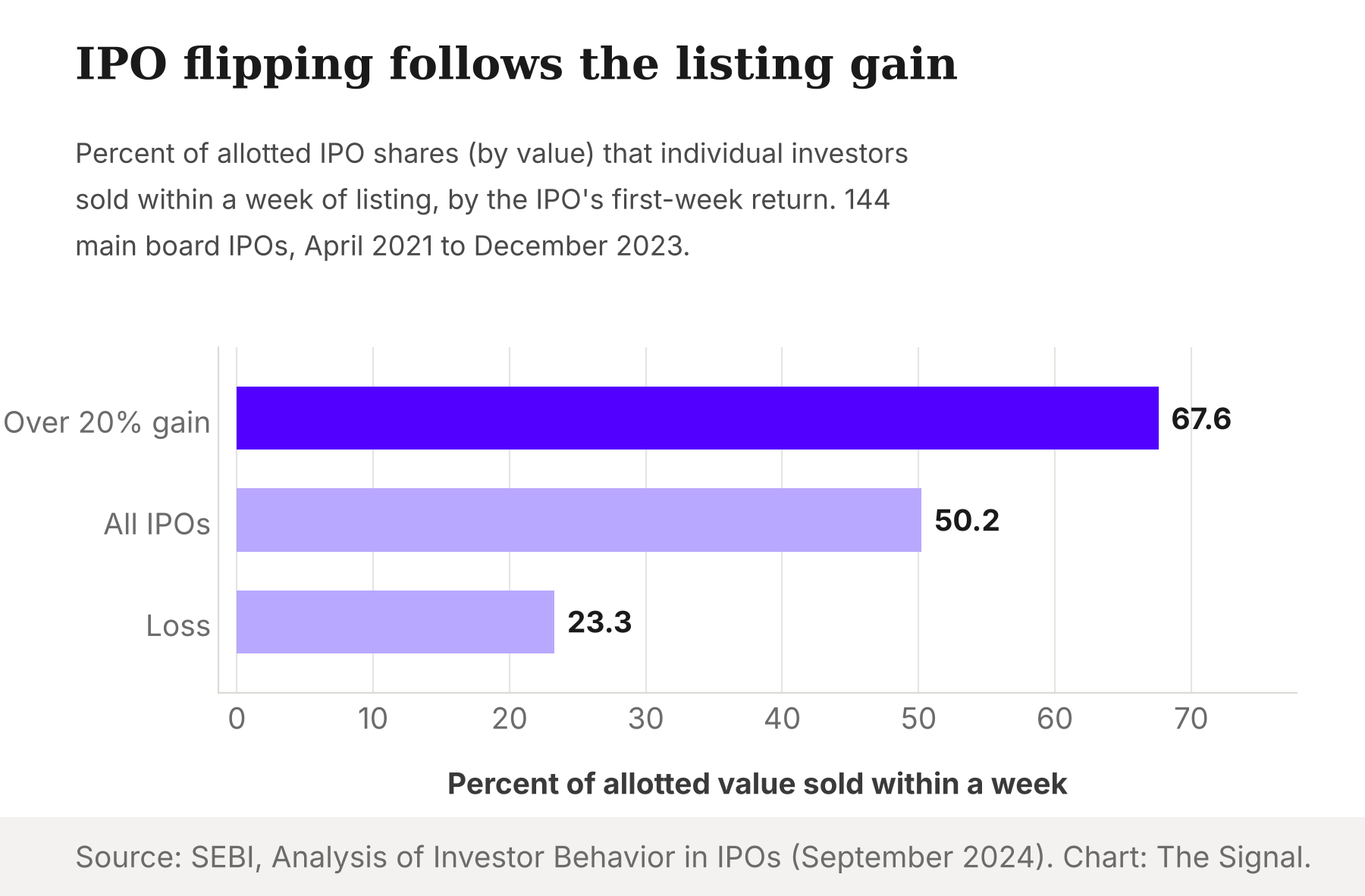
This is the mechanism the advisory leaves untouched. The grey market premium exists because a listing gain is expected and people want to lock it in, or buy it, before the shares are tradable. Take the published figure away and the expected gain is still there, and so is the reason to trade it.
The official number already does the forecasting
There is a second signal SEBI is not touching, and it is the exchanges' own. Subscription multiples are published live during the bidding window. SEBI's study shows that the 17 IPOs subscribed more than 100 times had a median listing-day return of 82 percent, the 75 subscribed 10 to 100 times had 22 percent, the 10 subscribed 5 to 10 times had 10 percent, and the 40 subscribed 1 to 5 times listed at a median of minus 2 percent.
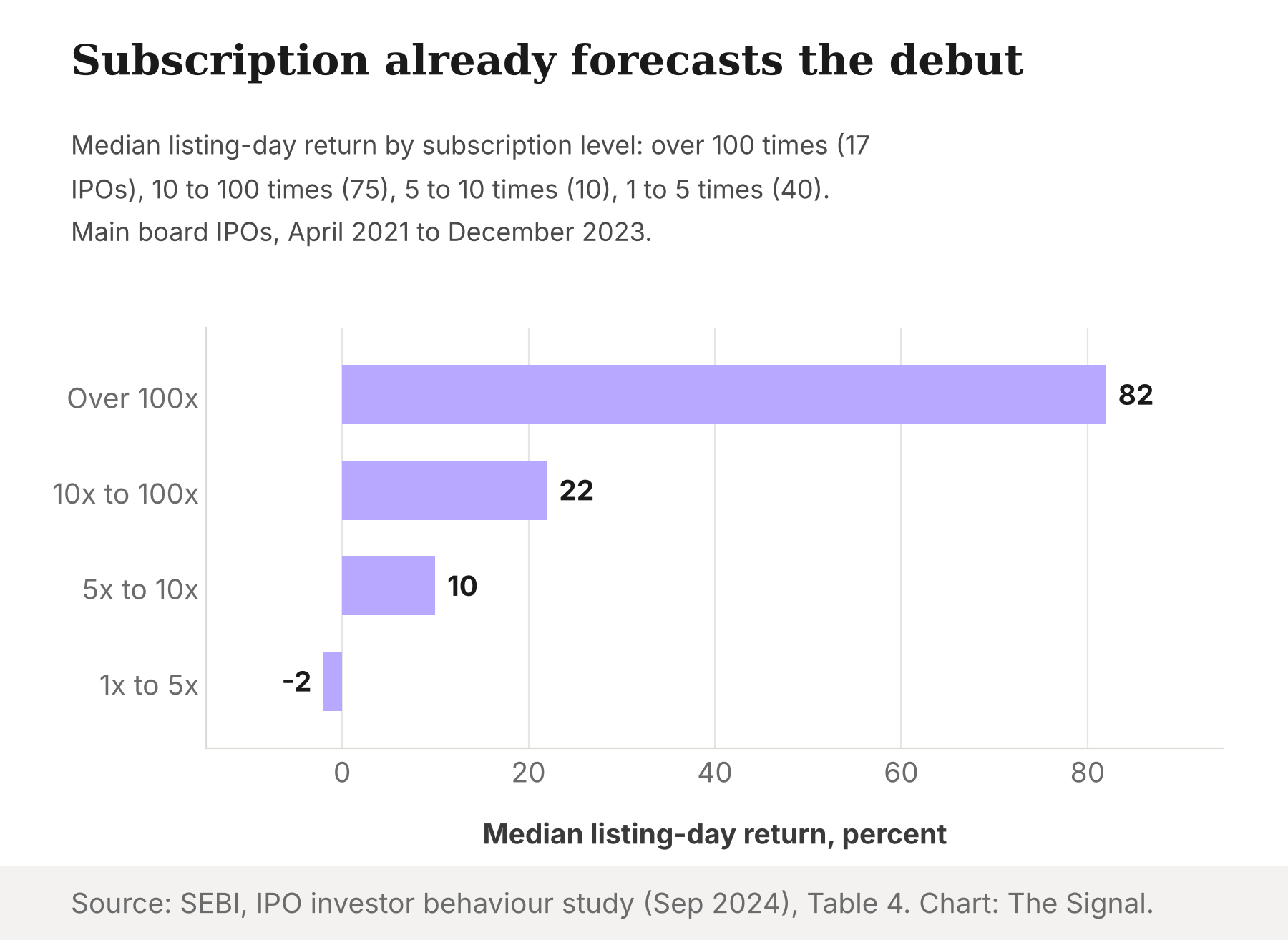
An investor who loses the GMP column still sees the oversubscription ticker on every broker app. Over SEBI's April 2021 to December 2023 sample, that ticker sorted IPOs into likely winners and likely losers with no grey market quote required.
What actually changed behaviour last time
SEBI has curbed IPO speculation before, and the lesson is in the same study. In April 2022 SEBI moved NII allotment from pro-rata to lottery and split the category by ticket size, and the RBI capped NBFC funding of IPO bids. After those changes, NII oversubscription fell from 38 times to 17 times, and the one-week exit of big-ticket NIIs fell from about 70 percent to about 25 percent. The financing limit is still on the books: the RBI's NBFC FAQ, updated November 11, 2026, sets a ceiling of ₹1 crore per borrower for financing IPO subscriptions.
Those measures worked because they changed the payoff: who gets shares, and with whose money. The GMP advisory changes what can be displayed. It does not change the payoff.
The stakes are not small. SEBI's Annual Report 2025-26 records 109 main board IPOs in 2025-26, raising ₹1.8 lakh crore, with a median issue size of ₹760 crore.
The regulated alternative is still missing
SEBI has diagnosed this before. Its November 2025 consultation paper observed that retail investors often rely on secondary and unregulated sources such as grey market trends and unverified social media for investment decisions. In January 2025, then SEBI chair Madhabi Puri Buch said, as reported by PTI, that pre-listing grey market trading was "not suitable" and that allottees who wanted to sell should "sell it in the organised market", with a "when listed" facility under discussion with two exchanges.
The November 23 advisory does not mention such a facility. It tells investors what not to read and what not to trade, but it offers no regulated place to trade an allotment before listing. Demand for that trade is what produces a grey market price in the first place.
The honest objection
The strongest case for the advisory is that GMP is not just unregulated, it is often wrong, and wrong in a way that pulls in late money. Lenskart is the cleanest recent example. Business Today reported that its GMP touched ₹108 a share against a ₹402 upper price band, about 27 percent, before falling to zero ahead of listing. The stock then listed at ₹390 on BSE on November 10, 2025, a 2.99 percent discount, after being subscribed 28.26 times. An investor who applied on the strength of the peak quote was disappointed, and a regulator is right to want that quote out of brokers' marketing.
That case is real. But Lenskart cuts both ways. Its 28.26 times subscription, the official signal, pointed to a gain that never came, while the grey market quote had already collapsed to zero by listing eve. The problem in that episode was not that an informal price existed. It was that the only live price for the shares was informal, unguaranteed and invisible to the regulator. Silencing that price will not make it more accurate, only harder to see.
The Signal
SEBI's advisory treats the published grey market premium as a hazard to investors. Its own 2024 study describes something different: individuals sell about half of what they are allotted within a week, they sell hardest when the listing gain is largest, and the subscription numbers the exchanges publish already sort issues by likely gain. The one intervention that clearly changed behaviour, in April 2022, did it by changing allotment rules and financing, not by changing what could be shown on a screen.
Watch two things. First, whether broker apps and IPO portals actually drop their GMP columns, or move them to channels SEBI does not supervise. Second, whether the when-listed facility discussed in January 2025 reaches a consultation paper. Until there is an organised market for an allotment before listing, the grey market will keep setting that price. It will just do so with fewer people watching.
Reporting basis: the advisory's text and date are from SEBI's press release No. 75/2026. The flipping rates, the exit-by-return figures, the 0.7 correlation, the subscription-band listing returns, the ₹15,000 crore first-week selling estimate and the post-April 2022 changes are all from a single SEBI study (Department of Economic and Policy Analysis, September 2024, covering IPOs listed April 2021 to December 2023), whose data now end nearly three years ago. The 2025-26 IPO totals and the November 2025 consultation-paper observation are also SEBI's. The NBFC financing cap is from the RBI's NBFC FAQ. Madhabi Puri Buch's remarks are per PTI, as carried by The Tribune. The Lenskart grey market, subscription and listing figures are per Business Today. SEBI is therefore the origin of most load-bearing numbers, with the RBI, PTI and Business Today as the other three independent origins. The "nearly three times" comparison and the Lenskart peak premium as a share of the price band are The Signal's calculations from those figures.