On Friday, November 20, the headline wrote itself. India's foreign exchange reserves fell $14.21 billion to $705.34 billion in the week ended November 13, the latest week the RBI has reported. A week earlier they had stood at $719.55 billion on November 6. A drop that size usually reads one way in India: the central bank is spending dollars to hold up the rupee.
The timing makes that read odd. Foreign money was arriving in force that week. NSDL's daily data show foreign portfolio investors put a net $1.72 billion into Indian equities on the November 6 reporting date alone, and about $4.8 billion across the November 9 to 13 reporting dates. Heavy inflows and a $14 billion reserve fall should not sit in the same week.
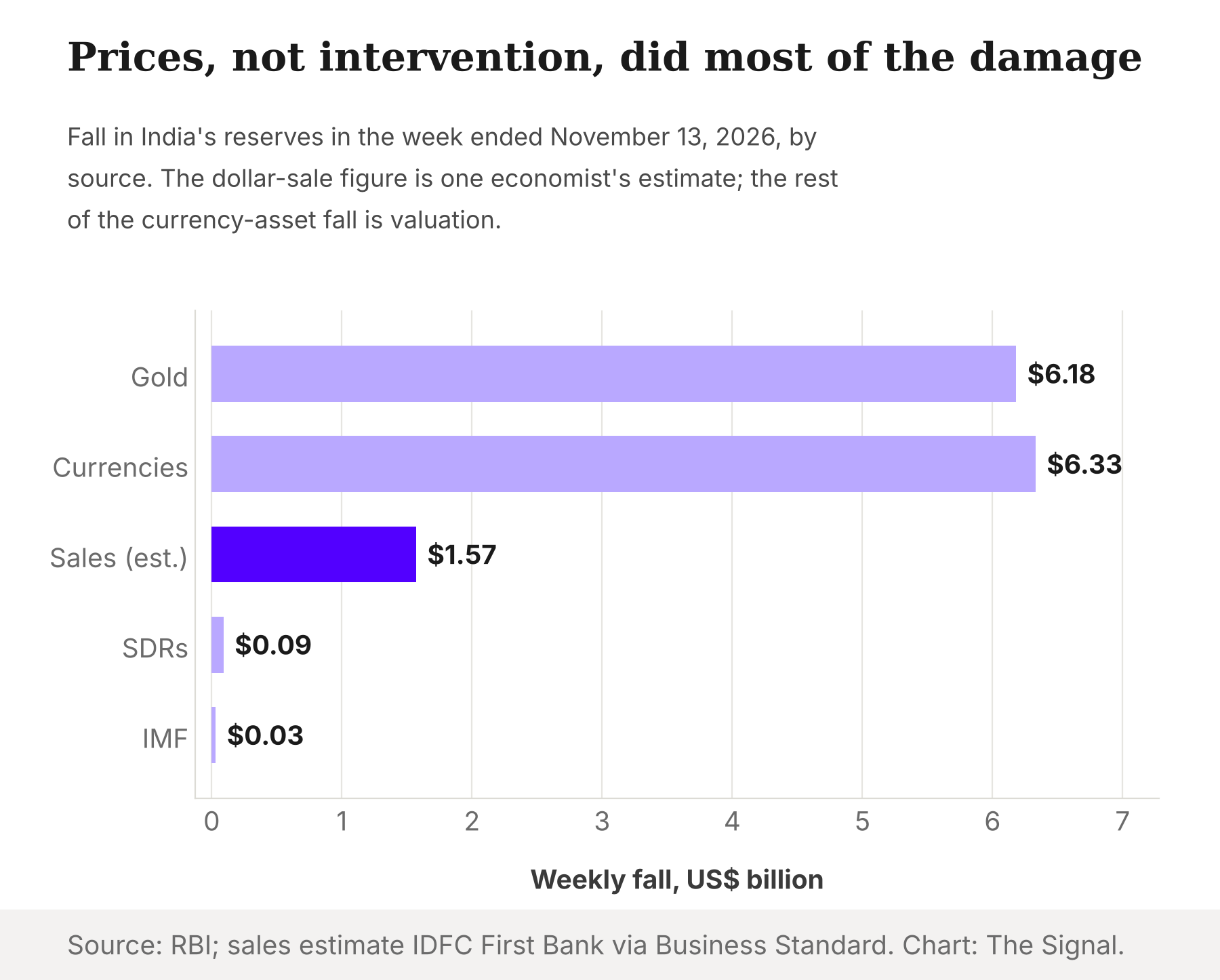
Strip out prices and the paradox mostly dissolves. Gaura Sen Gupta, chief economist at IDFC First Bank, told Business Standard that "there was dollar sale of $1.57 billion and rest is revaluation loss led by gold." If that estimate holds, roughly $12.6 billion of the $14.2 billion fall, close to nine-tenths, was the market value of what India already owns, not dollars handed out.
Two price moves did the work
The first was gold. The RBI's gold holdings fell $6.18 billion in the week to $98.61 billion, from $104.80 billion on November 6. That is a 5.9 percent loss of value in seven days without a single bar leaving the vault. The trigger was the metal itself. Spot gold fell 3 percent to $3,867.96 an ounce on November 12, Reuters reported, its lowest level since October 2025.
The second was the dollar. Foreign currency assets fell $7.90 billion to $583.45 billion. Business Standard notes that this line, expressed in dollars, includes the effect of moves in non-US currencies such as the euro, pound and yen held in the reserves. When the dollar strengthens, those holdings shrink in dollar terms. Take the estimated $1.57 billion of sales out of the $7.90 billion fall and about $6.3 billion is left for valuation.
Gold is now a large enough slice to move the headline on its own. At $98.61 billion of $705.34 billion in RBI data, it is 14 percent of India's reserves. A 5 percent swing in the gold price is worth about $5 billion in the weekly print, more than three times the RBI's estimated dollar sales in this one.
The year's gold loss has eaten half the currency gain
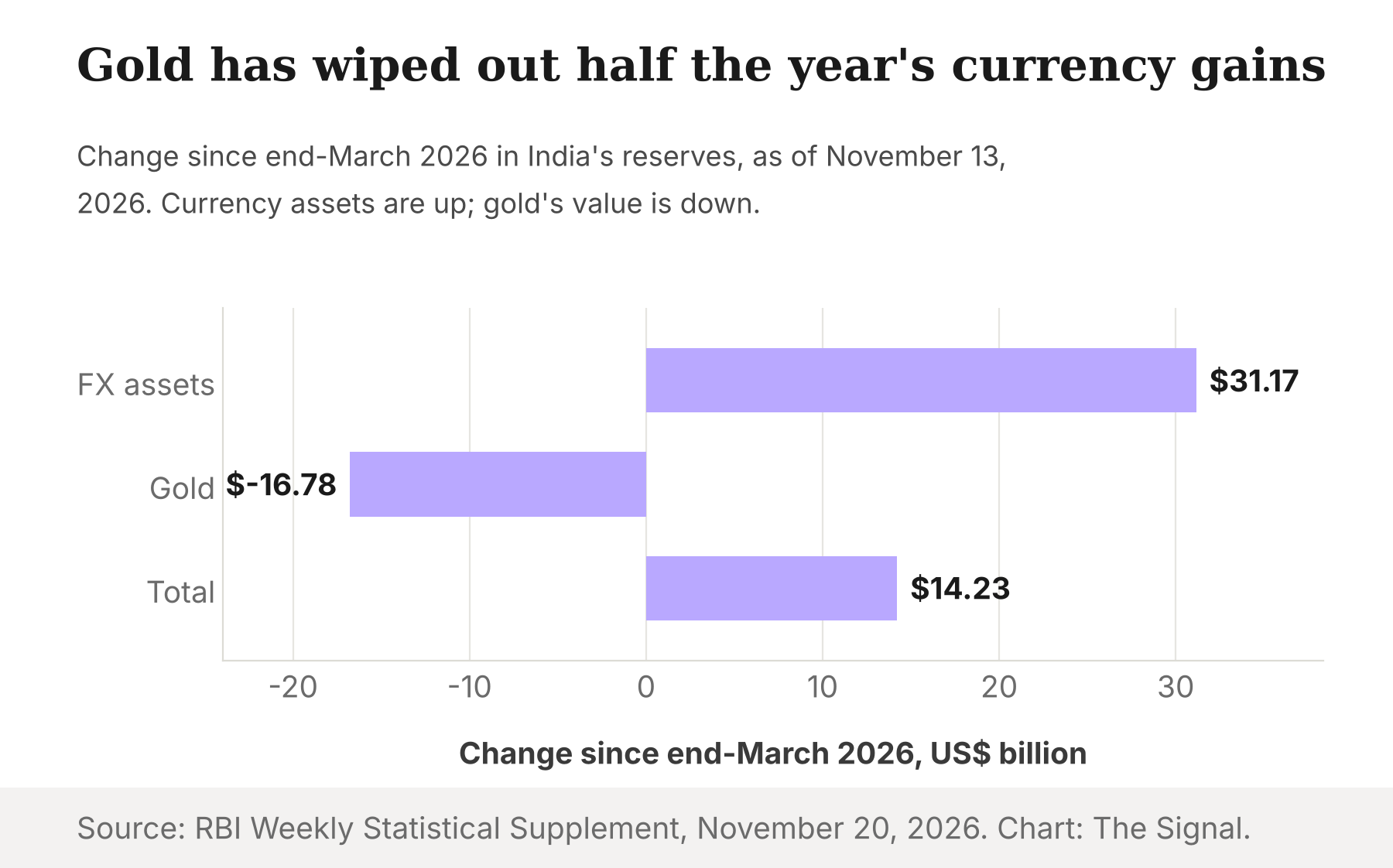
The same arithmetic runs across the whole financial year. Since end-March 2026, foreign currency assets are up $31.17 billion, gold is down $16.78 billion, and total reserves are up only $14.23 billion. Gold's fall has erased 54 percent of what the currency side added.
That changes how India should read its own buffer. Reserves are now about $80.4 billion below the record $785.7 billion of the week ended September 4, a peak Business Standard ties to inflows from a concessional swap scheme for diaspora deposits. Part of that slide is dollars spent on the rupee, and part is price. The weekly total alone cannot say which, and a reader who treats every fall as the RBI firing dollars will overstate how hard it has been fighting.
The rupee rally came after the reserve week
The reserve data also run a week behind the currency. During the reserve week the rupee was weak. It closed at 94.04 per dollar on November 12, with dealers citing dollar buying by state-run banks ahead of the inflation release. That is the setting in which an estimated $1.57 billion of RBI selling makes sense.
The turn came later. The rupee closed at 92.68 per dollar on Friday, November 20, up 2.46 percent for the month from 94.96 at end-October. It crossed 93 for the first time since April, and it is on track for its best month since November 2018, when it gained 6.28 percent.
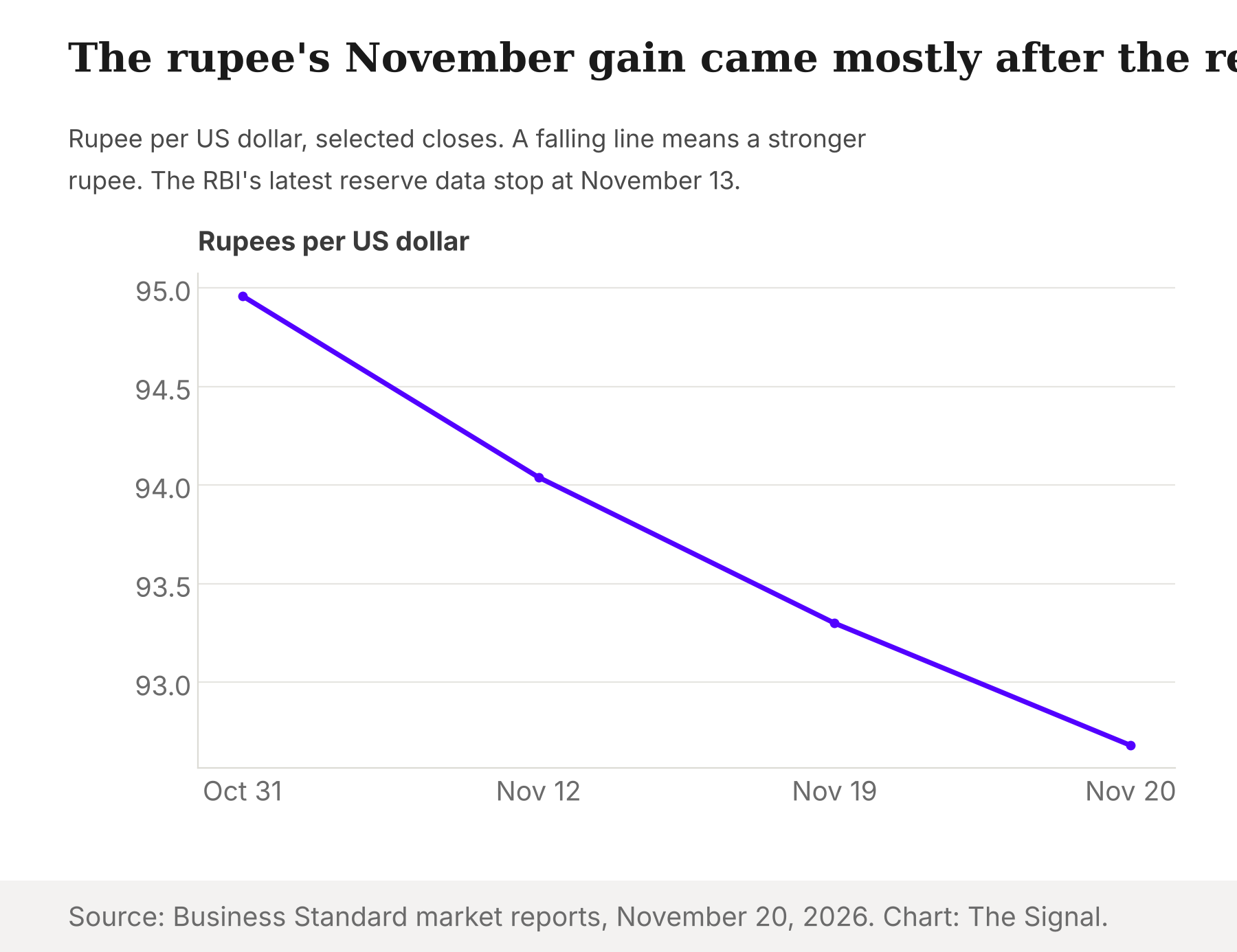
The money behind it is visible. Daily NSDL figures from November 2 to 20 add up to about ₹1.22 lakh crore, roughly $13.0 billion, of net foreign buying of Indian equities. The flow had not stopped by the end of the period: FPIs added a net ₹7,306 crore ($783 million) of equities on November 20. Business Standard also credits exporters' dollar sales and the RBI's special dollar window for oil companies, which moves part of their demand away from the open market, and notes the rupee rose even as the US Dollar Index touched a 20-month high.
| Measure | Figure | Period |
|---|---|---|
| Reserves, total | $705.34 billion | Week ended Nov 13 |
| Weekly change | minus $14.21 billion | Week ended Nov 13 |
| Estimated RBI dollar sales | $1.57 billion | Week ended Nov 13 |
| Rupee per dollar | 94.04 to 92.68 | Nov 12 to Nov 20 |
| Net FPI equity buying | about $13.0 billion | Nov 2 to Nov 20 reporting dates |
Sources: RBI Weekly Statistical Supplement; IDFC First Bank estimate and rupee closes via Business Standard; NSDL.
The honest objection
The case against this reading is strong. The $1.57 billion is one economist's estimate, not an RBI number. The RBI does not publish weekly intervention, and its forward book does not show in the weekly total at all. Valuation could be masking purchases as easily as sales. And a loss in gold's value is still a loss: a buffer worth $98.61 billion buys fewer dollars of imports than one worth $104.80 billion.
All true. But none of it restores the original story. Even if the sales estimate were doubled, price moves would still account for most of the $14.21 billion fall. And the gold loss, real as it is, is not a policy choice. It comes back if gold recovers, which a dollar spent on the rupee does not.
The Signal
The weekly reserve number has become two things at once: a gauge of RBI defence and a mark-to-market on a gold pile that is 14 percent of the total. In the week ended November 13, the second swamped the first. The real policy test is still ahead. With about $13 billion of foreign equity money arriving in November and the rupee at 92.68, market participants say the RBI could buy dollars to stop excessive appreciation. Meanwhile the 10-year government bond yield has eased to 7.19 percent. Watch the foreign currency assets line in the next two weekly prints, not the total. If it climbs while gold sits still, the RBI is rebuilding the buffer it spent. If it stays flat through a month of inflows, the RBI has chosen a stronger rupee over a bigger buffer. A reserve total is a price until someone trades it.
Reporting basis: reserve levels and component changes for the weeks ended November 6 and November 13, 2026 are from the RBI's Weekly Statistical Supplement. The estimate of $1.57 billion in RBI dollar sales is from Gaura Sen Gupta of IDFC First Bank, as reported by Business Standard, and rests on that single estimate; the September 4 record, the swap-scheme attribution and the November 12 rupee close are per that Business Standard report. The November rupee move, the dollar-window and exporter-supply explanations, the 10-year yield and the market view on RBI dollar buying are from a separate Business Standard markets report. Foreign portfolio flows are NSDL's daily FPI data. The gold price move is per Reuters, as carried by Khaleej Times. The valuation share of the weekly fall, the currency-asset valuation figure, gold's weekly percentage loss, gold's share of reserves, the share of currency gains erased by gold and the summed FPI totals are The Signal's calculations from those figures.