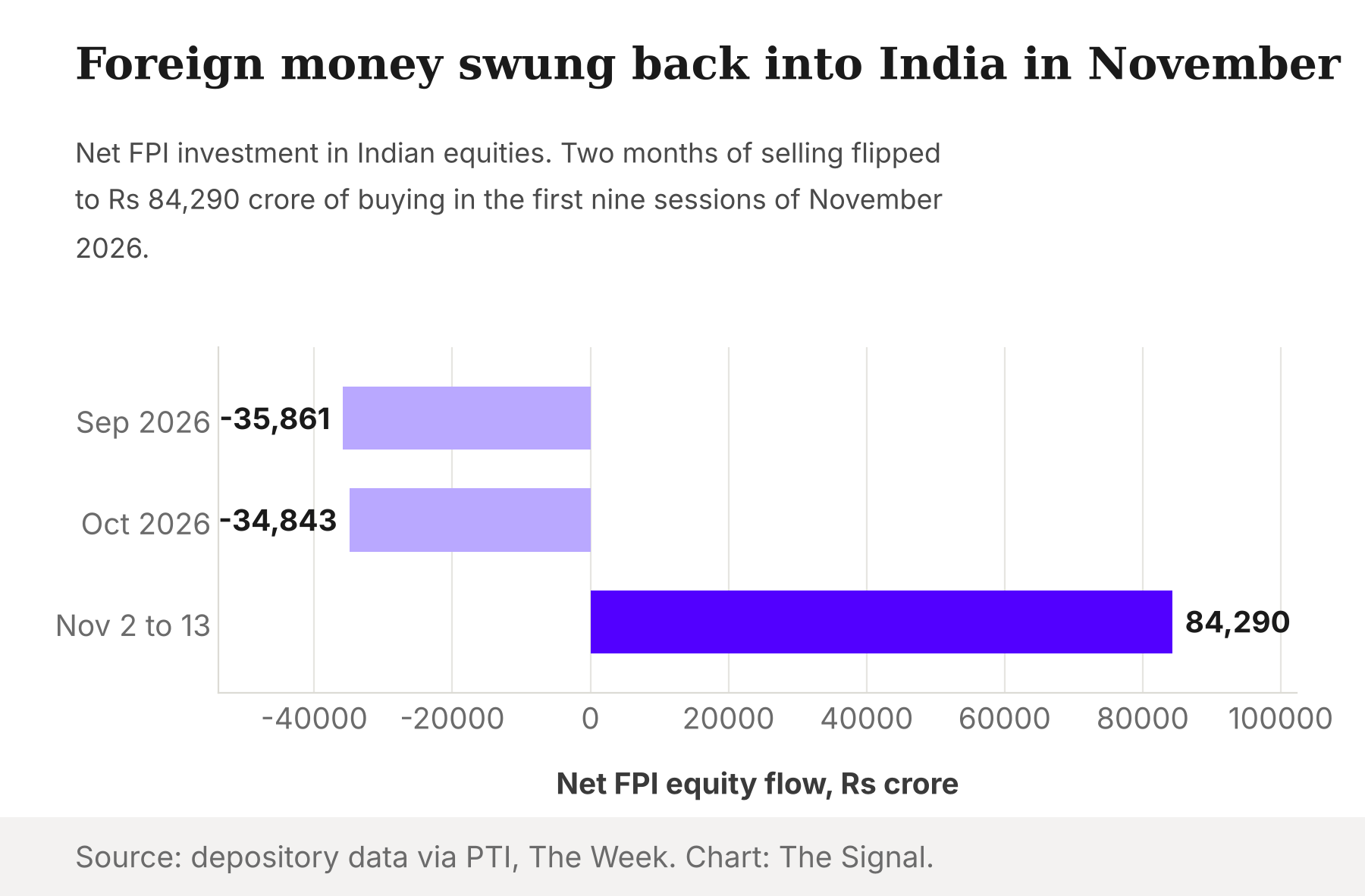
Foreign portfolio investors made a net investment of Rs 84,290 crore in Indian equities over the nine trading sessions from November 2 to 13, 2026, according to depository data reported by PTI. That followed net withdrawals of Rs 34,843 crore in October and Rs 35,861 crore in September, per the same data. Nine sessions of buying more than reversed two months of selling. One analyst quoted by PTI tied the turn partly to money rotating out of the crowded Asian AI trade, and the big foreign houses said it outright. JPMorgan's Rajiv Batra told CNBC that India has emerged as an "AI hedge" for portfolios trimming or diversifying out of crowded AI trades, and Jefferies' Christopher Wood called India an obvious emerging-market beneficiary of the reverse AI trade, Business Today reported. The read wrote itself: India is the market you buy when you want to own less AI.
It is worth slowing down on that. India does own AI. It just owns it through a handful of listed cable and fibre makers, and those stocks did not get the hedge.
The number that carries it
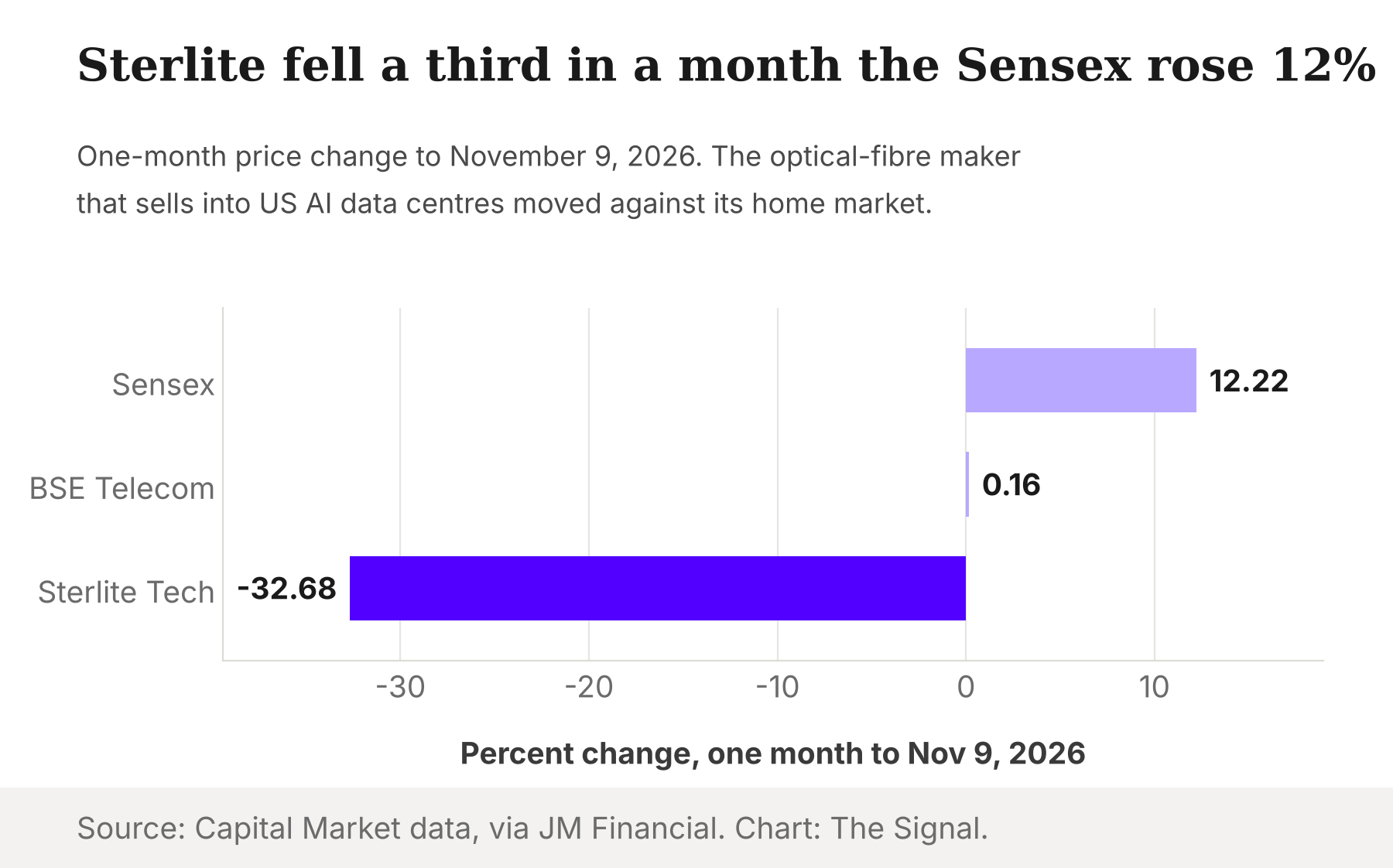
The figure is 32.68. That is how much Sterlite Technologies lost over the month to November 9, 2026, while the Sensex rose 12.22% and the BSE Telecommunication index gained 0.16%, per Capital Market newswire data. The gap between the optical-fibre maker and the benchmark is nearly 45 percentage points, in a single month.
Sterlite was not alone. On November 6, 2026, HFCL hit its 5% lower circuit at Rs 209.95, nearly 26% below its October 21 high of Rs 282.10, Kotak Neo reported from exchange prices. The same report put Sterlite down 5% at around Rs 719 that day, nearly 32% below its October 7 peak, as the selloff followed a $2.5 trillion rout in US technology shares. Upstox reported that most optical-fibre companies had corrected 25-30% from their record highs in the month to November 6.
So the foreign money arriving partly to escape AI and the Indian stocks falling because of AI were moving through the same market in the same weeks.
Why a fibre maker trades like a US tech stock
The answer is in where the revenue comes from. In its Q2 FY27 earnings call, Sterlite said North America accounted for 61% of its revenue in the first half of FY27, and its data-centre segment for 33%, driven by AI and cloud infrastructure demand. Its open order book stood at a record Rs 35,274 crore, per the same transcript.
The orders come from a few very large buyers. In May 2026, an STL subsidiary signed a multi-year product award letter valued at more than $1 billion to support a hyperscaler's AI data-centre build-out in the US, the company said. In the quarter to September 2026 it added a new five-year agreement with another global hyperscaler, with a potential value of $1.2 billion, on top of a $1.11 billion product award letter. Quarterly revenue was Rs 2,529 crore, up 145% year on year, per the earnings call.
Read that way, a company with 61% of its revenue in North America is a US data-centre capex stock with a Mumbai listing. When American investors doubt how long hyperscalers keep spending, the doubt reaches Sterlite before it reaches the Sensex. The index holds very little of that exposure, which is why foreign money liked it.
HFCL, another optical-fibre cable maker, shows the same pattern in its numbers. Upstox reported that HFCL's Q2 FY27 revenue rose more than 250% year on year to Rs 2,542 crore, on an order book of Rs 28,911 crore against Rs 9,981 crore a year earlier. Profit rose from Rs 72 crore to Rs 394 crore, per the same report.
Two fibre makers, one cycle: both tripled or better, then gave back a quarter to a third.
| Measure | Sterlite Technologies | HFCL |
|---|---|---|
| 52-week low (date, 2026) | Rs 84.65 (Jan 27) | Rs 59.83 (Jan 23) |
| Record or October high (date, 2026) | Rs 1,054.45 (Oct 7) | Rs 282.10 (Oct 21) |
| Price on November 6, 2026 | about Rs 719 | Rs 209.95 |
| Distance below the high on November 6 | nearly 32% | nearly 26% |
| Q2 FY27 revenue (year-on-year change) | Rs 2,529 crore (+145%) | Rs 2,542 crore (+250% or more) |
| Order book, end of Q2 FY27 | Rs 35,274 crore (open, record) | Rs 28,911 crore |
Sources: Capital Market via JM Financial, Kotak Neo, Upstox, Sterlite Q2 FY27 earnings call.
Who was holding it
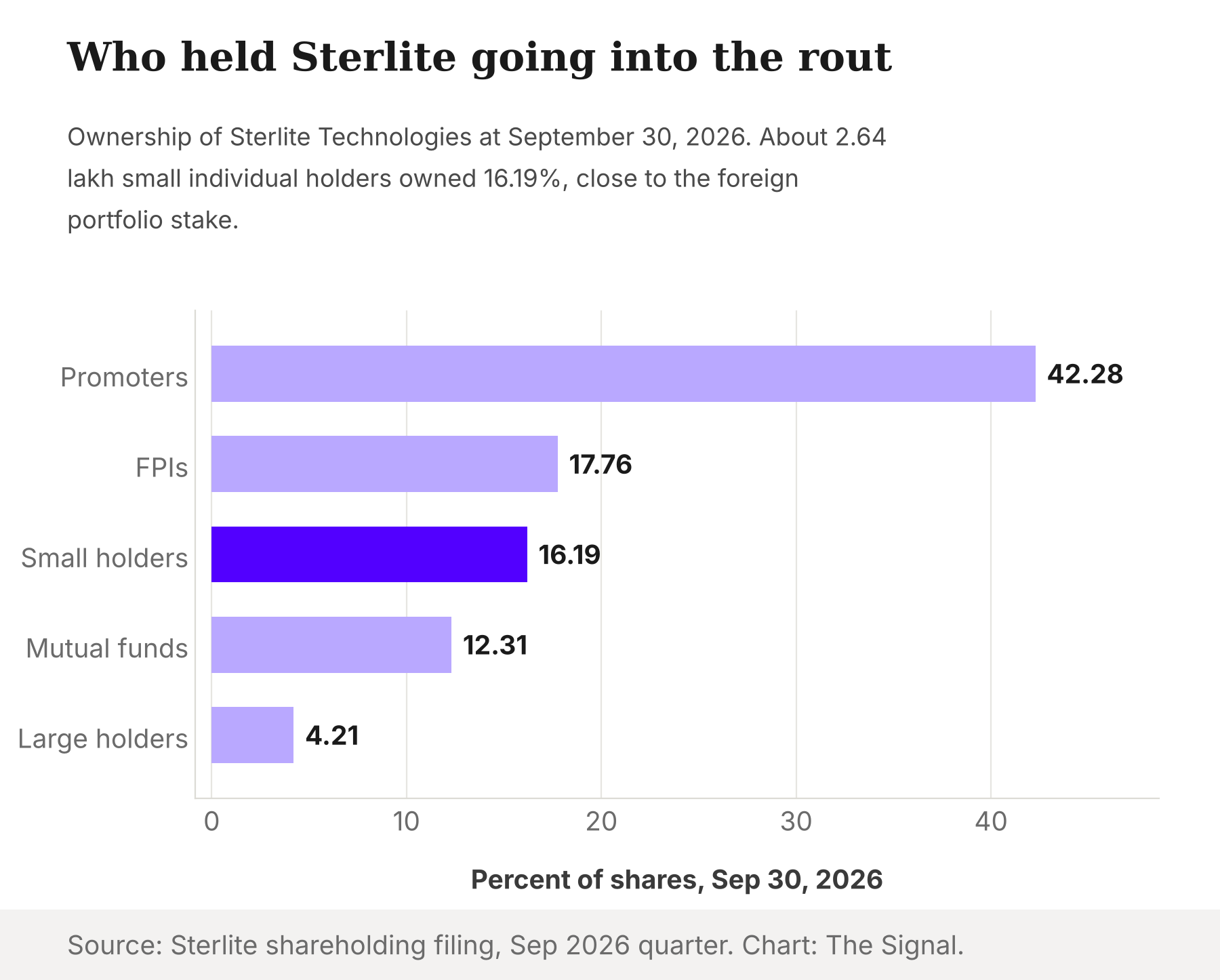
The hedge argument is made about an index. Losses land on shareholders. Sterlite's filing for the quarter ended September 30, 2026 shows 2,63,617 resident individuals with up to Rs 2 lakh of nominal capital holding 16.19% of the company, out of 2,75,650 shareholders in total. That is about 96% of all holders by count. Another 43 larger individual investors held 4.21%, per the same filing.
Foreign money was on the stock too. The filing shows foreign portfolio investors held 17.76%, mutual funds 12.31% and promoters 42.28% at the same date. Individuals together held 20.40%, more than the foreign portfolio stake.
That changes the shape of the trade. A global fund can underweight AI through India's index and still hold a fibre maker at the margin. One of the 2,63,617 small holders on Sterlite's register has no such offset. For that investor, "AI-free India" is somebody else's portfolio.
Outlook Business reported that Sterlite had risen 678% year to date and HFCL more than 200% by early November, in a market with no pure-play AI listings. Sterlite's record high of Rs 1,054.45 on October 7, 2026 came after a 52-week low of Rs 84.65 on January 27, 2026, per Capital Market data. That is a 12.5-fold rise in under nine months. When owning AI from a domestic brokerage account means two or three cable makers, demand piles into them.
The honest objection
The strongest objection is that nothing broke. A pullback of roughly a third after Sterlite's twelve-fold run is a correction, not a collapse. Upstox noted that HFCL was still up 209% in 2026 and Sterlite about 600% even after the slide to November 6. Sterlite's Rs 719 on that day, per Kotak Neo, was still about 8.5 times its January low. The revenue growth and record order books are real. On November 4, Business Today put Sterlite's market capitalisation at Rs 40,343 crore as the stock fell up to 5% in a sixth straight losing session. That is not far above its Rs 35,274 crore open order book.
That case is right about the businesses and wrong about the hedge. Sterlite fell 32.68% in the month to November 9 while reporting a record order book, because its buyers and sellers were pricing US hyperscaler spending. A holder who believed India's AI-light index protected them was holding the one slice of India that moves with US tech shares, not against them.
The Signal
The foreign flow is not settled. Angel One, citing a Business Standard report on NSDL data, said November inflows reached Rs 99,158 crore by November 17, the highest monthly figure on record, above Rs 70,896 crore in November 2020. That record rests on a single broker's report. The fibre makers did not share in it. Kotak Neo put the previous closes going into November 18 at Rs 641.50 for Sterlite and Rs 188.19 for HFCL, roughly 11% and 10% below their November 6 prices. Even after rising on Nvidia's results that day, the two traded at Rs 664.50 and Rs 193.50 at midday, still under their November 6 levels. PTI's analyst source called November's buying a sharp tactical turn, not yet a structural return, with 2026 outflows still at about Rs 2.1 lakh crore.
So two clocks are running. If the AI trade recovers, foreign money that came to India as a hedge has less reason to stay, and the fibre makers rebound with US tech. If the AI selloff deepens, the index may keep its shelter while Sterlite and HFCL slide again, as they did on November 6. Watch the December-quarter shareholding filings: if individual holders' share of Sterlite rose while foreign funds sold, the hedge was paid for by the people least able to see it. India is AI-free only for those who own all of it.
Reporting basis: foreign portfolio flows for September, October and November 2 to 13, 2026, and the analyst's characterisation of them, are from depository data and an analyst quote reported by PTI, via The Week. The JPMorgan and Jefferies characterisations of India as an AI hedge are as reported by Business Today. The November 17 cumulative inflow and its record status rest on a single source, Angel One, citing a Business Standard report on NSDL data. One-month returns, the record high and the 52-week low for Sterlite Technologies are Capital Market newswire data, via JM Financial Services. November 6 prices and distances from peak for HFCL and Sterlite, and the November 18 prices and previous closes, are per Kotak Neo, from exchange prices; the sector-wide 25-30% correction, the year-to-date figures and HFCL's quarterly results are per Upstox. Sterlite's revenue mix, order book, quarterly revenue and contract values are from the company's Q2 FY27 earnings-call transcript and its May 2026 press release, and its ownership from its quarterly shareholding-pattern filing for September 30, 2026. The 678% year-to-date figure is per Outlook Business, and the November 4 market capitalisation per Business Today. The 45-point gap, the 96% share of holders, the combined 20.40% individual stake, the 12.5-fold and 8.5-fold multiples, the roughly 11% and 10% declines from November 6 and the order-book comparison are The Signal's calculations from those figures.