Anthropic is due to start trading on Nasdaq under the ticker ANT on 19 November, US time. Its amended S-1 filed on 17 November offered 825,000,000 Class A shares at an estimated $70 to $78 each, which puts the base deal at roughly $57.8 billion to $64.4 billion before any upsizing. A day later, a Rule 462(b) filing on 18 November registered 178,250,000 more shares, including 23,250,000 for the underwriters' option. For an Indian reader the obvious question is how to get some.
The obvious answer is that India's investors are now global: open an overseas brokerage account, wire the money under the Reserve Bank's remittance scheme, and buy. That route is real. The question is how wide it is.
It is worth slowing down on that. RBI Bulletin data (Table 36, Outward Remittances under the LRS, released 23 October 2026) show that Indian residents sent $1,630.26 million abroad for travel in August 2026 and $321.53 million for investment in overseas equity and debt. Travel was about five times larger. Add up equity and debt for June, July and August 2026 in the same RBI table ($456.69 million, $344.57 million and $321.53 million) and the quarter comes to $1,122.79 million. One month of travel outspent a full quarter of foreign investing.
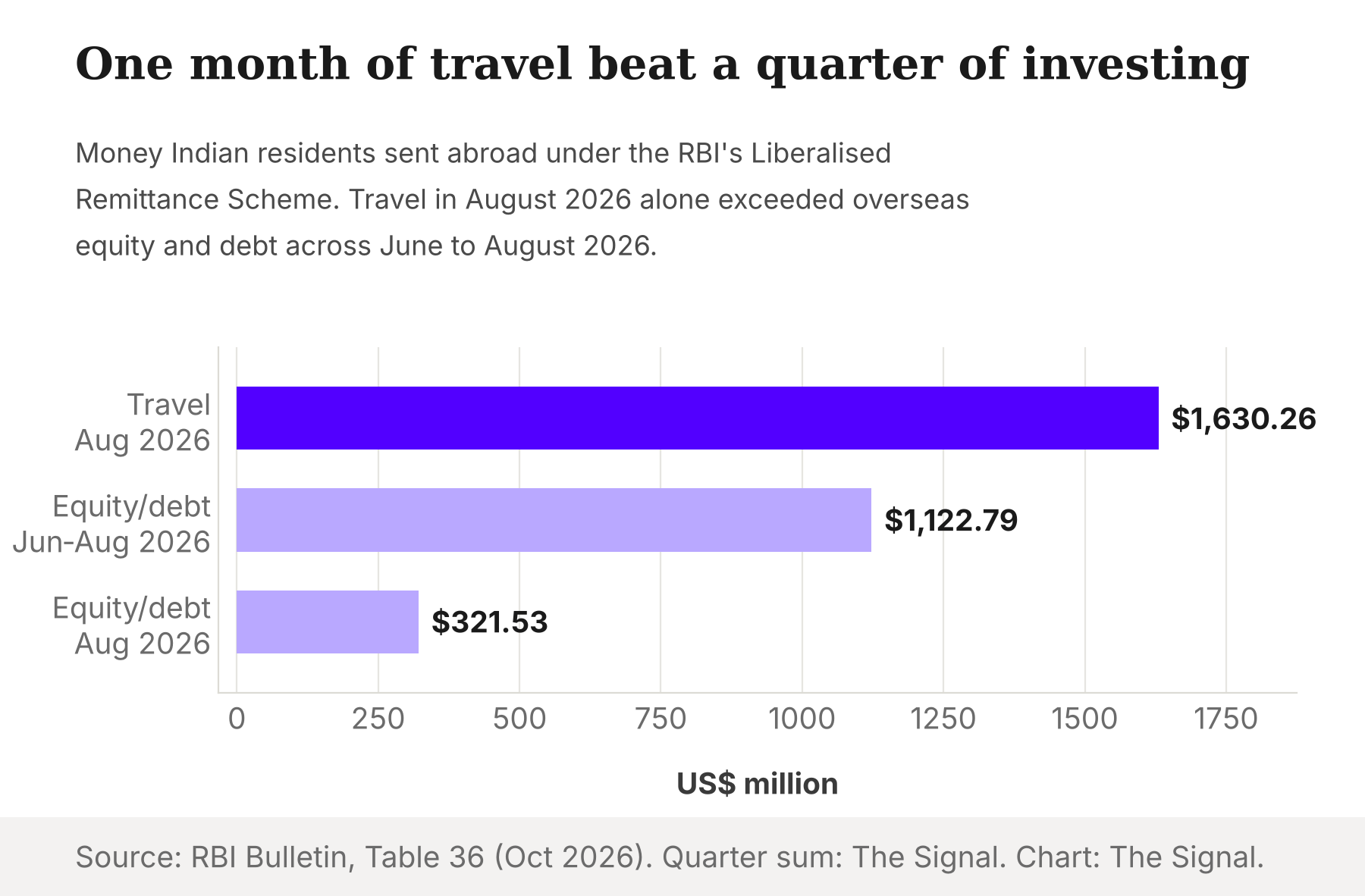
Source: RBI Bulletin, Table 36 (October 2026). The June to August total is The Signal's calculation. Chart: The Signal.
The IPO was not offered to India
The first constraint sits in Anthropic's own paperwork. The selling restrictions in Anthropic's S-1 filed with the US SEC on 26 October 2026 state that the prospectus has not been and will not be registered with any registrar of companies in India, nor reviewed by any Indian regulator. Indian retail investors cannot subscribe at the IPO price through a domestic public offer.
Other places got a retail door. Anthropic's Amendment No. 2 of 10 November 2026 states that retail allocations in the US and other countries were expected to reach up to 20% of the shares offered, partly through US platforms such as Schwab, Fidelity, Robinhood, SoFi and E*TRADE. Applied to the 825 million base shares, that is up to 165 million shares for retail buyers.
Retail buyers in Britain and nine European countries had a route in at the IPO price. India did not.
| Market | Retail access at the IPO price | What the filing says |
|---|---|---|
| United States | Yes | Retail up to 20% of offered shares, via Schwab, Fidelity, Robinhood, SoFi, E*TRADE |
| United Kingdom | Yes | Dedicated UK Retail Offer through RetailBook, launched 10 November 2026 |
| Nine EEA countries | Yes | Denmark, Finland, France, Germany, Ireland, the Netherlands, Norway, Spain, Sweden |
| India | No | Prospectus not registered in India; no public offer |
Sources: Anthropic S-1 Amendment No. 2, UK retail offer materials, IPO website prospectus, S-1 selling restrictions.
Anthropic's UK retail-offer materials, filed with the SEC on 10 November 2026, state that UK retail investors could apply through a UK offer facilitated by RetailBook. Anthropic's IPO-website prospectus of 10 November 2026 lists the nine European countries in its public retail offering and expected the final price to be set on 18 November. India is not on that list. So an Indian who wants ANT buys it after listing, at whatever the market charges, through the remittance pipe.
The pipe is the Liberalised Remittance Scheme
The RBI's FAQ on the Liberalised Remittance Scheme, last updated in April 2023, states that every resident individual may remit up to $250,000 per financial year (April to March) for permitted current or capital account transactions. The same FAQ notes the scheme began in 2004 with a $25,000 limit.
The cap is generous for one person. The flow is not. RBI Bulletin data (Table 36, released 25 September 2026) show that resident individuals remitted $28,979.36 million under the scheme in FY2025-26, of which $16,437.99 million went on travel and $2,652.01 million on overseas equity and debt. Travel took about 57% of the total and investment about 9%, a ratio of roughly six to one.
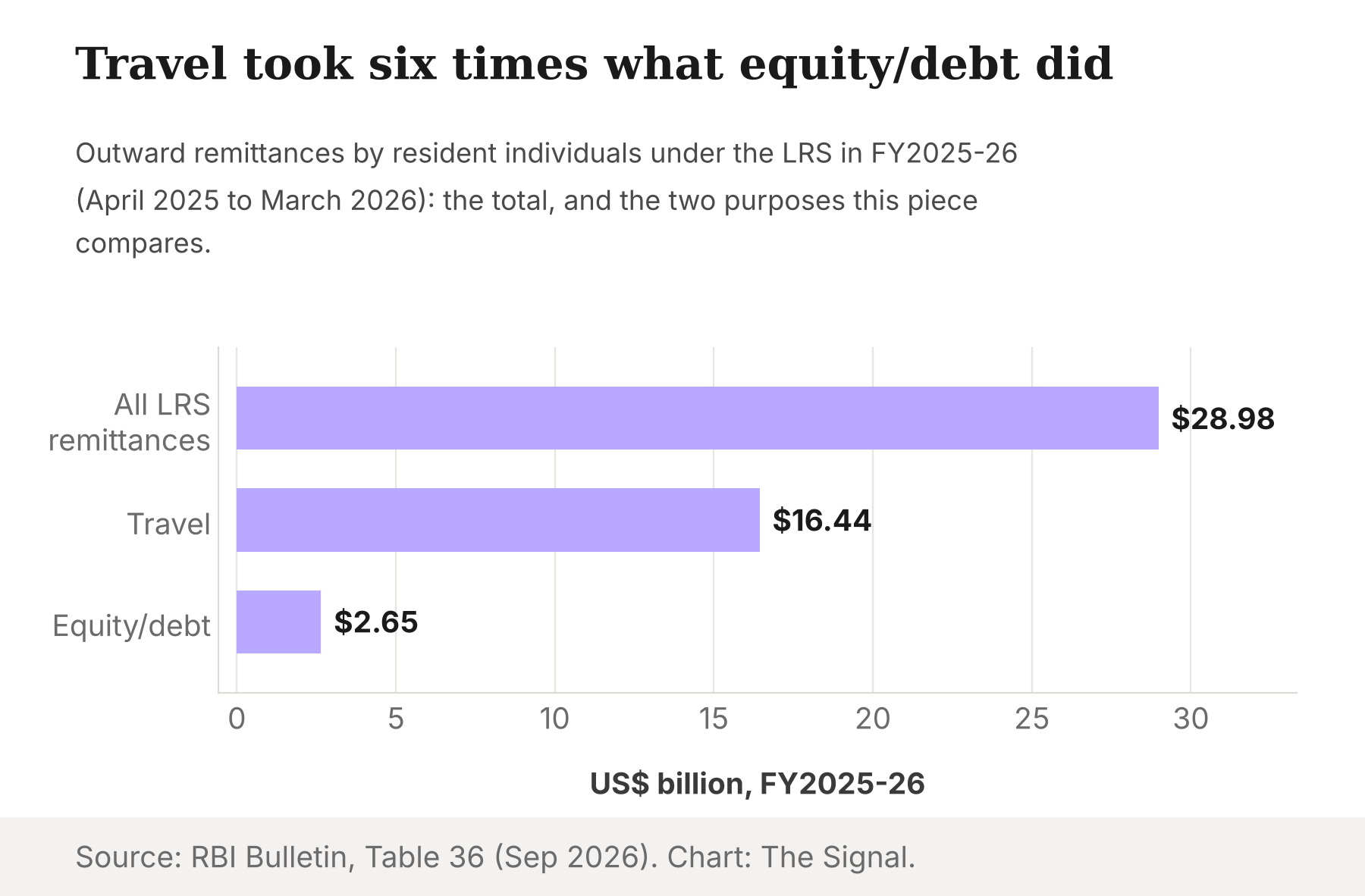
Source: RBI Bulletin, Table 36 (September 2026). Chart: The Signal.
Two derived figures put that $2.65 billion in scale. Divided by the $250,000 annual cap, a full year of Indian equity and debt remittances equals the whole allowance of about 10,600 people. And the low end of Anthropic's base deal of $57.8 billion is about 22 times the $2.65 billion Indians sent abroad for equity and debt in FY2025-26.
The toll on the way out
Price is the second constraint. The Union Budget 2026-27 memorandum explaining the Finance Bill 2026 states that tax collected at source on LRS remittances above ₹10 lakh in a year is 20% for purposes other than education or medical treatment, which covers buying overseas shares. The same Finance Bill 2026 memorandum proposed cutting the rate for education and medical remittances from 5% to 2%, and setting overseas tour packages at a flat 2%, from 1 April 2026.
Read the design as a signal of intent. Under the memorandum's proposals, a family paying for a foreign tour package faces a 2% rate, while an investor wiring more than ₹10 lakh for US shares faces 20% on the excess. The rule does not stop anyone buying ANT. It makes the larger cheque costlier to send up front, and it leans the other way for holidays.
The honest objection
The strongest case against this reading is momentum. RBI Bulletin data (Table 36, released 23 October 2026) show that equity and debt remittances in August 2026 were $321.53 million, against $152.18 million in August 2025, roughly double. The September 2026 Bulletin table shows July 2026 at $344.57 million against $156.19 million in July 2025, also more than double. A pipe that doubles in a year is widening fast, and a marquee listing could widen it further.
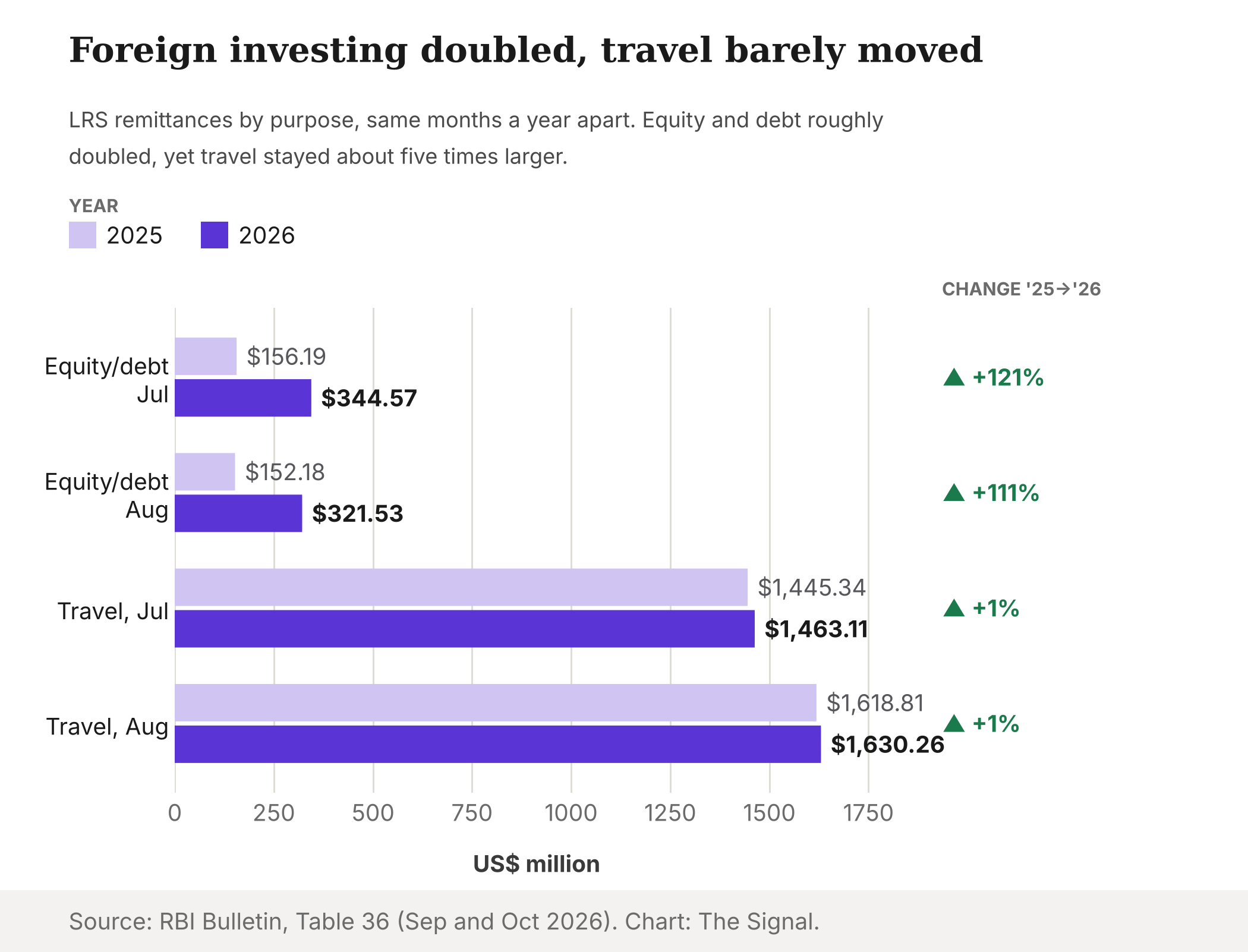
Source: RBI Bulletin, Table 36, September 2026 for July and October 2026 for August. Chart: The Signal.
That case is real, and the doubling is the most interesting number here. But it answers a different question. Growth from a small base still leaves investment at about a fifth of travel: in August 2026 travel was $1,630.26 million against $321.53 million for equity and debt. It is also small beside foreign institutional money. RBI Bulletin data (Table 35, released 23 October 2026) show net FPI flows into India of $4,371 million in July 2026 and $1,873 million in August 2026, after a net FPI outflow of $16,706 million in FY2025-26. Those are net figures and the LRS series is gross, so the two cannot be set against each other directly. The point is narrower: the swings of billions of dollars in these tables belong to foreign institutions, not to Indian households buying a US listing.
The Signal
Anthropic's IPO is a test of the gap between attention and ownership. The filings shut Indian retail out of the IPO price, the remittance scheme sets a generous per-person ceiling that the aggregate flow barely reflects, and the Finance Bill 2026 proposals charge 20% up front on the large investment cheque while charging 2% on a tour package. Watch the RBI's Table 36 for November and December 2026 when the RBI publishes it. If equity and debt remittances jump well clear of their mid-2026 run rate of $321.53 million to $456.69 million a month, per the October 2026 Bulletin, the listing moved real money. If travel still dwarfs them, Indian enthusiasm for the AI trade stayed what the data showed through mid-2026: something people talk about more than they wire.
Reporting basis: this piece rests on three origins. Every remittance and portfolio-flow figure is from the Reserve Bank of India's monthly Bulletin (Table 36 for LRS remittances, Table 35 for foreign investment flows), and the $250,000 limit is from an RBI FAQ last updated in April 2023, so all of the load-bearing flow data comes from that single origin. The TCS rates are from the Ministry of Finance's memorandum explaining the Finance Bill 2026, which sets out proposals as introduced; this piece did not verify the enacted text. Every detail of the Anthropic offering, including share counts, the $70 to $78 price range, retail allocations and the India selling restriction, is from Anthropic's own filings with the US SEC, a single issuer origin; the final IPO price and amount raised were not verified. GIFT City routes are not covered because no verified figure was available. The quarterly total, ratios, shares, the base-deal range, the 165 million retail shares, the 10,600-person equivalence and the 22-times comparison are The Signal's calculations from those figures.