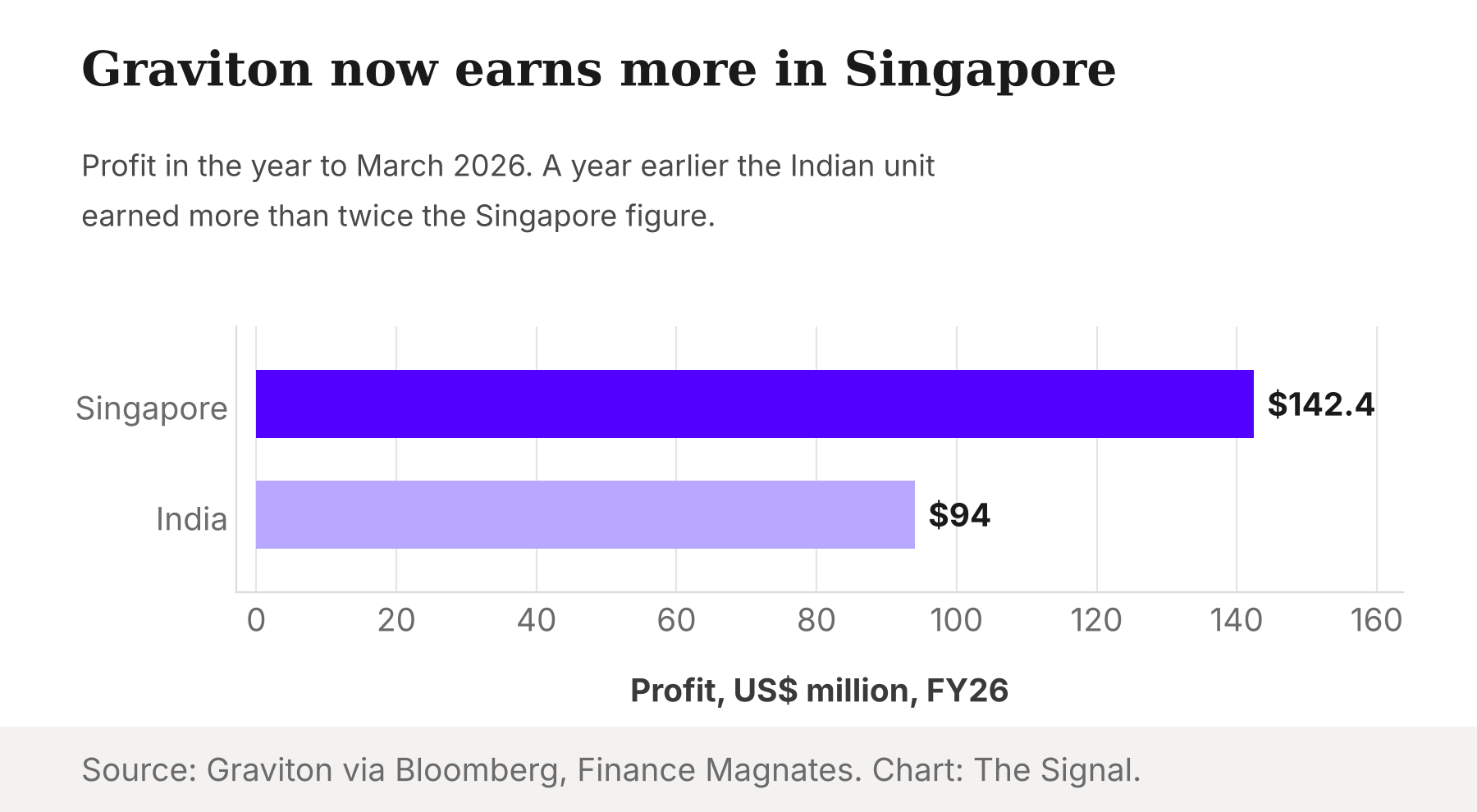
The obvious way to read Graviton's latest accounts is as a verdict on SEBI. India's best-known homegrown high-frequency trading firm now makes more money outside India than inside it. Its Singapore unit's profit rose 166% to $142.4 million in the year to March 2026, while its Indian unit earned 25% less, at ₹8.84 billion, or about $94 million, according to figures Graviton gave Bloomberg. The regulator spent two years tightening the futures and options market. A speed trader built on that market is now booking its growth abroad. Cause and effect seem to line up.
They do not, and SEBI's own data shows why.
The pool for prop traders barely shrank
Every argument that the curbs drove trading firms out of India assumes the curbs shrank the money those firms make here. For proprietary traders as a group, they barely did. SEBI's FY25-FY26 profitability study reports that proprietary traders' gross trading profit in equity derivatives fell only 3% in FY26, even as individual traders' gross loss fell 26%.
In rupees, prop traders made ₹45,955 crore in FY25 and ₹44,483 crore in FY26, against ₹31,085 crore and ₹13,896 crore for foreign portfolio investors. Over the same two years, individuals' gross loss went from ₹97,882 crore to ₹72,243 crore. Foreign investors lost more than half their profit. Prop traders, the category that covers proprietary trading firms such as Graviton's Indian unit, kept 97% of theirs.
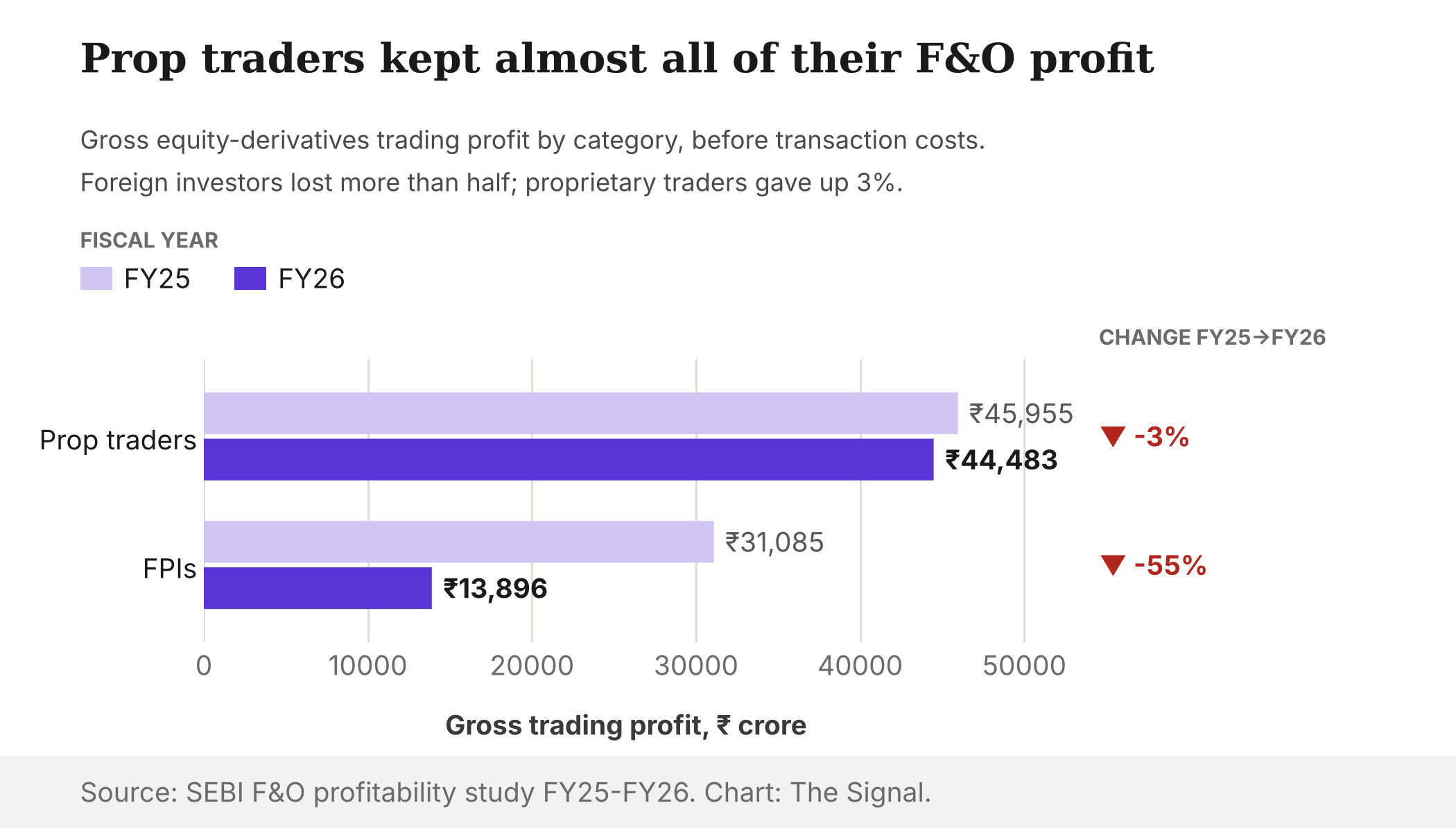
The foreign collapse has a known event behind it. SEBI's July 2025 interim order froze Jane Street's Indian operations and demanded a ₹4,843.57 crore escrow deposit. Jane Street disputes SEBI's findings. Whatever the outcome, the FPI line moved for a reason that had nothing to do with Graviton.
That leaves a puzzle. If the prop category's profit held almost flat, Graviton's 25% fall at home is not the curbs taking money out of the room. Someone else took Graviton's share.
More firms are splitting the same money
SEBI's numbers point to who. Proprietary algo entities trading at NSE rose 16%, from 279 in FY24 to 323 in FY26, and FPI algo entities rose 22%, from 306 to 372. Those are the firms that capture the profit. SEBI says 99% of profits for FPIs and proprietary traders were made by algo entities, and the top 10 prop entities earned about 75% of the category's gross profit in FY26.
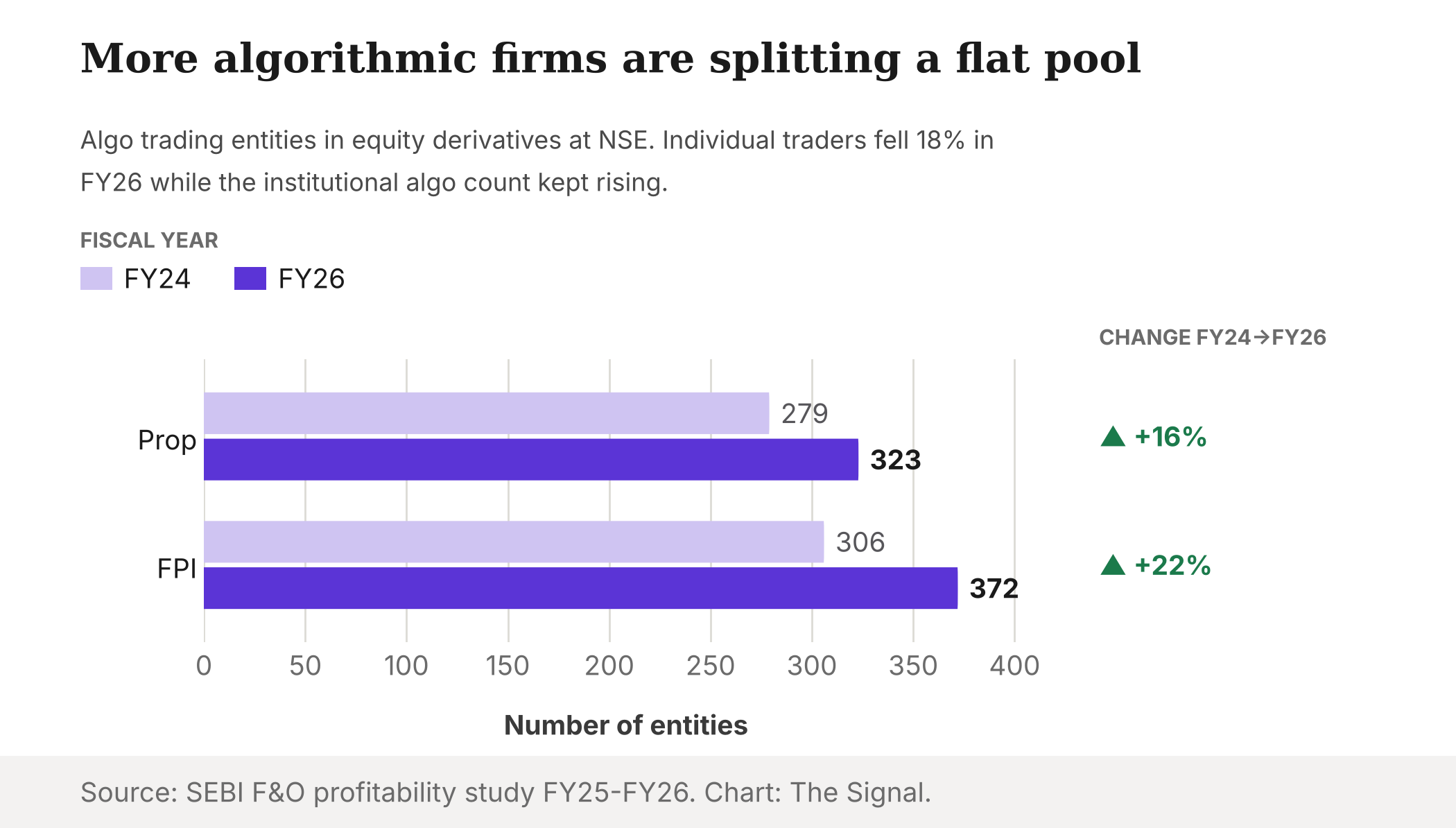
A flat pool, a rising count of skilled competitors and a winner-take-most split is a recipe for an incumbent losing share. Bloomberg's earlier reporting shows exactly that in another of Graviton's businesses. Graviton's share of large cash trades on NSE slipped to 20% in 2025 and fell below 7% in 2026 through April 2. In the year to March 2025, its Indian unit had reported a profit of ₹12 billion. The fall to ₹8.84 billion is a quarter of that gone in a market where the category total barely moved.
Costs are also rising on both sides. The Union Budget 2026-27 raised STT on futures to 0.05% from 0.02%, effective April 1, 2026, with option premiums also taxed more heavily. Inside the firm, Graviton's Indian revenue fell 11% to ₹22.8 billion while personnel expenses rose 21% to ₹11.6 billion. A business paying more for talent to defend a shrinking slice has a reason to put the next hire where the slice is growing.
Singapore is where the growth is
That is what the Singapore numbers say. The Singapore unit, which Graviton says represents its global business, more than doubled revenue to $239.4 million. A year earlier the Indian unit's profit was more than twice Singapore's. Now the order is reversed.
Global market making has also had a strong 2026, which helps explain the timing. Virtu Financial, the US market maker, reported net income of $282.5 million for the September 2026 quarter, against $149.1 million a year earlier, in its quarterly filing. A firm with world-class Indian engineers and a crowded home market would be expected to chase that.
What the curbs did and did not do
None of this means the curbs did nothing. They changed the retail side more than the prop side. From 20 November 2024, SEBI limited weekly expiries to one index per exchange and raised the minimum contract value to ₹15-20 lakh. By FY26, active individual traders had fallen 18%, from 106.2 lakh to 87.5 lakh, and aggregate net losses fell 18% to ₹91,685 crore, but the average loss per person rose to ₹1.17 lakh and 87.7% of individuals still lost money. Persistent losers stay. Among traders active through FY22 to FY26, only 0.5% were profitable in all five years while 65.6% lost money every year.
The exchange has not been starved either. NSE's transaction-charge revenue rose 9% to ₹3,035 crore in the September 2026 quarter, and equity options premium turnover rose 3%. Fewer retail traders are losing a little less in total, and the firms on the other side of their trades are still making almost as much.
The honest objection
The strongest case against this reading is that the category figure hides a squeeze. The SEBI totals are gross, before transaction costs, so a 3% fall in gross profit could be a bigger fall in net profit once the higher STT is paid. The STT increase also took effect on April 1, 2026, after the FY26 data period ends, so its full weight is not yet in any of these numbers. On that view, Graviton is simply early: it saw the cost line rising and moved first, and other prop firms will follow.
That case has force for FY27. It does not explain FY26. In the year Graviton's Indian profit fell a quarter, its category's gross profit fell 3% and the number of algorithmic rivals kept climbing. Higher taxes may push the whole category abroad later. The data fit a firm losing share to competitors better than one fleeing a shrinking pool.
The Signal
SEBI's curbs were sold as retail protection, and the retail numbers did move: fewer traders, smaller total losses, still nearly nine in ten losing. The firms on the other side kept almost all of their take. What changed for India's homegrown champion was not the size of the pool but the number of hands in it, and the answer to that was to grow somewhere less crowded. If FY27 shows the prop category's profit falling once the higher STT bites, the story becomes about tax. Until then, Graviton's Singapore numbers read less as an escape from SEBI than as a crowded incumbent growing where the room is.
Reporting basis: Graviton's FY26 profit and revenue figures for its Singapore and Indian units are Graviton's own figures as given to Bloomberg, verified via Finance Magnates' report; its FY25 Indian profit and its share of large NSE cash trades are from Bloomberg's April 2026 reporting, via GuruFocus. Both Graviton strands therefore rest on one origin, the company's figures through Bloomberg. Category-wise derivatives profits, algo-entity counts, individual participation and losses, and the November 2024 measures are from SEBI's August 2026 profitability study, and the five-year persistence figure is from SEBI's companion study on trading behaviour; SEBI is one origin. The STT change is from the Union Budget 2026-27 as reported by Business Today, NSE's quarterly figures are from its results as reported by Business Today, the Jane Street order is SEBI's as reported by Business Today, and Virtu's earnings are from its SEC filing. The 97% retained share and the size of Graviton's Indian profit decline relative to FY25 are The Signal's calculations from those figures.