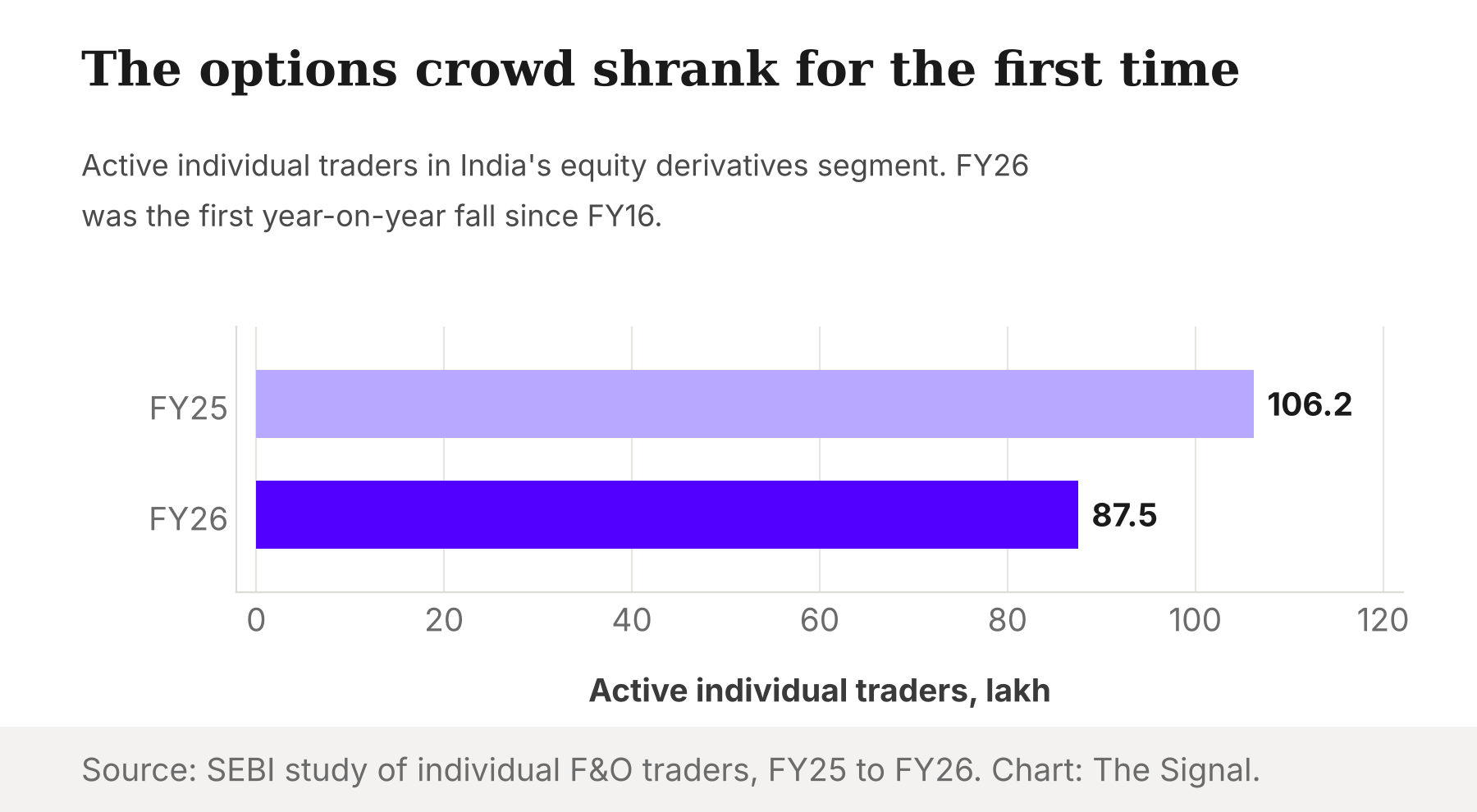
The official story of India's retail trading boom is that the regulator won. In October 2024, SEBI set a minimum index derivative contract value of Rs 15 lakh and cut weekly expiries to one per exchange, with the rules phased in from November 20, 2024. Two years later the crowd it targeted has thinned. SEBI's own study of individual derivatives traders counts 87.5 lakh active traders in FY26, down 18% from 106.2 lakh in FY25 and the first year-on-year decline since FY16.
Strip one number out of that story and it stops holding together. On November 17, 2026, Reuters reported that outstanding margin trading facility (MTF) positions had climbed to Rs 1.53 lakh crore, up 29% from a year earlier and nearly twice their end-2024 size. MTF is a broker loan that lets a client buy shares with a fraction of the money down. The leverage SEBI pushed out of options did not leave the market. A large part of it looks to have changed address.
The new address is the cash market
The same Reuters report says SEBI is now weighing a bar on fresh margin funding in any stock once margin-funded holdings reach 5% to 10% of its free float, the shares actually available for trading. More than 220 stocks already sit above 5%, at least 36 above 10%, and about two-thirds of the leverage is in small- and mid-cap stocks, according to the Reuters account carried by Business Today. The rules are not final and will go to public consultation first.
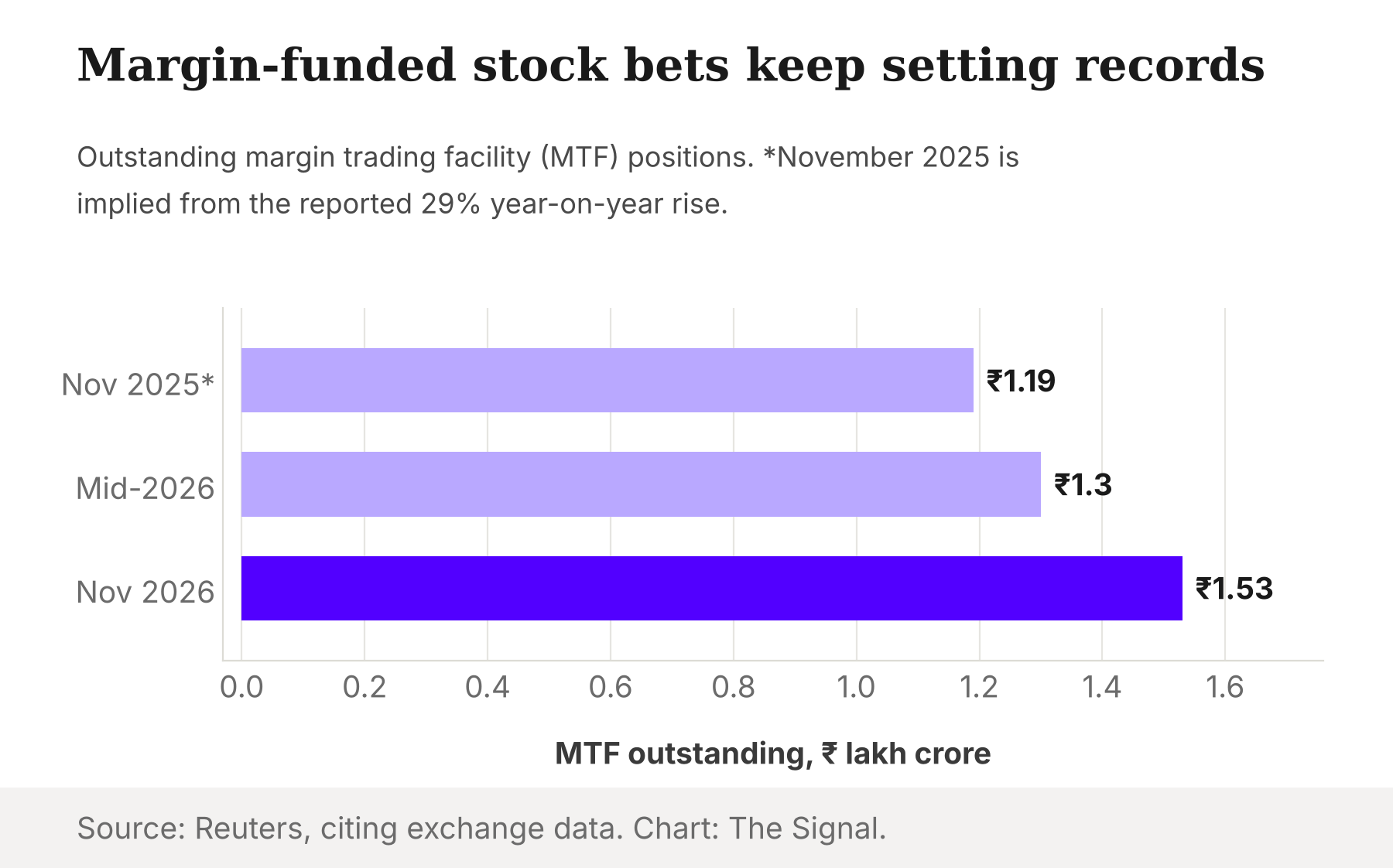
The climb has not paused. Reuters put the MTF book at about Rs 1.3 lakh crore by mid-2026, around 50% higher than a year before, when SEBI floated its first round of MTF risk curbs in June. Against the Rs 1.53 lakh crore reported on November 17, that is roughly another 18% in about five months. Working backward from the reported 29% annual rise puts the November 2025 level near Rs 1.19 lakh crore.
Who left the options pit
SEBI's study shows how hard the derivatives crowd turned over. New entrants fell about 40% to 20.8 lakh in FY26, and nearly 46 lakh traders who were active in FY25 did not trade at all in FY26, against 26 lakh exits a year earlier.
The losses shrank with the crowd. Individual traders' aggregate net losses fell 18% to Rs 91,685 crore in FY26, from a revised Rs 1.12 lakh crore in FY25, and the share of individuals who lost money eased only to 87.7% from 90.9%. By the regulator's measure, the options rules did their job.
SEBI's data cannot say where the 46 lakh leavers went, and The Signal does not claim they all moved to margin loans. What the data does show is timing. MTF nearly doubled from end-2024, the same stretch in which the options rules took full effect. In July 2026, Reuters described MTF leverage at an all-time high of about $15 billion, up 50% year-on-year, with brokers charging clients 9% to 18% to fund the positions.
The brokers followed the money
The clearest evidence of the shift sits in the brokers' own results. The app brokers have leaned hard into lending.
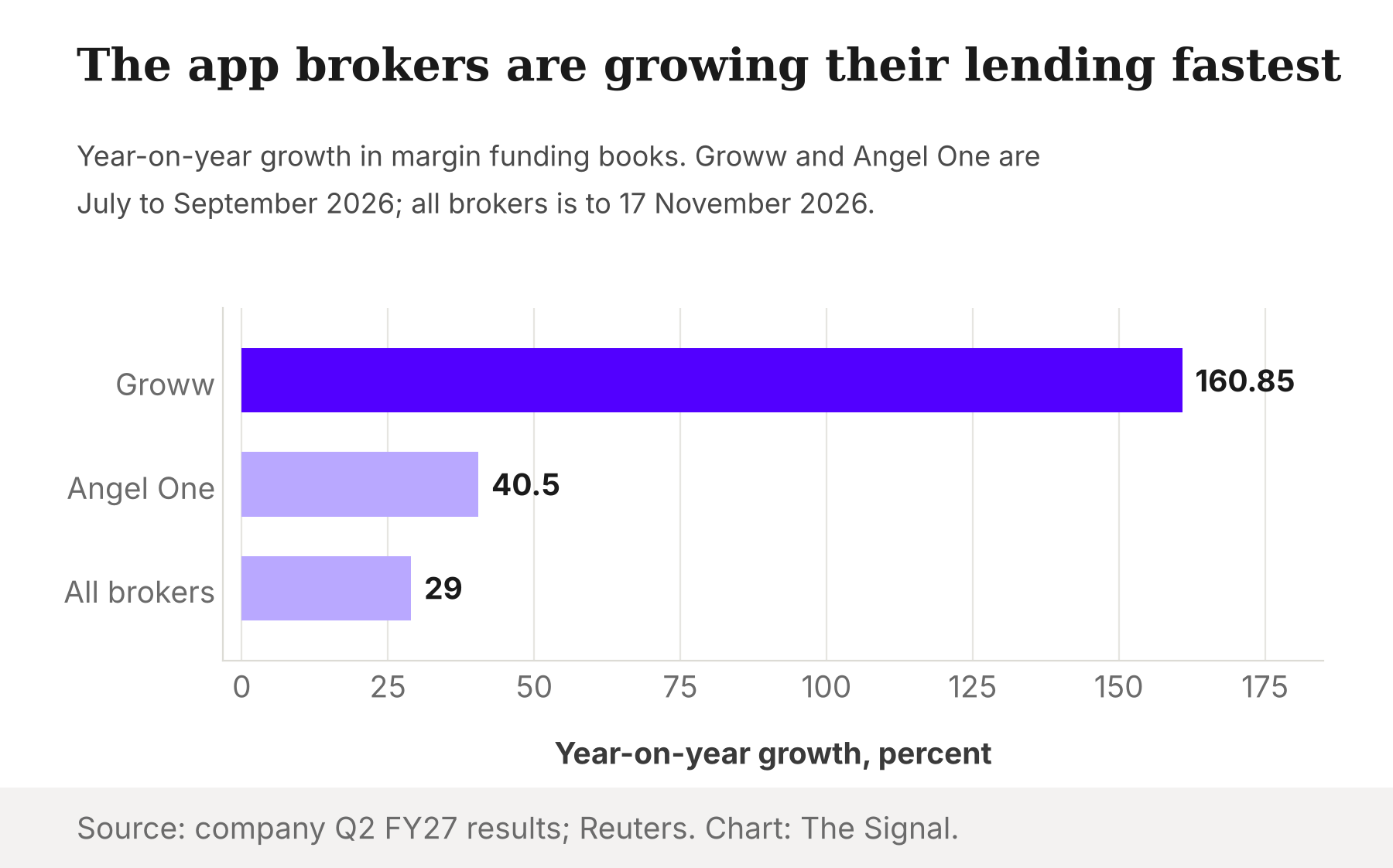
Groww's MTF book grew 160.85% year-on-year to Rs 4,351 crore in the July to September 2026 quarter, from Rs 1,668 crore, lifting its share of the MTF market to 2.7% from 1.6%. Derivatives still made up 44.8% of Groww's revenue in that quarter, but the lending book is the line growing fastest in the chart above. Angel One's average client funding book reached Rs 7,450 crore, up 40.5% year-on-year, in the same quarter.
| Measure | Figure | Period |
|---|---|---|
| Active individual F&O traders | 87.5 lakh, down 18% | FY26 |
| Individual F&O net losses | Rs 91,685 crore, down 18% | FY26 |
| Market-wide MTF positions | Rs 1.53 lakh crore, up 29% | November 17, 2026 |
| Groww MTF book | Rs 4,351 crore, up 160.85% | Jul to Sep 2026 |
| Angel One average funding book | Rs 7,450 crore, up 40.5% | Jul to Sep 2026 |
Sources: SEBI FY25 to FY26 derivatives study; Reuters, citing exchange data; Groww and Angel One Q2 FY27 results.
The cost of that leverage is not small. At the 9% to 18% interest rates Reuters reported, a Rs 1.53 lakh crore book carries an annual interest bill of roughly Rs 13,800 crore to Rs 27,500 crore before a single share moves.
Why the risk changed shape
An option buyer can lose only the premium paid. A margin buyer owns the stock with borrowed money and can lose beyond the cash put down. A falling price brings a margin call, and a forced sale, at the worst moment.
That is why the proposed cap is built around free float. If two-thirds of a Rs 1.53 lakh crore book sits in small and mid caps, a sell-off in one thinly traded stock can turn into forced selling by every margin client holding it at once. A cap set at a share of the tradable float is the first leverage rule aimed at the stock rather than the trader.
The squeeze is arriving from the funding side as well. The RBI deferred its amended capital market exposure directions to July 1, 2026, under which bank financing to brokers and other market intermediaries for proprietary trading may be extended only against 100% collateral in cash or cash equivalents.
The honest objection
The strongest case against alarm is that margin trading is a different and safer animal. An MTF client holds real shares, posts collateral and pays interest, and many buy large companies. In July 2026, Reuters noted that margin trading remains far smaller than the Rs 99.5 lakh crore deployed in derivatives. Growth is also slowing. The book was growing around 50% a year in mid-2026 and 29% a year by November. On this reading, a market with fewer options gamblers and more leveraged stock owners is an improvement, and a hard cap risks punishing the cautious with the reckless.
Much of that is true. The difference lies in where the money sits. A slower growth rate still left the book at a record. Leverage that is two-thirds concentrated in smaller companies, with more than 220 of them above 5% of free float, is a market-structure risk that a trader-level rule cannot see. That is why SEBI is now looking at the stock rather than the person.
The Signal
SEBI's derivatives rules shrank the number of people losing money in options, and that matters. But retail appetite for leverage was never only about one product. It found a new form, and the app brokers built lending books to meet it. The proposed free-float cap shows the regulator has noticed. What to watch is the threshold: at 5%, more than 220 stocks would be constrained on day one; at 10%, only 36 would. The second round of the crackdown is not about how much traders can lose. It is about how many of them can be forced to sell the same stock on the same day.
Reporting basis: the Rs 1.53 lakh crore MTF figure, the 29% annual rise, the proposed 5% to 10% free-float cap, the 220 and 36 stock counts and the small- and mid-cap share are per Reuters, citing exchange data and two people with direct knowledge, as carried by Business Today; this is a single origin and the rules are not final. The mid-2026 MTF level and the July 2026 description of MTF leverage, interest rates and the derivatives comparison are also per Reuters, as republished by Business Recorder, so all MTF market figures rest on that one wire origin. Trader counts, entries, exits and losses are from SEBI's study of individual traders in the equity derivatives segment, FY25 to FY26. The 2024 derivatives rules are from SEBI's October 1, 2024 circular, as reported by the Free Press Journal. Groww's figures are from its parent company's Q2 FY27 results, as reported by Business Today, and Angel One's from its Q2 FY27 results, as reported by the Free Press Journal. The bank funding rule is from an RBI press release. The implied November 2025 MTF level, the five-month growth since mid-2026 and the annual interest-bill range are The Signal's calculations from those figures.