On 4 November 2026, SEBI issued its final observations on Mahanadi Coalfields' draft offer documents, clearing the way for the third public listing of a Coal India subsidiary this year. The obvious read is a disinvestment story. A government that needs money is selling another slice of a coal company, and investors who did well on the first coal listing want a second helping.
That read misses what is being sold. The MCL issue is entirely an offer for sale of up to 661,836,300 shares held by Coal India, with no fresh shares. Coal India holds all 6,618,363,000 of MCL's shares, per the draft red herring prospectus, so the sale is 10% of the company. In a pure offer for sale, the money goes to the selling shareholder. That means Coal India gets the cash, not MCL and not the exchequer directly. The more interesting consequence lies elsewhere: the market is about to put a direct, daily price on the single largest source of Coal India's earnings.
One subsidiary, a third of the profit
Coal India's chairman told the 52nd AGM that consolidated profit after tax was ₹31,071 crore in the year to March 2026, and that Mahanadi delivered the highest subsidiary profit, ₹10,698 crore. That is 34.4% of the group's consolidated profit from one company.
The lead is thin. The same speech put Northern Coalfields close behind at ₹10,657 crore, only ₹41 crore less. Together the two earned ₹21,355 crore, or 68.7% of Coal India's consolidated profit. The next three named subsidiaries, South Eastern, Central and Western Coalfields, made ₹9,320 crore between them.
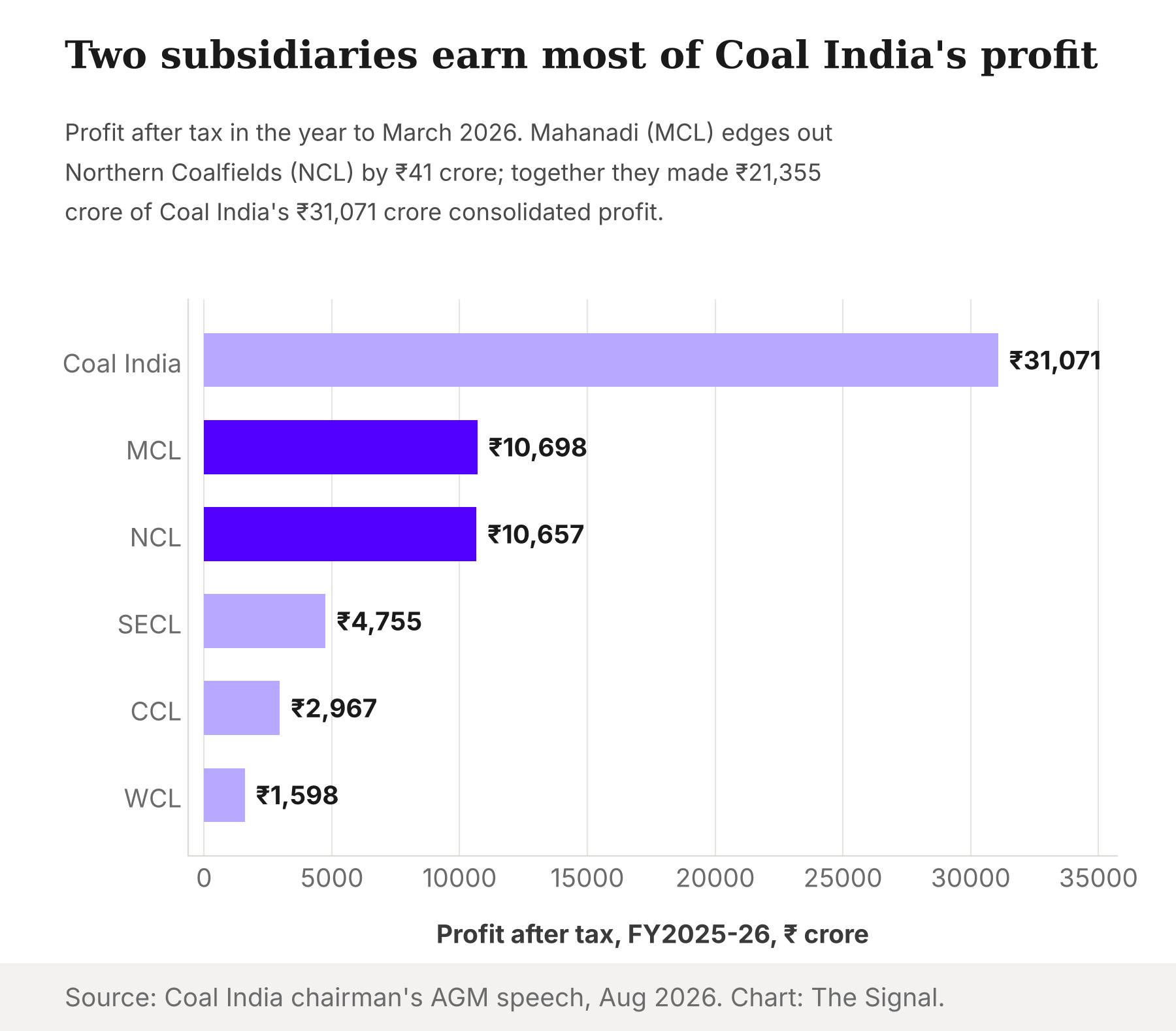
Source: Coal India chairman's speech, 52nd AGM. Chart: The Signal.
Mahanadi's weight in profit runs ahead of its weight in tonnes. MCL contributed 28% of Coal India's coal output in FY26, PTI reported. Its prospectus puts the figure at 28.3% of Coal India's FY26 output of 768.19 million tonnes, down from 781.06 million tonnes in FY25. Its own draft abridged prospectus puts FY26 production at 218.31 million tonnes, which MCL says was 21.00% of India's domestic coal production. The same filing shows FY26 revenue from operations of ₹30,549.6 crore against profit of ₹10,698.1 crore. Roughly 35 rupees of every 100 in revenue became profit.
Why the share grew
Mahanadi's profit is not rising. Its restated consolidated profit after tax, per the draft abridged prospectus, was ₹11,841.6 crore in FY24, ₹10,825.1 crore in FY25 and ₹10,698.1 crore in FY26. The April to June 2026 quarter came in at ₹2,398.8 crore against ₹2,448.3 crore a year earlier.
What changed is the parent. Coal India's consolidated profit fell from ₹35,450 crore to ₹31,071 crore between FY25 and FY26, a drop of about 12%. Mahanadi's slipped about 1% over the same year. On those figures MCL's share of the group's profit rose from roughly 30.5% in FY25 to 34.4% in FY26 (our calculation, comparing MCL's restated filing figure with the parent's reported consolidated total).
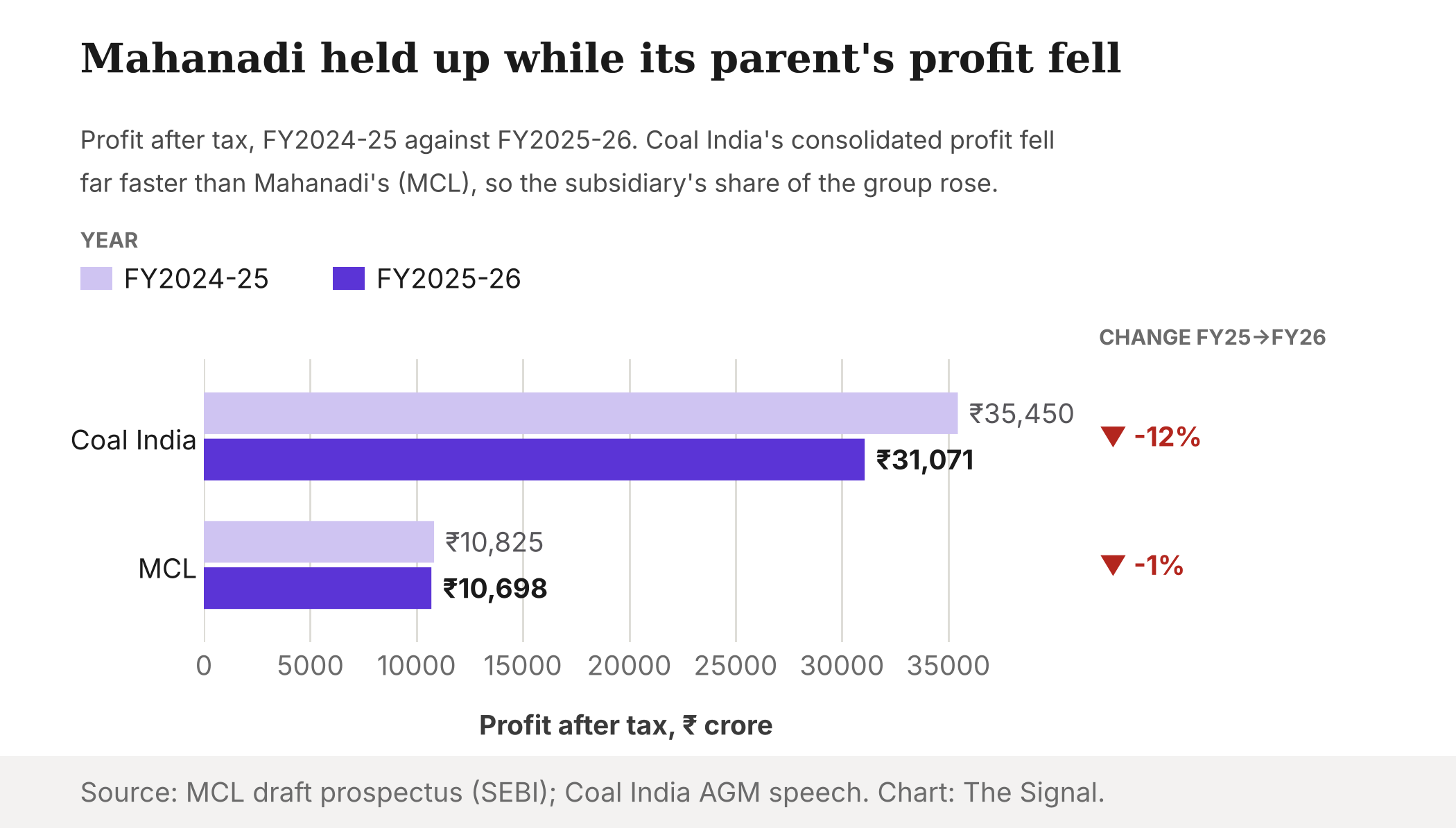
Source: Coal India figures from the chairman's 52nd AGM speech; Mahanadi figures from its draft abridged prospectus. Percentage changes are The Signal's calculations. Chart: The Signal.
That is the setup for the holding-company problem. When one unit's earnings are steadier than the group's, and that unit gets its own share price, investors can buy the steady part directly. They no longer need the parent to get it.
From operator to holding company
This IPO is the opening tranche, not the whole plan. Coal India's board on 23 March 2026 approved divesting up to 25% of its MCL shares through offers for sale in one or more tranches. The government's Alternative Mechanism capped the overall dilution at reducing Coal India's MCL holding by up to 25%, and allowed for possible fresh issues as well.
Mahanadi is also not alone. South Eastern Coalfields filed a DRHP dated 1 November 2026 for an offer for sale of up to 668,056,100 shares held by Coal India. Add the two listings already done, and four Coal India subsidiaries will have public prices if SECL follows through.
Once that happens, an investor can value Coal India two ways. One is its own share price. The other is the market value of its stakes in listed subsidiaries, such as the 90% it kept in BCCL, plus whatever the unlisted rest is worth. When the first number sits below the second, the gap is what investors call a holding-company discount. Coal India's stock has never had to answer the question, because none of its main profit engines had a price. After MCL lists, the comparison becomes something anyone can compute every trading day.
What the first two listings showed
The precedents point both ways.
The first two Coal India subsidiary IPOs drew opposite verdicts from the market.
| Subsidiary | Listing date | Shares sold by Coal India | Issue price | Subscription | Listing vs issue price |
|---|---|---|---|---|---|
| Bharat Coking Coal (BCCL) | 19 January 2026 | 465.7 million | ₹23 | 146.87 times | +96.56% |
| CMPDI | 30 March 2026 | 107.1 million | ₹172 | 1.05 times | -6.98% |
Sources: Coal India on BCCL and on CMPDI; listing prices and subscription from The Week and Business Today.
BCCL listed at ₹45.21 on the BSE, a 96.56% premium to its ₹23 issue price, after bids for 146.87 times the shares on offer. CMPDI, a ₹1,842 crore all-OFS issue, listed at ₹160 on the NSE, a 6.98% discount, after being subscribed only 1.05 times. In the BCCL sale Coal India sold 465.7 million shares at ₹23, which works out to about ₹1,071 crore. That is a small sum next to Mahanadi's annual profit.
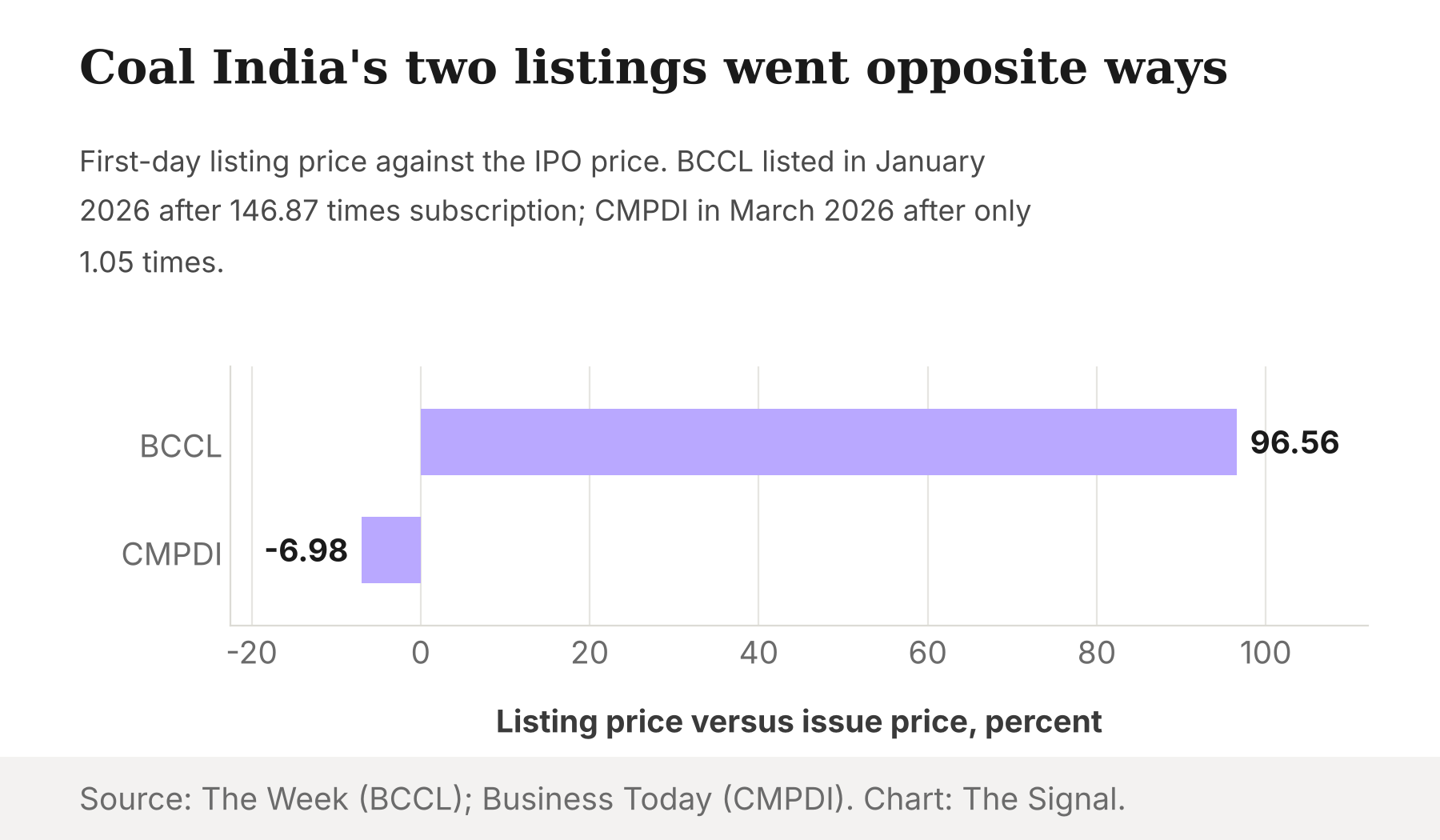
Source: The Week for BCCL and Business Today for CMPDI. Chart: The Signal.
Neither is a clean comparison. BCCL is a coking-coal miner, and CMPDI is a consultancy that plans mines. Mahanadi, a thermal-coal producer earning a third of the group's profit, is a different kind of asset.
Where the money goes
The fiscal angle runs one step removed. DIPAM's receipts table records a 2% Coal India offer for sale in FY2026-27 that raised ₹5,542.36 crore and cut the government's holding to 61.13%. That compares with 63.13% at the end of FY2025-26, per Coal India's draft annual return. The same DIPAM table put total FY27 disinvestment receipts at ₹55,757.29 crore as of its 4 November 2026 update. The FY27 Budget estimated ₹80,000 crore from disinvestment and asset monetisation, PTI reported. The receipts so far cover about 70% of that target.
The MCL sale does not fill that gap directly, because Coal India is the seller. The government benefits only through its 61.13% share of whatever Coal India does with the money, whether that is dividends, capital spending or cash on the balance sheet.
The honest objection
The strongest case against the holding-company reading is that a 25% ceiling leaves Coal India firmly in control. Coal India would still consolidate Mahanadi in full, still decide its dividends and capital spending, and still own most of its profit. On this view a minority float is a price-discovery exercise, not a change in what Coal India is. A falling profit line at Mahanadi, from ₹11,841.6 crore in FY24 to ₹10,698.1 crore in FY26 per its draft prospectus, also argues against expecting the subsidiary to outshine its parent.
That case is right about control and wrong about pricing. Control decides who runs Mahanadi. A listing decides who sets its value, and a holding-company discount needs only a visible price for the parts, not a loss of control. With Northern Coalfields earning almost as much as Mahanadi and still unlisted, Coal India keeps one large engine whose value only its own shares can express. That cuts against a steep discount. It does not prevent one.
The Signal
Until now, an investor who wanted Mahanadi had to buy all of Coal India. The Mahanadi listing ends that for the subsidiary that earned ₹10,698 crore of the group's ₹31,071 crore profit in FY26. Watch two numbers once trading starts: the market value of Coal India's remaining MCL stake as a share of Coal India's own market value, and whether that ratio moves when SECL lists. If the parent trades well below the sum of its listed parts, the next tranche under the 25% approval becomes a harder sell for Coal India's own shareholders. Coal India is not just selling a slice of Mahanadi. It is selling the market a way to value Coal India without owning it.
Reporting basis: the SEBI clearance date and Mahanadi's 28% share of Coal India output are per PTI, as carried by The Week. Mahanadi's share count, its 28.3% share of Coal India's output and Coal India's total production are from its draft red herring prospectus, and its profit, revenue and production figures from its draft abridged prospectus, both filed with SEBI. The offer size, the 25% board approval, the Alternative Mechanism cap, the SECL filing and the BCCL and CMPDI sale details are from Coal India's own stock-exchange disclosures, which count as one origin. Group and subsidiary profit for FY2025-26 come from the Coal India chairman's AGM speech, a second Coal India document. The government's 63.13% holding is from Coal India's draft annual return, and the 61.13% holding and FY27 receipts from DIPAM. The Budget target is per PTI. BCCL's listing price and subscription are per The Week, and CMPDI's per Business Today; each rests on that single outlet. Mahanadi's profit shares, its profit margin, the two-subsidiary total, the BCCL proceeds and the share of the disinvestment target met are The Signal's calculations from those figures.