The headline version of this week writes itself. Reuters reported that the Nifty and Sensex gained 8.6% and 8.8% in the week to 6 November 2026, the best week since February 2021. HDFC Bank and ICICI Bank rose 13.8% and 12.4%, their best weeks in about six years. Foreign institutional investors bought about ₹15,000 crore ($1.6 billion) of shares on Thursday 5 November alone. Read the top line and Dalal Street is back.
It is worth slowing down on that. Look at what else happened in the same days.
The rally has a mirror image
On Monday 2 November, Reuters reported that the Nasdaq-100 closed more than 10% below its 6 October record, confirming a correction. The stated worry was that investments in AI infrastructure are outpacing near-term cash generation.
Then came Thursday 5 November. FRED data show the Nasdaq-100 closed at 26,629.81, down from 28,437.17 the day before. That is a one-day fall of about 6.4%. The S&P 500 closed at 7,353.73, down from 7,688.62, a fall of about 4.4%.
That was the same Thursday foreign institutions bought about ₹15,000 crore of Indian shares, Reuters reported.
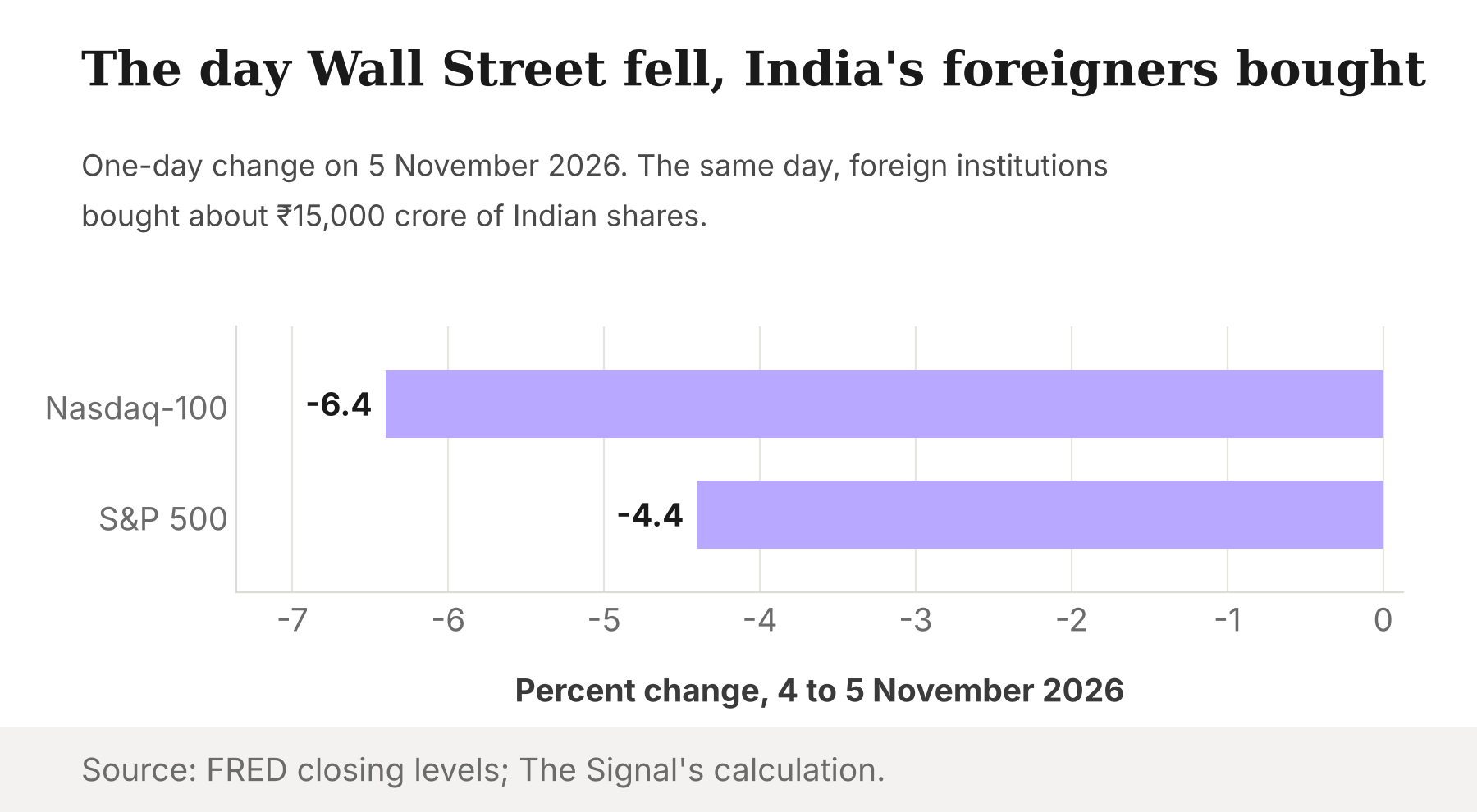
Two things happened on one day, and they are plausibly one story: money left a market priced on AI and went looking for one that is not.
The discount that became a hedge
India has long been seen as the reverse AI trade because it has few listed semiconductor and AI-related stocks, Business Today wrote in July 2026. That month, Business Today reported, Nifty IT returned 16.77% while the Philadelphia semiconductor index fell 20.66%.
During the boom that absence reads as a gap. When the AI trade breaks, the same gap reads as protection.
India did not get better this week. The thing that made it unattractive during the boom made it safe during the bust. The rally is a measure of what the market wanted to avoid, not of what Indian companies earned.
Reuters notes that Indian IT stocks, seen as relatively insulated from capital-intensive AI investment, outperformed.
The year is still negative
Here is the number that carries the thesis. Reuters reported that the Nifty and Sensex are still down 4.2% and 4.9% in 2026, against a gain of 7% for MSCI Emerging Markets.
Work backwards. A Nifty that rose 8.6% this week and is still down 4.2% for the year was down about 11.8% for 2026 a week earlier. To get back to flat, it needs a further gain of roughly 4.4%. These are our calculations from the Reuters figures.
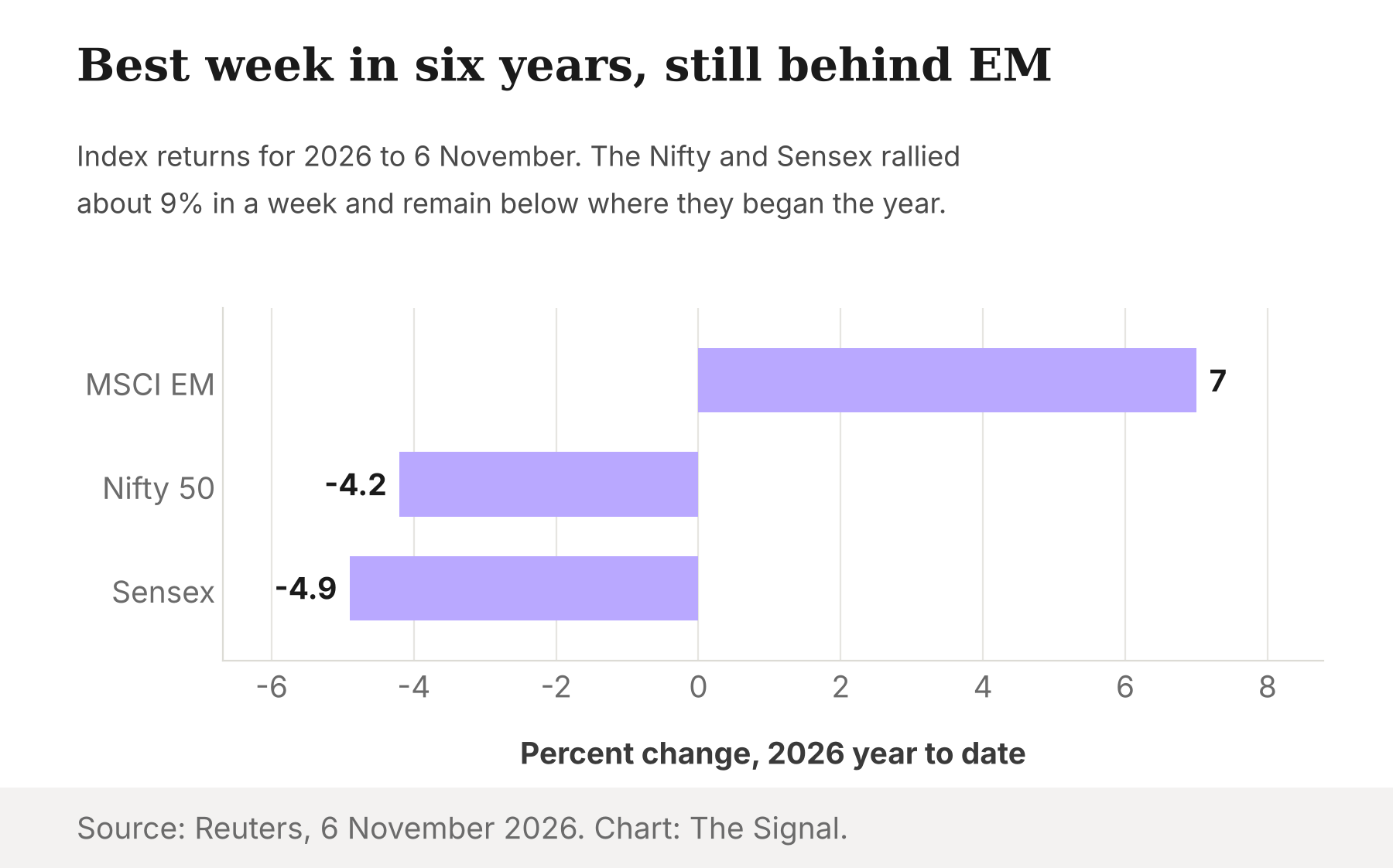
So the hedge worked for a week, in a year when the rest of emerging markets did better. If the absence of AI were enough to make India an outperformer, the gap to MSCI Emerging Markets would not be this wide after the best week in six years.
Banks carried the move
The leadership tells a similar story. HDFC Bank and ICICI Bank gained 13.8% and 12.4%, against 8.8% for the Sensex and 8.6% for the Nifty. By simple division, HDFC Bank rose about 1.6 times the Sensex.
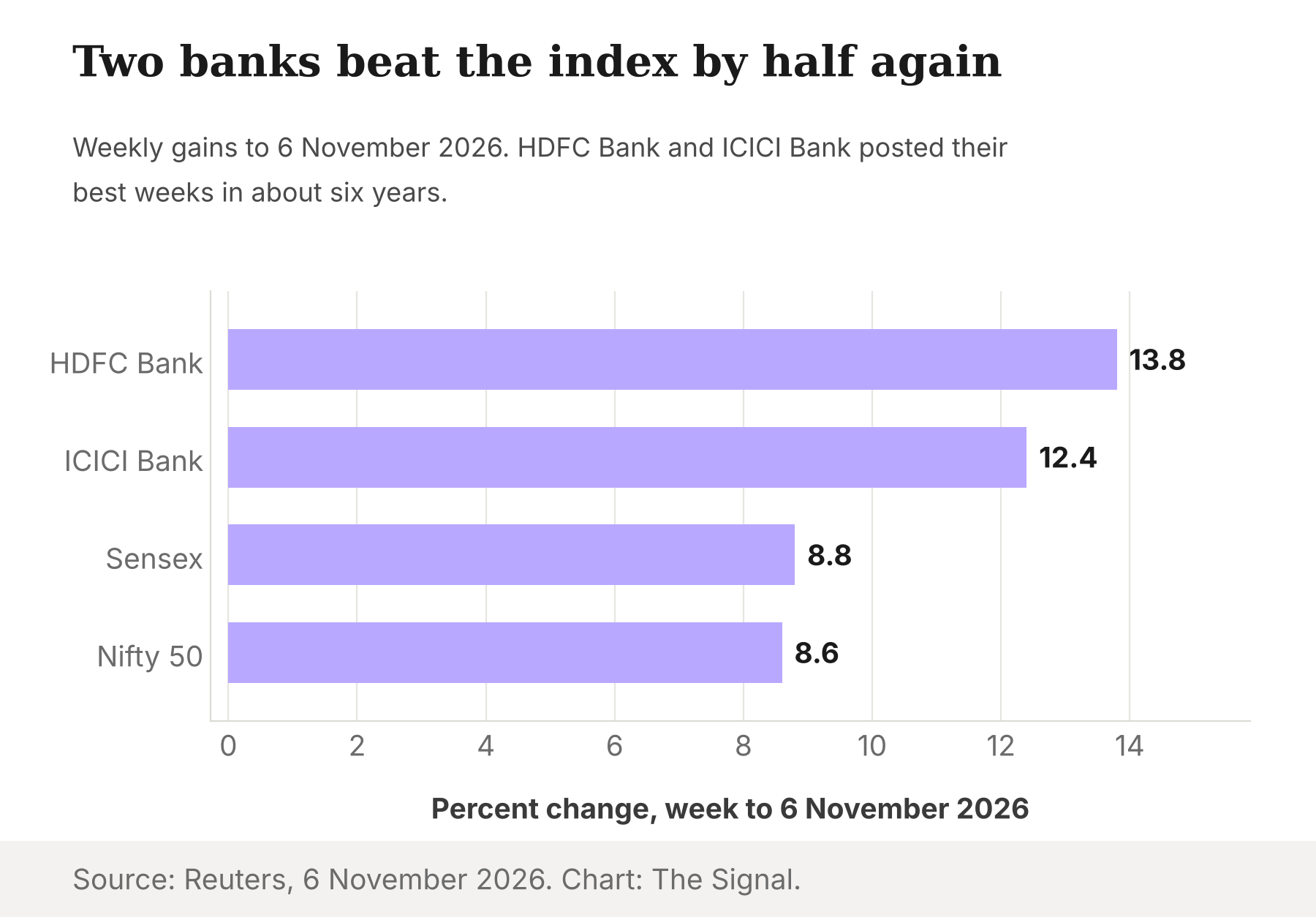
Two banks led the index, per Reuters, which looks like a flow pattern, and flows can reverse.
The honest objection
The strongest case against this reading is that one week and one big Thursday (₹15,000 crore of foreign buying) prove little. Foreign investors may simply have wanted to rebalance toward India after a weak year, and used a global selloff as the moment. On that view, the AI story is a trigger, not a cause.
That case is fair, and the data here cannot rule it out. A single day of foreign buying does not show intent. It would take a run of weeks to separate a hedge from a rebalance. The Nasdaq-100 also bounced earlier in the week, with Reuters noting AI heavyweights rebounding on 3 November, so the AI trade has already shown it can recover from a bad day.
The two readings make different predictions. If India's rally is a hedge, it should fade when AI stocks recover. If it is a rebalance, it should survive an AI rebound. Which one holds tells investors what they are actually buying.
The Signal
The week offers a clean lesson about what a market is priced for. India spent the year as the market without the AI story, and the price said so: down 4.2% for 2026 while MSCI Emerging Markets rose 7%. One violent week in the AI trade reversed the sign of that absence.
Watch two things. First, whether foreign buying repeats on a day when the Nasdaq is flat or up. A hedge buys only on bad days. Second, whether the Nifty, down 4.2% for 2026, closes the roughly 4.4% gap to a flat year without a fresh AI scare to help it.
A market that gains by being left out has not yet shown it can gain by being chosen.
Reporting basis: the weekly index gains, the year-to-date returns, the bank gains and the foreign institutional purchase are per Reuters, as carried by Business Recorder; the Nasdaq-100 correction is per Reuters, as carried by Kitco. Both relay one origin, so those figures rest on a single wire service. The Nasdaq-100 and S&P 500 closing levels are from FRED, the Federal Reserve Bank of St. Louis data service, and the reverse-AI-trade description and July sector returns are per Business Today. The one-day percentage falls, the 11.8% starting position, the 4.4% gap to flat and the 1.6 times bank multiple are The Signal's calculations from those figures.