The rupee story of October is a success story. On 10 October the RBI moved against what it called speculative dollar demand, and the RBI's own October Bulletin says the rupee appreciated in mid-October, "supported by the Reserve Bank's measures to curb speculative dollar demand", after a depreciating bias since late September. Read that line alone and the curbs worked.
It is worth slowing down on what else moved. A Bloomberg report, as relayed by Whalesbook, says Indian companies' forward dollar buying fell 35 percent in October 2026 to $49.5 billion, an eight-month low. A forward contract fixes today the rupee price of a dollar you will need or receive later. Companies that import, or owe dollar debt, buy them to protect against a falling rupee. The question is whether the RBI removed speculation, or removed protection, or both.
A record month, then a cliff
The comparison month matters. Corporate purchases of forward dollars rose to a record $77 billion in September, up 80% from a year earlier, according to a market report that also gave $41 billion for corporate forward dollar sales. October's $49.5 billion is 64 percent of September's, a drop of $27.5 billion in one month.
Forward dollar buying fell from $77 billion in September to $49.5 billion in October, about a third.
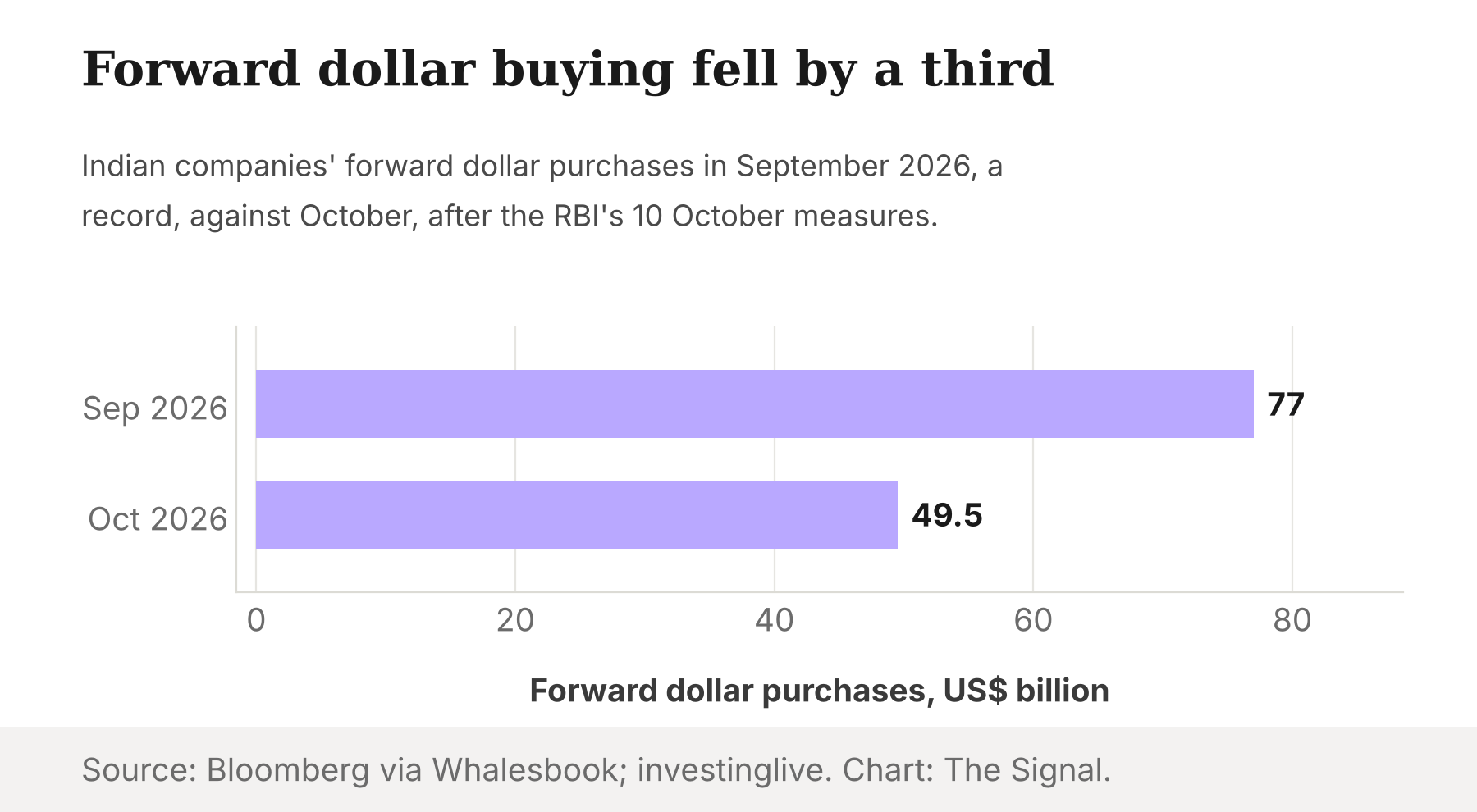
The scale of September is the first clue that it was not a normal month. A purchase total up 80 percent on a year earlier looks like a rush. October's fall is partly the rush ending. That is why "eight-month low" is a fair headline but a weak proof of damage: a month lower than a record can still be an ordinary month.
What the RBI actually changed
The package was four measures, set out in the RBI's 10 October press release. Two of them were aimed at speculation. The limit for hedging contracted exposures without proof of an underlying exposure fell from USD 100 million to USD 5 million, a 95 percent cut. And Circular No. 25 bars dealers from letting users rebook a cancelled rupee derivative contract, with immediate effect. Cancel-and-rebook is how a trader runs a position without a real exposure behind it.
The third measure is different in kind. Banks must now hold a cash reserve with the RBI of 20 percent of the rupee notional of each derivative above USD 2 million, and the rule covers contracts that hedge a current-account exposure where the user buys foreign currency. That is the importer's hedge. On a $10 million cover, $2 million of rupee-equivalent cash sits idle with the RBI. The bank will want to be paid for that, and the customer is the one who pays.
Six bankers estimated the measures could raise hedging costs by 80 to 150 basis points, depending on how much banks pass on to clients. The visible price tells the same story. The 12-month dollar-rupee forward premium rose from 3.36 percent at end-September to 4.57 percent on 30 October, a 121 basis-point increase.
The yearly cost of locking in the exchange rate rose by more than a third in a month, from 3.36 to 4.57 percent.
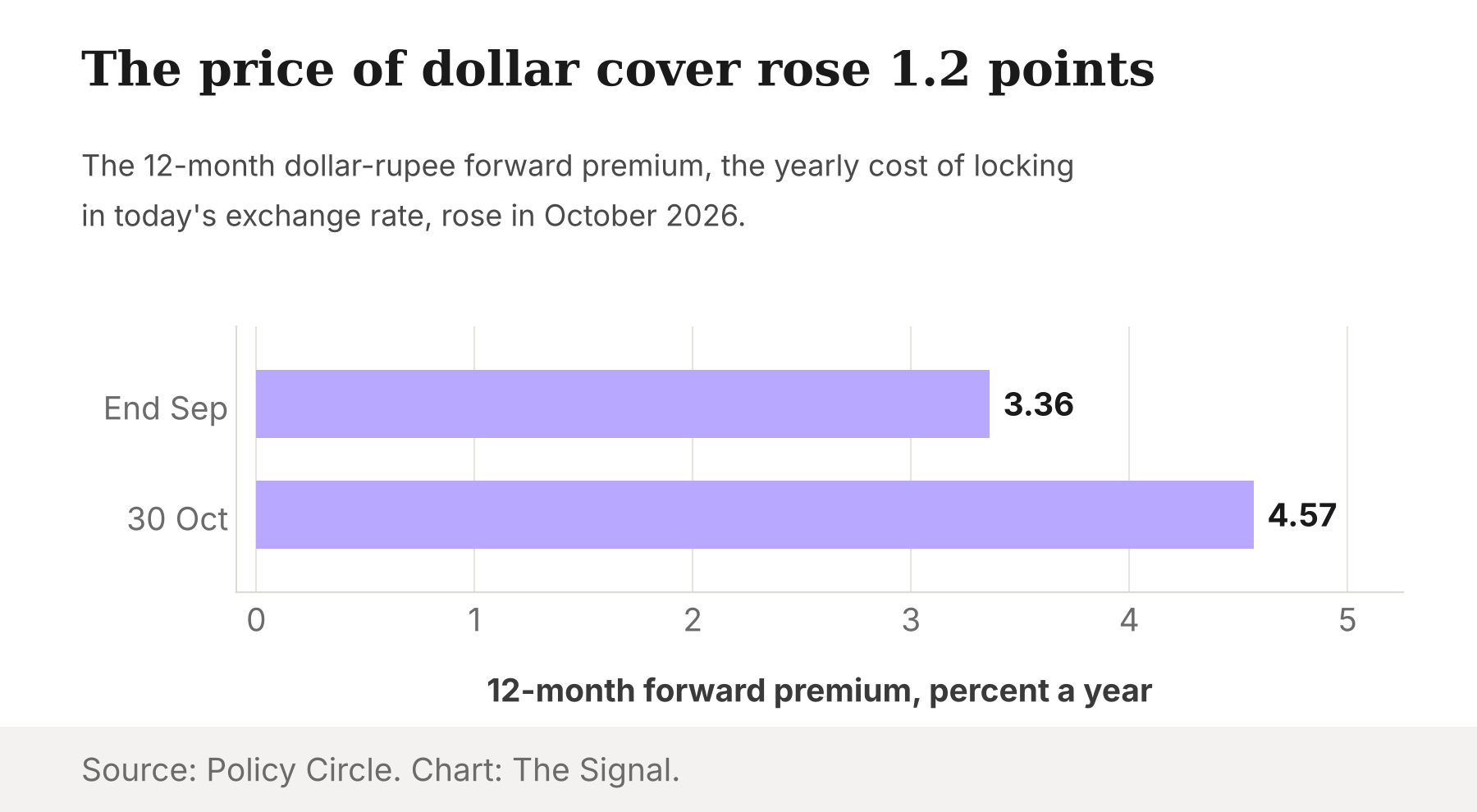
A premium moving from 3.36 to 4.57 percent, as Policy Circle reports, is a rise of 36 percent in the price of cover. Demand falls when price rises, and no theory of speculators is needed to explain it.
The central bank is on the other side
There is a second reason the cost matters. The RBI is itself the largest seller of forward dollars. Its outstanding net forward sales reached US$200,055 million at end-August 2026, up from US$136,768 million at end-July, a rise of about $63 billion in one month, or 46 percent. A larger forward book is a promise to deliver dollars later. It is a bet that the rupee will not need defending then.
Hedging gives that book some comfort, because a company that has already bought dollars forward is not a panicked buyer in the spot market later. When companies hedge less, more of next year's dollar demand arrives unhedged, at whatever the rupee is on the day. Foreign portfolio investors have already pulled out a net US$12.2 billion in 2026-27 up to 16 October, driven by equity withdrawals, so the other source of dollars is not reliable either.
The honest objection
The strongest case for the RBI is that the measures targeted the right behaviour. The September record of $77 billion may have included hedging with no real exposure behind it, and the cut in the no-proof limit exists to stop that. If most of the $27.5 billion that vanished was speculation, the policy did what it said, and the rupee's mid-October recovery is the evidence. The RBI can also point out that October's $49.5 billion is still a large number in its own right.
That case is real, and the figures here cannot refute it. The reported totals do not split speculative from commercial hedging, and we have no October figure from a year earlier to show what a normal October looks like. What the numbers do show is narrower. The reserve rule applies to contracts hedging current-account exposures, and the premium rose as the volume fell. The honest summary is that the curbs probably removed both kinds of cover and nobody can yet say in what proportion.
The Signal
The curbs bought a firmer rupee in October at a price paid in thinner cover. If the rupee holds, that is a good trade. If it turns, the companies that skipped a hedge priced at 4.57 percent a year will meet the move unprotected, and the RBI will meet it with a forward book already about $200 billion short at end-August. Watch two numbers: the November forward dollar buying total, and the 12-month premium. If buying holds near October's level while the premium falls, the market is normalising. If buying stays low while the premium stays high, the cover is simply not being bought. A currency is only as stable as the cover behind it.
Reporting basis: the October measures, the reserve requirement, the no-proof hedge limit and the rebooking ban are per the RBI's press release and circular. The rupee's mid-October appreciation, the portfolio outflow and the RBI's forward book are per the RBI's latest monthly Bulletin. The October forward dollar buying figure is per a Bloomberg report as relayed by Whalesbook, and rests on that single secondary relay; we did not read the Bloomberg page itself. The September record and the bankers' cost estimate are per one investinglive market report. The forward premium figures are per Policy Circle, which does not name its own source. All ratios, percentage changes and the illustrative reserve on a sample hedge are The Signal's calculations from those figures.