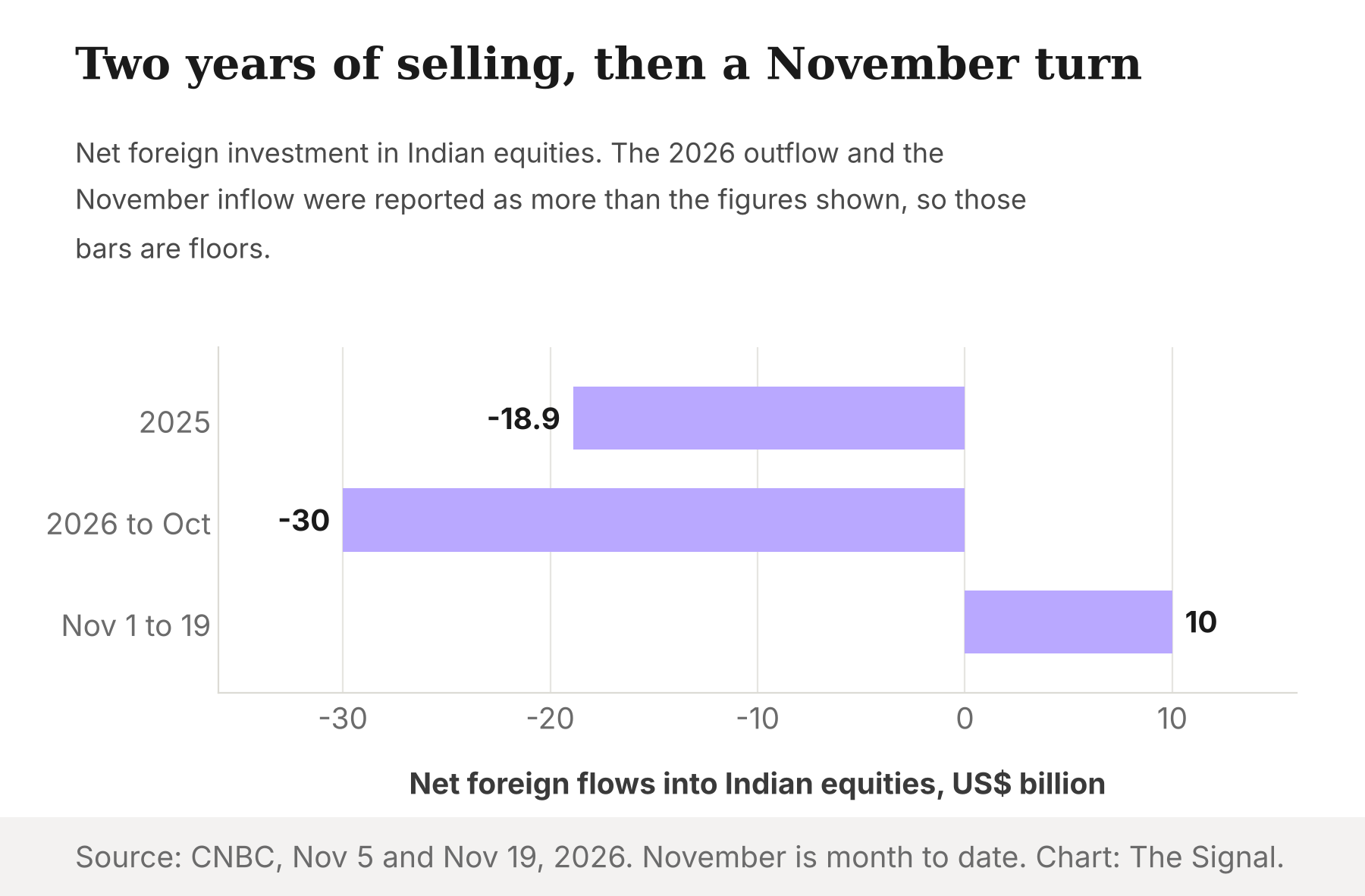
For most of 2026, India was the market foreign investors were leaving. CNBC reports that foreign investors cashed out a net $18.9 billion from Indian equities in 2025 and more than $30 billion in 2026 before November. A Nomura report, as reported by CNBC, put foreign holdings of Indian stocks at an all-time low of 14% in early November. In dollar terms, MSCI's India index factsheet shows a return of minus 13.90% for the year to October 30.
Then the AI trade cracked. CNBC reports that Nvidia lost roughly $1.7 trillion in market value between early October and November 13. Seoul Economic Daily reports that Taiwan's Taiex fell 17.5% in the week to November 20, its steepest weekly decline ever. The next day, Taiwan's Financial Supervisory Commission raised the minimum margin for short-selling from 130% to 150%, Focus Taiwan reports. And in New York, the Nasdaq, up almost 19% for the year at its October 6 record close, had given all of that back by November 20, per CNBC.
Over the same weeks, the money came back to Mumbai. CNBC reports that foreign investors put more than $10 billion net into Indian equities in November through the 19th. Against the $18.9 billion they pulled out in all of 2025, November's buying has reversed more than half of 2025's full-year selling in under three weeks. The easy story writes itself: India has no AI, so India is the AI hedge.
It is worth slowing down on that. Half of the easy story is measurable and true. The other half is an inference about motive that the people closest to the flows do not fully share.
The part that is true: India barely owns AI
The number that carries the argument is 8.80. The NSE Indices Nifty 50 factsheet shows information technology at 8.80% of the index on October 30, 2026, and those are IT services firms such as Infosys, not chipmakers. Compare the markets where the AI rout hit hardest. MSCI's Taiwan factsheet for the same date shows information technology at 85.75% of that index, nearly ten times India's weight. Korea's MSCI index is 70.76% information technology, and even the MSCI USA index is 37.22% information technology, more than four times the Nifty's share.
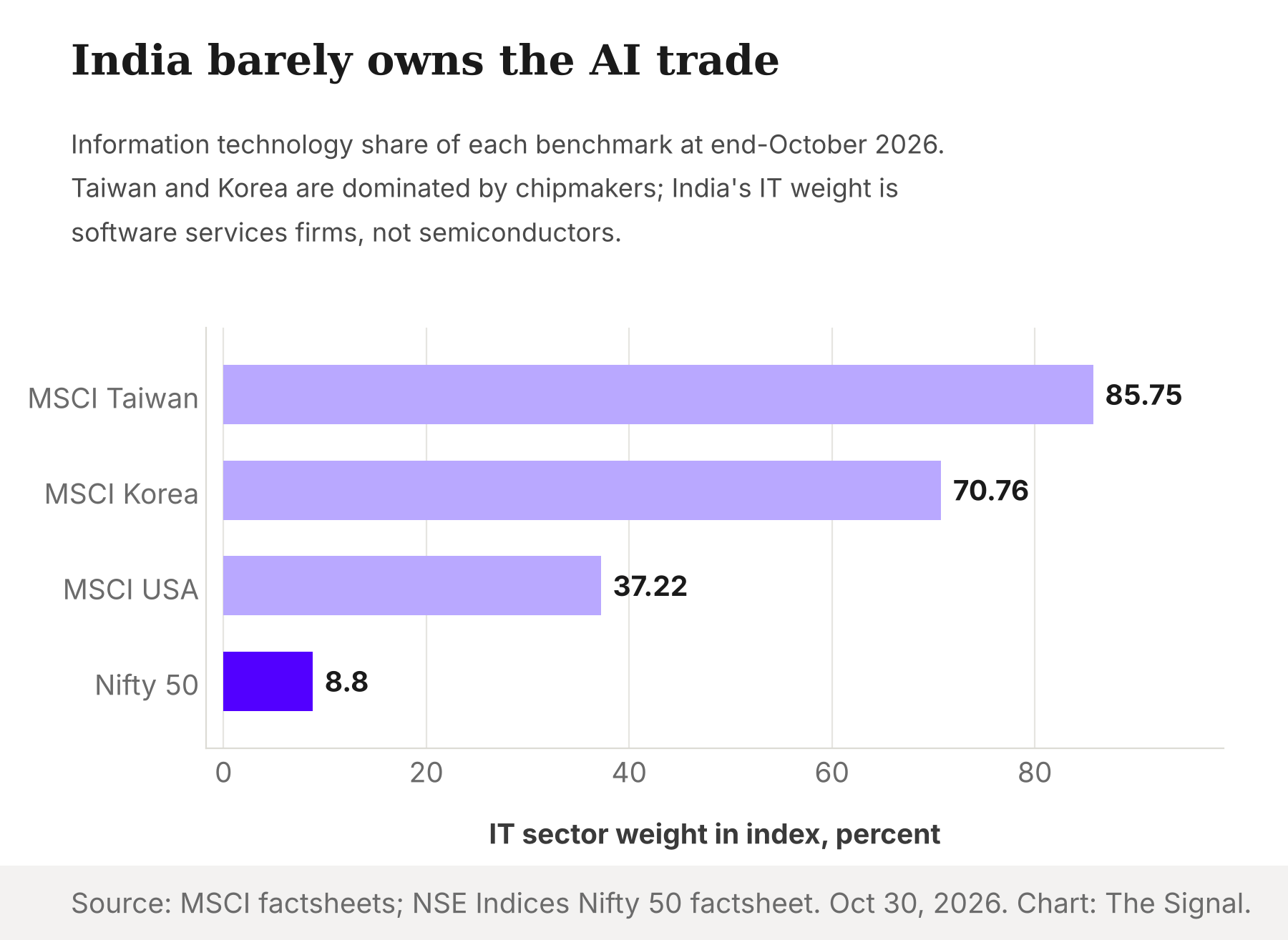
This is why India lagged the boom. A market with little AI had little to ride when AI was rising, and foreign investors sold it to buy what was. The same arithmetic runs in reverse when AI falls. CNBC reported on November 6 that the Nifty 50 had gained nearly 9% over the previous month, outperforming global markets with heavy AI exposure.
The AI rout hit the chip-heavy markets, not the one with almost no chips.
| Market or stock | Move | Period |
|---|---|---|
| Nvidia, market value | Lost roughly $1.7 trillion | Early October to Nov 13, 2026 |
| Taiex (Taiwan) | Down 17.5%, steepest weekly fall ever | Week to Nov 20, 2026 |
| Nasdaq Composite | Erased a gain of almost 19% for 2026 | Oct 6 record close to Nov 20, 2026 |
| Nifty 50 (India) | Up nearly 9% | Month to Nov 6, 2026 |
Sources: CNBC on Nvidia; Seoul Economic Daily on the Taiex; CNBC on the Nasdaq; CNBC on the Nifty 50. Periods differ by row.
India's tech is a different business
The word "hedge" implies something sharper than absence. It implies Indian stocks gain because AI loses. India's own tech sector does not behave that way. The NSE Indices October dashboard shows the Nifty IT index returned 18.06% in October 2026, even while it was down 7.13% over one year. That October rally came in the same month Nvidia's slide began. Indian IT services firms sell outsourcing work, not chips, and their shares answer to different news.
So the clean claim is narrower than the headline version. India is not short AI. It simply holds very little of it (information technology is 8.80% of the Nifty 50), so a crash in AI stocks costs Indian benchmarks far less than it costs Taipei, Seoul or the Nasdaq.
What the people tracking the flows say
The second half of the easy story is about motive: that the November money is fleeing AI specifically. Here the evidence turns mixed. Hanna Luchnikava-Schorsch of S&P Global Market Intelligence told CNBC that "November's return of capital inflows primarily reflects lower oil prices". In the same assessment, she pointed to a shift in global risk sentiment after the US midterm elections and to concerns about how sustainable the AI cycle is. She does not read the inflow as a structural shift.
That changes what the inflow means. Cheaper oil helps India directly: a July 2026 government backgrounder published by the Press Information Bureau says India imports close to 88.5% of the crude oil it consumes. A calmer post-election mood lifts risk assets everywhere. Neither driver is about AI. Both could fade for reasons that have nothing to do with Nvidia.
The low starting point matters too. With foreign ownership at a record-low 14%, per the Nomura report cited by CNBC, even a modest shift in global portfolios shows up as a large monthly number. In our reading, that is the profile of a market being re-weighted from an extreme, not one being rediscovered.
The honest objection
The strongest case against any AI framing comes from Bernstein. A Bernstein report, as reported by CNBC, says: "We disagree. India is neither an AI beneficiary nor an anti-AI trade," and adds that Indian valuations remain expensive. On this view, tying India's November to the AI rout is a story laid over flows that oil, elections and cheap positioning already explain.
That case is strong, and it is mostly right. It correctly kills the idea that India is a mirror image of the AI trade. The Nifty IT rally in October is evidence for Bernstein, not against it.
What it does not explain is the destination. When AI breaks, money leaving chip-heavy markets has to land somewhere. Taiwan's central bank governor, Yang Chin-long, said on November 10 that foreign institutional investors had moved about US$10 billion out of Taiwan since the beginning of November, Focus Taiwan reports. He added that the outflows included stock-market profits and dividends and called them normal business activity. No public data traces those dollars to Mumbai. The two figures are similar in size and overlap in time, but that is not proof that one became the other. But an index with an 8.80% IT weight is one of the few large markets where an AI crash does little direct damage. India does not need to be an anti-AI trade to collect that money. It only needs to be the large market the rout mostly missed. Bernstein describes what India is. The exposure numbers describe where money can go. Both can hold at once.
The Signal
India's November is relief, not a verdict. Two years of foreign selling met three tailwinds at once: cheaper oil, a post-midterm mood shift and an AI rout that spared a market with almost no AI. Only the first says anything about India's own economy, and none of the three says Indian earnings or valuations have changed.
What to watch is the mix. If oil stays low and flows hold after AI stocks steady, that would start to look like a case for India itself. If the buying fades as soon as Taipei and the Nasdaq stop falling, it was rotation. That is our reasoning about how to read the next few weeks of data, not a forecast any source has made. India did not win the AI rout. It had less to lose.
Reporting basis: foreign net flows for 2025, January to October 2026 and November 2026 are per CNBC, which is the single origin for all three figures. The record-low 14% foreign ownership is from a Nomura report and the Bernstein view is from a Bernstein report, both as reported by CNBC, which is the only text of either that was checked. The S&P Global Market Intelligence assessment of November's drivers is per Hanna Luchnikava-Schorsch's comments to CNBC. The Nifty 50's one-month gain to November 6, Nvidia's market-value loss and the Nasdaq's erased 2026 gain are each per separate CNBC reports. Sector weights are from the NSE Indices Nifty 50 factsheet and from MSCI's Taiwan, Korea and USA index factsheets, all dated October 30, 2026. The Nifty IT returns are from NSE Indices' October 2026 dashboard, and MSCI India's year-to-date return is from MSCI's India factsheet. The Taiex's weekly fall is per Seoul Economic Daily. The roughly US$10 billion moved out of Taiwan in early November is per Taiwan's central bank governor, via Focus Taiwan. India's crude import share is from a July 2026 Government of India backgrounder published by the Press Information Bureau. And Taiwan's short-selling margin change is from the Financial Supervisory Commission, via Taiwan's Central News Agency (Focus Taiwan). The Nifty 50 and MSCI weights come from different index families and are compared as published. The ten-fold and four-fold weight multiples and the share of 2025's outflow reversed in November are The Signal's calculations from those figures.