
On November 20, 2026, the Securities and Exchange Board of India proposed removing the Additional Disclosure Framework, the rule that makes certain foreign portfolio investors name every natural person behind them. SEBI's consultation paper makes the case in plain terms: the requirements are unique to India, they work as an entry barrier, and FPIs pulled more than ₹5.61 lakh crore ($62.24 billion) out of Indian equities between October 2024 and October 2026. Comments are due by December 11, 2026. Read the paper alone and the logic holds together: a strict rule, a long exodus, a regulator trying to win the money back.
The calendar complicates it. The money had already started coming back before the paper was published.
The flows turned first
NSDL data reported by Business Standard show FPIs put a net ₹99,158 crore into Indian equities in November 2026 up to November 17, the largest monthly inflow on record, ahead of ₹70,896 crore in November 2020. Over the four weeks from October 27 to November 17, 2026, the net inflow was ₹1.06 trillion. That is about a fifth of the two-year outflow SEBI cites, and it came back while the rule was fully in force.
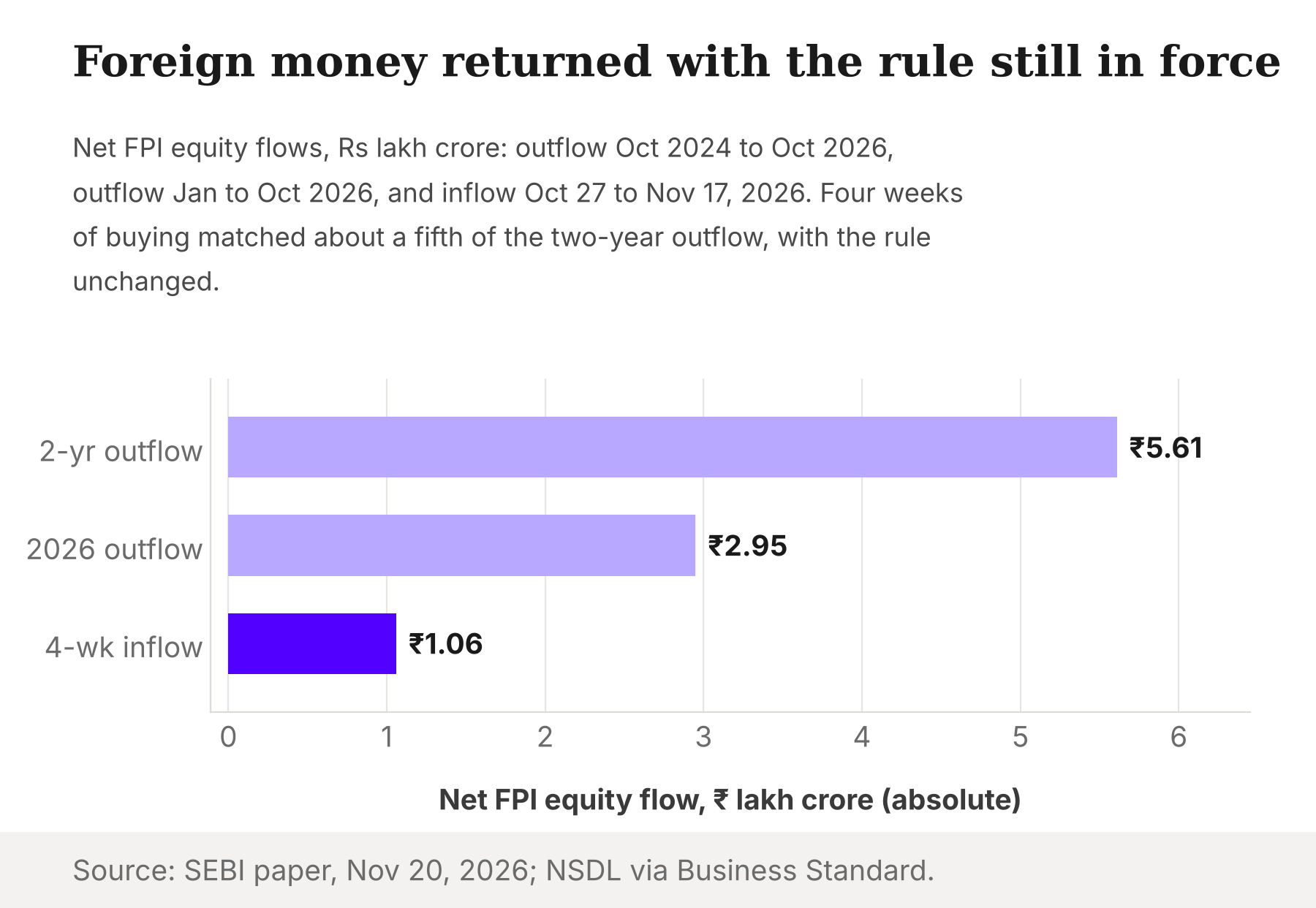
The same report gives the reason analysts saw behind the turn. It was a global sell-off in artificial intelligence stocks, which pushed money out of the United States, South Korea, Taiwan and Japan. India had nothing to do with that trigger, and neither did its disclosure rules. In January to October 2026, FPIs had taken out a net ₹2.95 trillion, per the same NSDL figures. Then the global trade flipped, and the money came back within weeks.
SEBI's paper is careful on this point. It concedes that "there may be several factors behind such FPI outflows" and argues only that the rule's burden requires a review. The outflow chart in the paper is still doing rhetorical work, though. A rule cannot be a deciding barrier for money that left and came back while the rule never moved.
What the rule was built to catch
The framework had two jobs, and they were never the same job. SEBI's 2023 board memorandum set them out. The first was to stop concentrated FPIs being used to get around Minimum Public Shareholding rules and takeover disclosures. The second concerned Press Note 3, the 2020 curb on investment from countries that share a land border with India, and the risk that the FPI route could be used to get around it.
The memorandum was specific about the first job. It observed that some FPIs held concentrated, near-static stakes in single corporate groups, and that such holdings "raise the concern and possibility that promoters of such corporate groups, or other investors acting in concert, could be using the FPI route" to avoid those rules. Business Standard notes the framework arrived months after Hindenburg Research accused the Adani group of shareholding violations and stock manipulation, charges the group denied. Reuters reported that the rules were introduced during SEBI's scrutiny of Adani offshore funds in 2023.
Each job got its own trigger. The current criteria catch an FPI with more than 50% of its Indian equity holdings in one corporate group (the concentration test), or one holding more than ₹50,000 crore of Indian equity with its investor group (the size test). Either way the FPI must disclose its owners on a full look-through basis, down to every natural person, with no threshold.
The legal case covers the size test
The paper's strongest argument is about the size test, and it is a good one. In March 2026, the Union Cabinet adopted the beneficial-owner definition from the Prevention of Money Laundering Rules for investment from land-border countries, and allowed non-controlling stakes of up to 10% through the automatic route. The Commerce Ministry says Press Note 2 of 2026 was notified on May 1, 2026, and that 29 investments worth ₹4,895.65 crore had been reported under it by August 20, 2026.
Once the government itself measures land-border ownership at the money-laundering thresholds, a SEBI look-through with no threshold is stricter than the policy it was guarding. SEBI makes exactly this point: the position under Press Note 3, as clarified, is now similar to what FPIs already disclose under those rules. The size test had also been loosened before. SEBI doubled its threshold from ₹25,000 crore to ₹50,000 crore in April 2025, reasoning that average daily cash turnover on NSE had risen 122% between FY2022-23 and FY2024-25 (counting the latter only to December 2024).
The concentration test gets a different answer
Nothing in Press Note 2 touches promoters, public shareholding or takeovers. For the concentration test, the paper offers two arguments. One is that disclosure has "practically become an entry barrier." The other is that even a concentrated FPI's investment "is capped at 10% of the shareholding of the listed entity".
That cap applies to one FPI. The worry SEBI wrote down in 2023 was several investors "acting in concert," and SEBI's own later rule-making measured that worry collectively. When it relaxed the framework in April 2024, it exempted concentrated FPIs in a group's apex company only if the composite holdings of all such FPIs stayed below 3% of that company's equity. The same memorandum noted that takeover rules require disclosure once an investor and those acting in concert cross 5%, with an open offer above 25%.
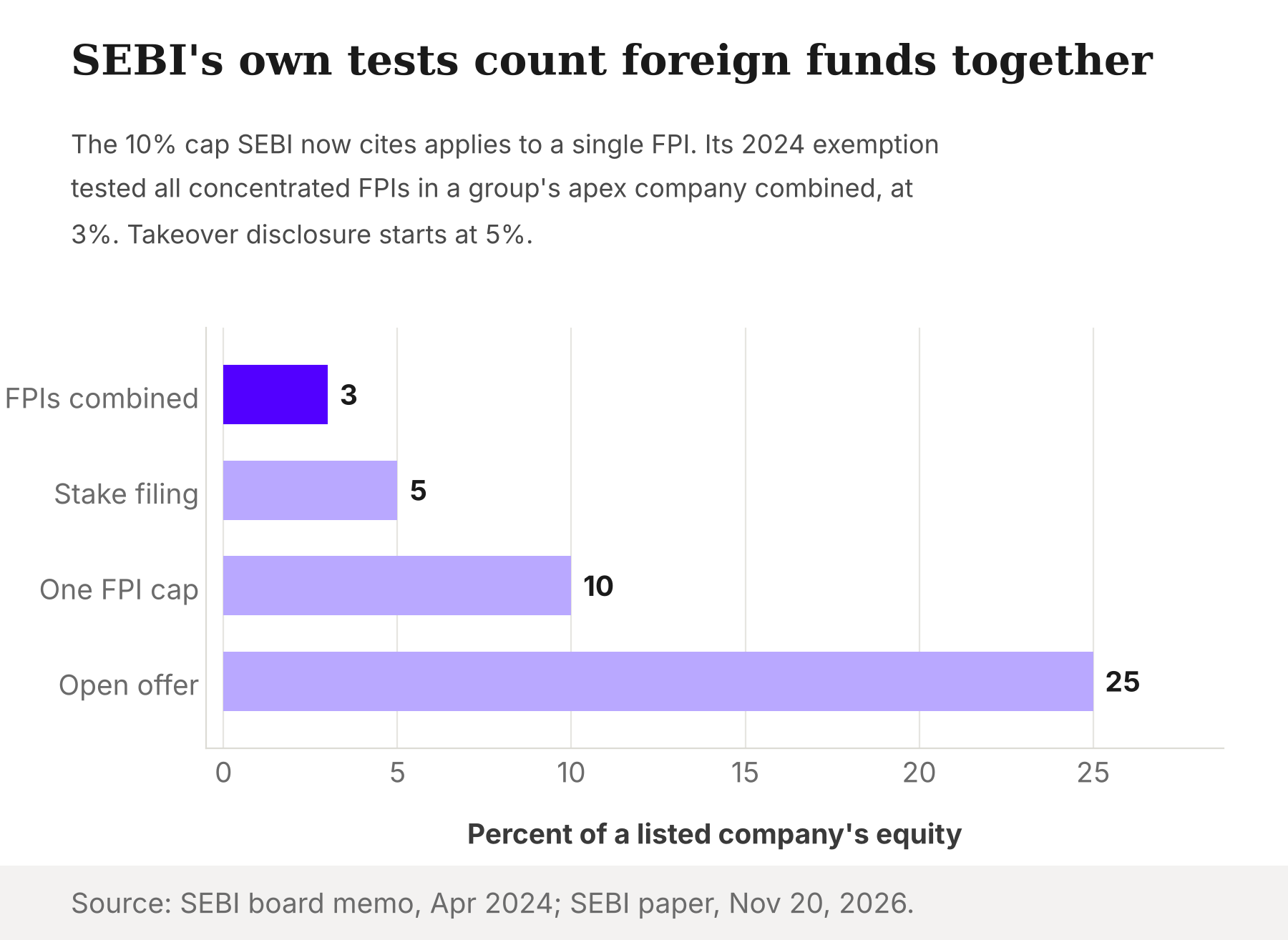
SEBI's 2026 argument and its 2024 rule measure different things.
| Test | What it measures | Line |
|---|---|---|
| Cap cited in the 2026 paper | One FPI's stake in a listed company | 10% |
| 2024 exemption test | All concentrated FPIs combined, in a group's apex company | 3% |
| Takeover disclosure | An investor plus those acting in concert | 5% |
| Open offer | An investor plus those acting in concert | 25% |
Source: SEBI consultation paper, November 2026; SEBI board memorandum, April 2024.
Three funds at 9% each sit under the single-fund cap and together hold 27%. That is a hypothetical, but it is the exact scenario the 2023 memorandum named. The basic beneficial-owner check would remain, at 10% or 15% depending on the client's legal form. That check names the owners inside each fund. It does not ask who stands behind several funds that each sit just below the line.
The honest objection
The case for SEBI is stronger than a timing argument. The burden is real and documented: the paper lists global funds forced to set up India-only vehicles, hedge funds re-identifying investors after every subscription, and fund-of-fund structures traced layer by layer. India already applies tighter ownership thresholds than most markets, 10% or 15% against a typical 25% abroad. And the concentration test is a blunt filter. It catches a fund for where its money sits, not for anything it has done.
All of that is a fair case for redesigning the concentration test, for example with the collective 3% logic SEBI itself used in 2024. It is not a case that the risk the test was built for has gone. The paper retires both tests on reasoning that fully answers only one of them.
The Signal
SEBI is right that a look-through rule with no threshold sits awkwardly beside the government's own new definition of a beneficial owner. On the size test, the cleanup is overdue. The concentration test is different. It was written for promoters who might hide behind friendly offshore funds, and its replacement is a per-fund cap. That cap cannot see the coordination the rule was meant to expose.
What to watch is the final circular after comments close on December 11, 2026. If SEBI drops the size test and keeps a narrower, collective version of the concentration test, it will have cut the burden without losing the view. If both go, SEBI will have given up that view to win back money that had already returned. The money came back with the rule in place.
Reporting basis: the proposal, its outflow figure, the ownership thresholds and the cap it cites are from SEBI's November 20, 2026 consultation paper. The framework's original purposes are from SEBI's 2023 board memorandum, the 3% composite exemption and takeover triggers from its April 2024 board memorandum, and the threshold increase and turnover figure from its April 2025 board memorandum, all SEBI documents counted here as one origin. November 2026 flow figures are NSDL data as reported by Business Standard, which was the version verified, and Business Standard's reporting is also the source for the Hindenburg timing; together these are a second origin. The Press Note 2 changes and investment counts are from Press Information Bureau releases on the Cabinet decision and the Commerce Ministry's DPIIT, a third origin. The link to SEBI's 2023 scrutiny of Adani offshore funds is per Reuters, as carried by MarketScreener, a fourth. The one-fifth share and the three-fund illustration are The Signal's calculations from those figures.