The December rate debate has settled into a narrow question: how big. India's retail inflation hit 6.09% in October 2026, above the top of the RBI's tolerance band. ICRA's chief economist Aditi Nayar told ThePrint that a further 25-basis-point hike "appears almost certain" at the Monetary Policy Committee meeting on December 2 to 4. On November 12, SBI Research cut its own December forecast to 25 basis points from 50, and one of its four reasons was that the RBI had eased liquidity pressure and overnight money market rates had moderated.
That last reason has not survived the month. The debate is about the size of a vote. The money market has stopped waiting for it.
From surplus to borrowing in three weeks
The repo rate is the rate the MPC sets. The rate banks actually pay each other overnight depends on how much spare cash sits in the system. When banks have more than they need, they park it with the RBI and overnight rates sink toward the floor of the policy corridor. When they run short, they borrow from the RBI and overnight rates climb toward the ceiling.
On November 3, 2026, the RBI was absorbing a net ₹2,08,200 crore of surplus cash from banks. By November 22, the position had flipped to a net injection of ₹12,479 crore: the banking system, on net, was borrowing from the central bank. That is a swing of about ₹2.2 lakh crore in under three weeks.
The corridor has fixed walls. After the MPC raised the repo rate by 25 basis points to 5.50% in October 2026, the standing deposit facility (the floor, where banks park spare cash) sits at 5.25% and the marginal standing facility (the penal ceiling, where they borrow in a pinch) at 5.75%. Where overnight rates sit inside that band tells you how tight money really is.
The overnight rate has already moved
On November 12, the weighted average rate across the overnight money market was 5.36%, below the repo rate. That was the day SBI's note came out, and its reading of easing pressure was accurate then.
Nine days later it was not. On November 21, the overnight weighted average was 5.69% and triparty repo traded at 5.75%. The same release shows banks borrowing ₹29,320 crore overnight from the marginal standing facility at the 5.75% penal rate. Triparty repo is the largest overnight segment, and on that day it cleared at the corridor's ceiling.
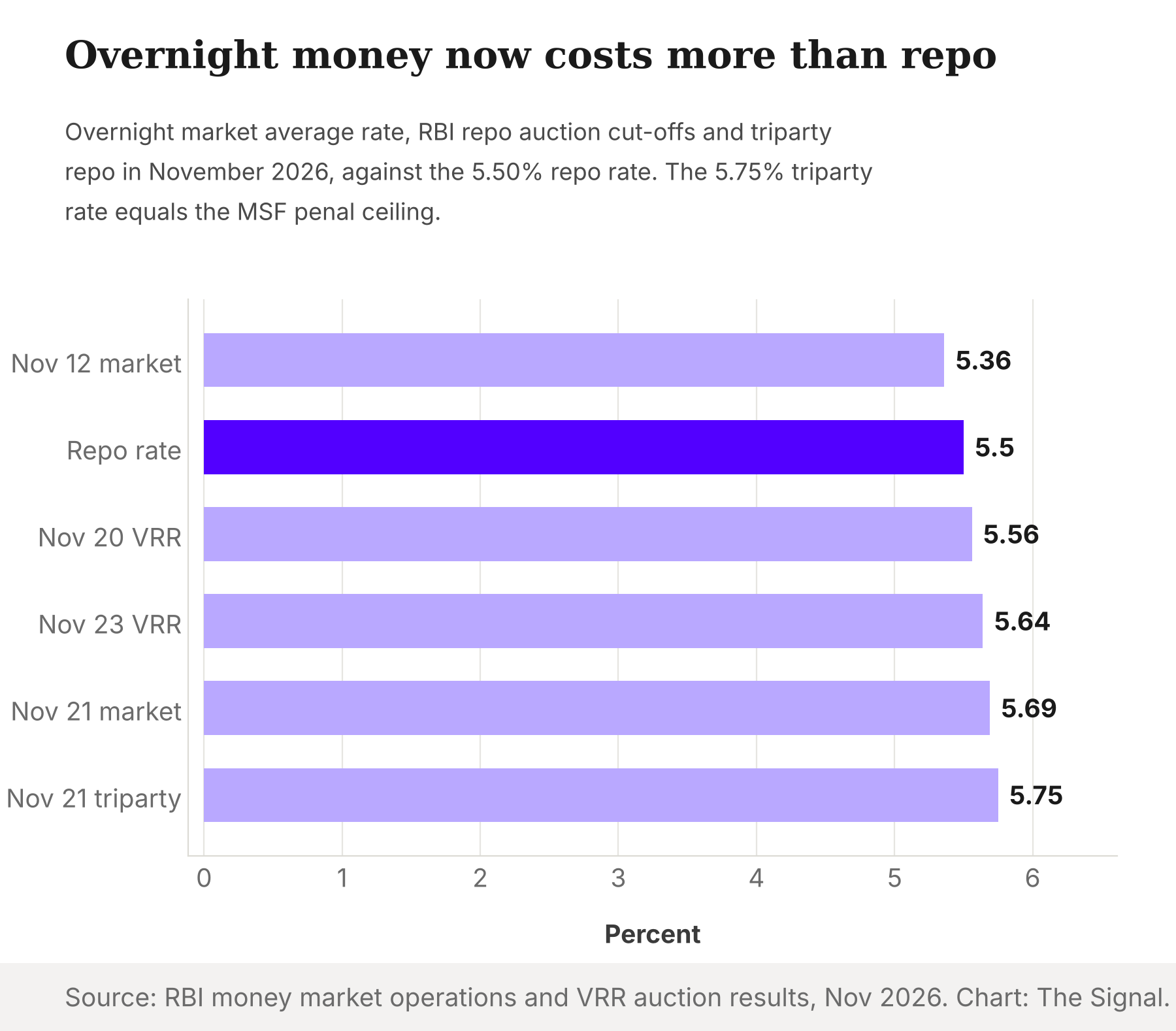
A 25 basis point hike in December would take the repo rate from 5.50% to 5.75%. Triparty money already cost 5.75% on November 21. For the borrowers who fund themselves overnight, a good part of the December hike has arrived early, delivered by a shortage of cash rather than by a committee.
The RBI is rationing the relief
The RBI has responded, but on its own terms. It adds cash through variable rate repo (VRR) auctions, where banks bid for a fixed amount and the RBI sets a cut-off rate.
At the 3-day auction on November 20, banks bid ₹1,12,555 crore for ₹50,000 crore on offer, and the cut-off was 5.56%. On November 23, the 4-day auction drew ₹1,51,982 crore of bids for ₹50,000 crore, with a 5.62% cut-off. The 2-day auction the same day drew ₹1,37,612 crore, with a 5.64% cut-off.
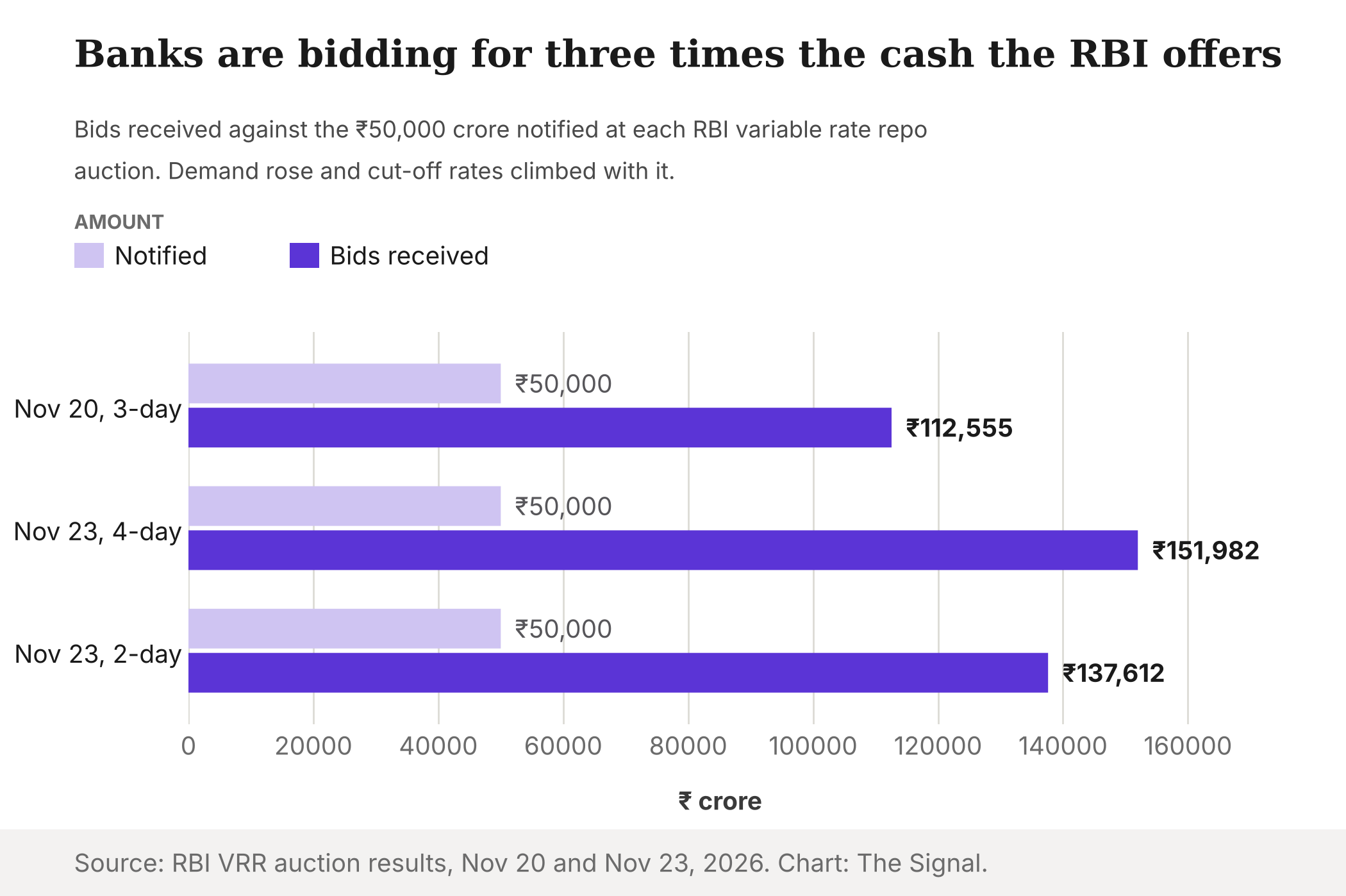
Demand ran at roughly three times the amount offered on November 23. And every cut-off cleared above the 5.50% repo rate, climbing from 5.56% on Friday, November 20 to 5.64% on Monday, November 23. The RBI is supplying cash, but it is not supplying it cheaply, and it is not supplying all that banks ask for. A central bank that wanted overnight rates back at repo could offer more. This one has chosen to let the price of money drift up ahead of the vote.
The deeper drain is in durable liquidity
Day-to-day swings come and go with tax dates and government cash balances. The slower-moving measure is net durable liquidity, the surplus that persists after those swings wash out.
It stood at ₹10,14,401 crore on September 30, 2026. By October 15 it was ₹7,93,409 crore, and by October 31, ₹7,02,107 crore. That is a fall of about ₹3.1 lakh crore, or 31%, in a single month.
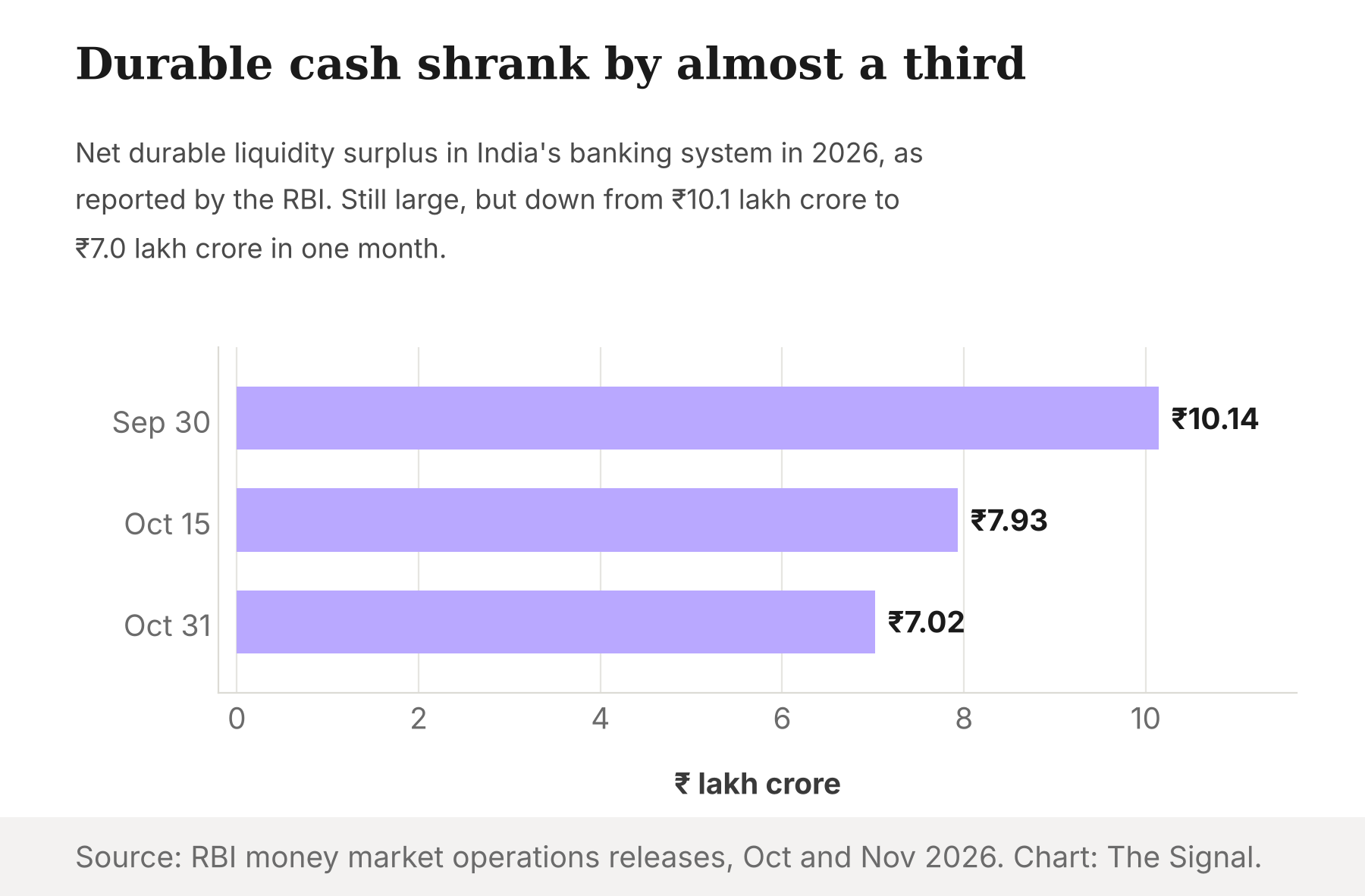
Jefferies, in a note reported by ETV Bharat, put the average system liquidity surplus at more than ₹2 trillion in October 2026, already moderating, and called a December hike likely. The durable cushion is still large. But a cushion that loses nearly a third of its size in a month makes each tax-date squeeze bite harder, and the November 21 move to the ceiling is what that looks like.
The honest objection
The strongest case against reading too much into this is that it is frictional. A net durable surplus of ₹7.02 lakh crore at the end of October is not a cash-starved system. Mid-month tax outflows and government balances routinely pull money out of banks for days at a time, and the cash comes back when the government spends it. On November 21 itself, the narrow interbank call money segment averaged 5.45%, below repo. On this reading, the deficit is a calendar artefact, and the December decision should rest on inflation, not on a weekend's funding.
That case is right about the cause and wrong about the consequence. A frictional squeeze still sets the price at which banks and money market funds roll their overnight books, and the RBI controls how fast it eases. It has chosen auctions at rising cut-offs over cheaper, larger injections. Whatever the source of the shortage, the decision to let overnight money trade at 5.69% to 5.75% is a policy choice. It is just one that does not need an MPC vote.
The Signal
The December meeting will be scored on a single number, 25 or 50. The more useful number is the gap between the repo rate and what overnight money actually costs. If the MPC hikes to 5.75% while triparty already trades there, the hike formalises tightening the market has absorbed. If liquidity loosens after the tax-date drain and overnight rates slide back toward 5.36%, the hike will do more work than its size suggests. SBI's case for a smaller move leaned on cheap overnight money. Watch the VRR cut-offs into December 4. If they stay above 5.60%, the RBI is already tightening by auction, and the vote will mostly confirm the price.
Reporting basis: all money market rates, net liquidity positions, durable liquidity figures, standing facility borrowing and variable rate repo auction results are from the Reserve Bank of India's daily money market operations releases and auction result press releases, which compile Clearing Corporation of India data; the repo, standing deposit facility and marginal standing facility rates are from the RBI's published resolution of the October 5 to 7, 2026 MPC meeting. October 2026 CPI inflation is from MoSPI's press release. The December hike expectation is ICRA's chief economist as quoted by ThePrint, the forecast revision is SBI Research's Ecowrap as reported by Business Today, and the October liquidity average is from a Jefferies note as reported by ETV Bharat; each of those three rests on that single relaying outlet. The ₹2.2 lakh crore swing in net liquidity, the ₹3.1 lakh crore and 31% fall in durable liquidity, the roughly threefold auction demand and the post-hike repo rate of 5.75% are The Signal's calculations from those figures.