The headline arrived on Monday with a round number attached. An ANI report on a new SBI Research note says the combined debt of the Magnificent Seven has increased nearly 45 per cent to $578 billion by mid-2026. The seven are Alphabet, Amazon, Apple, Meta, Microsoft, Nvidia and Tesla. The report also warns of a potential market capitalisation decline of around $1.67 trillion to $2 trillion for the group.
The timing matters. On Friday 30 October, the Associated Press reported that the Nasdaq composite fell 2.9% to 25,437.00 and the S&P 500 fell 1.8%, its worst day since June, on worries that Wall Street's frenzy around artificial intelligence had sent prices too high. Put the two together and the read writes itself: Big Tech is borrowing heavily to fund AI, and the market has started to notice.
The average hides two opposite stories
It is worth slowing down on "the Magnificent Seven's debt". A single number for seven companies assumes they behave like one. The companies' own quarterly filings with the US Securities and Exchange Commission say otherwise.
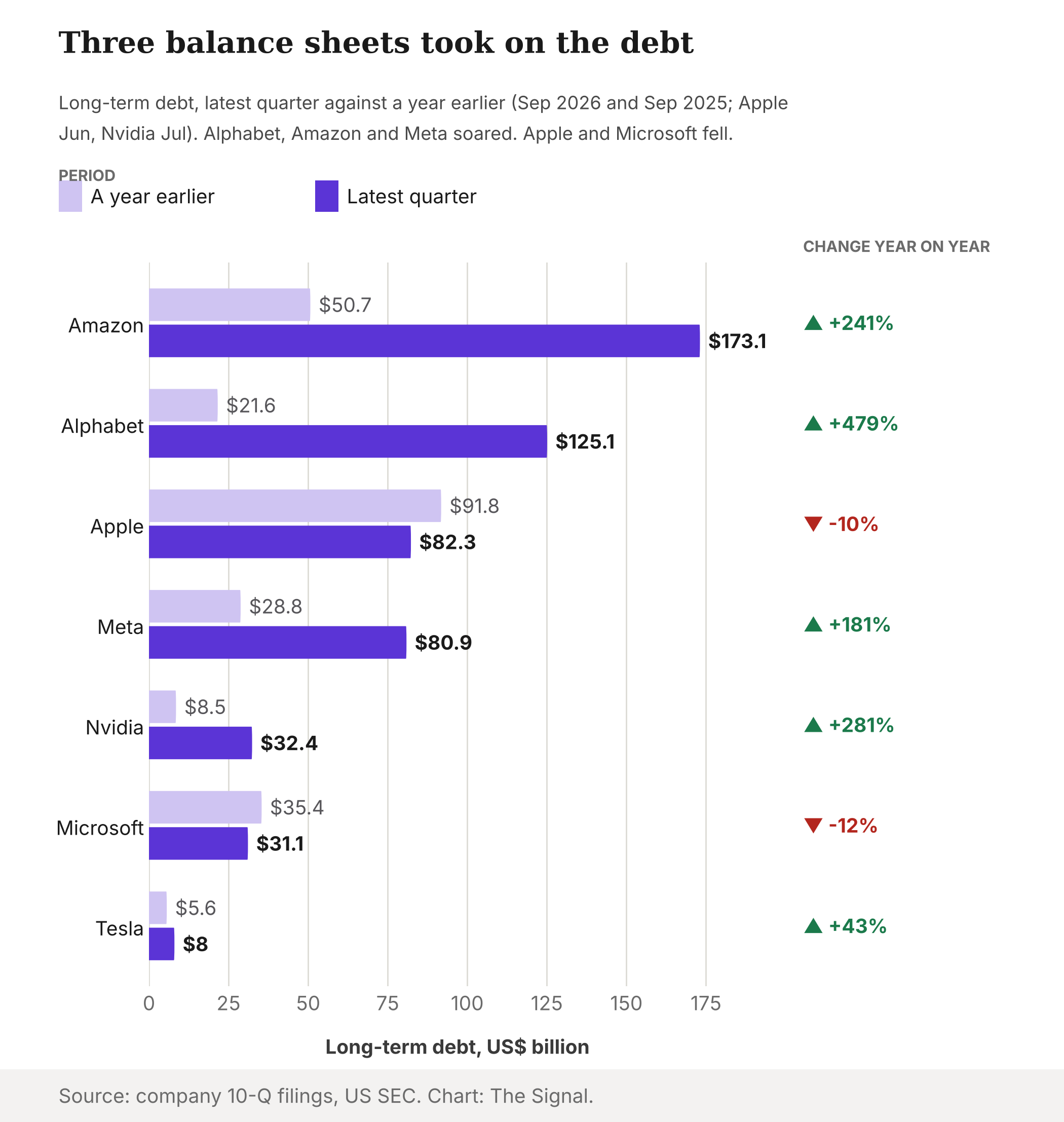
Start with the three that borrowed. Alphabet reported $125.1 billion of long-term debt at 30 September 2026, against $21.6 billion a year earlier. Amazon's was $173.1 billion, against $50.7 billion. Meta's was $80.9 billion, against $28.8 billion.
Now the others. Microsoft's long-term debt fell to $31.1 billion at 30 September 2026, from $35.4 billion a year earlier. Apple's fell to $82.3 billion at 27 June 2026, from $91.8 billion a year before. Nvidia's rose to $32.4 billion at 26 July 2026, from $8.5 billion, and Tesla's rose to $8.0 billion at 30 September 2026, from $5.6 billion.
One number carries the thesis
Add up the three. Alphabet, Amazon and Meta held about $101.2 billion of long-term debt a year ago and about $379.1 billion in their latest quarter. That is roughly 3.7 times as much, an increase of about $278.0 billion.
Add up all seven on the same basis (Alphabet, Amazon, Meta, Microsoft, Apple, Nvidia and Tesla) and the total rose from about $242.4 billion to about $532.9 billion, an increase of about $290.4 billion. The three account for about 96% of it. The other four, taken together, added about $12.5 billion, because Apple and Microsoft paying debt down offset most of what Nvidia and Tesla added.
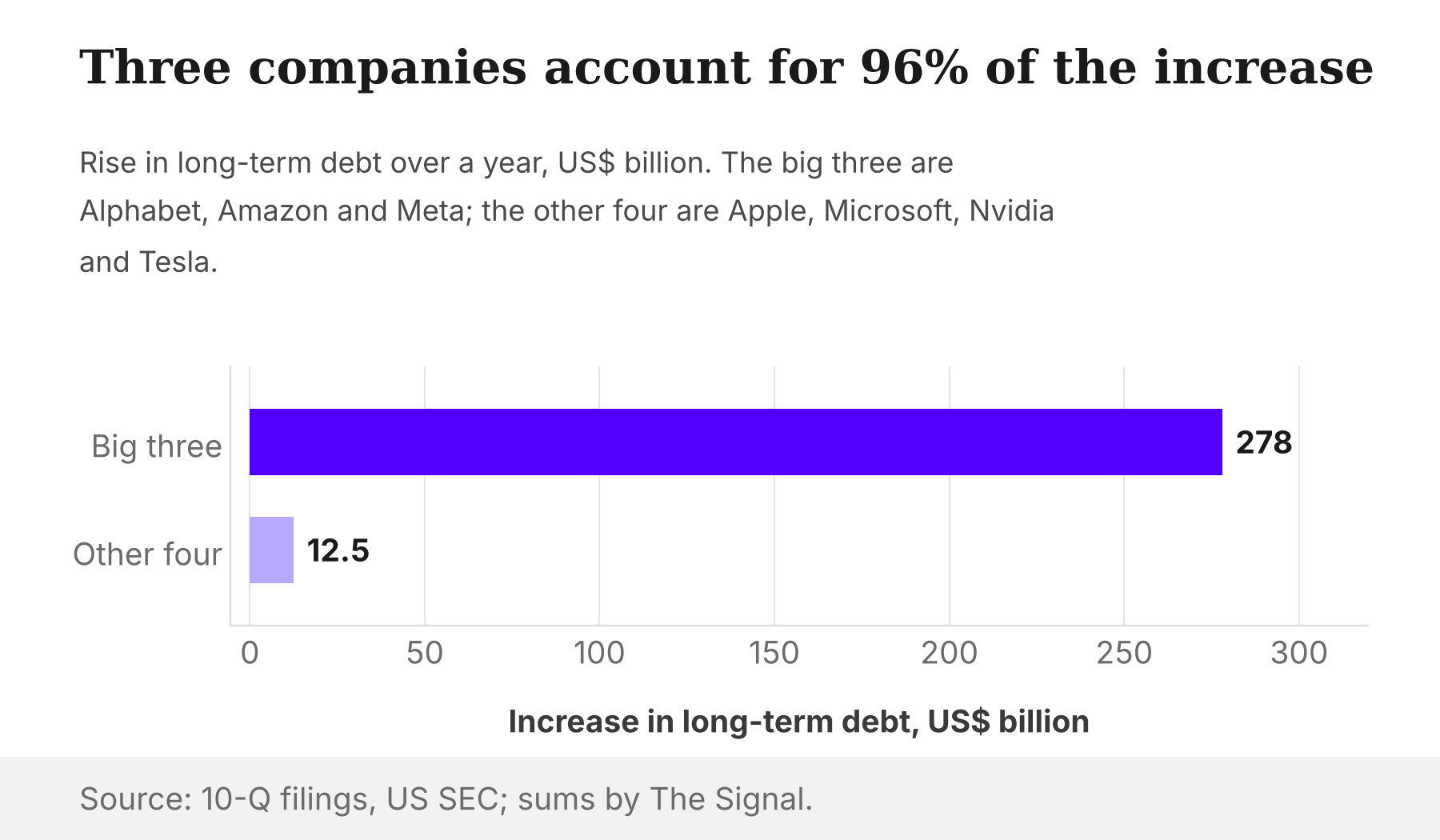
So the story is not that Big Tech has taken on debt. It is that the borrowing sits on three specific balance sheets: Alphabet, Amazon and Meta. Apple and Microsoft shrank their debt over the same year, and Nvidia, at $32.4 billion, carries far less than any of the three.
Why our total and SBI's differ
The Signal's sum, about $533 billion, is below the $578 billion in the SBI Research estimate. The gap is about $45 billion. We cannot say what causes it, because the ANI report does not set out which debt measures SBI counted and we did not find the underlying report to check.
Our figure is narrower by construction. It uses each company's balance-sheet long-term debt as tagged in its SEC filings (Alphabet, Apple, Tesla and the rest): the portion due after one year for Alphabet, Amazon, Meta, Microsoft and Nvidia, and total long-term debt for Apple and Tesla. The latest quarters also differ, with Apple's ending in June and Nvidia's in July. Treat our total as a floor on the same footing year to year, not a rival estimate. The year-on-year comparison inside it is like for like. The headline growth rate is not comparable between the two, because SBI's 45% is measured against a different base than our year-ago total.
The honest objection
The strongest case against the concentration reading is that these are the most creditworthy borrowers in the world. A company with a large cash pile can borrow cheaply and still be safe. On that view, the roughly $379 billion across Alphabet, Amazon and Meta is a financing choice, not a warning sign.
That case deserves weight, but it answers a different question. Whether the borrowers can repay is one issue for Alphabet, Amazon and Meta. Whether the market's valuation of AI rests on three companies continuing to borrow at this pace is another. The filings settle the first part of the debate only for balance-sheet long-term debt, not for any obligation outside it. The concentration is a fact about who is exposed, not a verdict on whether they should be.
Where India feels it
India holds none of this debt. Its exposure arrives through markets. Foreign portfolio investors withdrew ₹48,056 crore from Indian equities in October up to 25 October, according to depository data reported by All India Radio. Those outflows predate Friday's Nasdaq fall, so they cannot be blamed on it, and the link between US AI valuations and Indian flows is a channel to watch, not a proven cause.
For an Indian reader the practical point is that a sharp repricing of a few US stocks is not a distant event when global funds hold both markets in one portfolio.
The Signal
The consensus read treats "Big Tech's AI debt" as one risk spread across seven names. The filings show it is closer to a three-company bet (Alphabet, Amazon, Meta), with Apple and Microsoft standing largely outside it. That changes what to watch. If the three keep adding debt at the pace of the past year, the AI trade depends on their willingness to keep borrowing. If their debt levels flatten while the market keeps falling, the sell-off is about earnings, not leverage.
Either way, the number to track is not the combined $578 billion. It is how much of the next increase comes from the same three names. A club of seven is only as strong as the balance sheets actually doing the work.
Reporting basis: the $578 billion, 45% and market-value-decline figures are SBI Research estimates as carried in an ANI dispatch published by Times of Oman, and rest on that single secondary report because the SBI note itself was not located. The Nasdaq and S&P 500 moves are per the Associated Press, as republished by the Atlanta Journal-Constitution. Each company's long-term debt is from its own 10-Q filings with the US SEC, as served by the SEC's EDGAR XBRL data service (Alphabet, Amazon, Meta, Microsoft, Apple, Nvidia, Tesla), covering quarters ending between June and September of 2025 and 2026. The October foreign portfolio investor outflow is per All India Radio, citing depository data. The three-company and seven-company sums, the multiples, the 96 percent share and the gap to SBI's total are The Signal's calculations from those figures.